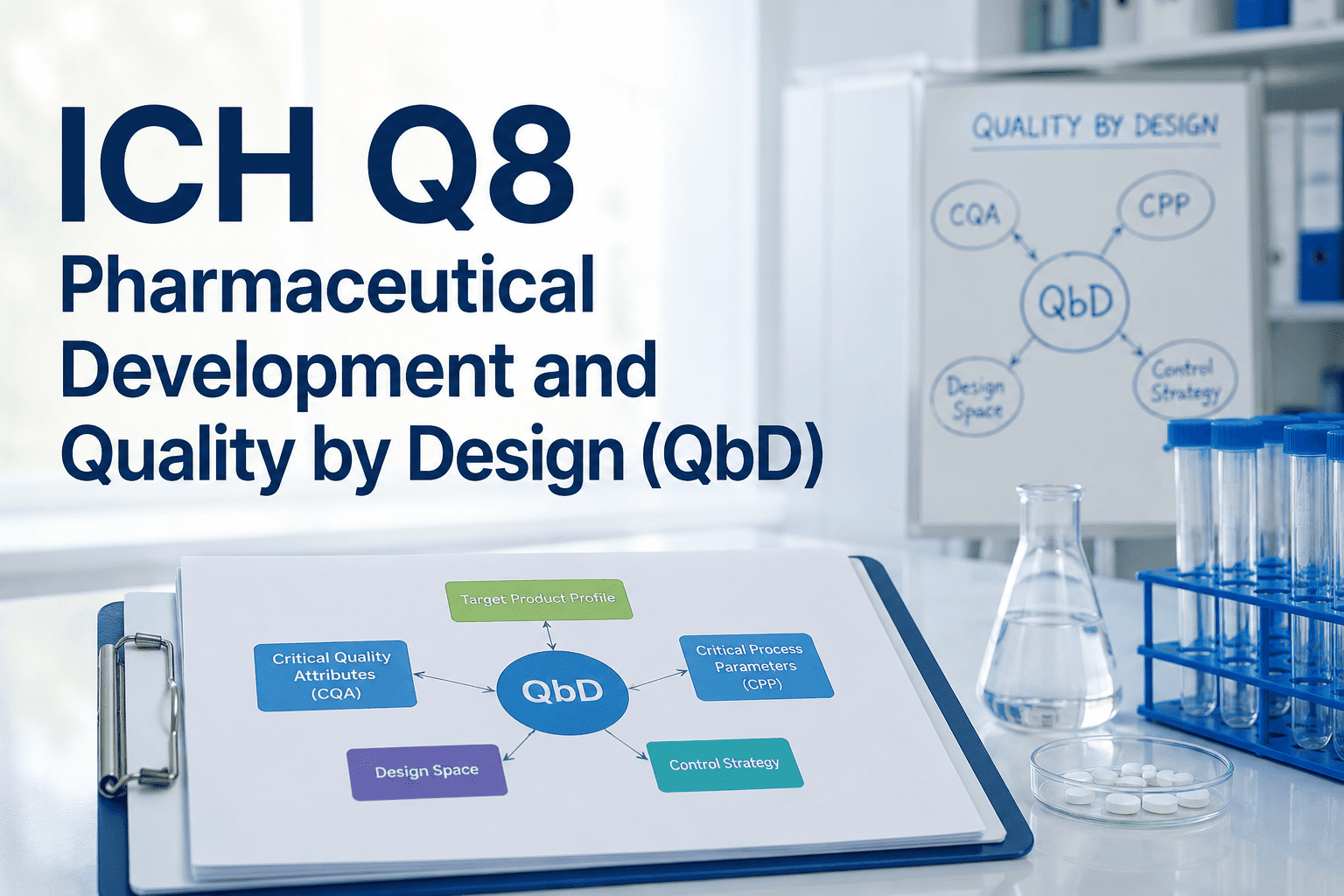
Every year, pharmaceutical companies hemorrhage millions in failed batches, regulatory rejections, and costly late-stage reformulations — not because their science is flawed, but because their development process lacks the structured intelligence to anticipate failure before it happens. ICH Q8 Quality by Design (QbD) was designed to close that gap. Yet most development teams still operate on intuition, legacy SOPs, and disconnected spreadsheets — leaving critical quality attributes undefined, design spaces unvalidated, and regulatory submissions vulnerable. The cost of inaction is not a delayed launch. It is a compromised product, a failed inspection, and a patient at risk.
Is Your Product Development Process QbD-Ready?
Map your CQAs, CPPs, and Design Space in a single intelligent platform — built for regulatory confidence and operational excellence.
What ICH Q8 Demands — And What Most Teams Are Missing
ICH Q8 mandates a science-based, risk-informed approach to pharmaceutical development. It requires organizations to formally define their Quality Target Product Profile (QTPP), identify Critical Quality Attributes (CQAs), map Critical Process Parameters (CPPs), and establish a validated Design Space. Without a unified platform, these elements live in isolated documents, disconnected systems, and individual team members' minds — creating audit exposure and development inefficiency that compounds with every product iteration.
QTPP Definition
- Formalize target product profile early
- Link quality goals to patient outcomes
- Drive downstream CQA identification
CQA Identification
- Structured attribute risk ranking
- Linked to formulation & process decisions
- Auditable justification trails
CPP Mapping
- Process parameter risk classification
- Statistical linkage to CQA impact
- Real-time monitoring integration
Design Space
- Validated operational boundaries
- Regulatory-accepted flexibility zones
- Change management without resubmission
Legacy Development Friction vs. iFactory QbD Excellence
The development gap is not a knowledge problem — it is an infrastructure problem. Teams that understand QbD principles still fail because their tools cannot support the rigor ICH Q8 demands. The comparison below quantifies the operational and financial cost of legacy friction versus an iFactory-optimized QbD workflow.
| Development Dimension | Legacy Friction | iFactory QbD Excellence | Financial Impact |
|---|---|---|---|
| CQA Documentation | Manual spreadsheets, version conflicts | Centralized, audit-ready CQA registry | High Risk Eliminated |
| CPP Identification | Expert-dependent, inconsistent | Structured risk-ranking workflows | Batch Failure Reduced |
| Design Space Validation | Static reports, siloed from manufacturing | Live design space linked to process data | CapEx Savings Realized |
| Regulatory Submissions | Fragmented data, long compile time | One-click dossier-ready export | Weeks Saved per Filing |
| Post-Approval Changes | Full resubmission required | Design space flexibility, no resubmission | Regulatory Capital Retained |
How iFactory QbD Tools Transform Development Teams
QbD is not only a regulatory strategy — it is a workforce productivity multiplier. When development data is structured, connected, and visible, scientists spend less time searching and more time deciding. The clinical and operational outcomes below reflect what iFactory-enabled QbD teams consistently achieve.
Accelerated Development Cycles
- Parallel CQA and CPP workflows reduce Phase II timelines
- Automated risk linkage eliminates manual gap analysis
- Structured design of experiments cuts iteration cycles
- Real-time data capture replaces manual lab notebook entry
Regulatory Risk Mitigation
- Immutable audit trails for every design decision
- ICH Q8/Q9/Q10 compliance built into every workflow
- Pre-formatted CTD module outputs for global submissions
- Design space boundaries enforced with process interlocks
Financial & Scale Outcomes
- 40% reduction in failed first-time-right batches
- Post-approval change management without resubmission costs
- Platform scales from single molecule to full portfolio
- Knowledge retention across scientist turnover events
Five Steps to an ICH Q8-Compliant Development Platform
Implementation of a QbD platform does not require a multi-year transformation. With iFactory's modular architecture, teams can activate QbD workflows in parallel with ongoing programs — building regulatory confidence without halting development momentum.
QTPP Digitization
Convert product profile documentation into structured, version-controlled digital records linked to every downstream quality decision.
CQA Risk Ranking
Deploy structured risk assessment modules to classify attributes by severity, probability, and detectability — with full justification capture.
CPP Mapping & Control Strategy
Link process parameters to CQAs through statistical risk models. Define control limits and integrate with manufacturing execution systems.
Design Space Validation
Build and validate operational boundaries using DoE data. Maintain living design space documents that update with each new manufacturing dataset.
Regulatory Submission Readiness
Generate ICH-compliant development reports, dossier sections, and change management documentation — directly from the platform with a single export action.
Six QbD Integration Failures That Stall Submissions
CQAs selected without documented rationale expose submissions to agency queries and complete development rework cycles.
Design space defined in static reports disconnected from real manufacturing data cannot be defended during post-approval inspections.
Process parameters identified without statistical linkage to quality attributes fail to satisfy ICH Q8 control strategy requirements.
Development rationale locked in individual scientists' files — not the platform — becomes a critical vulnerability at every team transition.
Design of experiments results stored outside the QbD framework cannot be systematically leveraged for design space boundary definition.
Post-approval change management not embedded into the original development platform forces costly resubmissions for every process optimization.
Transform Your ICH Q8 Compliance Into a Competitive Advantage
Book a live demo or request an Operational Gap Audit to benchmark your current QbD maturity against a fully integrated, submission-ready development platform.
Frequently Asked Questions — QbD Platform Implementation
Can iFactory support both small molecule and biologics QbD programs?
Yes. The platform's modular architecture accommodates ICH Q8 workflows across small molecules, biologics, and combination products — with configurable attribute libraries for each modality.
How does iFactory handle design space updates post-approval?
The platform maintains a living design space linked to real manufacturing data. Updates within the approved design space are managed without regulatory resubmission, providing maximum operational flexibility.
Does the platform integrate with existing LIMS and ELN systems?
iFactory connects via vendor-neutral APIs to major LIMS, ELN, and MES platforms — consolidating CQA, CPP, and process data into a single QbD intelligence layer without displacing existing infrastructure.
What is the timeline to achieve ICH Q8 submission readiness?
Most development teams achieve structured CQA and CPP documentation within the first 60 days. Full design space validation and dossier export readiness is typically reached within a single development program cycle. Book a Demo to review a program-specific timeline.
Activate a QbD-Compliant Development Platform for Your Next Program
Join development teams already accelerating submissions with integrated CQA tracking, CPP control, and validated design space management.