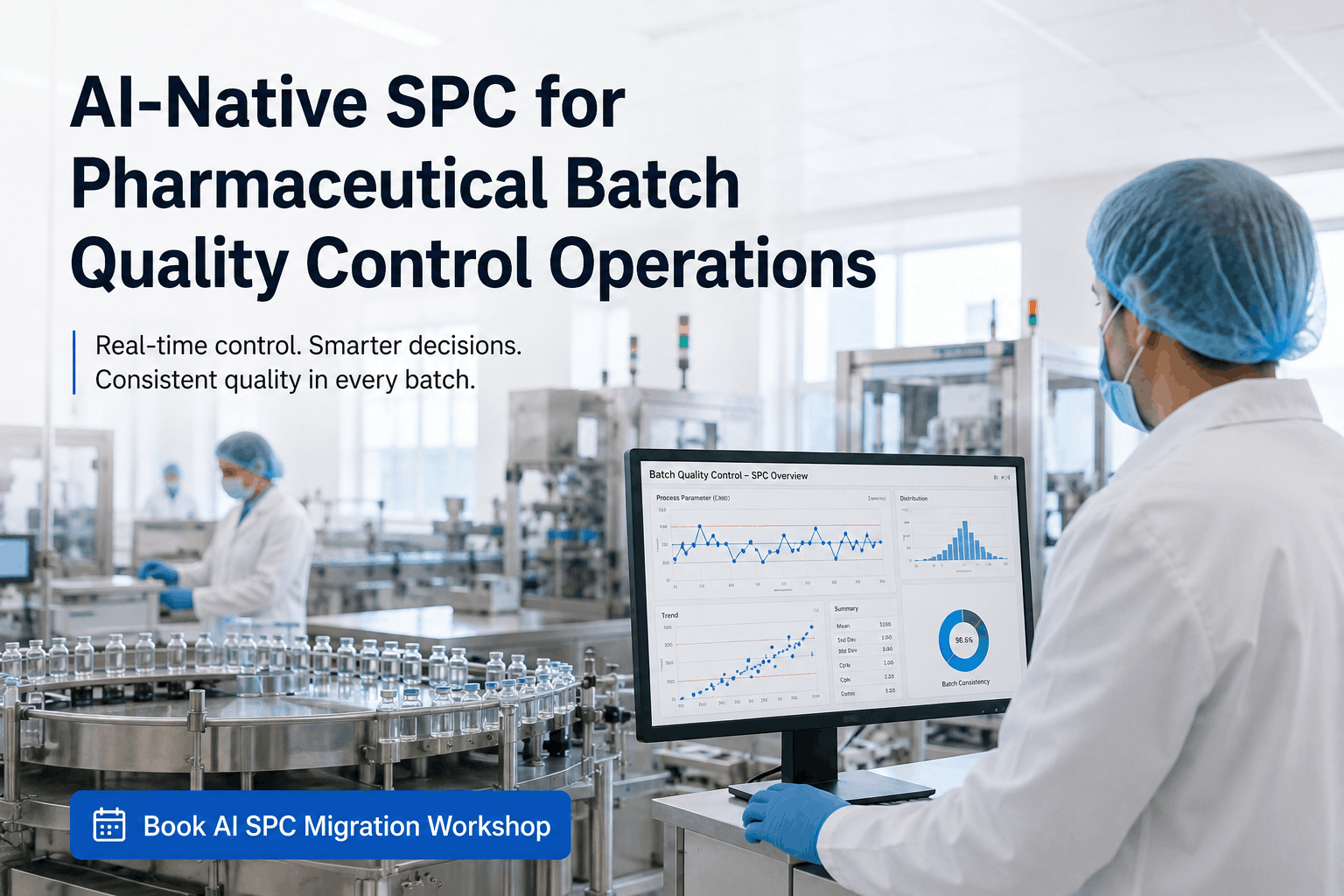
Pharmaceutical batch quality control on SAP xMII has a consistency problem that statistics make impossible to ignore. Even when every batch passes release testing, the run-to-run variability on critical quality attributes — assay, content uniformity, dissolution, particulate count, fill weight, hardness — produces deviation reports, CAPA investigations, and slow release cycles that consume QA bandwidth and increase regulatory exposure. Traditional SPC charts running on legacy MII or xMII catch parameters after they cross control limits; they don't catch the multivariate combinations that drive most batch variation. SAP DMC carries the same SPC paradigm forward into cloud-only deployment with full GxP re-validation effort. AI-native SPC handles the consistency problem differently. Three integrated capabilities running on a single on-prem NVIDIA appliance — AI Vision Inspection for tablets, vials, ampoules and lyophilized product; Real-time Control Charts with adaptive limits that tune to product, equipment, and operator shift; and Autonomous Root-Cause Analytics that identifies the upstream cause of any deviation in minutes instead of days. Batch consistency tightens, deviation count drops 40–65%, CAPA cycle time collapses, and release decisions get faster. The platform is GAMP 5 Category 4 pre-validated with 21 CFR Part 11 and Annex 11 templates included. This is the pharma SAP xMII SPC migration guide focused on what actually moves batch consistency.
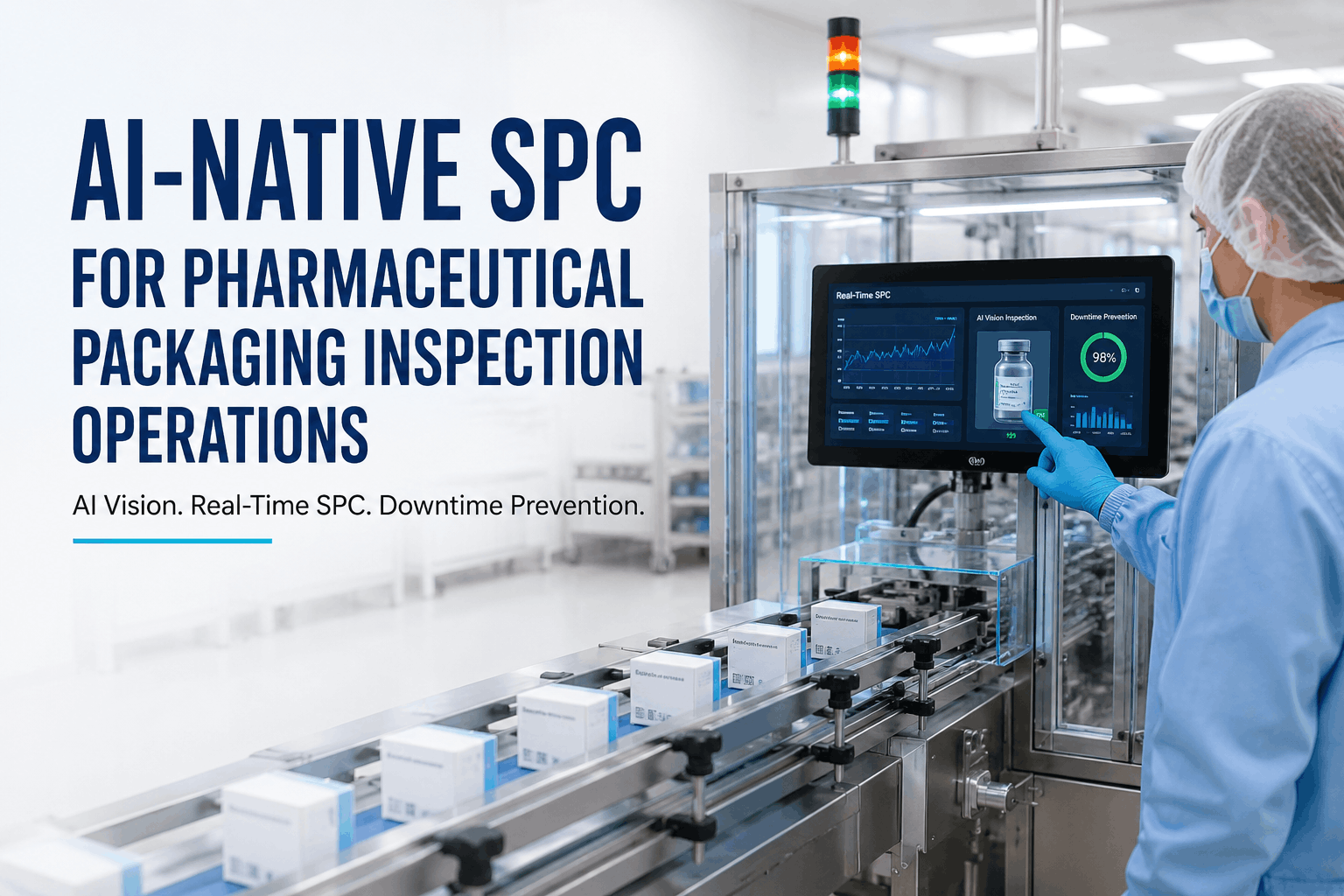
AI-Native SPC for Pharmaceutical Batch Quality Control Operations
Three capabilities, one platform — AI Vision Inspection, Real-time Control Charts, Autonomous Root-Cause Analytics. The pharma SAP xMII SPC migration path that tightens batch-to-batch consistency, cuts deviation count 40–65%, and accelerates release decisions. GAMP 5 pre-validated, 6–12 week deployment.
The Three Capabilities That Move Pharma Batch Consistency
Traditional pharma SPC platforms — SAP MII, xMII, and SAP DMC variants — handle batch quality control as univariate control chart monitoring with static limits. That architecture cannot move batch-to-batch consistency because most pharma variability is multivariate, develops gradually, and shows up in lab results after the batch is finished. AI-native SPC replaces it with three integrated capabilities running on the same on-prem appliance, sharing data, models, and audit trail.
AI Vision Inspection
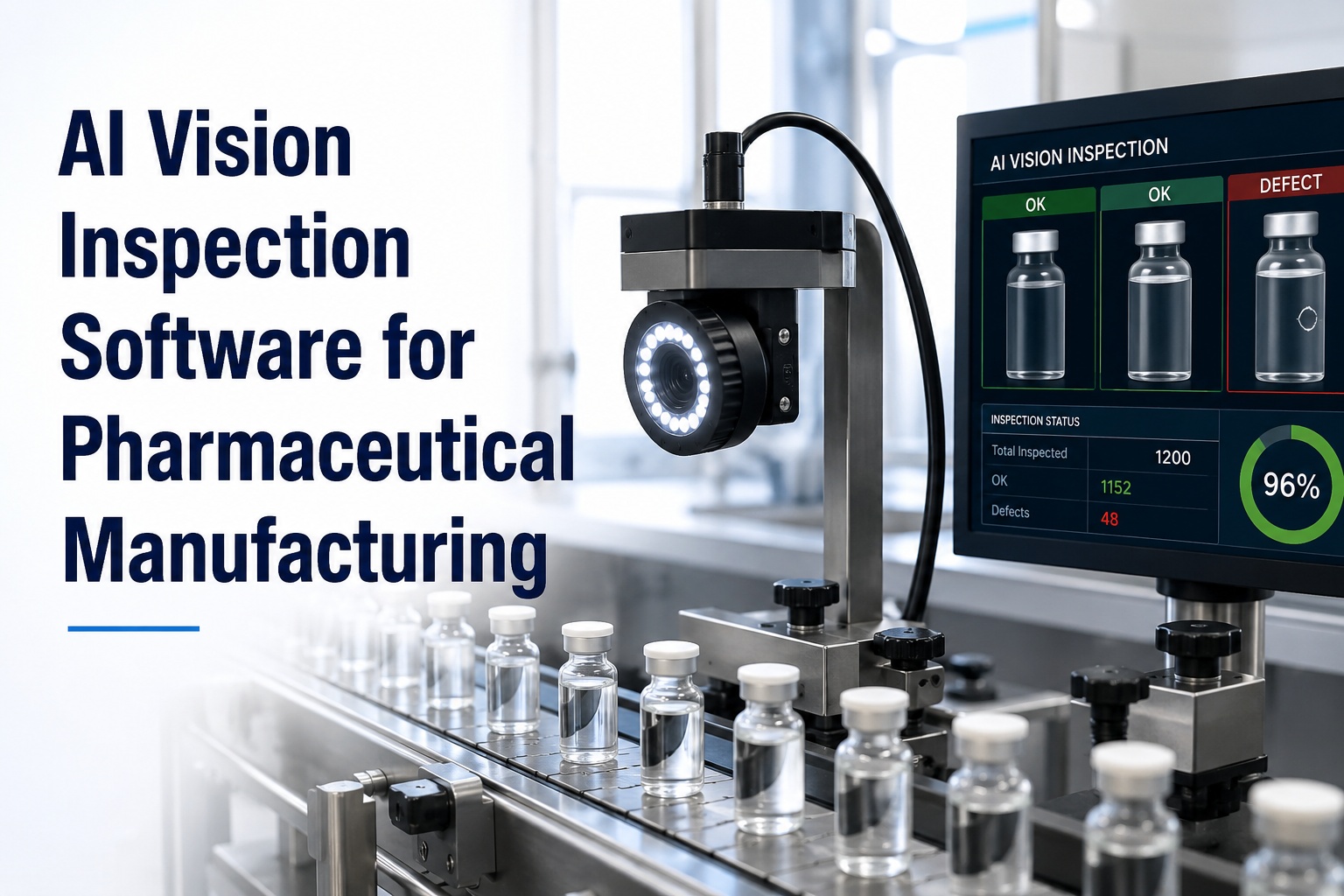
CNN-based inspection for tablets, capsules, vials, ampoules, blister packs, and lyophilized product. 100% coverage at production speed with 99.7% detection accuracy on pharma defect taxonomies.
Real-time Control Charts
Adaptive control limits that tune to product, equipment, shift, and operator. Western Electric and Nelson Rules automation plus LSTM forecasting that catches drift 30–120 min before limit breach.
Autonomous Root-Cause Analytics
When a deviation occurs or is predicted, AI runs the multivariate investigation that used to take days — surfaces top-3 root causes with confidence scores, recommends corrective action.
The Batch Consistency Distribution — What Moves When the Platform Changes
The single clearest argument for AI-native SPC in pharma is what happens to the batch-to-batch quality distribution. Traditional univariate SPC charts keep individual parameters within limits but don't tighten the multivariate distribution; AI-native adaptive limits combined with multivariate forecasting tighten the actual distribution around the target.
Want to see your batch-to-batch distribution analyzed against the AI-native projection? Request a Cpk and deviation audit from iFactory support — we'll analyze 12 months of your batch records and return a CQA-by-CQA baseline with projected consistency improvement after migration, returned within 5 business days.
How AI-Native SPC Prevents Deviations Before They Happen
The biggest single change for pharma batch operations is what happens between drift and deviation. Traditional SPC waits for the parameter to cross a limit, fires an alarm, and the batch enters the deviation workflow. AI-native SPC catches the drift trajectory 30–120 minutes earlier, predicts the deviation that would result, and gives operators the recommended adjustment to prevent it.
Want to see this deviation prevention applied to a real pharma scenario? Book the AI SPC Migration Workshop — sessions include a live walkthrough using a recent deviation from your operation (anonymized as needed), showing the trajectory AI would have caught and the recommended adjustment that would have prevented the batch from entering the deviation workflow. Sessions available this week.
Six Pharma Batch Consistency Applications
These are the six highest-impact pharma applications where AI-native SPC moves the batch consistency number measurably within a 12-month deployment. Each maps to a specific dosage form or process with measurable CQA improvement.
Tablet Weight & Content Uniformity
Multivariate prediction of weight and content uniformity from press parameters, granulation properties, and tooling wear. Catches drift before USP <905> stage-2 testing required.
Vial Fill Consistency
AI Vision fill-level inspection + multivariate prediction from pump parameters and product viscosity. Tightens vial-to-vial and batch-to-batch fill consistency for sterile injectables.
Capsule Fill Weight
Multivariate model on capsule filling machines — dosing disc parameters, powder flow characteristics, capsule properties. AI Vision verifies fill weight at the machine.
Assay Prediction
LSTM model predicts final batch assay from in-process measurements — operator sees predicted assay during the batch instead of after lab testing.
Dissolution Profile
Predicts dissolution profile from coating parameters, hardness, friability, and content uniformity. Catches batches trending toward dissolution failure before USP testing.
Lyophilization Endpoint
AI predicts lyo cycle endpoint from primary and secondary drying parameters. AI Vision inspects cake appearance for collapse and browning.
Want a CQA-specific consistency projection for your top pharma applications? Send your top 3 critical quality attributes and current Cpk baselines to iFactory support and the pharma team will return a projected consistency improvement map with deployment roadmap — typically within 3 business days, no obligation.
GAMP 5, 21 CFR Part 11, Annex 11 — Pre-Validated for Pharma
What ships ready for pharma deployment
- GAMP 5 Category 4 — configured product validation
- IQ / OQ / PQ protocols pre-written for pharma SPC use cases
- 21 CFR Part 11 — electronic records and signatures
- EU Annex 11 — computerized systems supplier governance
- ALCOA+ data integrity — all 9 attributes built into workflow
- ICH Q9 quality risk management framework alignment
- ICH Q10 pharmaceutical quality system support
- USP <1058> analytical instrument qualification alignment
The pre-validated package shortens the GAMP 5 validation effort from 18–36 months (typical for SAP DMC migration) to 8–14 weeks for iFactory deployment. Existing SAP xMII can run in parallel during the validation period before formal retirement. The on-prem appliance preserves the validated boundary inside your plant rather than re-establishing it around an external cloud supplier.
Two Real Pharma Batch Consistency Outcomes
Specialty pharma producer with batch consistency variation across multiple SKUs
A specialty pharma manufacturer producing 14 oral solid dose SKUs across 4 tablet press lines. Deviation count averaged 6–9 per month across the portfolio, with content uniformity and hardness variation driving most of the workload. CAPA cycle averaged 7 days per deviation. SAP xMII handled SPC but couldn't move the multivariate consistency numbers.
Biopharma fill/finish operation with batch-to-batch fill consistency variation
A biopharma fill/finish operation running 3 vial filling lines for monoclonal antibody products. Vial-to-vial fill variation ran ±3.8%, with batch-to-batch mean drift driving deviation reports under USP <697> tolerances. Particulate-related batch holds occurred 4–6 times monthly. SAP xMII SPC couldn't catch the multivariate drift patterns.
Neither scenario matches your operation? Send your top CQAs, current deviation rate, and SAP xMII footprint to iFactory support and the pharma team will return a customised migration analysis with consistency projection per attribute and 12-month roadmap — typically within 3 business days, no obligation.
iFactory's Pharma SPC Deployment — On-Premise or Cloud
Same AI-native platform on either deployment model. Same three capabilities — AI Vision, Real-time Control Charts, Autonomous RCA. Same GAMP 5 pre-validation. The deployment choice depends on validated state preservation strategy and multi-site approach.
iFactory On-Premise Appliance Default for pharma plants preserving existing validated state
- Pre-configured NVIDIA AI server — racked, software-loaded, ready to plug in.
- Validated boundary stays in plant — minimizes CSV effort, preserves GxP envelope.
- 24×7 monitoring — continuous coverage across all batch lines.
- Works during WAN outages — operations and vision continue uninterrupted.
iFactory Cloud For multi-site pharma operations with central QA oversight
- Fully managed — no rack, no facility requirements.
- Same three-capability platform — vision, control charts, autonomous RCA.
- Cross-site consistency benchmarking across all pharma plants in one tenant.
- Fastest deployment — first site live in 2–4 weeks.
Batch consistency is the pharma scoreboard. The platform determines whether you can move it.
Three integrated capabilities — AI Vision Inspection, Real-time Control Charts with adaptive limits, Autonomous Root-Cause Analytics — running on a single GAMP 5 pre-validated platform. Deviation count drops 40–65%, CAPA cycle collapses to minutes, batch consistency tightens measurably across CQAs. The AI SPC Migration Workshop sizes the migration with concrete consistency projections for your operation.
Frequently Asked Questions
Does AI-native SPC replace our existing batch record system?
No. iFactory's AI-native SPC layer integrates with major eBR / MES / LIMS systems via standard interfaces — OPC UA for process data, REST APIs for application integration, S88/S95 standards for batch context. Your batch records remain in their system of record; iFactory adds the AI-native quality intelligence layer above them. The validated batch genealogy continues uninterrupted.
How does this work with SAP DMC if we're considering both?
Many pharma plants evaluate SAP DMC alongside iFactory AI. SAP DMC is cloud-only and re-implements the same conceptual SPC approach as MII/xMII with full GxP re-validation required (18–36 months typical, $4–8M typical). iFactory AI provides three integrated capabilities (vision, control charts, autonomous RCA) on an on-prem appliance with 8–14 week validation effort. Different paradigms; the migration workshop sizes both for your operation.
How accurate is the deviation prediction?
For mature deployments (90+ days of training data on your products), the AI predicts deviations correctly 85–92% of the time within the 30–120 minute window. Confidence scoring means low-confidence predictions route to QA review rather than auto-recommending action. False positive rates typically drop below 8% within the first 90 days of operation. The system continuously learns from outcomes.
Will the autonomous RCA produce regulator-acceptable investigations?
Yes. Each RCA produces a complete causal chain with supporting evidence (process data, equipment logs, operator actions) timestamped and signed per 21 CFR Part 11. QA reviews and approves the AI-generated investigation rather than building from scratch. Regulators typically appreciate the deeper traceability versus traditional fishbone analyses. The autonomous RCA augments human investigation; it doesn't replace QA judgment.
Do I have to buy NVIDIA servers separately?
No. iFactory's on-premise appliance ships fully loaded — pre-configured NVIDIA AI server, software pre-installed, network gear, cabling, industrial cameras for vision inspection, edge devices for line-side inference. You provide rack space, line power, Ethernet, and PLC/SCADA integration points. The deployment team handles all installation, validation, and configuration. For cloud, no hardware investment at all.
Can we migrate one line first before going plant-wide?
Yes — that's the recommended approach. Start with the line where AI capabilities deliver the highest impact (typically tablet press, vial filling, or capsule filling). Validate the consistency improvement, prove the GAMP 5 framework, build operator and QA confidence. Then expand line-by-line in 2–4 week waves. Full plant migration for a 6–10 line pharma operation typically completes in 4–6 months.
What does the AI SPC Migration Workshop actually cover?
The half-day workshop covers — current-state SAP xMII assessment, consistency baseline analysis with your CQAs, three-capability platform walkthrough (vision, control charts, autonomous RCA), GAMP 5 validation approach review with pre-validated artifacts, deployment roadmap with milestone dates, and ROI projection. Outcome is a concrete migration recommendation with timeline. Suitable for operations leaders, QA, IT, and finance representatives.
Three capabilities. One pre-validated platform. 6–12 weeks.
SAP xMII keeps batches in spec but doesn't tighten the distribution or accelerate the investigation when something goes wrong. AI-Native SPC tightens batch consistency, predicts and prevents deviations, and collapses RCA from days to minutes — with GAMP 5 pre-validation that compresses CSV effort to weeks instead of years. The Migration Workshop is the fastest way to see what this looks like on your specific operation.
.png)