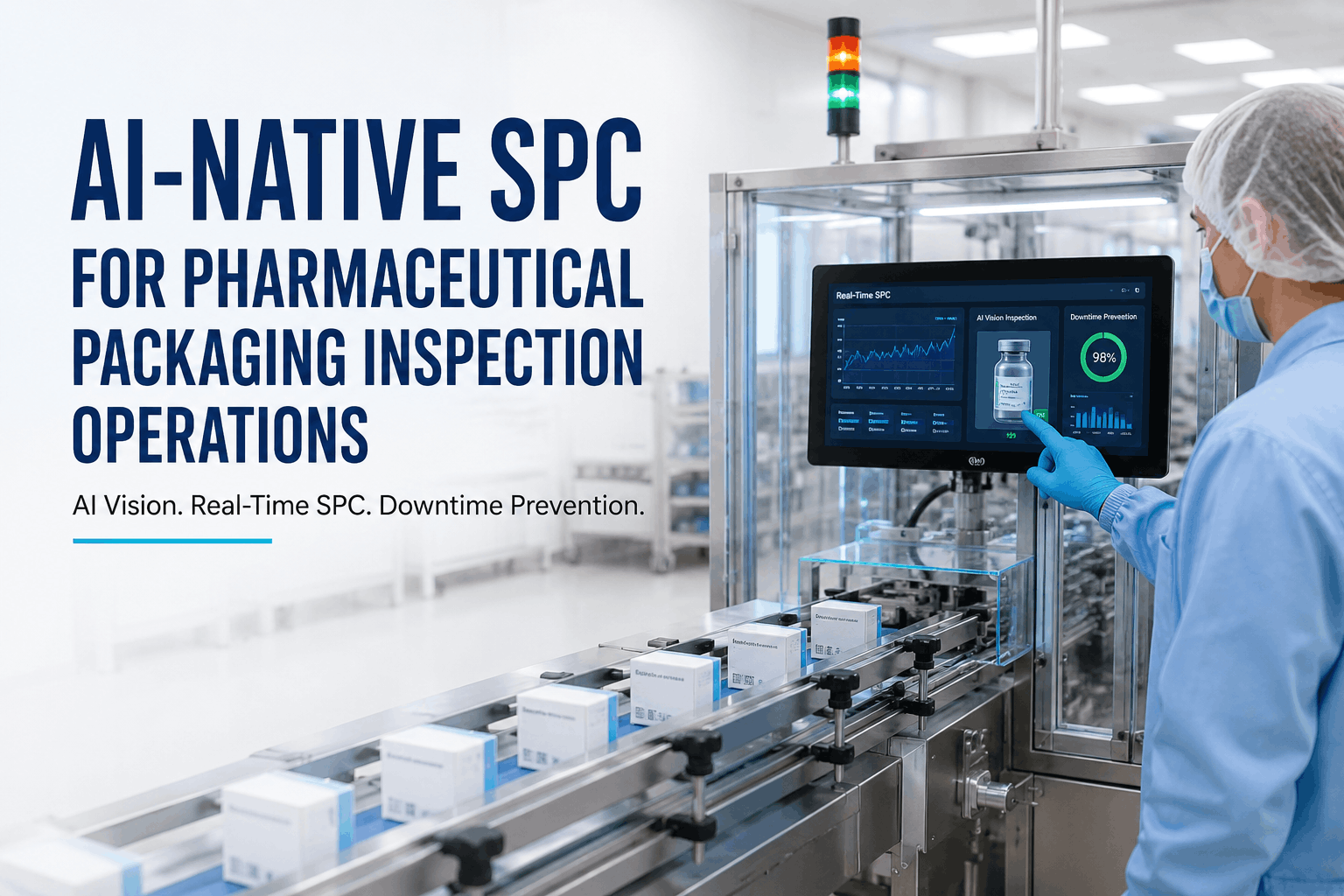
Pharmaceutical packaging lines fail in a small number of well-understood patterns — rejects pile up faster than the operator can clear them, vision systems false-positive into stoppage, serialization codes get challenged by inspection cameras, label registration drifts and triggers downstream issues, batch changeovers consume hours. The financial cost of each minute of downtime ranges from $400–$3,000 depending on product value and line speed, and across a typical pharmaceutical packaging operation with 6–12 lines, total annual packaging-line downtime cost runs $3M–$15M. Most of this downtime is fundamentally preventable — not through harder operator effort, but through AI-native SPC capabilities that catch drift signatures before they trigger reject cascades, that distinguish real defects from false positives with much higher accuracy than rule-based vision, and that diagnose root causes autonomously so adjustments happen in minutes rather than the typical 30–90 minutes of operator troubleshooting. iFactory AI delivers three core capabilities working together for pharmaceutical packaging — AI Vision Inspection at 99.7% accuracy on packaging defects, Real-time Adaptive Control Charts that tune limits per SKU/shift/material lot, and Autonomous Root-Cause Analytics that build investigation reports in 3–5 minutes versus 30–60 minutes of manual investigation. The platform runs on a pre-configured NVIDIA appliance inside the GAMP 5-validated boundary, deploys in 6–12 weeks, and is the AI-native alternative to SAP MII/xMII and SAP DMC for pharmaceutical packaging inspection operations. This page is the plant operator's strategic guide to AI-native SPC for pharma packaging, what the three capabilities actually do, and how downtime prevention translates to plant-level outcomes.
AI-Native SPC for Pharmaceutical Packaging Inspection Operations
The plant operator's guide to AI-native SPC for pharmaceutical packaging inspection — AI Vision Inspection at 99.7% accuracy, real-time adaptive control charts, and autonomous root-cause analytics that prevent the downtime patterns that legacy SPC and traditional vision systems can't. Pre-configured NVIDIA appliance, GAMP 5 pre-validated, live in 6–12 weeks.
Where Pharma Packaging Downtime Actually Goes
Pharma packaging line operators experience downtime in dozens of small ways each shift, but the dollar accumulation comes from a small number of repeating patterns. Most plants haven't quantified the breakdown — the visualization below shows what surfaces when packaging downtime is properly attributed across the typical operation, and which AI capability addresses each category most directly.
For a typical 8-line pharma packaging operation, this translates to recovering 1,400–2,200 production hours annually — at typical line value rates of $1,000–$2,500 per hour, the downtime recovery value runs $1.8M–$5.5M annually, before counting reduced overtime and quality cost avoidance.
Want a sized downtime breakdown for your specific pharma packaging operation? Book the AI SPC Migration Workshop — iFactory's pharma team will analyze your line configuration, current downtime pattern, and projected recovery across all five categories. Sessions available this week.
The Three AI Capabilities — Working Together on Every Package
AI Vision Inspection · Real-Time Adaptive SPC · Autonomous RCA
The trio works in real-time coordination on every package — vision inspects appearance, SPC monitors parameters, RCA pre-computes investigation if anything anomalous fires. Each capability addresses a different downtime category, and together they cover roughly 80% of the downtime patterns typical to pharma packaging operations.
AI Vision Inspection
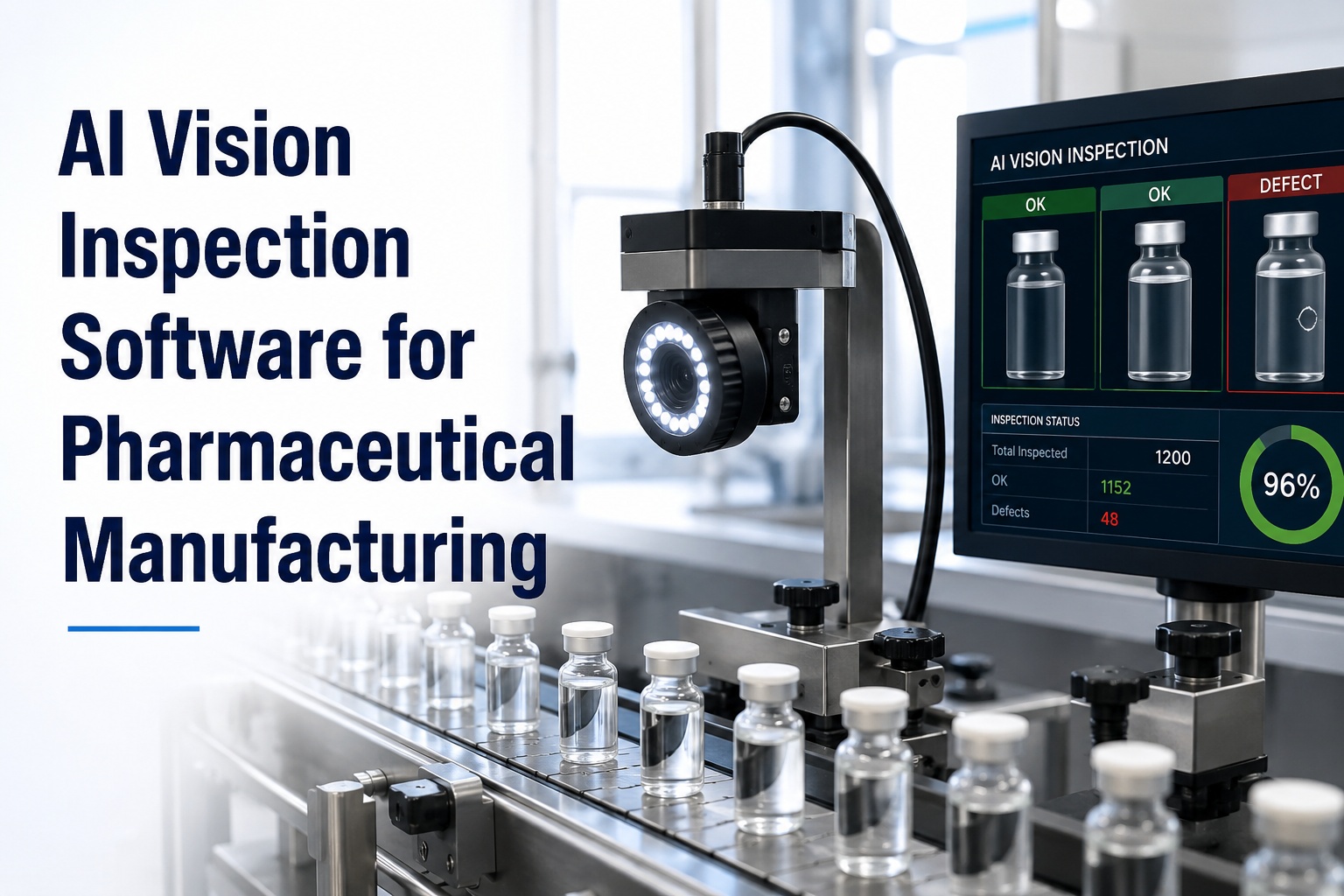
CNN-based defect detection on every container, label, seal, code, and tamper-evident feature. Trained on pharma defect taxonomies, fine-tuned on your specific SKUs during deployment.
Real-Time Adaptive Control Charts
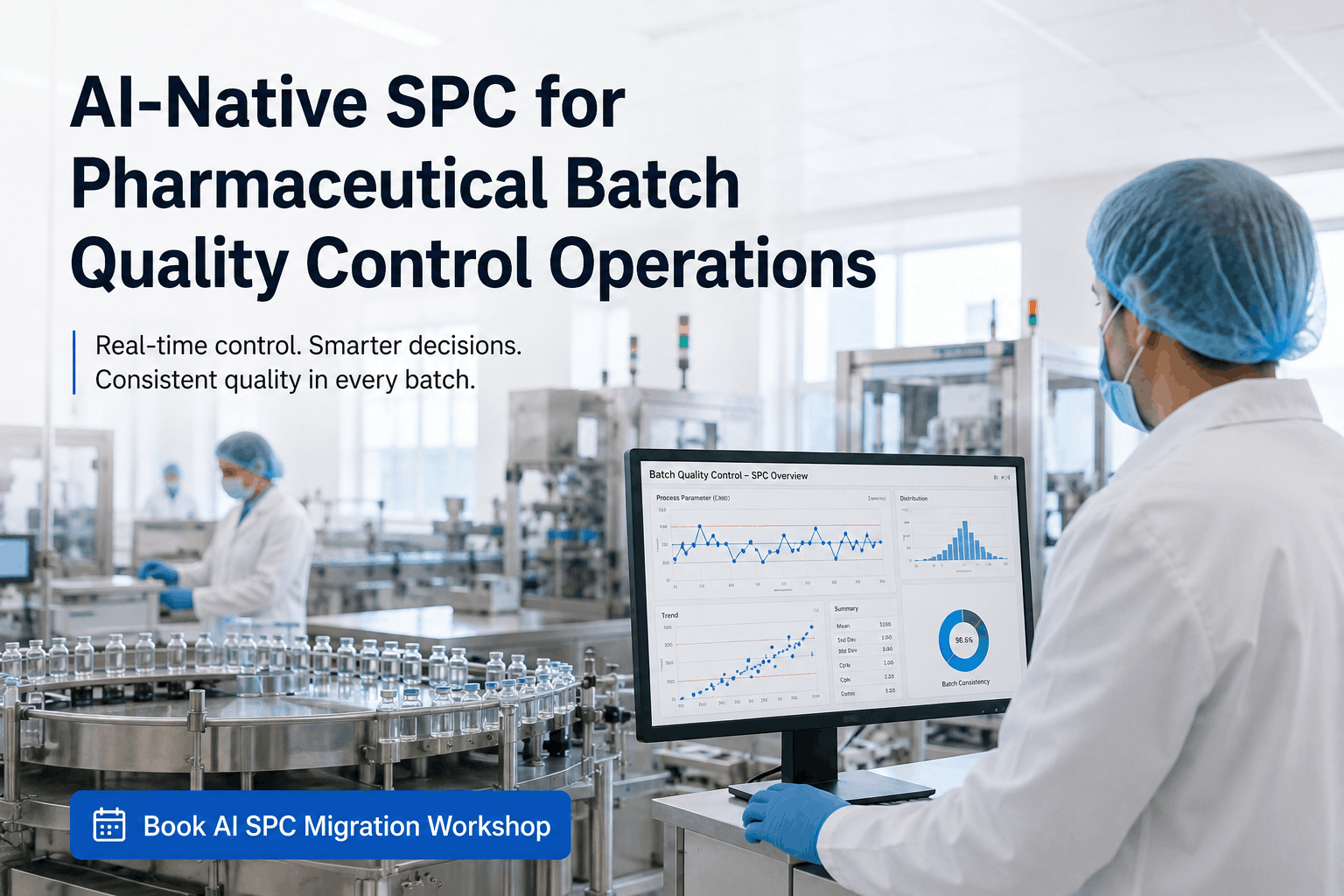
Live SPC on every measurable parameter — fill weight, closure torque, label position, code legibility — with adaptive control limits tuning per SKU, shift, material lot, and ambient conditions.
Autonomous Root-Cause Analytics
Investigation Agent maintains live causal hypothesis as the line runs. When anomaly fires, root cause is already pre-computed — operator sees explanation, not blank investigation.
Want to see the three-capability trio running on representative pharma packaging scenarios from your operation? Book the AI SPC Migration Workshop — sessions include live demonstration tailored to your bottle, vial, blister, or specialty packaging formats. Sessions available this week.
Real-Time Control Charts on Pharma Packaging — What Operators See
The legacy pharma packaging SPC experience is well-known to every operator — control charts updated retrospectively after the shift, summary reports the next morning, manual root-cause investigation when something failed. AI-native real-time control charts work differently. The operator dashboard shows live data, adaptive limits adjusting to current conditions, multivariate drift signatures surfacing before single-parameter breaches, and inline recommended actions. The visualization below shows what this actually looks like for a packaging line dashboard.
The dashboard updates continuously as the line runs. The operator sees current line status, live SPC chart with adaptive control envelope (not fixed thresholds), and predictive alerts surfacing issues 2–5 hours ahead with pre-computed RCA hints. Supervisors see the same view rolled up across all lines. The transition from legacy SPC paradigm to this real-time view is what operators consistently report as the most visible difference in their daily experience.
Six Pharma Packaging Operations Where AI-Native SPC Pays Back Fastest
Vial & Ampoule Inspection
AI Vision verifies vial integrity, fill level, closure, label position, and code legibility inline at production speed. Catches particulates, cracks, fill drift.
Blister Pack Quality
100% inspection of every cavity for tablet/capsule presence, color, shape, surface defects. Seal integrity verified inline. Empty/broken cavities caught.
Serialization & Track-Trace
AI Vision verifies every serialization code printed and applied correctly. Tamper-evidence verification at carton sealing. Aggregates data for regulatory submissions.
Bottle Filling Lines
Adaptive SPC on fill weight, closure torque, label adhesion. AI Vision catches missing labels, off-center caps, fill level drift. Multi-SKU support.
Pre-Filled Syringes & Cartridges
AI Vision inspects plunger position, fill volume, needle integrity, label, code. Particulate detection via spectral analysis. Critical for biologic products.
Secondary Packaging & Cartoning
Leaflet inclusion verification, carton coding accuracy, case label registration, shipper integrity. End-to-end packaging chain audit-ready.
Want application-specific downtime projections for your pharma packaging operation? Send your packaging formats, line configurations, and current SAP MII state to iFactory support and the pharma team will return a customised projection with 12-month roadmap — typically within 3 business days, no obligation.
21 CFR Part 11, EU Annex 1, GAMP 5 & Serialization — Built In
Pre-built workflows for pharma packaging regulatory frameworks
- 21 CFR Part 11 — electronic records and signatures
- EU Annex 11 — computerized systems validation
- EU Annex 1 — sterile medicinal products (2022 revision)
- GAMP 5 Category 4 — pre-validated with IQ/OQ/PQ artifacts
- DSCSA — Drug Supply Chain Security Act traceability
- EU FMD — Falsified Medicines Directive serialization
- USP <790> — visible particulates in injections
- USP <1207> — container closure integrity testing
iFactory ships with GAMP 5 Category 4 pre-validation including IQ, OQ, and PQ artifacts customized for packaging inspection workflows. Serialization aggregation, EU FMD reporting, and DSCSA traceability are pre-built. The on-prem deployment preserves the existing validated GxP boundary — no boundary re-validation required as with cloud SPC migration.
Two Real Pharma Packaging Operator Outcomes
Mid-size pharma packaging operation with 8 lines and chronic downtime patterns
A mid-size pharma packaging facility running 8 lines covering bottles, blisters, and vials across 35 SKUs. Unplanned downtime averaged 18–22% per line with false-positive rejects and manual investigations dominating the breakdown. Total annual packaging downtime cost ran approximately $6.4M. SAP xMII captured SPC data but couldn't reduce the downtime patterns.
Sterile injectable manufacturer with EU FMD compliance pressure and vision-related downtime
A sterile injectable packaging operation running 4 high-speed lines (vials, ampoules, pre-filled syringes) with EU FMD serialization aggregation requirements. Existing vision system suffered 8–12% false-positive rate on serialization code reads, driving frequent line stops and operator review queues. Compliance pressure made downtime even more costly because of batch release timing.
Neither scenario matches your operation? Send your packaging line count, formats, and current SAP MII state to iFactory support and the pharma team will return a customised packaging migration analysis with 12-month roadmap — typically within 3 business days, no obligation.
iFactory's Pharma Packaging Deployment — On-Premise or Cloud
Same AI-native platform on either deployment model. Same AI Vision Inspection, real-time adaptive SPC, autonomous RCA. For pharma packaging specifically, on-prem is strongly recommended because of GAMP 5 boundary preservation and inference latency at high packaging line speeds.
iFactory On-Premise Appliance Strong default for pharma packaging operations
- Pre-configured NVIDIA AI server — racked, software-loaded, ready to plug in.
- GxP boundary preserved — minimizes CSV effort.
- <50ms edge inference — keeps up with high-speed packaging lines.
- Works during WAN outages — packaging operations continue uninterrupted.
iFactory Cloud For multi-site pharma operations with central QA oversight
- Fully managed — no rack, no facility requirements.
- Same three-capability stack — AI Vision, adaptive SPC, autonomous RCA.
- Cross-site benchmarking on packaging downtime across all plants.
- Fastest deployment — first site live in 2–4 weeks.
Packaging downtime is preventable. The capability trio decides whether it actually gets prevented.
AI Vision Inspection, real-time adaptive control charts, autonomous root-cause analytics — running together on a pre-configured NVIDIA appliance inside the GAMP 5-validated boundary of your packaging operation. 55–75% unplanned downtime reduction within 12 months is typical. The AI SPC Migration Workshop sizes the migration with concrete packaging-specific projections for your operation.
Frequently Asked Questions
How is AI Vision Inspection different from traditional pharma vision systems?
Traditional pharma vision systems use rule-based detection — defined thresholds for known defect patterns. AI Vision uses CNN-based deep learning trained on thousands of defect examples across pharma packaging contexts, achieving 99.7% accuracy with under 3% false positives. AI Vision also adapts across SKUs without reprogramming, learns continuously from operator-verified outcomes, and handles novel defect patterns the rule-based system would miss entirely.
How do real-time adaptive control charts differ from xMII charts?
Legacy SPC platforms like xMII display control charts with fixed control limits set during configuration. Adaptive control limits tune automatically to current conditions — different SKU, shift, material lot, ambient temperature — giving genuine drift detection without false alarms on normal variation. The same physical line running 100ml bottles in the morning and 250ml in the afternoon gets two completely different limit envelopes automatically.
How does autonomous RCA actually work for packaging defects?
The Investigation Agent maintains a continuous causal hypothesis as the line runs — tracking equipment state, recent operator actions, material lot info, environmental conditions, and historical defect patterns. When an anomaly fires, the agent has already pre-computed the most likely root causes ranked by probability. Operators see an investigation summary with supporting evidence in 3–5 minutes rather than building the investigation from scratch.
What about GAMP 5 validation for the AI components?
iFactory ships as a GAMP 5 Category 4 configurable product with IQ, OQ, and PQ artifacts pre-built. The deployment team customizes these for your specific packaging line configuration during the 6–12 week installation. AI model decisions are captured as auditable records per 21 CFR Part 11 — attributable, contemporaneous, tamper-evident. Operators retain full authority to accept, modify, or override AI recommendations.
Do I have to buy NVIDIA servers separately?
No. iFactory's on-premise appliance ships fully loaded — pre-configured NVIDIA AI server, software pre-installed, network gear, cabling, industrial cameras for line inspection, edge devices for line-side inference. You provide rack space, line power, Ethernet, and PLC integration points. The deployment team handles installation, GAMP 5 validation, and configuration. For cloud, no hardware investment at all.
Can we deploy on one packaging line first?
Yes — and it's the recommended approach. Start with the line where downtime cost is highest or compliance pressure is most acute. Validate the three-capability trio on that line and prove the downtime reduction. Then expand line-by-line in 2–4 week waves with templated workflows. Full multi-line packaging deployment typically completes in 3–5 months end-to-end for an 8–12 line operation.
What does the AI SPC Migration Workshop actually cover?
The half-day workshop covers — current-state SAP MII assessment, packaging downtime breakdown analysis specific to your operation, three-capability trio demonstration on your representative packaging formats, three-path migration comparison with cost/timeline projections, GAMP 5 validation timeline, deployment roadmap with milestone dates, ROI analysis on downtime prevention. Outcome is a concrete migration plan. Suitable for plant operators, quality leaders, IT, QA, and finance representatives.
The three-capability trio is the operational difference. Downtime prevention is the financial outcome.
AI Vision Inspection at 99.7% accuracy, real-time adaptive control charts, autonomous root-cause analytics in 3–5 minutes — these capabilities work together on every pharma packaging line they're deployed to. The result is 55–75% unplanned downtime reduction, +10–16% OEE improvement, and packaging operations that run quietly rather than reactively. The AI SPC Migration Workshop is the fastest way to size the migration for your specific operation — sessions available this week.

.png)