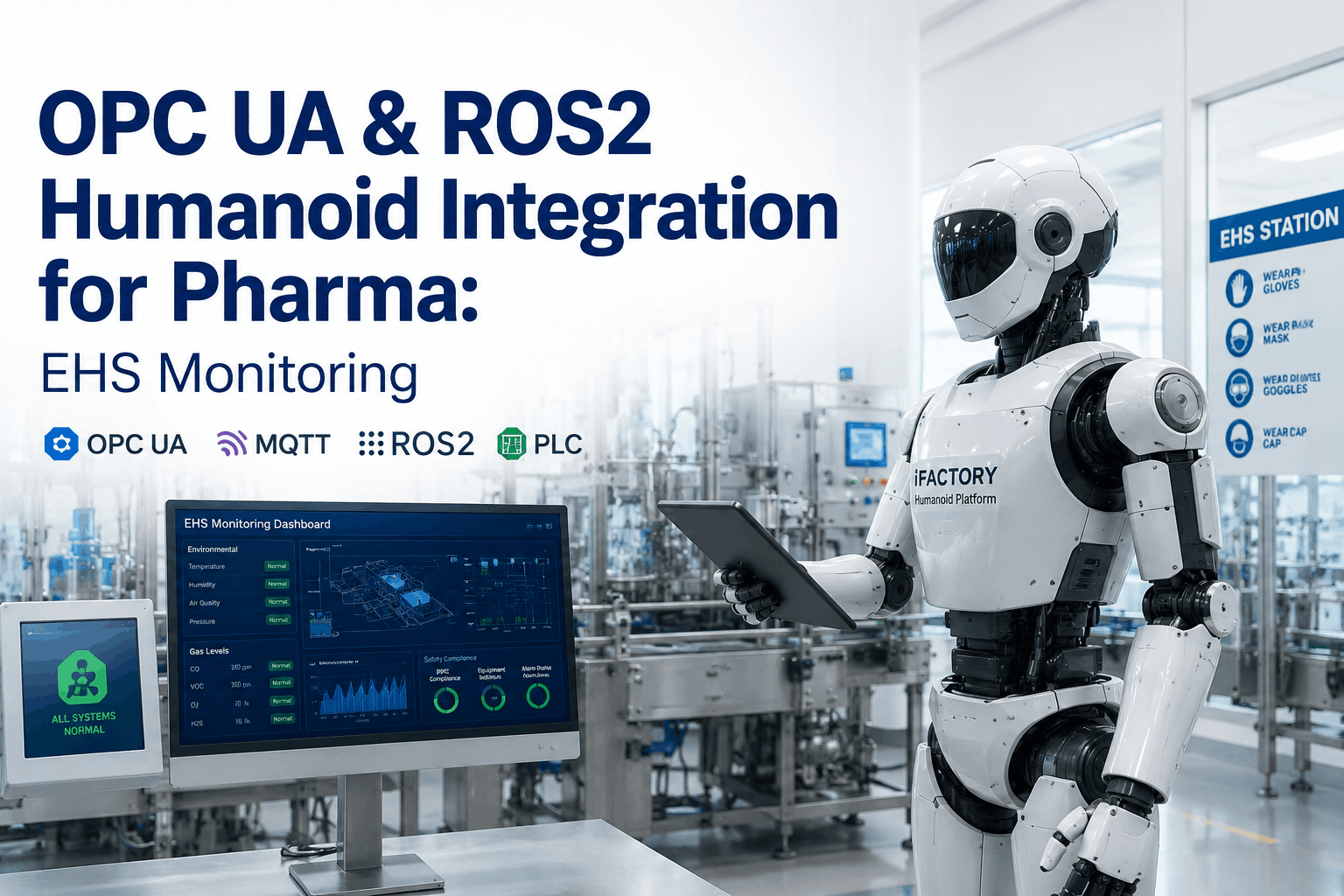
Bringing a humanoid robot into a pharmaceutical plant for EHS and safety monitoring is, at its core, a systems-integration problem — and the integration is harder than the robotics. The robot itself is a self-contained system that speaks ROS2 internally, while the plant it patrols runs on an entirely different set of protocols: PLCs communicating over PROFINET, EtherNet/IP, or Modbus; SCADA and MES layers exchanging data over OPC UA; and IoT telemetry flowing through MQTT brokers. A humanoid that detects a gas leak or an out-of-range gauge during a patrol produces that finding inside its ROS2 graph — but for it to matter, that data has to cross into the plant's OPC UA and MQTT world, trigger an EHS alert, raise a CMMS work order, and land in a compliance record. None of that happens automatically. This guide is a technical reference for the engineers and architects who have to make it work: what OPC UA, MQTT, ROS2, and PLC protocols each do, where the integration boundaries sit, a reference architecture for humanoid-based EHS monitoring in pharma, and how iFactory's data-fusion layer bridges the robot's world to the plant's systems without custom point-to-point integration for every device.
OPC UA & ROS2 Humanoid Integration for Pharma EHS Monitoring
A reference architecture for integrating humanoid robots with pharmaceutical PLC, OPC UA, MQTT, and ROS2 stacks — covering the protocol boundaries, an EHS monitoring data-flow, and how iFactory's data-fusion layer bridges robot to plant without per-device custom integration.
The Integration Challenge: Robot World vs Plant World
The fundamental obstacle is that humanoid robots and pharmaceutical plants were built on different communication paradigms. The robot's internal nervous system is ROS2 — a publish/subscribe middleware built on DDS, optimized for high-frequency sensor and control data inside the machine. The plant's nervous system is industrial: deterministic PLC fieldbuses at the equipment layer, OPC UA for structured data exchange up to SCADA and MES, and MQTT for lightweight telemetry. These two worlds do not natively talk to each other. The diagram below shows the gap that every humanoid EHS deployment has to bridge.
Bridging the gap is the entire integration project. The naive approach — writing custom point-to-point connectors between the robot and each plant system — does not scale: every new sensor, every new system, every new robot multiplies the connection count. The better approach is a single data-fusion layer that normalizes ROS2 data on one side and speaks OPC UA, MQTT, and PLC protocols on the other, so the robot integrates once and reaches every system.
The Four Protocols You Need to Understand
Each protocol occupies a specific role in the stack. Understanding what each is built for — and where its boundaries lie — is the foundation for any humanoid EHS integration.
OPC UA
The dominant standard for secure, structured industrial data exchange from PLC up to MES. Provides rich information modeling, security, and both client/server and pub/sub modes. This is the lingua franca of the pharma OT/IT boundary.
MQTT
A lightweight publish/subscribe messaging protocol ideal for telemetry and IoT-scale data over a broker. With Sparkplug B for industrial payloads, it efficiently streams patrol readings and sensor data to many subscribers at once.
ROS2
The middleware running inside most modern humanoids (including Unitree's open ecosystem). Built on DDS, it handles high-frequency perception, navigation, and control data internally — but it is a robot-side world, not a plant protocol.
PLC Fieldbus
The deterministic protocols at the equipment layer, where PLCs control plant machinery and safety interlocks. Humanoid EHS data often needs to correlate with PLC state — e.g. confirming a valve position when a leak is detected.
| Protocol | Pattern | Typical Use in EHS Monitoring | Integration Boundary |
|---|---|---|---|
| OPC UA | Client/server & pub/sub | Structured plant context, SCADA/MES values, asset models | Plant-side — fusion layer is an OPC UA client/server |
| MQTT | Broker pub/sub | Streaming patrol readings, gas/particulate telemetry, alerts | Plant-side — fusion layer publishes/subscribes to broker |
| ROS2 | DDS pub/sub | Robot perception, gas-sensor topics, navigation state | Robot-side — fusion layer bridges ROS2 topics out |
| PLC fieldbus | Deterministic cyclic | Equipment state correlation, safety interlock status | Equipment-side — read via OPC UA gateway or driver |
Scroll horizontally on mobile to view the full table.
EHS Monitoring Reference Architecture
The reference architecture below shows how a humanoid robot integrates into a pharmaceutical plant for EHS and safety monitoring. The key design principle: the robot connects once to the data-fusion layer, which then speaks every plant protocol — eliminating the per-device custom integration that makes humanoid deployments stall.
Want this reference architecture mapped to your specific OT/IT stack? Book a demo to review your protocol landscape with iFactory's integration team — they will map your PLC, OPC UA, MQTT, and historian estate to a humanoid EHS architecture. Sessions available this week.
A Safety Event, End to End
How a single safety event travels from ROS2 sensor to EHS action
The clearest way to understand the integration is to trace one event. When a patrolling humanoid detects a gas concentration above threshold, here is the path that finding takes — from the robot's ROS2 graph to an EHS alert, a CMMS work order, and a compliance record, in under half a second.
Integration Best Practices for Pharma
Design principles for a robust, validated deployment
- Bridge ROS2 once into a fusion layer, not per-system
- Use OPC UA for structured plant context and asset models
- Use MQTT (Sparkplug B) for telemetry and event streaming
- Correlate with PLC state before raising critical alerts
- Normalize all data to a common information model
- Log every event as a GxP-compliant audit record
- Keep the integration layer inside the validated boundary
- Design platform-agnostic so robots can be swapped
How iFactory's Data Fusion Layer Bridges Robot and Plant
iFactory AI is purpose-built as the data-fusion layer in this architecture. It subscribes to the humanoid's ROS2 topics on one side, and speaks OPC UA, MQTT, and PLC protocols on the other — normalizing every reading into a common information model, correlating robot findings with plant state, running anomaly detection and alert triage, and logging everything as GxP-compliant audit records. Because it is platform-agnostic, the same fusion layer works whether you deploy a Unitree, Figure, Agility, or future Tesla platform — and because it integrates the robot once rather than per-device, adding new sensors or systems does not multiply the integration burden. This is the difference between a humanoid that produces interesting sensor data and one that becomes a working, validated part of your pharma EHS program.
On-Premise Deployment
Run the iFactory data-fusion layer on-prem inside your validated GxP boundary — keeping all robot data, protocol bridging, and compliance records inside your network with sub-500ms event latency. Recommended for pharma data sovereignty and validation.
Discuss On-Premise SetupCloud Deployment
Run the fusion layer in the cloud for multi-site fleets, with edge components handling latency-critical safety events locally and the cloud aggregating fleet-wide EHS intelligence across plants.
Discuss Cloud SetupThe robot speaks ROS2. Your plant speaks OPC UA, MQTT, and PLC. iFactory speaks both.
A single data-fusion layer bridges the protocol gap — integrate the humanoid once, reach every plant system, and turn patrol findings into EHS alerts, CMMS work orders, and GxP records in under half a second. Platform-agnostic, on-prem or cloud, validated-boundary ready.
FAQ: Humanoid Robot Integration for Pharma EHS
How does a ROS2-based humanoid connect to our OPC UA plant systems?
Through a bridge in the data-fusion layer. The humanoid publishes its sensor and patrol data as ROS2 topics; iFactory subscribes to those topics, normalizes the data, and re-exposes it over OPC UA (and MQTT) to your SCADA, MES, and EHS systems. You do not write custom code per topic or per system — the fusion layer handles the protocol translation and the information modeling, so the robot integrates once and reaches everything. Book a demo to map this to your stack.
Why use MQTT and OPC UA together rather than just one?
They serve different jobs. OPC UA excels at structured, modeled data exchange with rich context and security — ideal for plant asset models, MES values, and SCADA. MQTT excels at lightweight, high-fan-out telemetry and event streaming over a broker — ideal for pushing patrol readings and alerts to many subscribers efficiently. A robust humanoid EHS architecture uses OPC UA for structured context and MQTT for streaming events, with the fusion layer speaking both.
Can the integration correlate robot findings with PLC equipment state?
Yes — and it should. When a humanoid detects a gas reading or anomaly, correlating it with PLC state (valve positions, pump status, interlock conditions) read via an OPC UA gateway dramatically reduces false alarms and adds diagnostic context. The fusion layer performs this correlation before raising a critical alert, so an EHS incident arrives with the equipment context already attached.
What end-to-end latency is achievable for a safety event?
With an on-prem fusion layer, the full path — ROS2 detection, protocol bridging, PLC correlation, EHS alert, and CMMS/compliance logging — typically completes in under 500ms. Latency-critical safety events are handled at the edge rather than round-tripping to the cloud, which is one reason on-prem deployment is recommended for pharma EHS monitoring where response time matters.
Does this integration work across different humanoid platforms?
Yes. Because most modern humanoids expose data via ROS2 (and the fusion layer bridges from ROS2), the same architecture works whether you run Unitree, Figure, Agility, or a future Tesla platform. Your protocol bridging, normalization, alert logic, and compliance records live in the fusion layer — so you can swap or mix robot platforms without rebuilding the integration.
How is GxP compliance maintained across the integration?
Every event that crosses the fusion layer is captured as a 21 CFR Part 11-compliant audit record — the detection, the correlated context, the alert, the resulting action, and the timestamps, all attributable and traceable. Keeping the fusion layer inside the validated GxP boundary (on-prem) means the integration itself sits within your validated environment rather than introducing an external, unvalidated data path.
Bridge the protocol gap once. Reach every system, with every event audit-ready.
OPC UA, MQTT, ROS2, and PLC integration for humanoid EHS monitoring — designed as a single data-fusion layer that integrates the robot once and reaches MES, CMMS, EHS, historian, and PLC/SCADA across every protocol. Platform-agnostic, GxP-ready, sub-500ms safety events. iFactory's integration team will map it to your stack.


.png)
.png)