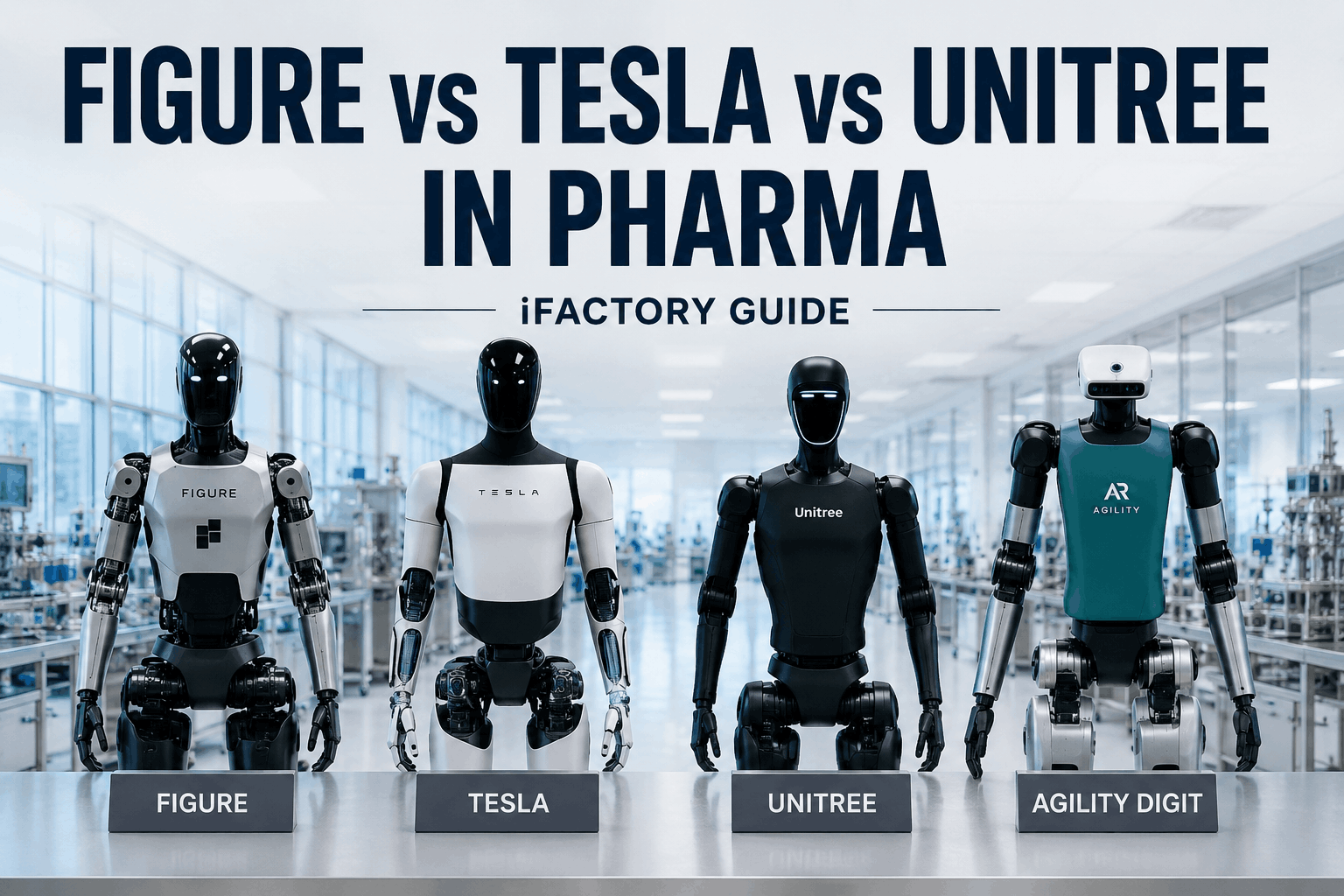
If you are responsible for deciding which humanoid robot to bring into a pharmaceutical plant, the question you actually face is not "which robot is most impressive?" — it is "which platform will deliver a safe, supported, integrated patrol of my hazardous zones with the least deployment risk?" Those are very different questions, and the most advanced robot is rarely the best answer to the second. The humanoid market in 2026 offers four serious industrial platforms — Figure AI's Figure 03, Tesla's Optimus Gen 3, Unitree's H1 and G1, and Agility Robotics' Digit — each with genuine strengths and real limitations. For pharmaceutical ATEX and toxic zone patrols specifically, the right choice depends on a clear set of selection criteria, an honest reading of each platform's deployment maturity, and a realistic view of the one capability gap that affects every option: explosion-protection certification. This buyer's guide gives you a decision framework rather than a spec sheet. It walks through the five criteria that matter most for pharma, ranks the platforms by how deployable they actually are today, maps each to the pharma use cases it fits best, and provides a decision path to your shortlist — plus how iFactory AI keeps your choice future-proof by integrating any platform with your plant systems.
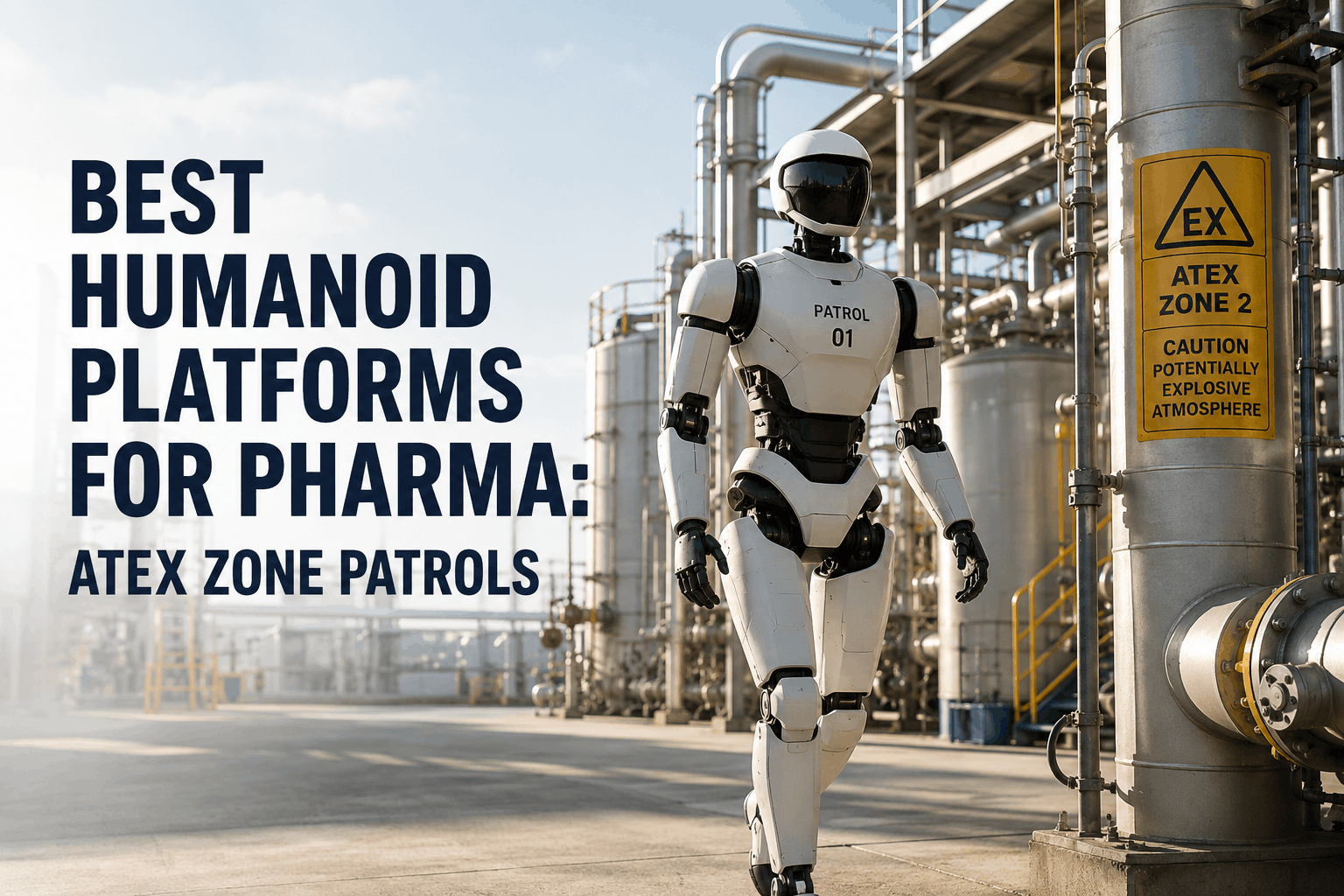
Best Humanoid Platforms for Pharmaceutical ATEX & Toxic Zone Patrols
A 2026 decision framework for choosing the right humanoid platform — Figure 03, Tesla Optimus, Unitree, or Agility Digit. Five selection criteria, deployment-readiness tiers, use-case fit, the critical ATEX gap, and a clear decision path to your shortlist.
The Five Criteria That Actually Matter for Pharma
Most humanoid comparisons lead with raw capability — speed, degrees of freedom, AI demos. For a pharmaceutical hazardous-zone patrol, those rank below five practical criteria that determine whether a deployment succeeds or stalls. Weight these for your situation before you look at any single robot.
Notice what is not on this list: AI demo sophistication. For patrol and inspection — the highest-value early pharma tasks — proven mobility, safe operation, and clean integration matter far more than headline manipulation skills. A robot that reliably walks a route and logs readings into your CMMS beats a more dexterous robot that needs months of custom work to do the same job.
Platform Readiness Tiers for Pharma Deployment
Ranked by how close each platform is to a working, supported pharma patrol today — not by raw capability. This is the single most useful lens for a buyer, because it maps directly to deployment risk.
Agility Digit
The most operationally proven platform, with real commercial deployments and a Robots-as-a-Service model that lowers upfront risk. Strong human-centric mobility (stairs, ramps) suits plant patrol routes. Logistics-optimized, but the most credible choice for a low-risk pharma pilot today — in non-explosive hazardous zones.
Unitree H1 / G1 · Figure 03
Unitree offers the most accessible pricing and an open ROS2 SDK ideal for building custom patrol routines — the best value for a cost-controlled pilot. Figure 03 brings the most advanced AI dexterity and is in active industrial pilots, though broader availability is still ramping. Both are strong pilot candidates that require integration work.
Tesla Optimus Gen 3
The most aggressive price-at-scale ambition in the segment, but not yet sold to external customers — current units operate inside Tesla facilities, with third-party availability expected later. A platform to design your program to accommodate, not one to deploy today.
The ATEX certification gap applies to every platform
No mainstream humanoid currently holds ATEX or IECEx certification for explosive atmospheres. For true ATEX Zone 1/2 or Zone 21/22 areas, every option on this page requires compensating controls (operating only when the zone is purged and de-classified) or a purpose-built explosion-protected variant that is still emerging. The realistic strategy: deploy in toxic-but-non-explosive zones now, and treat ATEX-rated patrols as a fast-follow as certified hardware arrives. Any vendor claiming a drop-in ATEX humanoid in 2026 deserves close scrutiny.
Platform Fit by Pharma Use Case
Beyond overall readiness, each platform fits specific pharma tasks better than others. This matrix maps the four platforms against the most common hazardous-zone patrol use cases, so you can match a platform to your highest-priority task.
| Pharma Use Case | Agility Digit | Unitree H1/G1 | Figure 03 | Tesla Optimus |
|---|---|---|---|---|
| Gas/vapor zone patrol | Strong | Good | Good | Future |
| Gauge & instrument reading | Strong | Good | Strong | Future |
| Dexterous visual inspection | Good | Good | Strong | Future |
| Low-cost pilot | Premium | Strong | Limited | N/A yet |
| Off-hours autonomous patrol | Strong | Good | Good | Future |
| Custom integration / R&D | Good | Strong | Good | N/A yet |
Scroll horizontally on mobile. Fit ratings reflect 2026 deployment reality and shift as platforms mature.
Want this matrix scored against your actual zones and priorities? Book a demo to identify the highest-value humanoid patrol tasks for your specific plant — iFactory's team will help you weight the criteria and shortlist the right platform. Sessions available this week.
How to Choose: A Decision Path
Four questions that narrow the field fast
Run your situation through these four decisions and you will land on a shortlist of one or two platforms. The path prioritizes deployment risk and integration over raw capability — the right order for a pharma buyer.
The fourth question sits underneath all of these: how will the platform connect to your plant systems? Whichever robot your decision path produces, the patrol only becomes valuable when its data flows into your MES, CMMS, EHS, and GxP records — which is the question iFactory is built to answer, and the reason platform choice should never be a lock-in.
A Phased Deployment Roadmap
The roadmap deliberately separates the robot decision from the integration decision. Because iFactory's integration layer stays constant across phases, you can pilot on one platform and scale on another without rebuilding patrol logic, alert workflows, or compliance records — the phased path protects your investment as the fast-moving humanoid market evolves.
Why iFactory Makes the Platform Choice Future-Proof
The humanoid market is moving faster than any procurement cycle. The platform that looks best today may be surpassed within a year, and ATEX-certified hardware will change the calculus again. Committing your patrol logic, alert workflows, and compliance records to a single robot vendor is the real lock-in risk — not the robot itself. iFactory AI is the platform-agnostic integration layer that connects whichever humanoid you choose to your MES, CMMS, EHS, and GxP compliance systems. Choose on merit today, switch or mix freely tomorrow, and keep everything above the hardware layer intact.
On-Premise Deployment
Run the iFactory integration layer on-prem inside your validated GxP boundary — keeping patrol data, compliance records, and plant-system connections inside your network. Recommended for pharma data sovereignty and validation requirements.
Discuss On-Premise SetupCloud Deployment
Run the integration layer in the cloud for multi-site fleets and centralized patrol management across plants. Suited to organizations standardizing humanoid patrol programs across several facilities with central oversight.
Discuss Cloud SetupChoose the platform on merit. Keep everything above it portable.
Weight the five criteria, read the readiness tiers honestly, match a platform to your highest-value use case — then let iFactory connect it to your MES, CMMS, EHS, and GxP records. Platform-agnostic, on-prem or cloud, no vendor lock-in as the market evolves.
FAQ: Choosing a Humanoid Platform for Pharma
What criteria matter most when choosing a humanoid platform for pharma?
Five criteria outweigh raw capability: safety and ATEX path (can it legally enter the zone), deployment maturity (proven operation and support, not just demos), integration openness (does data reach your MES and CMMS), mobility for your specific routes (stairs, runtime, payload), and total cost of ownership (hardware plus integration plus support). For patrol and inspection — the highest-value early tasks — these five matter far more than headline manipulation skills. Book a demo to weight these criteria for your plant.
How do the four platforms rank for pharma deployment readiness?
In practical 2026 terms: Tier 1 (deployable now) is Agility Digit, thanks to proven real-world deployments and a Robots-as-a-Service model. Tier 2 (pilot-ready) is Unitree (most affordable, open SDK) and Figure 03 (most advanced AI, ramping availability). Tier 3 (future option) is Tesla Optimus, which is not yet sold externally. This ranking reflects deployment risk, not raw capability — the right lens for a buyer.
Can we mix different humanoid platforms in one plant?
Yes — and it is often the smart strategy. Different zones and tasks suit different platforms: a premium proven unit for critical patrols, an affordable unit for routine routes, a dexterous unit for inspection. With a platform-agnostic integration layer like iFactory, a mixed fleet shares the same patrol logic, alert workflows, and compliance records, so mixing platforms adds capability without adding operational complexity.
What ATEX or safety certifications should we require?
For explosive atmospheres, the relevant frameworks are ATEX (EU) and IECEx (international), with zone classifications (Zone 1/2 for gases, Zone 21/22 for dusts) defining the protection level required. No mainstream humanoid holds these certifications today, so for true ATEX zones you will need compensating controls or emerging explosion-protected variants. For toxic-but-non-explosive zones, standard industrial safety and the right containment protocols are sufficient — which is why most pharma programs start there.
How long does a humanoid patrol pilot take to deploy?
A focused single-zone pilot typically runs 1–8 weeks to stand up, followed by a 2–4 month validation period to confirm safety, data flow, and CMMS integration before scaling. The biggest variable is integration, not the robot — which is why proving the integration layer early (Phase 1–2 of the roadmap) de-risks everything that follows. Scaling to additional zones then proceeds in waves on validated hardware.
How does iFactory future-proof our platform choice?
iFactory is the integration layer that sits above the hardware, connecting any humanoid platform to your MES, CMMS, EHS, and GxP systems. Because your patrol logic, alert workflows, and compliance records live in iFactory rather than in the robot, you can switch platforms, adopt newer models, or run a mixed fleet without rebuilding any of it. In a market evolving this fast, that portability is the most valuable protection a buyer can have.
Get a platform shortlist built around your zones, not a vendor's pitch.
iFactory's team will weight the five criteria for your situation, rank the platforms by deployment readiness for your zones, and map a phased roadmap from pilot to fleet — all platform-agnostic, with integration to your MES, CMMS, and GxP records. Choose on merit; stay free to switch.




.png)
