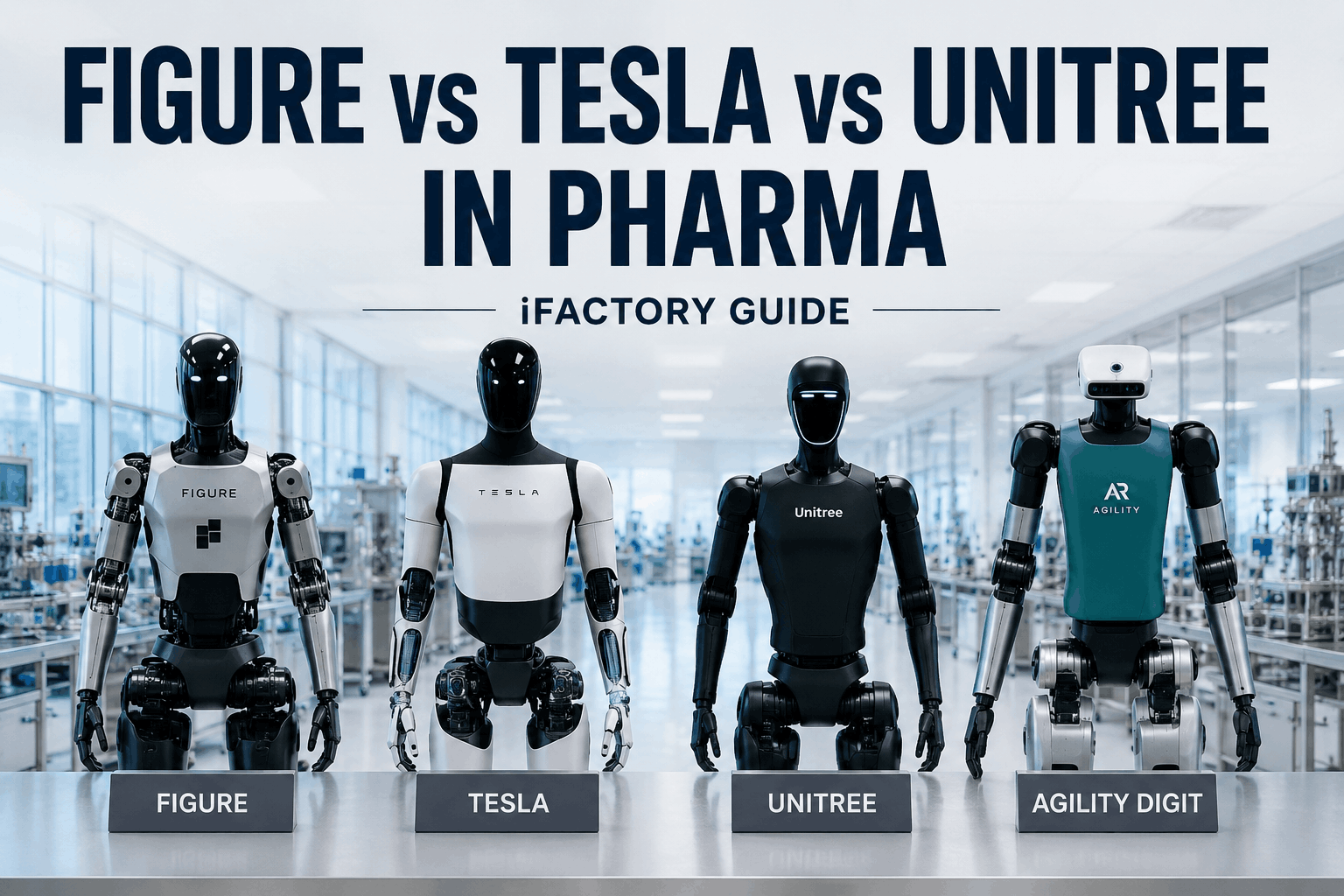
Pharmaceutical plants contain some of the most hazardous work environments in manufacturing — ATEX-classified zones where solvent vapors and fine powders create explosive atmospheres, and toxic zones where high-potency active ingredients (HPAPIs), cytotoxic compounds, and hazardous reagents put human operators at exposure risk every time they enter. These are exactly the areas where humanoid robots promise the most value: sending a machine instead of a person to patrol, inspect, take readings, and detect leaks in environments that are dangerous, restricted, or simply unpleasant for humans. The humanoid robot market has moved from research novelty to genuine commercial deployment in 2026, with four platforms dominating industrial conversations — Figure AI's Figure 03, Tesla's Optimus Gen 3, Unitree's H1 and G1, and Agility Robotics' Digit. But choosing a platform for pharmaceutical ATEX and toxic zone patrols is not as simple as picking the most advanced robot. It involves intrinsic safety certification, deployment maturity, integration with your existing MES and CMMS, and a clear-eyed view of what these machines can and cannot do today. This guide compares the four leading platforms specifically for pharmaceutical hazardous-zone applications, and explains how iFactory AI provides the integration layer that turns any humanoid platform into a working part of your plant.
Figure vs Tesla vs Unitree vs Agility for Pharmaceutical ATEX & Toxic Zone Patrols
A practical 2026 comparison of the four leading humanoid platforms for pharmaceutical hazardous-zone patrols — covering capabilities, pricing, deployment maturity, the critical ATEX certification gap, and how iFactory AI integrates any platform with your MES and CMMS.
Why Pharma Hazardous Zones Are the Killer Use Case
The strongest near-term case for humanoid robots in pharma isn't fine assembly or dexterous manipulation — it's removing humans from danger. Pharmaceutical facilities have well-defined zones where a patrolling humanoid delivers immediate safety value: taking gas and particulate readings, performing visual equipment inspections, detecting leaks, reading gauges, and logging conditions in areas where every human entry carries risk and requires extensive PPE, permits, and exposure monitoring. The map below shows where humanoid patrols fit in a typical pharma plant.
Across all four zones, the humanoid value proposition is identical: a mobile, sensor-equipped platform that walks human-designed routes, climbs stairs, reads analog and digital instruments, detects gas and particulate hazards, captures visual inspection data, and logs everything to your plant systems — without exposing a person to the risk. Because pharma plants are built for human access (stairs, ladders, walkways), a bipedal humanoid fits the existing infrastructure better than fixed sensors or wheeled robots.
The Four Platforms Compared for Pharma
Each platform brings different strengths. Figure leads on AI-driven dexterity, Tesla on price-at-scale ambition, Unitree on affordability and openness, and Agility on real-world deployment maturity. The table below summarizes how they compare on the dimensions that matter for pharmaceutical hazardous-zone patrols.
| Platform | Indicative Price (2026) | Payload / Mobility | Deployment Maturity | Best Fit for Pharma |
|---|---|---|---|---|
| Figure 03 | ~$20K target (commercial pilots; not generally available) | ~20 kg payload · ~5 hr runtime · advanced Helix AI dexterity | Active industrial pilot (BMW); broader availability late 2026 | Dexterous inspection & manipulation tasks |
| Tesla Optimus Gen 3 | ~$20K–$30K target at scale (not yet sold externally) | General-purpose; internal Tesla deployment first | Fremont internal use; external availability ~2027 | Future low-cost scale once available |
| Unitree H1 / G1 | H1 ~$90K–$100K · G1 from ~$16K | H1: 3.3 m/s, 360° LiDAR · G1: compact, ~2 hr runtime | Shipping commercially; large install base; ROS2 / open SDK | Pilots, R&D, custom patrol integration |
| Agility Digit | ~$250K (or Robots-as-a-Service) | ~16 kg payload · stairs/ramps · human-centric mobility | Most mature real-world deployments (Toyota, GXO/Amazon) | Proven logistics & patrol-style mobility |
Scroll horizontally to view the full comparison on mobile. Pricing is indicative and changes rapidly; confirm current figures with each vendor.
Figure 03
The most AI-advanced platform, with tactile-sensing hands and a vision-language-action model. Strong on dexterous inspection, but availability is limited to pilots and its design targets general-purpose use rather than hazardous-zone hardening.
Tesla Optimus Gen 3
The most aggressive price ambition in the segment, but not yet sold to external customers — current units run inside Tesla facilities, with third-party availability expected later. A platform to plan for, not deploy today.
Unitree H1 / G1
The most accessible platforms with the largest install base and an open ROS2 ecosystem — ideal for building custom patrol routines. The G1 is highly affordable; the H1 adds full-size mobility. Both require integration work for production patrols.
Agility Digit
The most operationally proven platform, with real commercial deployments in logistics and a Robots-as-a-Service model that lowers upfront risk. Strong human-centric mobility (stairs, ramps) suits plant patrol routes, though it is logistics-optimized.
None of these platforms is ATEX-certified today
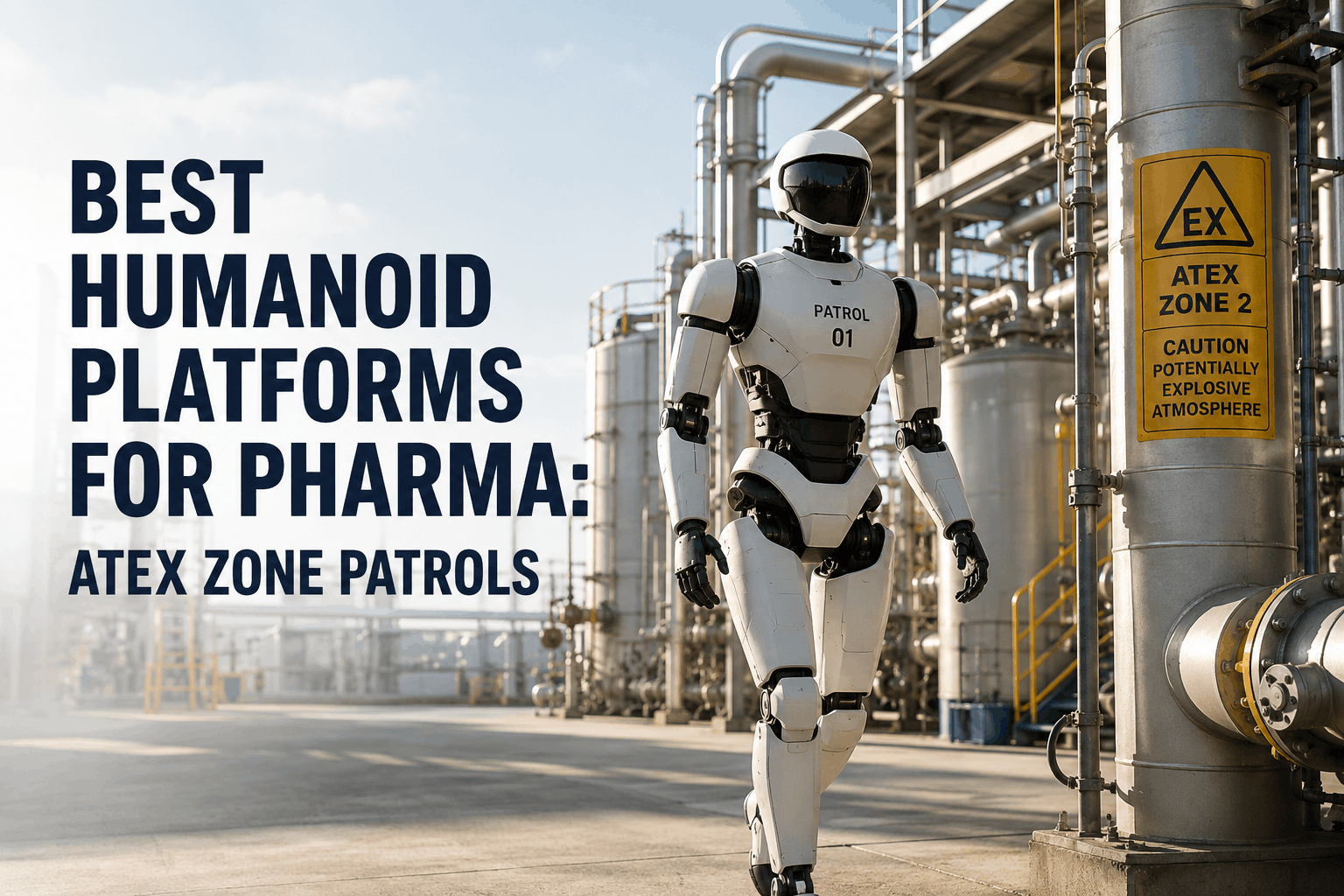
This is the single most important fact for pharma buyers. ATEX (and the equivalent IECEx) certification for explosive atmospheres requires intrinsically safe electronics, ignition-source control, and enclosure ratings that none of the mainstream humanoid platforms currently hold. For true ATEX Zone 1/2 or Zone 21/22 areas, humanoid patrols today require either compensating controls (operating only when the area is purged and de-classified), restriction to non-ATEX hazardous zones (toxic but non-explosive), or purpose-built explosion-protected variants that are still emerging. Any vendor claiming a drop-in ATEX humanoid in 2026 should be scrutinized carefully.
Pricing & Deployment Readiness
Price alone is misleading — a cheaper robot that needs months of integration may cost more in practice than a proven Robots-as-a-Service deployment. The chart below maps the four platforms on the two axes that actually determine total cost of ownership for a pharma patrol program: acquisition cost and deployment readiness.
Where the four platforms sit today
Deployment readiness reflects how close each platform is to a working, supported pharma patrol — not just raw capability. Agility leads on readiness; Unitree leads on accessibility; Figure and Tesla lead on future potential.
Not sure which platform fits your specific hazardous zones and budget? Book a demo to identify the highest-value humanoid patrol tasks for your specific plant — iFactory's team will assess your zones, integration needs, and the right platform mix. Sessions available this week.
How iFactory AI Integrates Any Humanoid Platform
The hardest part of a humanoid patrol program isn't the robot — it's making the robot a useful part of your plant. A patrol that detects a gas leak is worthless if the alert doesn't reach your MES, trigger a CMMS work order, and feed your compliance records. iFactory AI is the integration layer that connects whichever humanoid platform you choose to the systems that run your plant.
Because iFactory is platform-agnostic, you are never locked into one robot vendor. Start a pilot with an affordable Unitree unit, scale with Agility's proven mobility, or adopt Figure or Tesla when they mature — iFactory's integration layer stays constant, so your patrol logic, alert workflows, and compliance records carry across whichever hardware you run. This is the difference between an impressive robot demo and a working pharma safety program.
On-Premise Deployment
Run the iFactory integration layer on-prem inside your validated GxP boundary — keeping patrol data, compliance records, and plant-system connections inside your network. Recommended for pharma operations with data sovereignty and validation requirements.
Discuss On-Premise SetupCloud Deployment
Run the integration layer in the cloud for multi-site fleets and centralized patrol management across plants. Suited to organizations standardizing humanoid patrol programs across several facilities with central oversight.
Discuss Cloud SetupThe robot is the easy part. Integration is where patrols become a working safety program.
Whichever humanoid platform fits your zones and budget, iFactory AI connects it to your MES, CMMS, EHS, and GxP compliance systems — turning hazardous-zone patrols into routed, logged, audit-ready operations. Platform-agnostic, on-prem or cloud, no vendor lock-in.
FAQ: Humanoid Robots in Pharmaceutical Manufacturing
Are humanoid robots ready for pharma ATEX and toxic zone patrols today?
Partially. For toxic-but-non-explosive zones (HPAPI handling, cytotoxic areas), humanoid patrols are deployable today with the right platform and integration. For true ATEX explosive atmospheres, no mainstream humanoid holds ATEX/IECEx certification yet — so deployments require compensating controls (operating only when the zone is purged) or purpose-built explosion-protected variants that are still emerging. The practical path is to start with non-explosive hazardous zones and expand as certified hardware arrives. Book a demo to map deployable patrols for your specific zones.
Which platform is best for a pharma plant starting out?
It depends on your priorities. For the lowest-risk proven deployment, Agility Digit offers real-world maturity and a Robots-as-a-Service model. For the most affordable pilot and custom patrol development, Unitree's G1 and H1 lead on price and open SDK. Figure 03 offers the most advanced AI dexterity but limited availability, and Tesla Optimus is a future option not yet sold externally. Most pharma operations begin with an affordable pilot to prove the integration, then scale on proven hardware.
How does a humanoid patrol connect to our MES and CMMS?
Through the iFactory integration layer. The humanoid captures patrol data (gas readings, visual inspections, gauge values); iFactory normalizes that data, runs anomaly detection, and routes results to your systems — feeding production context to the MES, auto-generating CMMS work orders when an issue is found, raising EHS alerts for safety incidents, and logging everything to GxP-compliant audit records. This works regardless of which robot platform you choose.
Does choosing iFactory lock us into one robot vendor?
No — the opposite. iFactory is deliberately platform-agnostic. You can pilot with one platform and scale with another, or run a mixed fleet, without rebuilding your patrol logic, alert workflows, or compliance records. As the humanoid market evolves rapidly, this protects your investment: the integration layer stays constant while you adopt whichever hardware delivers the best value over time.
What's the realistic cost of a pharma humanoid patrol program?
Hardware ranges widely — from roughly $16K for an entry Unitree G1 to around $250K for an Agility Digit (or a Robots-as-a-Service subscription). But total cost of ownership is dominated by integration, safety engineering, and ongoing support, not the robot sticker price. A proven RaaS deployment can be cheaper in practice than a low-cost robot that needs heavy custom integration. The iFactory Workshop produces a sized program cost for your specific zones and platform choice.
What patrol tasks deliver value first in pharma?
The highest-value early tasks are repetitive, structured, and safety-relevant: gas and particulate readings in solvent zones, gauge and instrument readings in utility rooms, visual equipment inspections, leak detection, and off-hours monitoring when no staff are present. These are well within current humanoid capability and remove humans from risk. Fully unstructured manipulation in hazardous zones remains a medium-term horizon — start with patrol and inspection, expand scope as confidence builds.
Compare platforms with your zones, your budget, and your systems in the room.
Figure, Tesla, Unitree, and Agility each fit different pharma situations — and the right choice depends on your hazardous zones, integration needs, and deployment timeline. iFactory's team will help you map the highest-value patrols, choose the right platform mix, and connect it all to your MES, CMMS, and GxP records. Platform-agnostic, no lock-in.




.png)
