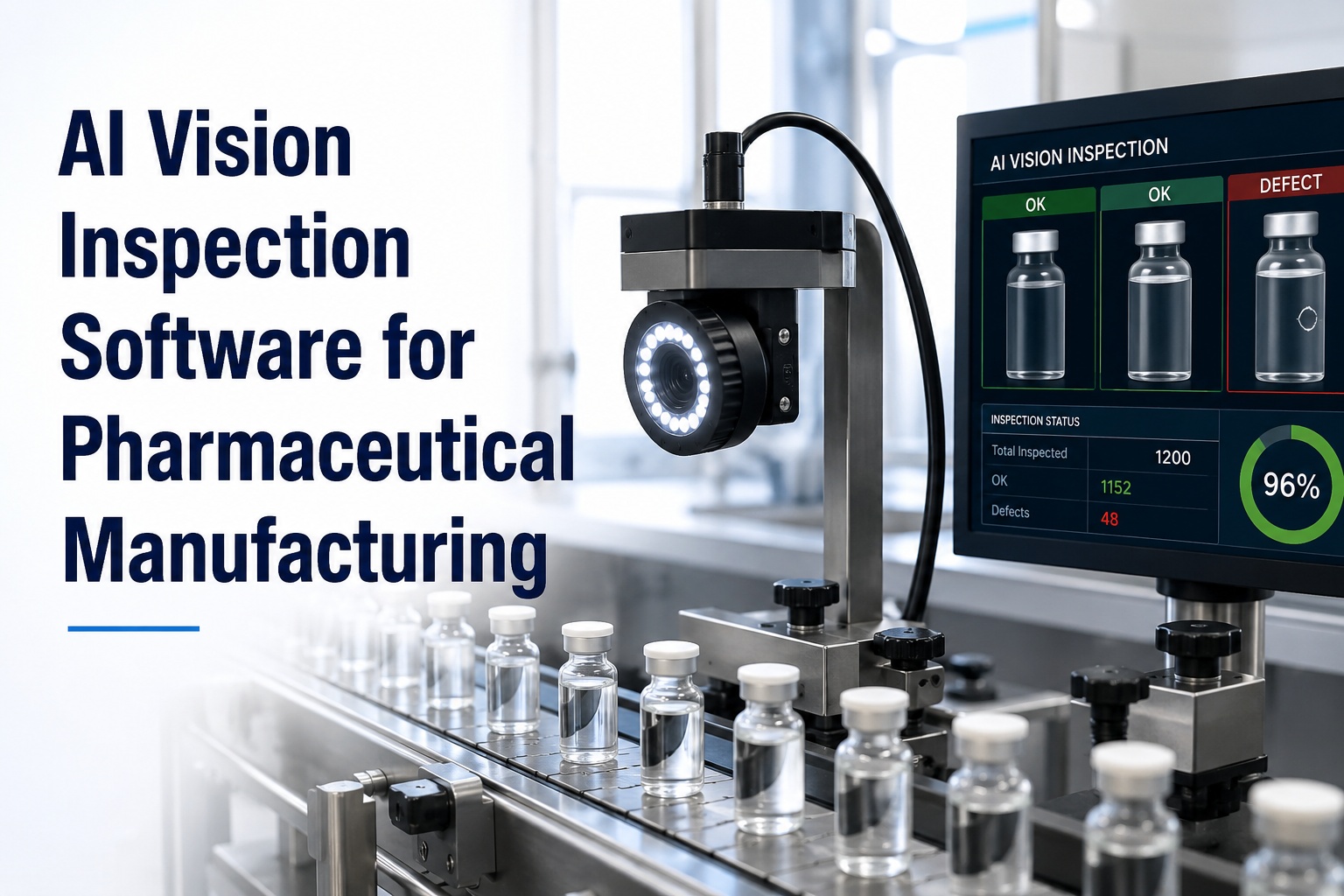
For injectable and sterile pharmaceutical products, 100% visual inspection isn't a best practice — it's a regulatory mandate, because visible particulate matter in an injectable can jeopardize patient safety. The trouble is that the traditional machines doing that inspection are notoriously over-cautious: conventional automatic visual inspection can falsely reject up to 20% of good vials, mistaking an air bubble for a particle or a glass reflection for a crack. That's not a rounding error — it's millions of good units quarantined, with one real case seeing roughly 10 million prefilled syringes (about $3.2M of product) sitting in hold. AI vision inspection fixes both ends of the problem at once: it catches the true defects human and rule-based systems miss, and it stops rejecting the good product they wrongly flag. This guide explains how AI vision inspection software works in pharmaceutical manufacturing, the defect classes it detects, how it earns GMP validation, and how iFactory deploys it on-premise inside your fence.
AI Vision Inspection Software for Pharmaceutical Manufacturing
Automate 100% inspection of vials, tablets, blisters, and packaging — catching particulate, cosmetic, fill, and label defects while cutting the false rejections that quarantine good product. Deep-learning vision that tells a bubble from a particle, with full audit trails for GMP. On-premise so batch and image data stay in the plant. Validated, and live in 6–12 weeks.
The Two-Sided Problem AI Vision Solves
Pharmaceutical inspection has always carried a painful trade-off. Set the inspection tight enough to catch every true defect, and you reject mountains of good product on bubbles and glare. Loosen it to protect yield, and you risk a real defect reaching a patient. Manual inspection adds fatigue and inter-inspector variability on top. AI vision is the first approach that improves both error rates at once — fewer escaped defects and fewer false rejects.
A real particle, hairline crack, or contaminant slips through — the worst outcome, a patient-safety and recall risk.
A bubble read as a particle, glare read as a crack — up to 20% of good vials wrongly quarantined, destroying yield.
Curious what your false-reject rate is costing in quarantined good product? Book a 30-minute demo — iFactory will benchmark your current inspection against AI performance on representative images and quantify the recoverable yield. Sessions available this week.
What AI Vision Inspects in Pharma
Modern systems analyze tablets, capsules, vials, ampoules, blister packs, and packaging at high speed, delivering real-time pass/reject decisions. The defect families that matter span product and packaging.
Particulate in liquids
Foreign particles in vials and syringes — surfaced by pre-spin that swirls the solution so cameras catch suspended matter.
Cosmetic defects
Cracks, chips, misprints, and discoloration on tablets, capsules, and containers — across critical, major, and minor classes.
Fill level
Under- and over-fill on vials, ampoules, and syringes — verified on every unit, with nozzle-clog warnings from fill drift.
Label & code
Missing, crooked, or wrong labels; unreadable lot codes and serialization — preventing mix-ups and mislabeling.
Blister integrity
Missing or broken tablets, malformed pockets, foil and seal defects across hundreds of thousands of blisters daily.
Closure & seal
Stopper seating, crimp, and container-closure integrity — additional sensors complement vision on sterile products.
Why Deep Learning Beats Rule-Based Inspection
Legacy AVI uses fixed rules: if a shape matches a particle template, reject. That rigidity is exactly why it over-rejects — a bubble and a particle look similar to a rule. AI takes two smarter routes. Supervised CNNs train on real defects and real false triggers, learning to discriminate. And unsupervised anomaly detection models normal variation, then flags anything that deviates — ideal for the rare, unpredictable defects that defy labeling.
- Fixed templates and thresholds
- Confuses bubbles, glare, reflections
- Up to 20% false rejection of good vials
- Re-coded by hand for each new product
- CNNs trained on true defects + false triggers
- Distinguishes particle from bubble or glare
- Unsupervised anomaly detection for rare defects
- Learns new products from sample images
Want to know whether your defect types suit supervised, unsupervised, or both? Ask iFactory Support with a few sample images and your product formats, and the team will recommend the right model approach and a validation path — typically a response within 3 business days.
How an AI Vision Inspection Runs — Per Unit
From container to pass-or-reject, with the audit record attached
Earning GMP Validation — The Non-Negotiable
AI vision can absolutely run in a GMP environment — Amgen's regulator-supported vial deployment proved it — provided the validation is thorough. The difference between an AI tool and a validated AI system is documentation: training data, validation protocols, performance metrics, change control, and audit trails. iFactory is built for that from the start, including transparency that addresses "black box" concerns.
Worried about the validation lift? Schedule a demo and iFactory will walk through the validation package — training-data documentation, protocols, metrics, and change control — mapped to your products and regulatory scope. Slots open this week.
On-Premise Deployment — Inside the Fence
Pharmaceutical inspection images carry batch genealogy and process IP, and the vision system must talk to PLCs for reject gates at line speed — both reasons on-premise is the default. iFactory retrofits onto existing lines with clean-room-compatible mounts, communicates with reject actuators over OPC-UA, and runs all inference inside your fence.
iFactory On-Premise Appliance The pharma default — images stay in-fence
- Pre-configured NVIDIA AI server — racked, loaded, inside your fence.
- Low-latency PLC integration — OPC-UA to reject gates and divert.
- Clean-room-compatible install — retrofits onto legacy lines.
- Images never leave the site — batch genealogy stays put.
iFactory Cloud For multi-site model governance
- One validated model — deployed across all sites under central governance.
- Quality consistency — enforced algorithmically across geographies.
- Same vision engine — CNN + anomaly detection, full defect library.
- Central model updates — versioned and change-controlled.
Catch every real defect. Stop rejecting the good product.
AI vision inspection ends the trade-off pharma has lived with — fewer escaped defects and fewer false rejects at the same time, with the bubble-vs-particle discrimination legacy AVI can't manage. iFactory delivers validated, GMP-ready vision across vials, tablets, blisters, and packaging on a pre-configured on-premise appliance inside your fence. Live in 6–12 weeks, ROI proven on one line first — against a recall cost that averages $10M.
Frequently Asked Questions
Is AI vision inspection allowed in a GMP environment?
Yes. AI vision can run in GMP manufacturing provided it's thoroughly validated and documented — Amgen's deep-learning vial inspection was supported by regulators precisely because of improved documentation and robust validation. The requirements are documented training data, validation protocols, performance metrics, change control, and audit trails. AI augments rather than wholesale replaces the inspection system, with a validated path to higher GMP compliance.
How does AI reduce false rejections?
Legacy rule-based AVI confuses innocuous features — bubbles, glass reflections, glare — with real defects, falsely rejecting up to 20% of good vials. Deep-learning models trained on both true defects and false triggers learn to discriminate a real particle from a bubble, sharply cutting false rejects while still catching genuine defects. That recovers good product and protects yield without compromising safety.
What products and defects can it inspect?
Tablets, capsules, vials, ampoules, blister packs, and packaging — for particulate in liquids, cosmetic defects (cracks, chips, misprints, discoloration), fill level, label and code correctness, blister integrity, and closure/seal. Defects are categorized as critical, major, or minor. For liquids, pre-spin rotation suspends particulate so cameras can capture it, and additional sensors can assess container-closure integrity.
Do we have to inspect 100% of units?
For injectable and sterile products, yes — regulators require 100% visual inspection because visible particulate matter can jeopardize patient safety, under standards like USP 1790, EP 2.9.20, and EU GMP Annex 1. AI vision makes 100% inspection practical at the speeds modern lines demand, delivering real-time pass/reject decisions on every unit with a full traceable record.
What's the return on investment?
It comes from three directions: recovered yield from fewer false rejects, avoided recall exposure (the average pharma recall costs about $10M in direct expenses), and productivity — reported gains of up to 30% labor savings and 25% throughput increase with defect occurrences down as much as 40% versus manual inspection. Contact iFactory Support for a sized estimate on your lines.
How do I book a demo or get a feasibility check?
Two routes. For a live walkthrough on your own product images, schedule a 30-minute demo — it covers the inspection pipeline, your defect types, the validation package, and a sized yield-and-throughput projection. For a written feasibility and camera check, contact iFactory Support with sample images and your formats and expect a response within about 3 business days. No obligation either way.
100% inspection, validated — without quarantining your good product.
The 2026 pharmaceutical inspection baseline is AI vision: deep-learning discrimination that catches true defects and clears the bubbles and glare legacy AVI rejects, across vials, tablets, blisters, and packaging — validated, GMP-ready, and on-premise inside your fence. Live in 6–12 weeks, ROI proven on one line first. The next step is a 30-minute demo against your own product images. Sessions available this week.



.png)