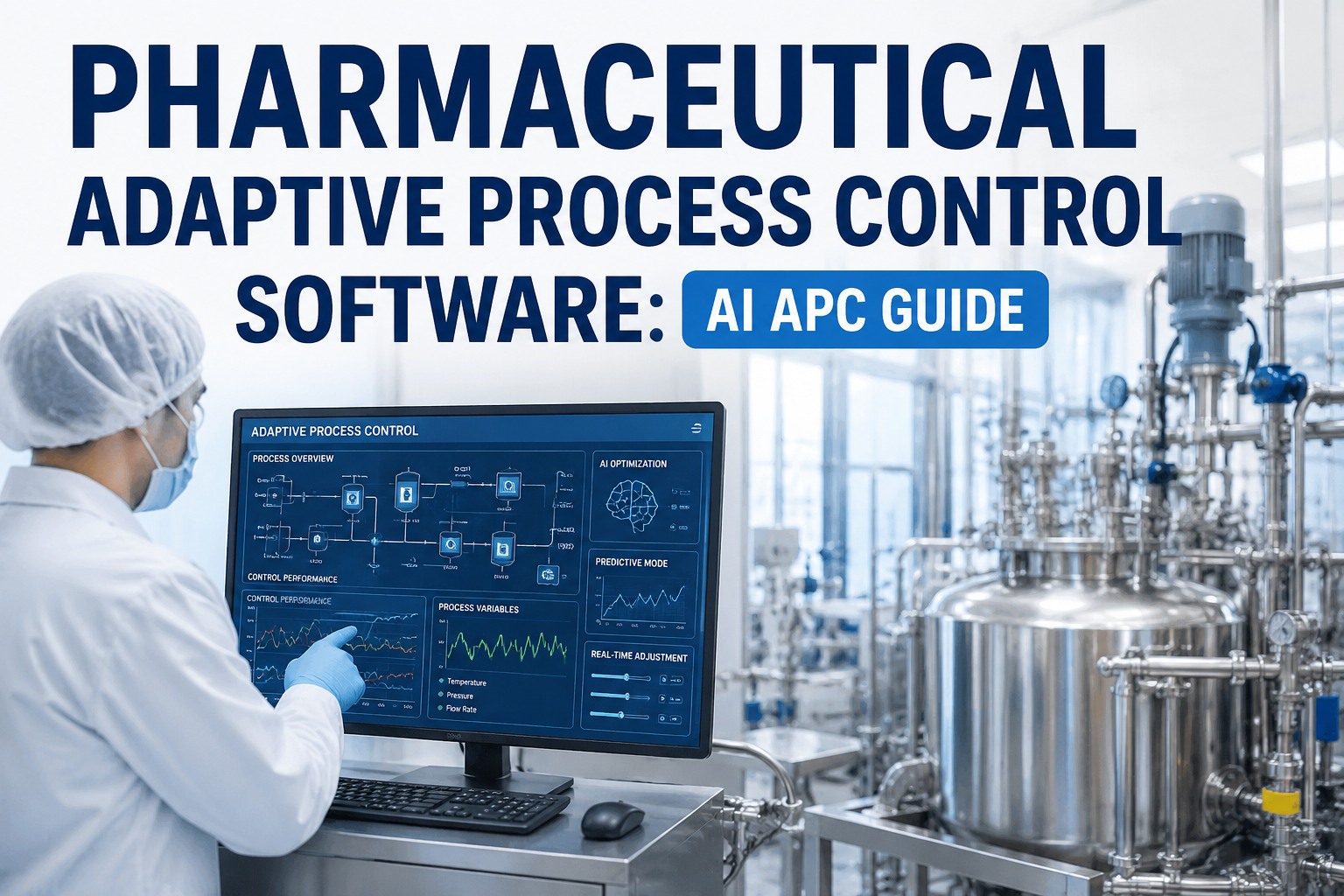
SPC tells you a process is drifting. Adaptive process control does something fundamentally different — it moves the process back. That distinction matters enormously in pharmaceutical manufacturing, where critical quality attributes like tablet weight, hardness, and blend uniformity shift constantly under material variability, dynamic coupling between unit operations, and the delays inherent in quality testing. Traditional static optimization — set the parameters, hold a narrow range, test at the end — can't keep up with that, which is exactly why continuous manufacturing requires advanced control rather than end-product testing. AI-powered adaptive process control closes the loop: it predicts how the process will behave, computes the optimal correction in real time, and learns from every batch so control gets better over time. This guide explains how adaptive process control software works in pharma, how model predictive control and AI keep CQAs on target, and how iFactory deploys it on-premise for PAT-driven, GMP-compliant manufacturing.
Pharmaceutical Adaptive Process Control Software: The AI APC Guide
Move beyond monitoring to real-time control. AI-driven APC predicts process behavior, computes optimal corrections within constraints, and learns batch-to-batch — holding tablet weight, hardness, and blend uniformity on target despite material variability. PAT-integrated, model predictive control, real-time release ready. On-premise so models and data stay in the plant. GMP-compliant, 21 CFR Part 11.
Monitor vs Control — The Line APC Crosses
The simplest way to understand adaptive process control is by what it does after it detects a problem. Monitoring — even predictive monitoring — stops at the alert. Control acts. APC reads the process state, predicts where the CQAs are heading, and adjusts the critical process parameters automatically to keep the output on target, all within validated constraints.
"The process is drifting."
- Detects drift and flags it
- Operator decides and acts manually
- Reaction speed limited by people
- Variation already in the product
"Correcting the process now."
- Predicts CQA trajectory ahead
- Computes & applies the optimal move
- Acts in real time, within constraints
- Keeps output on target — no drift
Model-Free vs Model-Based — Why PID Isn't Enough
Pharma control strategies split into two paradigms. Model-free controllers like PID act only on the error between setpoint and measurement — simple and reliable for a single valve or airflow loop, but they fall apart on complex, multivariate processes with the delays and constraints pharma is full of. Model-based control predicts future behavior from a dynamic model and computes moves that anticipate disturbances while respecting every constraint. That's what CQA control actually requires.
Model-free · PID
Acts on real-time error only — desired vs actual. Great for localized loops (valves, airflow), but blind to interactions, delays, and constraints.
Model-based · MPC + AI
Predicts future process behavior from a dynamic model, computes optimal moves over a horizon, anticipates disturbances, and honors all CQA, equipment, and safety constraints.
Wondering whether your process needs MPC or where PID still suffices? Book a 30-minute demo — iFactory will map your control loops and show where adaptive, model-based control would tighten CQA performance on your line. Sessions available this week.
How the MPC Control Loop Works
Model predictive control runs a continuous predict-optimize-act cycle. At each step it uses real-time PAT measurements and a process model to forecast the CQA trajectory over a future window, solves for the control moves that keep it on target within constraints, applies the first move, then repeats — re-forecasting with fresh data every cycle. AI makes the model adaptive, so it improves as data accumulates.
Predict, optimize, act — every cycle, with PAT in the loop
Want to see the predict-optimize-act loop on a representative process like blending or tableting? Ask iFactory Support with your unit operations and CQAs, and the team will outline the control model and PAT integration, plus a validation path — typically a response within 3 business days.
Where APC Pays Off in Pharma
Adaptive control delivers most where processes are dynamic, multivariate, and quality-critical — which describes the heart of solid-dose and biologics manufacturing.
Tablet weight & hardness
Holds weight stability in high-speed compression despite material fluctuation — where static methods cause big swings.
Blend uniformity
NIR-based control of continuous powder blending keeps API content uniform at low dosage, batch after batch.
Granulation & drying
Controls roller compaction, wet granulation, and drying endpoints — coupled steps that defy single-loop control.
Bioreactor control
Manages cell growth, media, and impurities in biologics — complex, fast-changing systems conventional control can't tame.
End-to-end continuous
Plant-wide MPC coordinates synthesis through tableting, managing the interactions between integrated process units.
Real-time release
Tight, documented CQA control is the foundation for real-time release testing — quality assured in-process, not after.
Adaptive Learning — Control That Improves Every Batch
The "adaptive" in APC is what separates it from fixed control. A tableting process is a dynamic system with both within-batch time variation and batch-to-batch evolution. Iterative Learning MPC tackles both: it optimizes parameters in real time within a batch, and progressively updates the process model using accumulated data across batches — so the control gets sharper as it runs.
Curious how much tighter your CQA control could get with adaptive learning? Schedule a demo and iFactory will show iterative-learning MPC on representative data and project the variation reduction for your process. Slots open this week.
APC the Right Way — A Process Initiative, Not an IT Project
The common pitfalls are well documented: treating APC as an IT rollout rather than a process-engineering and quality initiative, underestimating the modeling effort, and neglecting operator training. iFactory is built to avoid them — pairing the platform with model development, PAT integration, and a validation path that treats control as the quality initiative it is.
On-Premise or Cloud — Same Control Engine
APC models encode deep process IP and must run at control-loop latency, so on-premise is the default for pharma — keeping models and data inside the fence with real-time edge execution. A governed cloud option supports multi-site model management, with the same adaptive engine either way.
iFactory On-Premise Appliance The pharma default — control models stay in-fence
- Pre-configured NVIDIA AI server — racked, loaded, inside your fence.
- Control-loop-latency execution — real-time at the process.
- Models & data never leave — process IP stays put.
- GAMP 5 categorized — validation-ready, audit-ready.
iFactory Cloud For governed multi-site model management
- Fully managed — where governance and policy permit.
- Same APC engine — MPC, adaptive learning, PAT integration.
- Cross-site model governance — versioned and consistent.
- Central updates — change-controlled across facilities.
Stop reacting to drift. Start controlling the process.
Adaptive process control is the leap from watching CQAs to holding them on target — predicting process behavior, computing the optimal correction within constraints, and learning batch-to-batch. iFactory delivers PAT-integrated, model-predictive, adaptive control on a pre-configured on-premise appliance inside your fence — GMP-compliant, RTRT-ready, ROI proven on one process first.
Frequently Asked Questions
What's the difference between SPC and adaptive process control?
SPC monitors — it detects and flags drift, leaving the correction to an operator. Adaptive process control acts — it predicts where the critical quality attributes are heading and automatically adjusts the critical process parameters to keep output on target, in real time and within validated constraints. SPC tells you the process is drifting; APC moves it back before the variation reaches the product.
What is model predictive control (MPC)?
MPC is an advanced control strategy that uses a dynamic process model to predict how the process will behave over a future window, then computes the optimal control moves subject to constraints. It runs a continuous predict-optimize-act loop, re-forecasting with fresh PAT data each cycle. Unlike PID, it handles multivariate processes with significant delays and constraints — exactly what pharmaceutical CQA control demands.
Why isn't PID control enough for pharma?
PID is model-free — it reacts only to the error between setpoint and measurement. It's excellent for localized loops like valve or airflow regulation, but it's blind to the interactions, delays, and constraints in complex multivariate processes. For comprehensive control of CQAs across coupled unit operations, model-based control like MPC is required, often in a hybrid MPC-PID architecture.
How does "adaptive" learning improve control?
A pharmaceutical process is dynamic both within a batch and across batches. Iterative Learning MPC optimizes parameters in real time within each batch and progressively updates the process model from accumulated multi-batch data. The result is control that sharpens over time — variation falls and CQAs hold tighter as the model learns your specific process.
Is APC compatible with continuous manufacturing and RTRT?
It's essentially required for them. Continuous manufacturing needs advanced control rather than end-product testing or operation within a narrow fixed range. By holding CQAs tightly on target with documented, PAT-driven control, APC provides the foundation for real-time release testing — assuring quality in-process instead of after the batch. It aligns with the FDA's PAT and QbD frameworks.
How do I book a demo or get a control assessment?
Two routes. For a live walkthrough on your own process, schedule a 30-minute demo — it covers the MPC control loop, your CQAs and CPPs, PAT integration, adaptive learning, and a validation path. For a written control assessment, contact iFactory Support with your unit operations and quality attributes and expect a response within about 3 business days. No obligation either way.
From process understanding to process control.
The 2026 pharmaceutical advantage is adaptive process control: model-predictive, PAT-integrated, self-learning control that holds CQAs on target through material variability and process dynamics — the foundation for continuous manufacturing and real-time release. On-premise inside your fence, GMP-compliant, ROI proven on one process first. The next step is a 30-minute demo against your own process. Sessions available this week.