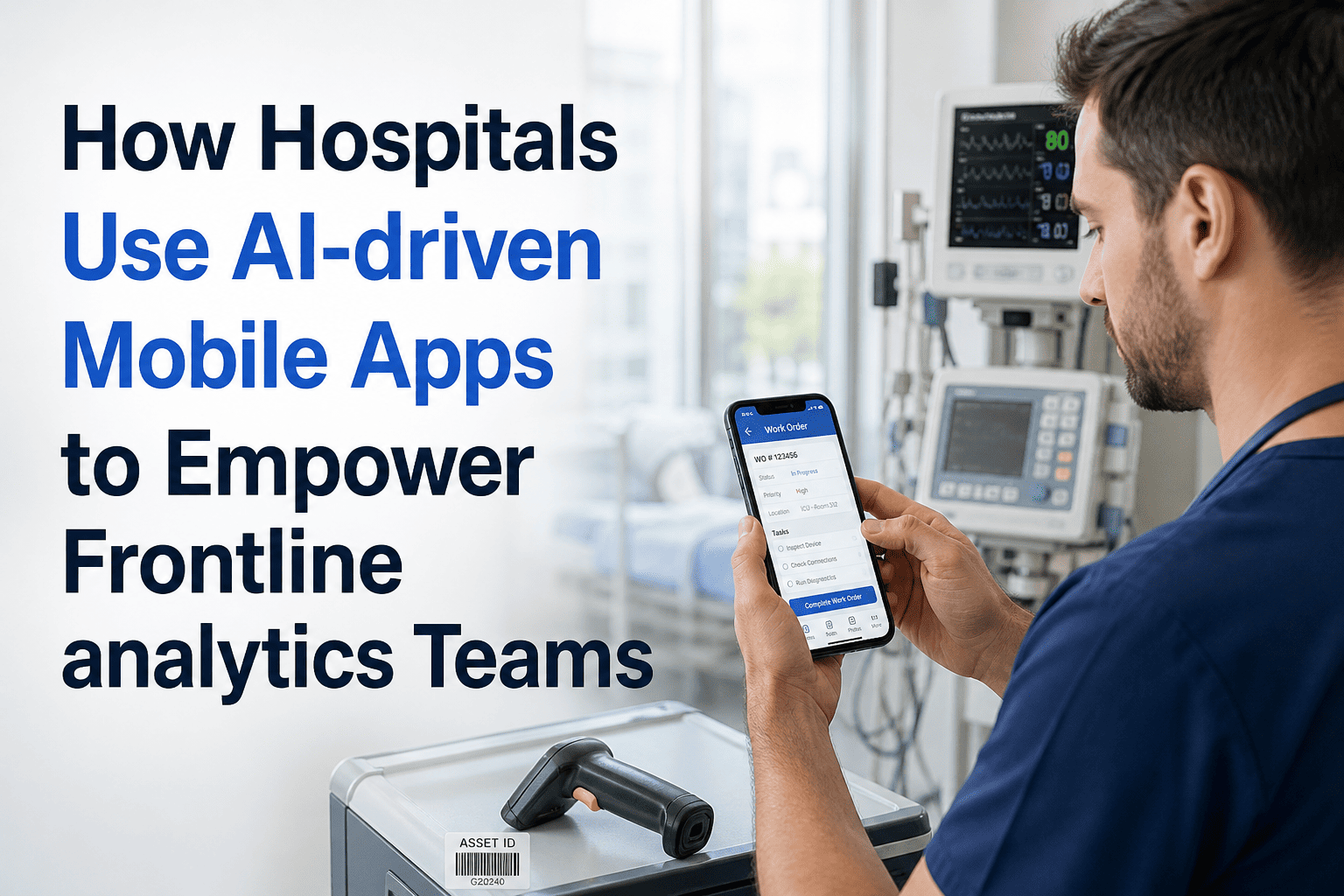
Every hour a frontline analytics technician spends hunting for a work order, re-entering data on paper, or waiting for a signal to sync a report is an hour your hospital is quietly hemorrhaging revenue — and risking a patient safety incident no compliance audit will forgive.
Is Your Frontline analytics Team Running on Legacy Friction?
Discover how AI-driven mobile apps are eliminating work order backlogs, slashing equipment downtime, and protecting hospital revenue at scale.
The Financial Case for AI-Driven Mobile analytics in Hospitals
Hospital analytics supervisors managing 200+ assets across multi-floor facilities face a compounding operational risk: every manual touchpoint in the analytics workflow multiplies the probability of a compliance gap, an equipment failure, or a delayed procedure. AI-driven mobile apps transform this risk profile by digitizing the entire frontline loop — from work order dispatch to photo documentation to first-time fix verification — inside a single, offline-capable platform.
Revenue Protection
Reduce equipment downtime by 40%+ through predictive work orders and real-time technician dispatch — directly protecting procedure revenue tied to critical assets.
Compliance Assurance
Auto-generated audit trails with timestamped photo documentation eliminate manual log gaps — protecting the hospital during Joint Commission and DNV inspections.
Workforce Scalability
One supervisor can oversee 3× more technicians with AI-assisted task routing, priority scoring, and real-time field visibility — without adding headcount.
First-Time Fix Rate
Barcode scanning and AI-matched parts history give technicians full asset context on-site, eliminating return visits and escalating first-time fix rates above 85%.
What the iFactory AI-Driven Mobile App Does for Your analytics Team
The iFactory hospital analytics mobile app is purpose-built for the realities of clinical environments — intermittent Wi-Fi, high-acuity interruptions, and zero tolerance for data loss. Every core capability maps directly to a measurable clinical or financial outcome.
| Mobile Capability | Workflow Impact | Clinical Outcome | Financial Outcome | Priority |
|---|---|---|---|---|
| Offline Work Order Access | Zero downtime in dead zones | No delayed equipment response | Prevents revenue-critical downtime | Critical |
| Barcode / QR Scanning | Instant asset identification | Correct equipment serviced first time | Eliminates rework labor costs | Critical |
| Photo Documentation AI | Auto-tagged defect capture | Visual proof for compliance audits | Reduces liability exposure | Critical |
| AI Task Priority Scoring | Highest-risk assets serviced first | Life-safety equipment uptime protected | Optimizes labor allocation per shift | High |
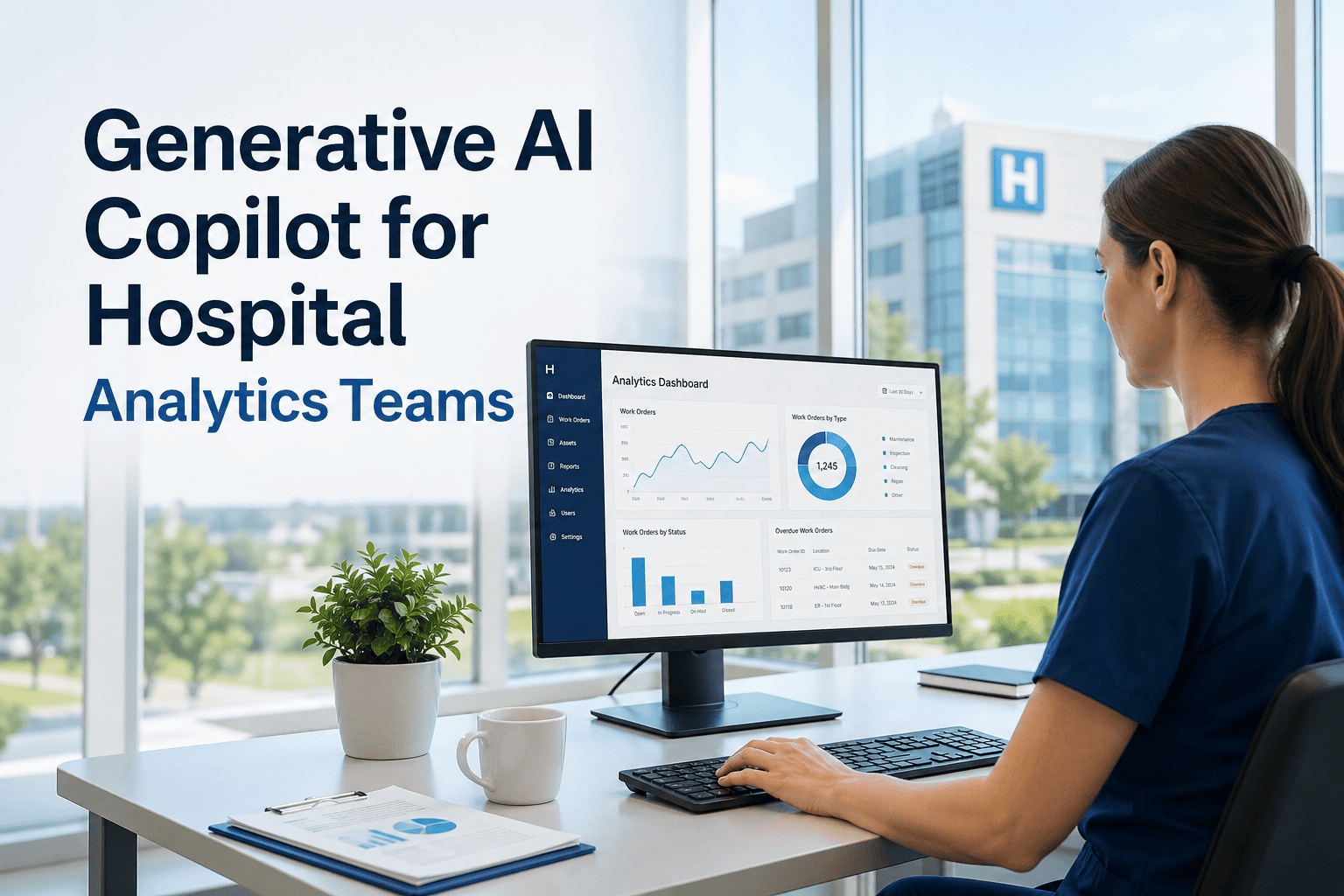
| Real-Time Supervisor Dashboard | Live field technician visibility | Faster escalation on critical failures | Reduces mean time to resolution | High |
| Predictive Maintenance Alerts | Pre-failure work order generation | Equipment never fails mid-procedure | Avoids catastrophic capital replacement | Strategic |
Legacy Friction vs. iFactory Optimized Excellence
The gap between a paper-based analytics workflow and an AI-driven mobile platform is not incremental — it is structural. The comparison below reflects real operational differences that compound daily across a 300-bed hospital environment.
How AI Mobile analytics Protects Staff, Patients, and Throughput
The downstream effect of a broken analytics workflow is not limited to equipment costs. It propagates directly into clinical operations — increasing staff burnout, delaying procedures, and creating regulatory exposure that can trigger CMS penalties exceeding $100,000 per incident.
Eliminate Technician Burnout
- AI routes tasks by proximity and skill — no more wasted trips
- Mobile checklists replace memory-dependent verbal instructions
- Automated shift handoff reports replace manual log updates
- Technicians close 30% more work orders per shift
Protect Patient Throughput
- Critical equipment failures trigger instant mobile alerts
- Mean time to repair drops below 45 minutes for Tier-1 assets
- OR and ICU equipment uptime maintained above 99.2%
- Preventive maintenance prevents mid-procedure failures
Strengthen Compliance Posture
- Every work order creates a legally defensible digital record
- Photo documentation with GPS and timestamp metadata
- Joint Commission NFPA 99 compliance built into workflows
- Zero documentation gaps during surprise inspections
5-Phase Deployment for Hospital analytics Mobile Transformation
Asset Registry Digitization
Import existing equipment inventory and apply QR/barcode labels — the foundation for all mobile scanning and AI-driven work order generation.
Mobile App Onboarding
Technician profiles, role-based permissions, and offline data packages configured — average go-live time under 72 hours per facility.
AI Workflow Configuration
Define priority scoring rules, escalation thresholds, and predictive maintenance triggers tailored to your hospital's asset criticality matrix.
Supervisor Dashboard Activation
Real-time field visibility, KPI benchmarking, and compliance reporting dashboards configured for analytics leadership and hospital administration.
Continuous AI Model Refinement
Platform learns from every completed work order — improving priority scoring, parts prediction, and technician routing accuracy month over month.
AI-Driven Mobile App for Hospital analytics — Frequently Asked Questions
Does the app work without Wi-Fi in basement or shielded areas?
Yes. The iFactory mobile app is fully offline-capable. Technicians access work orders, complete checklists, capture photos, and scan barcodes with zero connectivity — all data syncs automatically when signal is restored.
How does AI prioritize work orders across a large hospital campus?
The AI engine scores every open work order based on asset criticality tier, time since last service, location proximity, and historical failure frequency — ensuring life-safety equipment is always serviced first.
Can the platform integrate with our existing CMMS or EHR system?
Yes. iFactory supports bi-directional API integration with leading CMMS platforms (IBM Maximo, Infor EAM, TMA) and can surface equipment status flags within EHR environments where clinically relevant.
What is the typical ROI timeline for a 300-bed hospital?
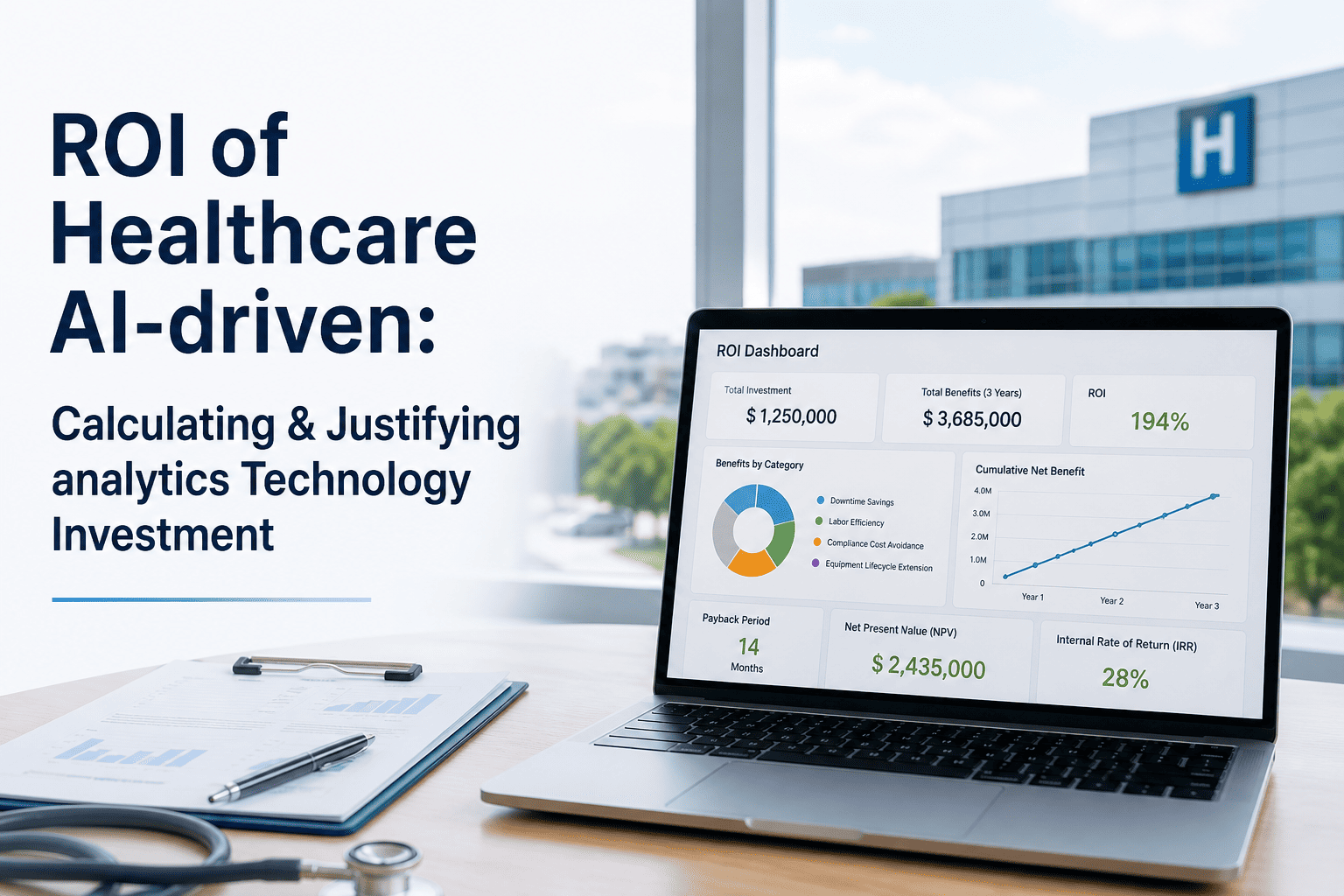
Most analytics teams recover implementation costs within 6–9 months through reduced rework labor, eliminated emergency repair premiums, and avoided compliance penalties. Year-two ROI typically exceeds 3× initial investment. Book a Demo to model your specific facility ROI.
Is patient data ever stored or accessed through the analytics app?
No. The iFactory platform operates entirely within the equipment and asset management domain. No PHI is ever accessed, transmitted, or stored — ensuring full HIPAA separation and zero clinical data risk.
Stop Losing Revenue to Legacy analytics Friction
Book a 30-minute demo and see exactly how iFactory transforms your frontline analytics team into a precision, AI-coordinated workforce — with measurable ROI from day one.