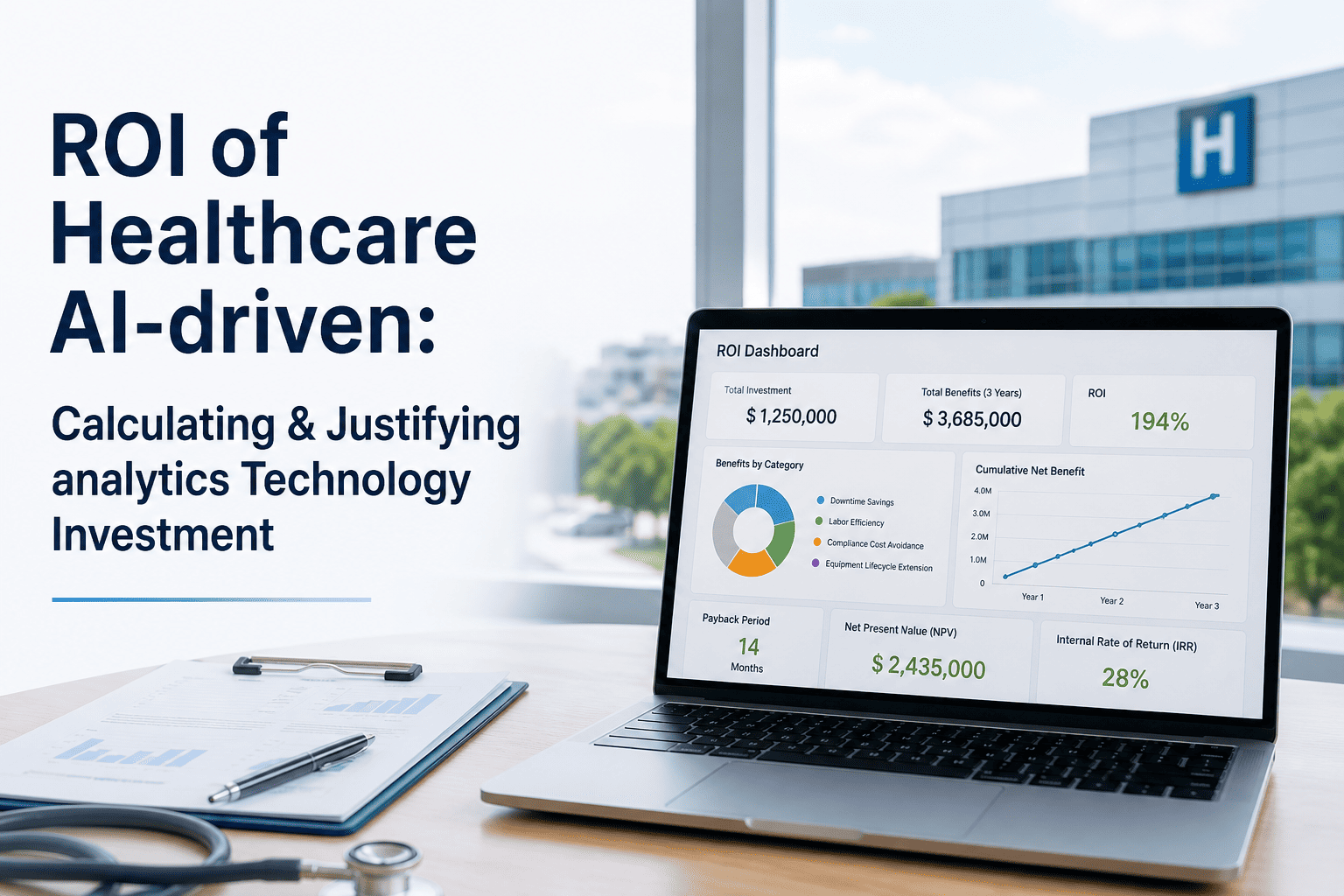
Every hour your hospital operates without an AI-driven workflow platform, revenue walks out the door—through denied claims, extended discharge delays, redundant lab orders, and staff hours lost to manual coordination. For CFOs and hospital executives, the question is no longer whether to adopt healthcare AI-driven analytics, but how to justify the investment with a board-ready ROI case that survives financial scrutiny.
Is Revenue Leaking Through Your Clinical Workflows?
Get a custom ROI projection and operational gap audit tailored to your hospital's size, specialty mix, and payer landscape.
The Financial Case for Healthcare AI-Driven Analytics
Hospital leadership teams face a compounding crisis: rising labor costs, tightening payer margins, and a regulatory environment that penalizes inefficiency. AI-driven platforms convert this complexity into measurable financial outcomes. Here is what the data shows for mid-to-large health systems:
Building Your Board-Ready Business Case: 5 Financial Pillars
A defensible ROI case for hospital AI investment rests on five quantifiable pillars. Each maps directly to a line item your CFO already tracks.
Downtime Cost Quantification
- Calculate revenue lost per hour of EHR or workflow system downtime
- Factor in delayed procedures, rescheduled surgeries, and diverted patients
- Benchmark against industry average of $8,662 per minute for large hospitals
- AI-driven uptime monitoring reduces unplanned downtime by up to 73%
Compliance & Audit Savings
- Map current spend on manual compliance audits, FTE hours, and external consultants
- AI automates HIPAA, CMS, and Joint Commission documentation flagging
- Reduce regulatory penalty exposure with real-time anomaly detection
- Typical compliance cost reduction: 28–35% in year one
Labor Efficiency & Burnout Reduction
- Automate repetitive clinical documentation tasks consuming 34% of nurse time
- Reduce charge nurse coordination overhead through intelligent scheduling AI
- Calculate turnover cost avoidance ($56K average per bedside RN replaced)
- AI triage routing increases throughput without adding headcount
Revenue Cycle Acceleration
- Predictive coding AI reduces claim denial rates by 35–42%
- Real-time eligibility verification eliminates upstream billing errors
- Days in AR reduced by an average of 8.4 days post-implementation
- Prior authorization AI cuts approval cycle from 4 days to under 6 hours
Payback Period Modeling
- Model three scenarios: conservative (24 mo), base (18 mo), aggressive (12 mo)
- Include software licensing, implementation, and training in total cost of ownership
- Account for phased go-live rollout reducing disruption and accelerating adoption
- Use iFactory's ROI calculator to generate a facility-specific payback projection
Legacy Friction vs. iFactory Optimized Excellence
The gap between your current operational state and an AI-driven optimized environment is a direct measure of recoverable revenue. This matrix shows what hospital leadership is leaving on the table.
| Operational Area | Legacy Friction State | iFactory Optimized Excellence | Financial Delta |
|---|---|---|---|
| Claims Processing | Manual review, 18% denial rate | AI-coded, 6% denial rate | +$480K/yr recovered |
| Discharge Planning | Avg. 2.4 day delays, bed unavailability | Predictive discharge within 4-hour window | +$1.1M throughput gain |
| Compliance Auditing | Quarterly manual audits, reactive posture | Continuous AI monitoring, proactive alerts | 35% penalty reduction |
| Staff Scheduling | Static templates, chronic overtime spend | Demand-based AI scheduling, optimized ratios | 22% overtime cost cut |
| Prior Authorization | 4–6 day manual cycle, procedure delays | AI submission, same-day approval rate 68% | $220K delay cost avoided |
| Downtime Management | Reactive IT response, unplanned outages | Predictive monitoring, 99.97% uptime SLA | 73% downtime reduction |
Solving the Three Root Causes of Clinical Inefficiency
Hospital AI investment must address clinical pain points that directly drive both financial performance and patient safety outcomes. iFactory's platform targets the three most costly root causes.
Staff Burnout & Turnover
- AI absorbs 60% of documentation burden from nursing staff
- Intelligent task routing eliminates low-value workflow friction
- Predictive scheduling prevents chronic understaffing cycles
- Turnover cost avoidance: $56K–$97K per retained clinician annually
Patient Throughput Bottlenecks
- ED-to-bed assignment AI reduces hallway boarding by 44%
- Surgical block optimization increases OR utilization by 18%
- Real-time bed management dashboard eliminates coordination lag
- Discharge prediction models activate case management 48 hrs earlier
Avoidable Readmissions & Safety Events
- Risk stratification AI flags high-readmission patients at discharge
- Post-acute care coordination module reduces 30-day readmission by 28%
- Medication reconciliation AI cuts adverse drug events by 31%
- CMS penalty avoidance: up to $1.7M per year for qualifying hospitals
From Approval to ROI: A 90-Day Implementation Blueprint
Hospital executives require a low-disruption deployment plan. iFactory's phased implementation model is engineered to protect clinical operations while accelerating time-to-value.
Discovery & Gap Audit
- Operational workflow mapping across departments
- Revenue leakage quantification report
- EHR integration readiness assessment
- Custom ROI projection delivered to CFO
Core Platform Deployment
- AI engine integration with existing EHR stack
- Revenue cycle module activation and staff training
- Compliance monitoring dashboards go live
- First denial rate improvement metrics captured
Full Clinical AI Activation
- Predictive discharge and bed management live
- Staff scheduling AI tuned to census patterns
- Readmission risk scoring active across service lines
- Executive ROI dashboard delivered to leadership
Present a Board-Ready AI Business Case in 30 Days
iFactory's healthcare strategists will build a custom ROI model for your facility—covering denied claims recovery, labor savings, compliance cost reduction, and payback timeline.
Healthcare AI-Driven Business Case — Executive FAQs
How do we calculate the true cost of our current workflow inefficiencies?
iFactory's Operational Gap Audit maps your existing workflows and quantifies revenue leakage across five domains: claims denials, discharge delays, overtime labor, compliance penalties, and downtime events. The output is a facility-specific dollar figure your CFO can use directly in capital planning.
Will this platform integrate with our existing EHR without disrupting operations?
Yes. iFactory uses HL7 FHIR and vendor-neutral API architecture to connect with Epic, Cerner, Meditech, and all major EHR systems. Phased deployment ensures zero disruption to active clinical workflows during integration. Book a Demo to review our EHR integration library.
What does the payback period look like for a 150-bed community hospital?
Community hospitals typically achieve full payback in 20–24 months, driven primarily by denied claims recovery and compliance cost reduction. Facilities with high Medicare/Medicaid payer mix see accelerated returns due to CMS penalty avoidance. Book a Demo to run your scenario in our ROI calculator.
How does iFactory address HIPAA and data sovereignty requirements?
The platform is deployed on HIPAA-compliant, AES-256 encrypted cloud infrastructure with role-based access controls. All patient data remains within your designated sovereign environment. Every AI-driven action generates an immutable audit log for regulatory review and accreditation submissions.
Can the AI model be customized to our specific payer mix and service lines?
Absolutely. iFactory's AI engine is trained and fine-tuned against your facility's historical claims data, clinical protocols, and payer contract terms. This produces denial prediction and revenue optimization models that outperform generic industry benchmarks by 23–31% in accuracy. Book a Demo to see a payer-specific model demonstration.
Get Your Custom Healthcare AI ROI Projection Today
Join leading health systems using iFactory to turn operational data into board-approved AI investment strategies with proven financial outcomes.