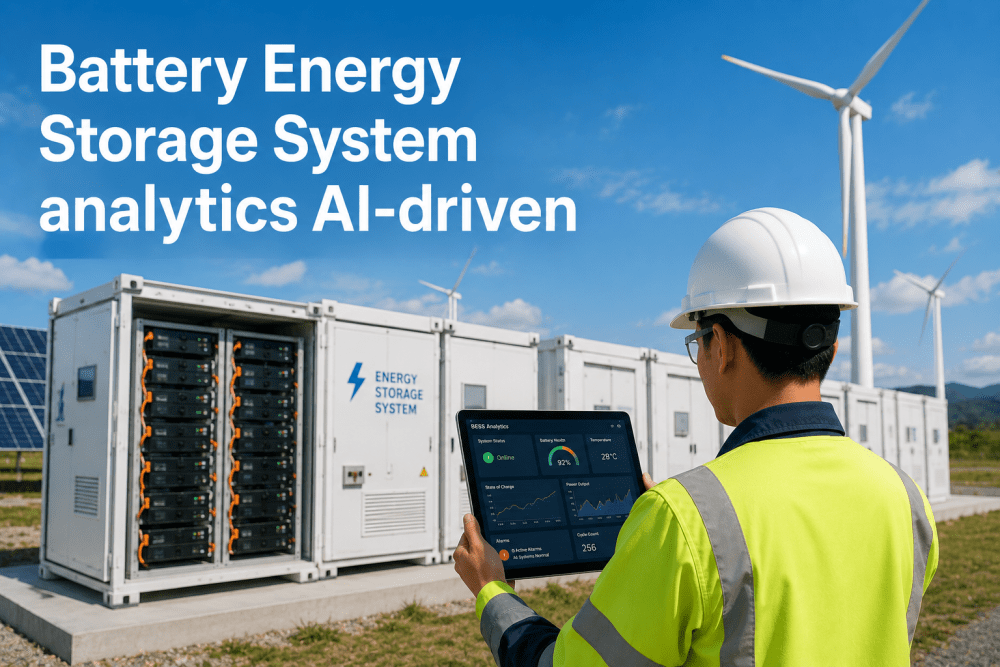
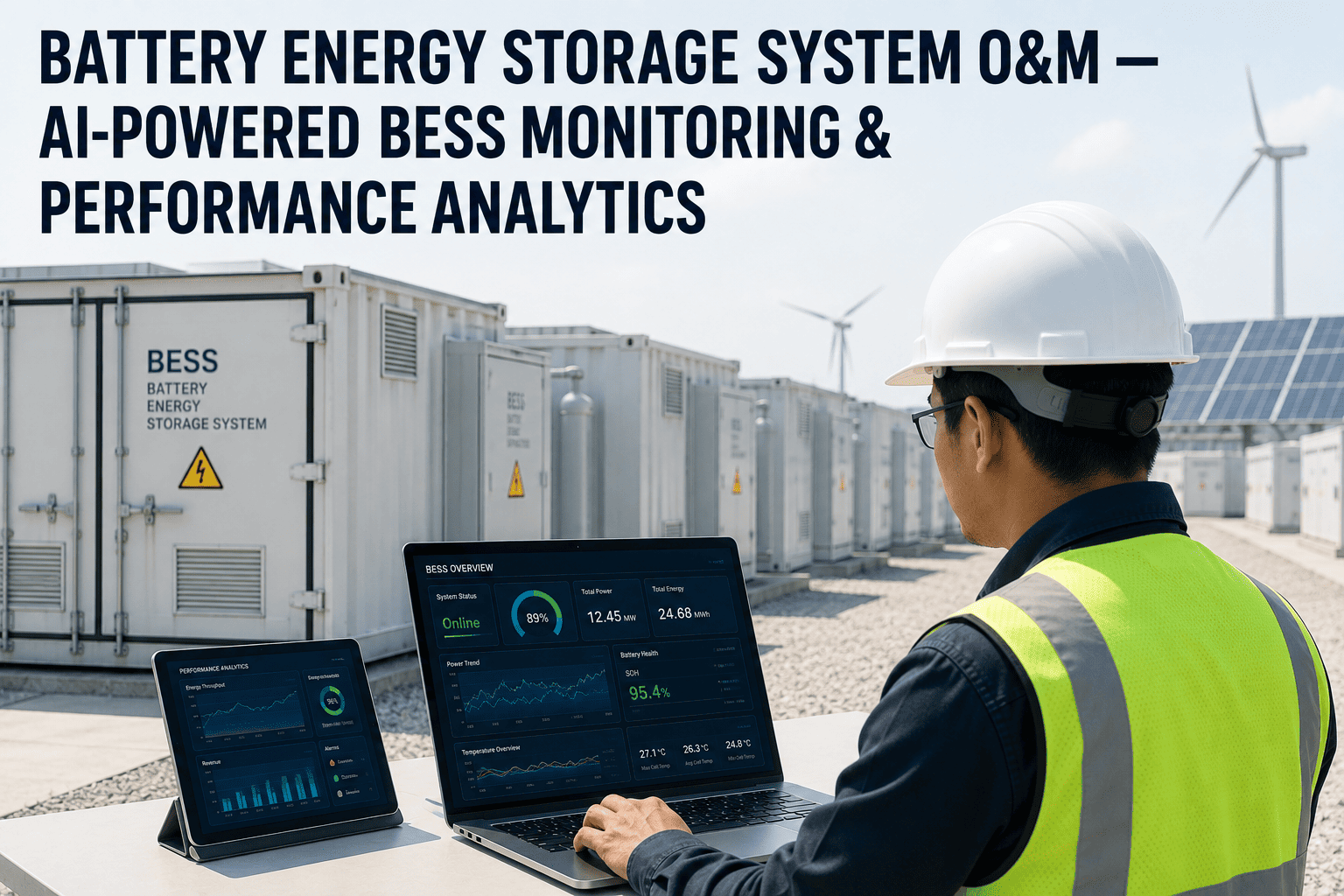
Battery energy storage systems are growing faster than the maintenance frameworks designed to manage them. A utility-scale BESS installation at a solar farm, a grid-stabilization facility, or an industrial microgrid represents $5–$50 million capital investment whose performance over a 15–20 year operating life depends almost entirely on how well the maintenance organization can track battery module degradation, manage thermal runaway risk, schedule inverter servicing, and anticipate cell replacement needs before they become forced curtailment events. The challenge is that BESS assets are new enough that most CMMS platforms still treat them as generic electrical equipment — without the module-level asset hierarchy, cycle-count tracking, state-of-health monitoring hooks, or thermal management inspection workflows that effective BESS analytics require. iFactory's AI-driven analytics platform delivers the purpose-built BESS analytics layer that bridges this gap — connecting battery management system (BMS) data to structured maintenance workflows, tracking module health at the string and rack level, scheduling thermal management inspections on condition rather than calendar, and generating the degradation trend data that turns reactive battery replacement into a planned capital program with predictable cost and performance outcomes. For an assessment of how your current CMMS handles BESS assets, talk to our support team.
Power Plant AI-driven · Battery Energy Storage · BESS Analytics
Battery Energy Storage System Analytics: Track Module Health, Thermal Risk, and Inverter Servicing in iFactory AI-driven.
As BESS installations scale across power plants, microgrids, and grid-stabilization facilities, analytics teams need AI-driven tools that manage battery module health, thermal management systems, and inverter servicing at the string, rack, and system level — not as generic electrical assets.
$200B+
Global BESS market by 2030 — maintenance programs must scale with deployments
20%
Average capacity fade per BESS installation from untracked thermal management gaps
3–5×
Higher module replacement cost when degradation is discovered reactively vs. trending
40%
Reduction in unplanned BESS curtailment with AI-driven condition monitoring
The BESS Analytics Gap
Three Core Maintenance Challenges Specific to Battery Energy Storage Systems
80%
of BESS Assets Tracked as Generic Equipment
Most CMMS platforms register a battery storage system as a single asset — no module hierarchy, no string-level health tracking, no cycle count integration from the BMS. This makes it impossible to identify which rack or string is degrading faster than expected before it affects system capacity or triggers a protection event.
60°C+
Thermal Runaway Threshold Reached Without Warning
Thermal management failures are the leading cause of BESS forced outages and safety incidents. Without continuous thermal inspection scheduling linked to BMS temperature data and ambient condition records, thermal hot spots develop undetected between scheduled maintenance visits — often only discovered after the protection system has already triggered a curtailment.
$180K
Average Cost Per Reactive Inverter Failure
BESS inverters are the highest-cost individual components in most installations after the battery modules themselves. Inverter failures discovered at fault rather than anticipated from condition trending — capacitor degradation, fan performance decline, coolant level monitoring — produce emergency procurement delays, specialist mobilization costs, and revenue curtailment that consistent preventive tracking prevents.
5 Core Capabilities
What iFactory's BESS Analytics Module Delivers — and What Each Capability Protects
Asset Register
Module-Level Asset Hierarchy
Every BESS installation structured in iFactory at system, container, rack, string, and module level — each with its own asset record, installation date, manufacturer specifications, cycle count, and state-of-health trend data. Replaces the single-asset registration that makes string-level degradation invisible in conventional CMMS platforms.
String-level visibility — not just system-level
Thermal Management
Condition-Based Thermal Inspections
Thermal inspection scheduling driven by BMS temperature deviation data, ambient conditions, and seasonal heat load patterns — not fixed calendar intervals. When BMS temperature readings from a specific module cluster deviate from the established baseline by a configurable threshold, an inspection work order is automatically generated before the deviation reaches the thermal management alarm level.
Inspections before alarms — not after
State of Health
Battery Module Degradation Trending
State-of-health (SoH) trends calculated per module from BMS cycle data, capacity test results, and operating temperature history — displayed as degradation curves that forecast when each module or string will reach the replacement threshold. Turns reactive module replacement into a planned capital program with 6–18 months of advance notice.
6–18 months replacement forecast visibility
Inverter Servicing
Inverter PM and Condition Tracking
Inverter preventive maintenance schedules built from manufacturer recommendations and actual operational hours — covering capacitor inspection intervals, cooling fan performance checks, DC link voltage monitoring, and thermal interface material replacement cycles. Condition-based alerts generated when inverter operating parameters deviate from established baselines before they reach fault thresholds.
Fault prevention — not fault response
Compliance Docs
BESS Safety and Regulatory Documentation
All BESS inspection findings, thermal management records, protection system test results, and module replacement histories maintained in audit-ready format within the asset record. NFPA 855, IFC, and utility interconnection inspection documentation generated automatically from completed work orders — eliminating the manual assembly that currently takes days before any regulatory site review.
Audit-ready documentation in under 60 seconds
Performance ROI
BESS Availability and Revenue Tracking
BESS availability rate calculated from actual curtailment events and planned maintenance downtime windows — compared against the PPA or grid services contract availability requirements. Maintenance cost per MWh of storage capacity tracked against the project's financial model, giving asset owners the performance documentation required for warranty claims, insurance reporting, and O&M contract performance reviews.
Availability vs. PPA requirement — tracked live
Measured Outcomes
What Structured BESS Analytics Delivers Across Module, Thermal, and Inverter Management
40%
Fewer Curtailment Events
Condition-based thermal and module monitoring eliminates the unplanned protection-system-triggered curtailments that reactive maintenance produces
3–5×
Lower Module Replacement Cost
Planned module replacement from degradation trending costs 3–5× less than emergency replacement after a string failure event and curtailment
18 mo
Advance Replacement Planning
State-of-health trending gives O&M managers 6–18 months of advance notice on module replacement needs to plan capital and procurement
100%
Audit Documentation Coverage
NFPA 855, IFC, and interconnection compliance documentation generated automatically from completed inspection work orders — no manual assembly
How It Works
The iFactory BESS Analytics Workflow — From BMS Data to Maintenance Action
01
BMS Data Integration
BMS operating data — cell voltage, temperature, SoC, SoH, cycle count — streams into iFactory continuously, mapped to the module-level asset hierarchy for per-string and per-rack condition visibility
02
Baseline Establishment
Healthy operating baselines established per module cluster from initial commissioning data — the cleanest reference state the system ever has — enabling deviation detection throughout the operating life
03
Anomaly Detection
AI models flag temperature deviations, SoH decline acceleration, and inverter parameter drift before they reach alarm or curtailment thresholds — generating condition-based work orders automatically
04
Planned Intervention
Thermal inspections, module replacements, and inverter servicing scheduled in planned maintenance windows with parts confirmed available — not triggered by fault events during revenue service
05
Documentation + ROI
Every inspection and replacement generates audit-ready compliance records automatically. BESS availability rate and maintenance cost per MWh tracked against PPA and financial model targets continuously
iFactory Brings Module-Level BESS Analytics to Your Energy Storage Installations — Live From BMS Data.
String-level SoH trending, condition-based thermal inspections, inverter PM scheduling, and NFPA 855 compliance documentation — all inside the AI-driven analytics platform your maintenance team already uses for work orders and predictive maintenance.
Before vs. After
BESS Analytics Without iFactory vs. With iFactory AI-Driven Platform
Without BESS Analytics
Battery system registered as one asset — no string, rack, or module hierarchy in CMMS
Thermal management scheduled on fixed calendar — hot spots develop undetected between visits
Module SoH tracked only at system level — individual string degradation invisible until string failure
Inverter servicing calendar-based — capacitor and cooling degradation discovered at fault, not before
NFPA 855 and interconnection documentation assembled manually — days of effort before any site review
BESS availability rate tracked in spreadsheets — no live comparison against PPA requirements
With iFactory BESS Analytics
Module-level asset hierarchy — SoH trend, cycle count, and temperature history per string and rack
Thermal inspections triggered by BMS temperature deviation — condition-based, not calendar-based
Per-string SoH degradation curves — 6–18 months advance notice on module replacement needs
Inverter condition trending — capacitor, fan, and DC link deviations flagged before fault thresholds
Audit documentation generated automatically from completed work orders — under 60 seconds for any review
Live BESS availability dashboard — actual vs. PPA requirement tracked continuously
Expert Perspective
What BESS O&M Managers Say About AI-Driven Battery Analytics
"When we commissioned our first 80 MWh BESS installation, we registered it in our CMMS as a single asset and built a maintenance schedule from the O&M manual. That worked for about 14 months. Then we started seeing our capacity test results drift — the system was delivering 91% of rated output instead of the 98% we'd been averaging. The problem was a thermal management failure on three adjacent racks in container 4 that had been developing for six weeks before the capacity test caught it. By the time we identified the specific racks, two string controllers had already tripped and we'd lost those modules to accelerated degradation. The replacement cost was $340,000. When we rebuilt the CMMS configuration with module-level asset hierarchy and linked BMS temperature data to inspection scheduling, the same type of thermal deviation would have generated an inspection work order in week two instead of being discovered through a capacity test in week eight. The modules would have been recoverable and the thermal management remediation would have cost $18,000 instead of $340,000. The lesson is that BESS assets need to be registered at the granularity the BMS data provides — not at the system level. A single-asset CMMS record for an 80 MWh installation is the equivalent of tracking all rotating equipment in a power plant as one asset called 'rotating machines.' The data exists at string level. The maintenance program needs to live at string level."
— BESS O&M Manager, 240 MWh Grid-Stabilization Installation, U.S. Southwest · PE Licensed · 12 Years Energy Storage O&M · SEPA Grid Edge Advisory Council Member
$340KReactive replacement cost vs. $18K planned intervention
6 weeksThermal deviation undetected without condition-based monitoring
String-levelRequired CMMS granularity for effective BESS analytics
Conclusion
BESS Analytics at System Level Is Not Analytics — It Is Guesswork With Good Intentions
The rapid scaling of battery energy storage installations across power generation, industrial, and grid services applications is outpacing the maintenance management frameworks designed to support them. A BESS asset registered as a single line item in a CMMS — with a calendar-based PM schedule and no connection to the BMS data that describes its actual condition — is not a managed asset. It is a capital investment waiting for an expensive surprise to make the maintenance gap visible.
The cost of closing that gap is a fraction of a single reactive module replacement event. iFactory's BESS analytics module builds the module-level asset hierarchy, connects BMS data to condition-based inspection triggers, tracks string-level SoH degradation curves, schedules inverter servicing on condition rather than calendar, and generates the compliance documentation trail that NFPA 855 and interconnection requirements demand. It does this inside the analytics platform the maintenance team already uses — without a separate system, a separate data layer, or a separate IT project. Book a Demo to see iFactory's BESS analytics configured for your installation size and chemistry.
Frequently Asked Questions
BESS Analytics in iFactory — What O&M Teams and Asset Owners Ask First
What BMS protocols and data formats does iFactory support for BESS data integration?
iFactory integrates with BESS BMS data through Modbus TCP/IP, CAN bus, DNP3, and IEC 61850 — the primary communication protocols used by major BESS OEMs including Tesla Megapack, Fluence Gridstack, BYD Battery-Box, and CATL TENER. For installations using proprietary BMS communication architectures, iFactory's integration layer supports SCADA historian export (OSIsoft PI, Aveva, GE Historian) and cloud-based BMS API connections. The key data fields required for iFactory's BESS analytics capabilities — cell voltage, temperature by zone, state of charge, state of health, cycle count, and fault event log — are available from virtually all modern BMS platforms in one or more of these formats. Integration configuration is confirmed during the implementation scoping process to match your specific BMS communication architecture.
Book a Demo to review the integration options for your specific BESS OEM and BMS version.
How does iFactory structure the module-level asset hierarchy for different BESS configurations?
iFactory's BESS asset hierarchy follows the physical architecture of the installation: System → Container → Rack → String → Module. Each level carries its own asset record with the relevant attributes for that level — the system record holds PPA performance requirements and interconnection data; the container record holds thermal management system specifications; the rack record holds protection relay settings; the string record holds cycle count and SoH trend data; the module record holds individual cell chemistry, capacity rating, and installation date. For installations with non-standard architectures — containerized AC-coupled systems, DC-coupled arrays with shared inverter buses, or multi-chemistry installations — the hierarchy is configurable to match the physical and logical structure of the specific installation. The BMS data mapping connects to the appropriate hierarchy level based on the granularity of data the BMS provides per installation.
How does iFactory generate NFPA 855 and IFC compliance documentation from BESS maintenance records?
NFPA 855 and IFC compliance documentation requirements for BESS installations include documented evidence of: thermal management system inspection frequency and findings, protection system test results and calibration records, emergency response procedure training completion, suppression system inspection records, and battery module condition monitoring results. iFactory generates all of these as structured outputs from the work orders completed by the maintenance team — no separate data entry required. When an inspection work order is completed, the findings are automatically formatted into the documentation record required by the applicable code section and stored in the asset record with the technician's name, timestamp, and any attached photo evidence. The full compliance documentation package for a site review is exportable in under 60 seconds from the BESS system asset record.
Book a Demo to see the compliance documentation export demonstrated for a sample BESS installation.
How does the state-of-health trending work and how far in advance can it forecast module replacement needs?
iFactory's SoH trending engine calculates a degradation curve per string using three data inputs: the BMS-reported state of health values over time, the capacity test results from scheduled performance testing, and the operating temperature history which accelerates degradation above certain thresholds. The degradation curve is fit to a capacity fade model appropriate for the battery chemistry — lithium iron phosphate (LFP), nickel manganese cobalt (NMC), or lithium titanate (LTO) — using the manufacturer's documented degradation parameters as a starting reference, then calibrated to the actual observed degradation rate for the specific installation. The model forecasts the date when each string will reach the replacement threshold (typically 80% of rated capacity for utility-scale applications) with a confidence interval that narrows as more operational data accumulates. For most installations with 6+ months of BMS history, the forecast horizon is 12–24 months. For installations with accelerated degradation from thermal management issues or high cycle rates, the model updates the forecast trajectory automatically when it detects a change in the degradation rate slope.
Can iFactory track BESS availability against PPA and grid services contract requirements, and generate performance reporting for asset owners?
Yes — BESS availability tracking against contractual requirements is a core output of iFactory's BESS analytics module. The availability calculation ingests both planned maintenance downtime (from scheduled work orders) and unplanned curtailment events (from BMS fault logs and protection system trip records) to produce the net availability rate that PPA and grid services contracts define. The availability dashboard shows live performance against the contracted requirement, with trend data showing whether the installation is tracking above or below the required level for the current contract period. Monthly and quarterly availability reports in the format required by most PPA reporting obligations are generated automatically from the same data. For installations with performance-linked incentive payments or availability guarantees with financial consequences for underperformance, iFactory's availability tracking provides the documented performance record needed to resolve any disputed performance calculations.
Book a Demo to see the availability dashboard configured for your specific contract requirements.
BESS at System Level Is Guesswork. BESS at String Level Is Management.
iFactory's BESS analytics module delivers module-level asset hierarchy, BMS-connected thermal inspection triggers, string-level SoH degradation forecasting, condition-based inverter servicing, and NFPA 855-ready compliance documentation — all inside the AI-driven analytics platform your maintenance team already uses. Book a demo to see it configured for your installation.




.png)