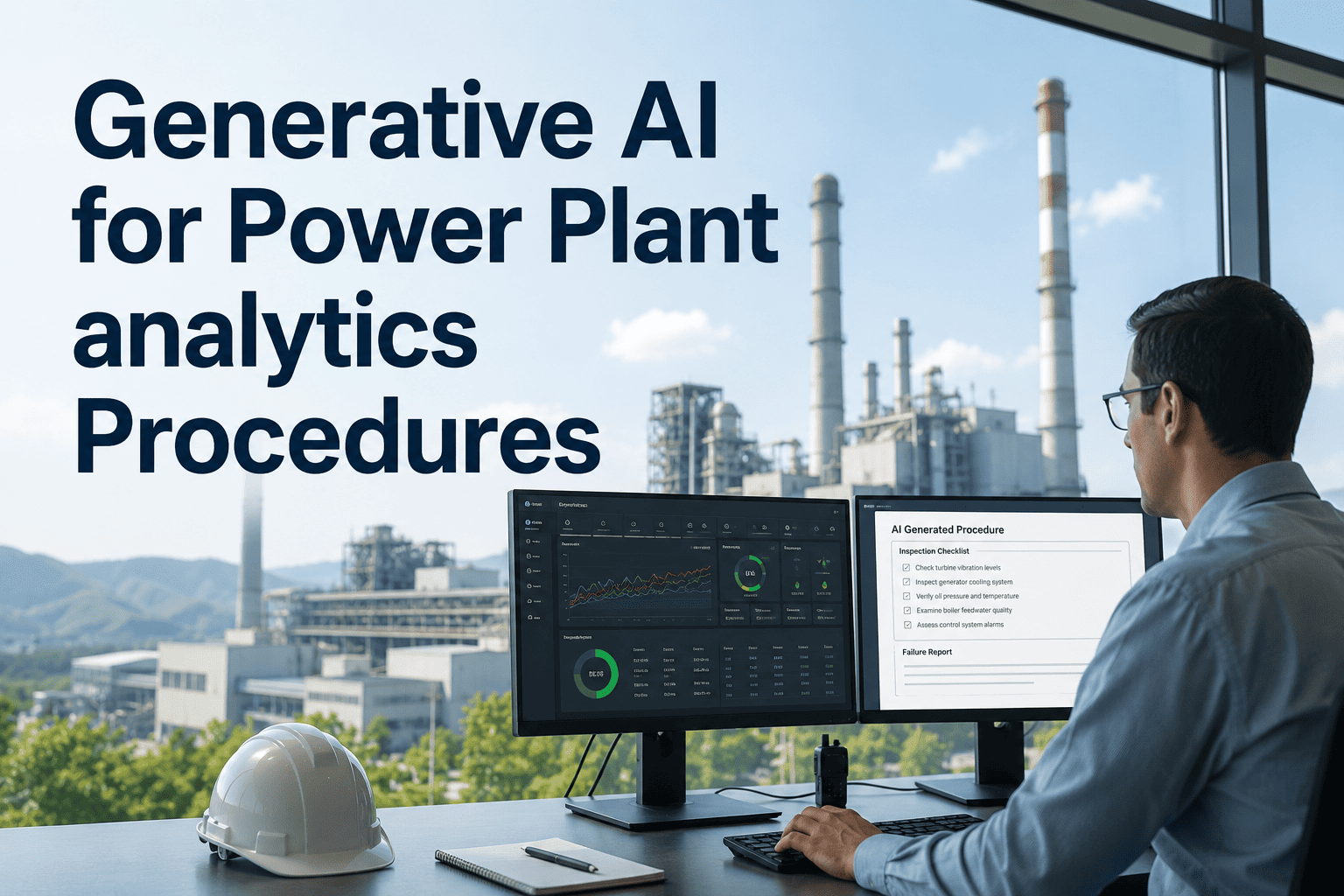
Generative AI is changing how power plant teams handle one of their most persistent operational burdens: documentation. For decades, analytics procedures, inspection checklists, and failure reports have been produced the same way — technician or engineer fills out a form, types up observations, and hands the document of for review. The process works, but it consumes time that skilled plant personnel do not have. When a turbine trip investigation requires a written root cause analysis, when a scheduled outage generates forty inspection reports, or when a new procedure must be drafted before a regulatory audit, the documentation backlog builds faster than the team can clear it. Generative AI inside AI-driven platforms changes that equation by auto-drafting the documents that power plant teams previously had to write from scratch — drawing on real sensor data, maintenance history, and operational context to produce accurate first drafts in seconds rather than hours.
Generative AI for Power Plant
Analytics Procedures
How LLM-powered platforms auto-draft inspection checklists, failure reports, and analytics procedures — cutting documentation time by up to 70% for U.S. power plant teams.
What Generative AI Actually Does Inside an AI-Driven Platform
The term "generative AI" covers a wide range of capabilities, and its application inside an industrial AI-driven platform is more specific — and more operationally useful — than the general-purpose chatbot use case that most plant teams associate with the technology. In a power plant context, generative AI refers to large language models (LLMs) that are embedded directly into the analytics workflow and given access to structured operational data: sensor readings, alarm histories, work order records, maintenance logs, equipment specifications, and regulatory checklists. The LLM does not generate content from general knowledge alone. It generates content from your plant's actual data, contextualized against the document type it is producing.
The result is a draft document that reflects what actually happened at your plant — not a generic template with blanks to fill in. A failure report auto-drafted from a turbine trip event will include the specific fault codes, the sensor values that preceded the alarm, the equipment tag, and a structured narrative of the event sequence, all drawn from the data the platform recorded. The technician reviews, adjusts, and approves — rather than writing from a blank page.
The Three Document Types GenAI Handles Best in Power Plant Operations
Generative AI is not equally useful for every documentation task in a power plant environment. Its advantages are largest where document production is repetitive, data-dependent, and time-sensitive — the three conditions that define a specific category of operational documents. The following breakdown maps where the technology delivers the most measurable value and what it actually produces in each case.
Analytics procedures define how specific equipment is monitored, what alarm thresholds apply, what actions follow specific readings, and how findings are escalated. They are required for NERC CIP compliance documentation, outage planning, and new equipment commissioning. Manually drafting a new analytics procedure — or revising an existing one to reflect updated threshold values — typically takes an engineer two to four hours per document. Generative AI reduces that to a ten-minute review-and-approve cycle.
Inspection checklists are generated repeatedly — for every scheduled outage, every PM cycle, every post-trip inspection. When checklists are produced manually, they are often identical copies of a prior version with a date change, missing equipment-specific context that has accumulated since the last inspection. GenAI-produced checklists draw on the asset's current condition data, flagging items that warrant extra attention based on anomaly scores or sensor trends detected since the last inspection.
Failure reports are among the most time-consuming documents a plant operations team produces — and among the most consequential. A thorough root cause analysis following a turbine trip or transformer fault requires an engineer to reconstruct the event timeline, correlate sensor data with alarm sequences, identify contributing factors, and document corrective actions. When done manually, this process typically requires three to six hours of engineering time per event. GenAI reduces the data assembly and narrative drafting to minutes, leaving the engineer to apply judgment rather than perform data retrieval.
GenAI vs. Manual Documentation: Side-by-Side Comparison
The operational difference between manual documentation and GenAI-assisted documentation is not just a matter of speed. The quality, consistency, and auditability of the output also change in ways that matter for compliance and root cause analysis programs. The comparison below maps both dimensions for each document category relevant to power plant operations.
| Document Type | Manual Process | Time Required | GenAI-Assisted Process | Time Required | Quality Improvement |
|---|---|---|---|---|---|
| Analytics Procedure (New) | Engineer drafts from template, pulls threshold data manually, writes narrative sections | 2–4 hours | LLM generates full draft from asset data; engineer reviews and approves | 15–30 min | Consistent structure; no missing sections; threshold data always current |
| Analytics Procedure (Revision) | Engineer locates prior version, identifies changed parameters, rewrites affected sections | 1–2 hours | LLM generates redlined revision draft highlighting changed values; engineer approves delta | 10–20 min | Full revision trail; prior version preserved; change rationale documented automatically |
| Scheduled Inspection Checklist | Technician copies prior checklist, updates date, may miss new items or prior open findings | 20–45 min | LLM generates asset-specific checklist with anomaly flags from current AI scores | 5 min review | Open findings carried forward; inspection scope adjusted to current asset condition |
| Post-Trip Failure Report | Engineer manually pulls sensor logs, reconstructs timeline, writes root cause narrative | 3–6 hours | LLM assembles timeline from platform data, drafts root cause narrative with contributing factors | 30–60 min review | No data gaps; chronology verified against raw sensor records; corrective actions cross-referenced |
| Outage Inspection Package | Maintenance planner assembles checklists for each asset class; manual compilation takes days | 1–3 days | LLM generates full outage package for all in-scope assets simultaneously | 2–4 hours review | Asset-specific scope for each unit; no missed assets; consistent format across package |
| Regulatory Compliance Report | Compliance officer pulls records from multiple systems, writes narrative sections manually | 4–8 hours | LLM aggregates data from platform and drafts compliance narrative with citation mapping | 45–90 min review | All citations verified against current regulations; audit trail built in automatically |
NERC CIP and Auditability: What GenAI Documentation Means for Compliance
For U.S. power plants operating under NERC CIP, the compliance implications of AI-assisted documentation are as important as the efficiency gains. Regulators do not require that documents be written by humans — they require that documents be accurate, complete, attributable, and supported by an auditable record of who produced them and on what basis. GenAI documentation tools inside an AI-driven platform satisfy those requirements, and in some respects satisfy them more reliably than manual documentation does.
Attribution and Authorship Trail
Every GenAI-drafted document records the data sources used, the LLM version that produced the draft, the reviewer who approved it, and any changes made between draft and approval. This creates an authorship trail that satisfies CIP audit requirements and withstands scrutiny in event investigations.
Data Accuracy Verification
Because the LLM draws directly from structured platform data — not from human memory or manually transcribed records — the factual content of GenAI-drafted documents is verifiable against the underlying data source. Auditors can trace any value in a failure report back to the sensor record that produced it.
Regulatory Citation Consistency
GenAI drafts for compliance documents are configured with the current regulatory citation library — NERC CIP standards, OSHA 1910.269, applicable state utility commission requirements. Every document references the correct standard version, eliminating the manual error of citing superseded regulatory text.
Human Review Requirement Preserved
iFactory's GenAI drafting workflow requires human review and approval before any document is finalized. The platform enforces this — drafts cannot be submitted to the document management system without a named reviewer sign-off. This preserves the human accountability layer that NERC CIP auditors look for.
Implementation Timeline: Going from Manual to GenAI-Assisted Documentation
One of the practical questions plant operations leaders ask about GenAI documentation tools is how long implementation takes before the technology is producing real documents in real workflows. The answer depends on the scope of document types being configured and the complexity of the plant's existing documentation system — but for most combined-cycle and renewable generation facilities, a phased implementation over eight to twelve weeks is typical.
iFactory's implementation team catalogs the plant's existing document types, identifies which are candidates for GenAI drafting, and configures the LLM with the plant's document templates, terminology, and regulatory citation library. Existing procedure and checklist libraries are ingested into the platform.
The platform connects to the plant's historian, CMMS, and asset management systems. Asset registry data — equipment tags, specifications, maintenance histories — is mapped to document generation contexts so the LLM has the right data for each asset class.
GenAI drafts are generated for a representative sample of each document type — typically ten to twenty documents per category. Plant engineers review drafts against what they would have written manually, and feedback is used to calibrate the LLM's output for plant-specific terminology, escalation paths, and formatting preferences.
Review and approval workflows are configured to match the plant's existing sign-off structure. Technicians and engineers are trained on the review interface — typically a two-hour session covering draft review, annotation, and approval. No coding or technical expertise is required from plant staff.
GenAI drafting goes live for all configured document types. iFactory monitors draft acceptance rates and reviewer correction patterns, using that data to continuously improve LLM output accuracy. Plants typically reach 90%+ first-draft acceptance rates within sixty days of production launch.
Expert Review: What Operations Leaders Say About GenAI Documentation
Documentation has always been the invisible tax on power plant operations. Every trip investigation, every outage, every procedure revision generates a documentation obligation that competes with the actual work of running the plant. Generative AI does not eliminate that obligation — it changes who bears the burden. Instead of an engineer spending four hours writing a failure report, the engineer spends thirty minutes reviewing and refining one. That shift has real operational consequences, and not just efficiency ones.
Conclusion: GenAI Documentation Is an Operational Upgrade, Not a Shortcut
The case for generative AI in power plant documentation is not primarily about saving time, though the efficiency gains are real and measurable. The stronger case is that GenAI-assisted documentation produces more complete, more accurate, and more auditable records than manual documentation does at scale — because it draws on structured data that humans cannot efficiently access and organize under operational time pressure. A failure report written from memory at the end of a twelve-hour shift is not the same quality document as one drafted by an LLM from the complete sensor and alarm record. The GenAI draft is the better starting point even before the engineer improves it.
For U.S. power plant operations leaders evaluating AI-driven platforms, the generative AI documentation capability is not a nice-to-have feature alongside predictive analytics and anomaly detection. It is the mechanism by which the intelligence those tools produce gets translated into permanent, auditable operational records. Plants that deploy it fully — configuring it for all high-volume document types, integrating it with the approval workflow, and using the feedback loop to improve draft accuracy — report documentation burden reductions that free meaningful engineering capacity for higher-value work. The implementation investment is modest relative to that return.