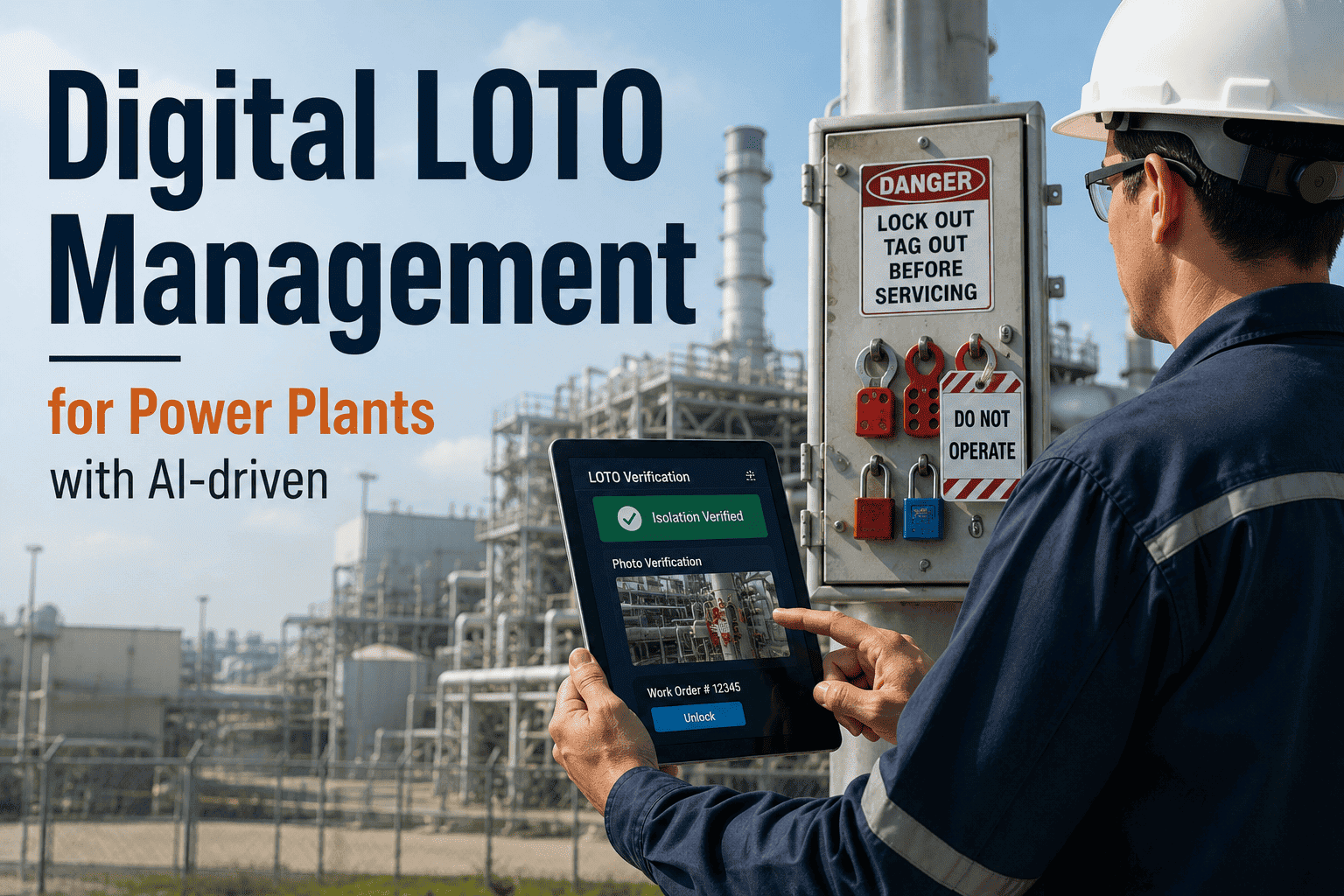
Every year, power plant workers are injured — and some are killed — during maintenance on equipment that wasn't properly isolated. The root cause is almost never technical failure. It procedural failure: paper LOTO binder that was out of date, a step that got skipped under shift pressure, a high-voltage isolation point that wasn't visually confirmed before work began. Digital LOTO management for power plants closes this gap by replacing paper-based lockout-tagout procedures with photo-verified, AI-driven isolation confirmation — making it structurally impossible to unlock a work order without documented physical proof that every energy source is controlled. For U.S. power generation facilities operating under OSHA 29 CFR 1910.147 and NFPA 70E, this isn't a technology upgrade. It's a compliance and liability transformation.
Still relying on paper lockout-tagout binders and manual isolation checks? Book a 30-minute digital LOTO assessment with iFactory's power plant safety and operations team to see how photo-verified isolation and AI-driven lockout management can strengthen safety and compliance.
Why Paper LOTO Binders Are a Liability at Modern Power Plants
Paper-based lockout-tagout systems were designed for a simpler era of industrial maintenance — one where asset counts were lower, shift handovers were less complex, and regulatory scrutiny was less granular. At a modern combined cycle power plant, gas peaker facility, or coal-to-gas transition station, those conditions no longer exist. A single forced outage event can involve dozens of isolation points across rotating equipment, high-voltage switchgear, steam systems, and process piping — all of which need to be documented, physically verified, and cleared in sequence before any technician touches a live system.
Paper binders fail at this scale in predictable ways. Procedures go out of date when equipment is modified and the binder isn't updated. Isolation point photos — if they exist at all — are printed in low resolution and don't reflect current asset configuration. Workers operating under time pressure skip verification steps or sign off on checkboxes without physically confirming isolation. Supervisors approve work orders based on paperwork that doesn't reflect field reality. And when an incident occurs, there's no audit trail that proves which steps were completed, by whom, and when.
What Digital LOTO Management Actually Does — Step by Step
Digital LOTO management is not a digitized version of a paper binder. It is a structured workflow enforcement system that makes skipping isolation steps technically impossible — because the next step in the work order sequence doesn't unlock until the current step produces verified evidence of completion. Here is how a full digital LOTO cycle works at a U.S. power plant:
Digital LOTO vs. Paper LOTO: A Direct Capability Comparison
The operational difference between paper and digital LOTO management is not marginal — it is structural. Paper LOTO relies on human discipline to execute every step correctly under time pressure. Digital LOTO makes correct execution the only path forward. The table below compares both systems across the capabilities that matter most for U.S. power plant compliance and safety performance.
| Capability | Paper-Based LOTO | Digital LOTO with AI Verification |
|---|---|---|
| Procedure Version Control | Manual binder updates required after every equipment modification. Outdated versions remain in circulation until physically replaced. | Live procedure pulled from asset database at work order creation. Every technician receives the current version — automatically, every time. |
| Isolation Point Verification | Checkbox completion. No physical confirmation that the correct point was accessed or that a lock was actually applied. | Photo-verified at every isolation point. AI layer validates correct location, correct device, and visible lock engagement before step advances. |
| Audit Trail Quality | Signed paper form. No timestamp per step, no GPS location data, no photographic evidence. Post-incident reconstruction relies on memory. | Full timestamped, GPS-tagged, photo-documented record per step. Immutable audit log available for OSHA inspection, incident investigation, and insurance review. |
| Group LOTO Management | Multiple lock application tracked on paper log. No system enforcement of sequencing or clearance confirmation across multiple crews. | Individual lock assignments tracked digitally per technician. De-isolation blocked until every assigned worker confirms clearance from work area. |
| Control Room Visibility | LOTO status communicated verbally or via radio. Control room has no real-time view of which assets are under active lockout. | Active LOTO status displayed in control room DCS integration. Attempted operation of a locked-out asset triggers immediate alert to control room and supervisor. |
| OSHA 1910.147 Compliance Documentation | Manual assembly of paper records for OSHA audit. Gaps and missing records common in high-volume maintenance environments. | Compliance documentation generated automatically from completed LOTO records. Full procedure history, verification evidence, and sign-off chain available on demand. |
| CMMS and ERP Integration | Parallel paper process disconnected from CMMS work order system. Maintenance records and LOTO records stored in separate silos. | Native integration with SAP PM, IBM Maximo, Infor EAM, and Oracle EBS. LOTO completion status gates work order progression in the CMMS automatically. |
Still relying on paper lockout-tagout binders and manual isolation checks? Book a 30-minute digital LOTO assessment with iFactory's power plant safety and operations team to see how photo-verified isolation and AI-driven lockout management can strengthen safety and compliance.
Regulatory and Compliance Impact: OSHA 1910.147, NFPA 70E, and Beyond
U.S. power plants operate under a layered regulatory framework for hazardous energy control — and the documentation requirements are explicit. OSHA 29 CFR 1910.147 mandates written procedures for every equipment type, training documentation for every authorized employee, and periodic inspection of each energy control procedure at least annually. NFPA 70E adds arc flash boundary requirements, shock protection documentation, and PPE selection records that must be tied to specific equipment and isolation configurations. Digital LOTO management addresses all of these requirements through a single integrated system — rather than multiple disconnected paper files.
Integration Architecture: How Digital LOTO Connects to Your Existing Plant Systems
The value of a digital LOTO system depends entirely on its depth of integration with the systems power plants already operate. A standalone LOTO application that runs parallel to the CMMS, the asset database, and the DCS creates the same silo problem it was meant to solve. iFactory's digital LOTO management platform is designed for native bidirectional integration — so LOTO status is a live condition inside every system that maintenance, operations, and engineering teams use daily.
Still relying on paper lockout-tagout binders and manual isolation checks? Book a 30-minute digital LOTO assessment with iFactory's power plant safety and operations team to see how photo-verified isolation and AI-driven lockout management can strengthen safety and compliance.
Expert Review: What Reliability Engineers Say About Digital LOTO Deployment
Measured Results: Digital LOTO Performance KPIs From Live Power Plant Deployments
The following KPIs reflect aggregated performance data from U.S. power generation facilities operating iFactory's digital LOTO management platform across rotating equipment, high-voltage electrical systems, and process assets — measured in the 12 months following full deployment.
Still relying on paper lockout-tagout binders and manual isolation checks? Book a 30-minute digital LOTO assessment with iFactory's power plant safety and operations team to see how photo-verified isolation and AI-driven lockout management can strengthen safety and compliance.
Frequently Asked Questions
Conclusion: The Only Acceptable LOTO Failure Rate Is Zero
Lockout-tagout is not a documentation exercise. It is the last line of defense between a maintenance technician and a fatal energy release event. Paper-based LOTO systems accept a failure rate defined by human discipline under time pressure — and at modern U.S. power plants operating with lean maintenance crews, multi-craft job scopes, and continuous grid commitments, that failure rate produces incidents. Digital LOTO management with AI-driven photo verification changes the fundamental constraint: correct execution is not enforced by discipline. It is enforced by the system.
The 73% reduction in near-miss events, the zero OSHA recordable incidents in 12 months post-deployment, and the 18% insurance premium reductions reported at live facilities are outcomes of a system that cannot advance past an isolation step without verified physical evidence that the step was completed correctly. That is the standard every power plant should hold — and it is fully deployable in five weeks without disrupting plant operations or requiring capital replacement of existing maintenance systems.