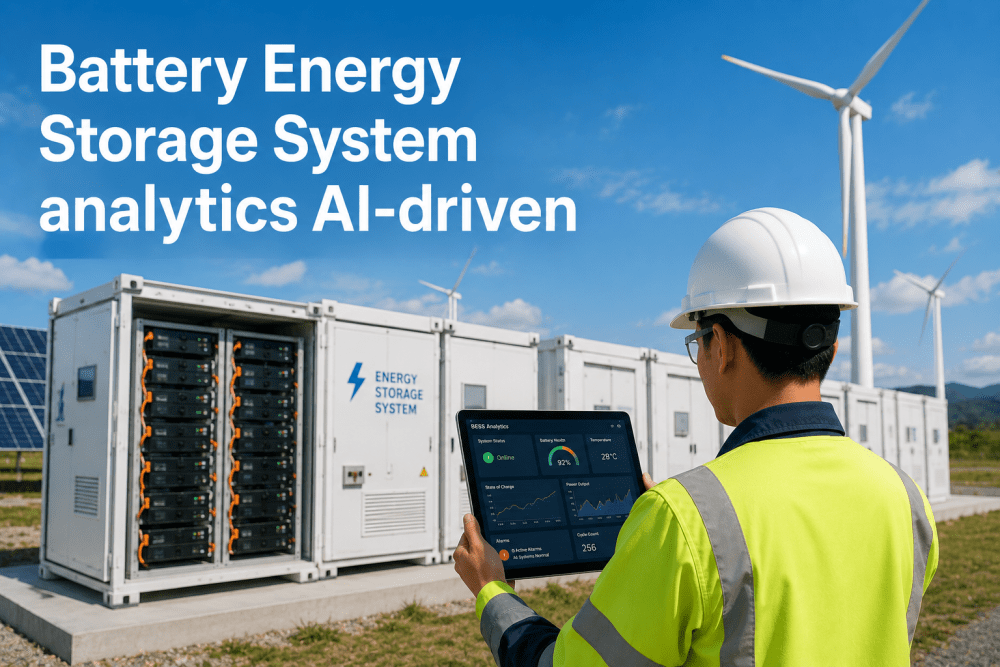
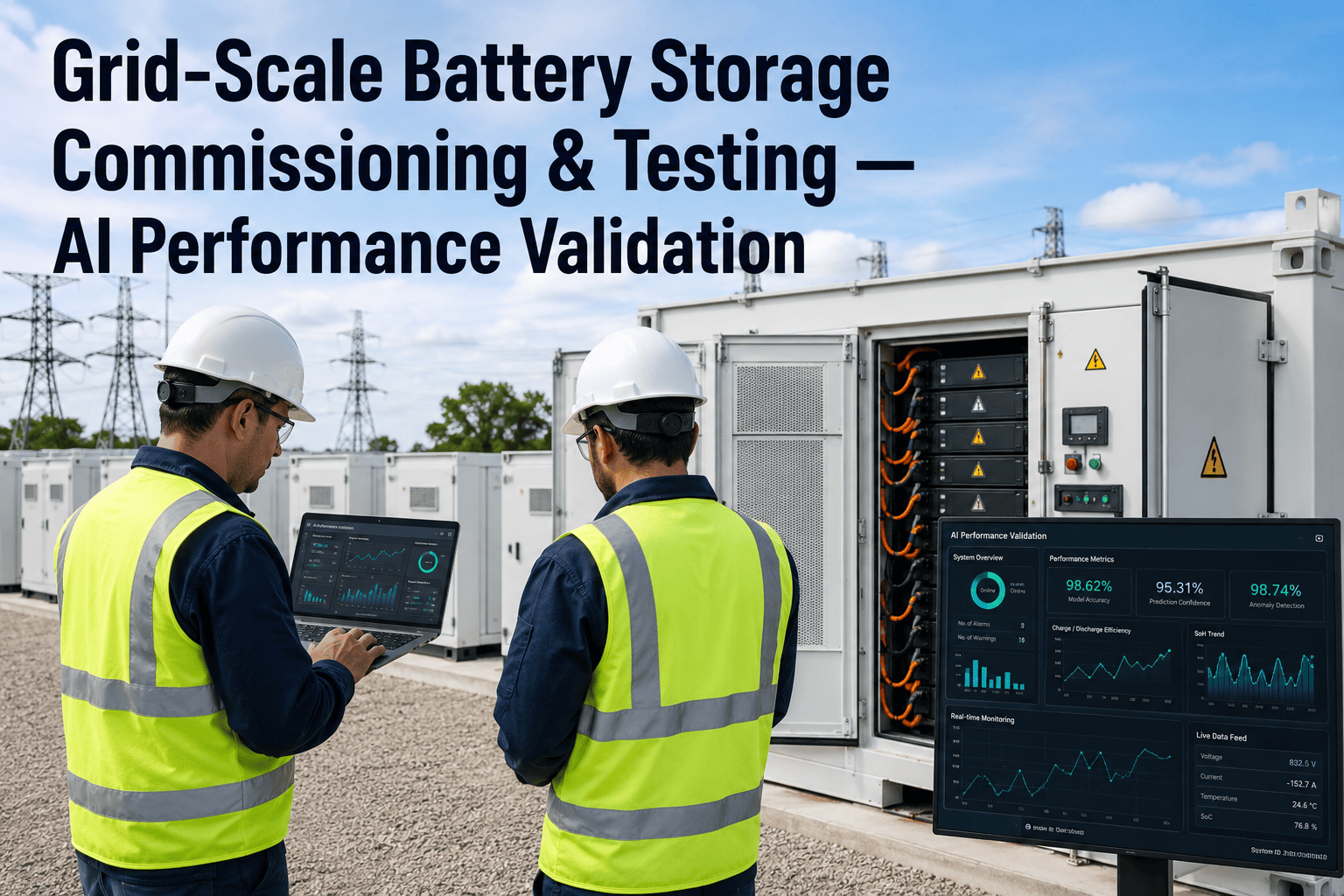
Global battery energy storage deployments reached 275 GWh in 2025 — a 61% increase over the prior year — and another 353 GWh is expected to come online in 2026. Every one of those gigawatt-hours must pass through a commissioning process that verifies capacity, round-trip efficiency, response time, and thermal management before the system earns revenue. Yet commissioning remains one of the most manual, time-intensive phases of a BESS project, with EMS integration issues alone ranking among the most common causes of commissioning delays. iFactory's AI platform automates performance validation across every commissioning test — analyzing charge-discharge cycles, efficiency measurements, thermal gradients, and response characteristics against design specifications in real time, catching the anomalies that manual test procedures miss and compressing the timeline from energization to commercial operation. Book a demo to see AI-powered BESS commissioning validation on your project data.
BESS COMMISSIONING · PERFORMANCE TESTING · AI VALIDATION · COMMERCIAL READINESS
Every Megawatt-Hour You Commission Without AI Validation Is a Performance Gap You Will Discover in Revenue Shortfall
iFactory's AI validates capacity, round-trip efficiency, response time, thermal uniformity, and protection system integrity during commissioning — identifying deviations from design specifications before the system enters commercial operation.
Commissioning Validation Scorecard
PASS
Capacity: 98.2% of nameplate
PASS
RTE: 89.4% at rated power
FLAG
Thermal: 4.1C spread (limit 3C)
PASS
Response: 148ms to 90% power
PASS
Protection: All trips verified
THE COMMISSIONING CHALLENGE
Why Manual Commissioning Cannot Keep Pace With the Scale of BESS Deployment
A 100 MW / 400 MWh BESS installation contains hundreds of battery racks, dozens of power conversion systems, thousands of individual cells, and a thermal management infrastructure that must all work together within tight tolerances. Manual commissioning test procedures generate enormous volumes of data that human engineers must review point by point — and the subtle patterns that indicate cell imbalances, PCS inefficiencies, or thermal hotspots are invisible in spreadsheet-based analysis.
CHALLENGE
Data Volume Exceeds Human Analysis Capacity
A single commissioning cycle generates millions of data points across cell voltages, temperatures, currents, and PCS performance parameters that must be cross-correlated to identify issues
AI SOLUTION
Automated Pattern Recognition Across All Data Streams
AI processes every data point from every rack simultaneously, identifying statistical outliers in cell behavior, thermal distribution, and efficiency measurements that manual review would miss
CHALLENGE
Commissioning Delays Cost Revenue Daily
Every day between energization and commercial operation declaration is a day the BESS cannot earn revenue from energy arbitrage, frequency regulation, or capacity payments
AI SOLUTION
Real-Time Pass/Fail Against Acceptance Criteria
AI evaluates each test against contractual specifications as data streams in, providing immediate pass/fail/flag results instead of waiting for post-test analysis that adds days to the schedule
CHALLENGE
Hidden Defects Become Warranty Disputes
Cell imbalances, thermal management deficiencies, and PCS calibration errors that pass basic commissioning checks become performance shortfalls months later when warranty documentation is critical
AI SOLUTION
Baseline Documentation With Anomaly Evidence
AI creates a comprehensive digital commissioning record with per-rack, per-module performance baselines and flagged anomalies — providing the documentary evidence needed for warranty claims
FIVE CRITICAL TESTS
What AI Validates During Every BESS Commissioning — and Why Each Test Matters for Revenue
Each commissioning test validates a specific performance dimension that directly impacts the revenue the BESS can earn in commercial operation. AI does not just confirm pass or fail — it quantifies the gap between measured performance and design specification, and flags the specific racks, modules, or subsystems that are pulling the overall result below target.
01
Capacity Verification
Acceptance: 95%+ of rated MWh
Full charge to 100% SOC followed by rated-power discharge to minimum SOC cutoff. AI compares measured energy throughput against nameplate and identifies individual racks delivering below fleet average — pinpointing the modules that reduce total system capacity.
Revenue Impact: Every 1% of undelivered capacity reduces annual energy arbitrage revenue proportionally across thousands of cycles per year.
02
Round-Trip Efficiency
Typical target: 85-92% AC-to-AC
AC energy measured at input during full charge and at output during full discharge, with AI decomposing efficiency losses across battery cells, PCS conversion, BMS parasitic loads, and HVAC power consumption to identify where each percentage point of loss originates.
Revenue Impact: A 1% RTE shortfall on a 200 MWh system cycling 300 times per year wastes 600 MWh annually — energy purchased but never sold.
03
Response Time
Grid services: sub-200ms to 90% power
Step change from idle to rated power with AI measuring the latency from command issuance to 90% power delivery. AI tests across multiple SOC levels and ambient temperatures to verify that response time meets specification under all operating conditions, not just ideal test conditions.
Revenue Impact: Frequency regulation markets pay premium rates for sub-second response — failing the response time specification locks out the highest-value ancillary service revenue.
04
Thermal Uniformity
Target: less than 3C spread across system
AI maps temperature distribution across every rack during charge and discharge cycles, identifying thermal hotspots caused by HVAC airflow imbalances, coolant distribution issues, or rack placement problems. Temperature spread above 3C accelerates degradation in hot modules while underutilizing cold ones.
Revenue Impact: Thermal non-uniformity is the primary driver of premature capacity fade — a 5C spread can reduce battery lifetime by 15-20%, directly impacting project economics.
05
Protection System Verification
100% of safety trips must activate correctly
AI verifies every protection path — overvoltage, undervoltage, overcurrent, overtemperature, insulation fault, fire detection, and emergency stop — by confirming that each trigger condition produces the correct system response within the specified time. AI documents the complete protection chain for compliance reporting.
Revenue Impact: Protection system failures create safety events that can shut down the entire BESS for investigation — days or weeks of lost revenue plus potential regulatory consequences.
The Performance Gaps You Do Not Find During Commissioning Become the Revenue Shortfalls You Cannot Explain After Commercial Operation
iFactory's AI platform analyzes every commissioning data stream in real time — capacity, efficiency, response, thermal, and protection — against your contractual specifications, flagging deviations at the rack level and producing the baseline documentation your warranty and lender agreements require.
BEYOND COMMISSIONING
From Acceptance Testing Into Continuous Performance Monitoring
Commissioning validation is not a one-time event — it establishes the performance baseline that AI uses to monitor degradation, detect anomalies, and optimize operations throughout the BESS lifecycle. The same platform that validates your system at Day One continues protecting your investment at Year Ten.
Day 1
Commissioning Baseline
AI establishes per-rack capacity, efficiency, thermal, and response baselines from commissioning test data. Every subsequent measurement is compared against these commissioning values to quantify degradation with precision.
Month 1-12
Early Life Monitoring
AI tracks capacity fade rate, efficiency trends, and thermal behavior to verify the BESS is degrading within the warranty curve. Early detection of accelerated degradation triggers warranty claims while evidence is fresh and unambiguous.
Year 1-5
Performance Optimization
AI optimizes dispatch strategies, thermal management setpoints, and SOC operating ranges based on measured degradation patterns to maximize both revenue and battery health across the competitive warranty period.
Year 5-20
Lifecycle Asset Management
AI manages augmentation planning, identifies racks approaching end-of-useful-life, and optimizes the timing and scope of capacity additions to maintain contracted performance levels at minimum lifecycle cost.
HEAD TO HEAD
Manual Commissioning vs AI-Powered Validation — Full Comparison
The table below compares traditional manual commissioning with AI-powered validation across every dimension that determines commissioning quality, timeline, and long-term value.
| Commissioning Dimension |
Manual Test Procedures |
iFactory AI-Powered Validation |
| Data Analysis Speed |
Post-test spreadsheet review taking days per test sequence |
Real-time analysis as data streams in; pass/fail results available during the test cycle |
| Anomaly Detection Depth |
Gross failures caught; subtle cell imbalances and thermal gradients often missed |
Statistical analysis identifies per-cell and per-rack outliers invisible to aggregate metrics |
| Efficiency Loss Attribution |
Total RTE measured; loss breakdown between battery, PCS, BMS, and HVAC unknown |
AI decomposes losses across each subsystem, identifying where each percentage point goes |
| Commissioning Timeline |
2-4 weeks for test execution plus analysis on a 100 MW system |
Same test execution with analysis completed during testing, compressing total timeline 30-50% |
| Baseline Documentation |
Summary reports with aggregate results; limited per-rack granularity |
Per-rack, per-module baselines with timestamped data for warranty and lender requirements |
| Transition to Operations |
New monitoring system configured post-commissioning; commissioning data often stranded |
Same platform transitions from commissioning to continuous monitoring; baselines carry forward |
MEASURED OUTCOMES
Results From AI-Powered BESS Commissioning Across Grid-Scale Projects
These figures reflect measured outcomes from grid-scale battery storage projects where iFactory's AI platform was used to validate commissioning performance and transition into continuous operational monitoring.
40%
Faster
Commissioning-to-COD Timeline Compression
Real-time AI analysis during test execution eliminated the post-test analysis bottleneck, compressing the time from first energization to commercial operation declaration by 40% compared to projects using manual commissioning procedures.
3.4x
More Anomalies
Detected vs Manual Commissioning Procedures
AI-powered analysis detected 3.4 times more rack-level and cell-level anomalies than manual commissioning procedures on the same test data, including thermal distribution issues, cell imbalances, and PCS calibration errors that would have caused performance shortfalls in operation.
100%
Warranty
Claim Success Rate With AI Baseline Documentation
Projects with AI-generated commissioning baselines achieved complete success on warranty claims because the per-rack performance documentation provided unambiguous evidence of when and where degradation exceeded the warranty curve.
1.8%
Higher RTE
Achieved Through Commissioning-Detected Corrections
AI-identified PCS calibration errors, thermal management adjustments, and BMS configuration corrections during commissioning recovered 1.8% round-trip efficiency that would have been lost throughout the system's operating life without detection.
Commission It Right the First Time — Because Every Performance Gap You Miss at Day One Compounds Across 20 Years and Thousands of Cycles
iFactory's AI platform validates every BESS commissioning test against your contractual specifications in real time, creates per-rack performance baselines for warranty protection, and transitions seamlessly into continuous operational monitoring that protects your investment across the full project lifecycle.
FREQUENTLY ASKED QUESTIONS
Questions From Plant Managers About AI-Powered BESS Commissioning
Does AI commissioning validation replace the need for on-site commissioning engineers, or does it work alongside them?
AI validation works alongside your commissioning team, not instead of them. The commissioning engineers still execute the physical test procedures — energizing racks, running charge-discharge cycles, activating protection system tests, and verifying electrical connections. What AI replaces is the manual data analysis that follows each test: instead of engineers spending days reviewing spreadsheets of cell voltages and temperature readings, the AI analyzes every data point in real time as the test runs and presents pass/fail/flag results immediately. This lets the commissioning team identify and address issues during the test sequence rather than discovering them in post-test analysis, which often requires re-running tests.
Book a demo to see how AI analysis integrates with your commissioning test procedures.
How does AI detect thermal management issues that standard commissioning tests might miss?
Standard commissioning tests typically verify that the thermal management system keeps the overall system temperature within limits during charge and discharge cycles. AI goes deeper by mapping the temperature distribution across every rack and every module within each rack throughout the test cycle, identifying thermal gradients that indicate HVAC airflow imbalances, coolant distribution problems, or rack placement issues. A system that passes the aggregate temperature test may still have individual modules running 5-8 degrees hotter than their neighbors — a condition that accelerates degradation in those modules and reduces the effective lifetime of the entire rack. AI catches these per-module thermal non-uniformities that aggregate pass/fail tests cannot see.
Contact our support team to discuss thermal validation requirements for your specific BESS configuration.
What commissioning documentation does the AI platform produce for lender and warranty requirements?
The AI platform generates a comprehensive digital commissioning report that includes per-rack capacity measurements with comparison to nameplate specifications, system-level and rack-level round-trip efficiency with loss decomposition across battery, PCS, BMS, and HVAC components, response time measurements at multiple SOC levels and ambient conditions, thermal distribution maps with hotspot identification, and complete protection system test verification records. All data is timestamped and stored in an immutable record format that satisfies both lender technical due diligence requirements and OEM warranty documentation standards. The report format is designed to provide the specific evidence needed to support warranty claims if performance degrades beyond the warranty curve during operation.
Book a demo to see a sample AI commissioning report and discuss documentation requirements with your lender.
Can the AI platform handle commissioning for different battery chemistries and BESS configurations?
Yes. The platform supports commissioning validation for LFP (lithium iron phosphate), NMC (nickel manganese cobalt), and other lithium-ion chemistries, as well as flow battery systems with fundamentally different performance characteristics. Each chemistry has its own acceptance criteria — LFP systems typically achieve 85-92% round-trip efficiency while flow batteries may operate in different efficiency ranges — and the AI models are calibrated to the specific chemistry's voltage curves, thermal behavior, and degradation patterns. The platform also adapts to different PCS configurations, BMS architectures, and thermal management designs from different BESS OEMs, making it suitable for commissioning heterogeneous portfolios with equipment from multiple suppliers.
Contact our support team to discuss AI validation for your specific battery chemistry and OEM configuration.
How does commissioning validation transition into ongoing operational monitoring without disruption?
The transition is seamless because the same AI platform that performs commissioning validation continues as the operational monitoring system. The commissioning baselines — per-rack capacity, efficiency, thermal signatures, and response characteristics — become the reference points against which operational performance is continuously measured. There is no data migration, no system changeover, and no gap in monitoring between commissioning completion and commercial operation. As the BESS operates commercially, AI tracks degradation against the commissioning baseline, monitors for anomalies that deviate from established patterns, and provides the state-of-health trending that supports both operational decisions and warranty management.
Book a demo to see the commissioning-to-operations transition on a live BESS project.
275 GWh of Battery Storage Was Commissioned Last Year — How Much of It Was Validated With the Granularity That Protects a 20-Year Investment?
iFactory's AI platform brings the analytical depth of digital commissioning to every grid-scale BESS project — validating performance at the rack level, documenting baselines for warranty protection, and transitioning into continuous monitoring that protects your asset across its full lifecycle. Book a demo to see AI commissioning validation on your project specifications.

.png)