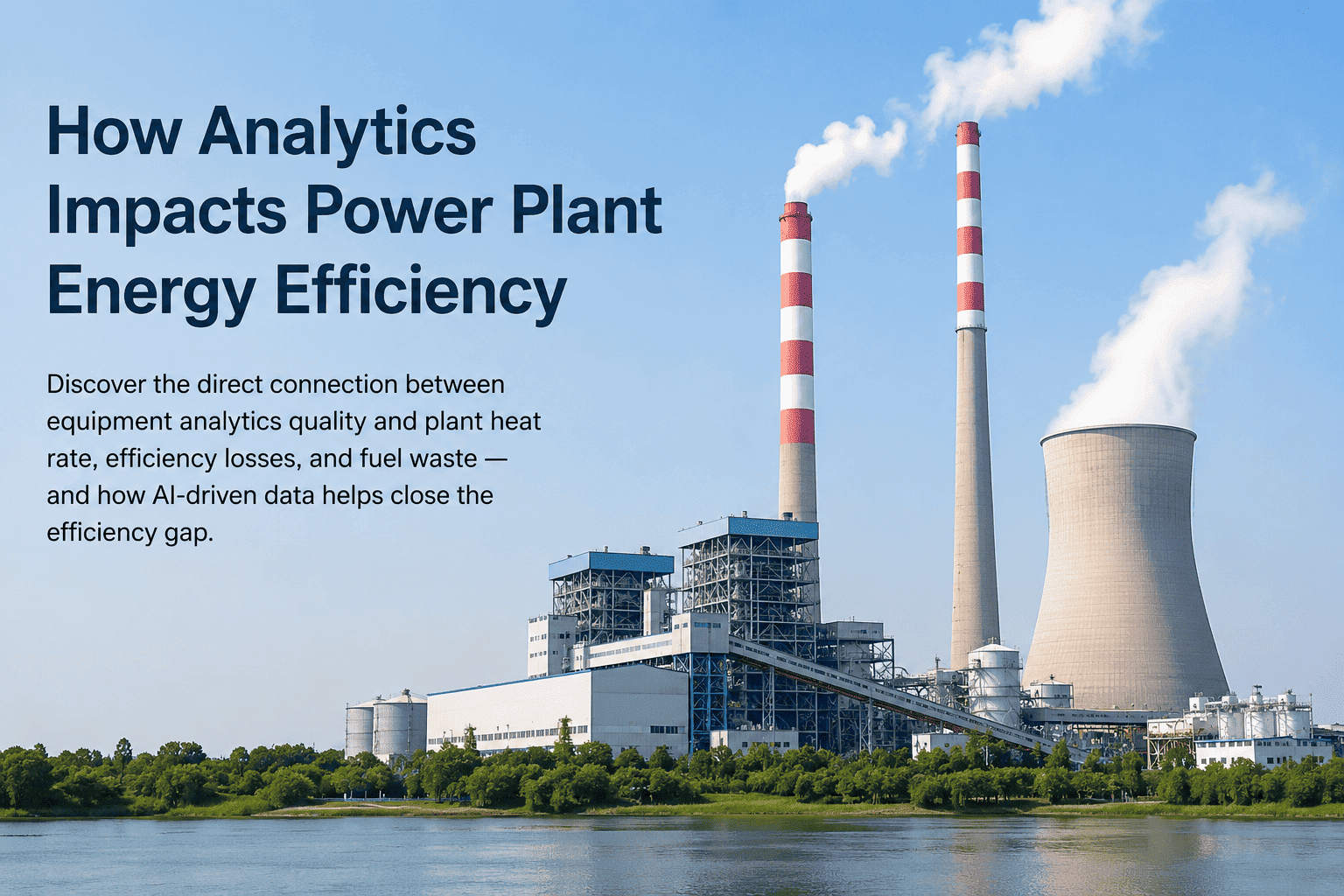
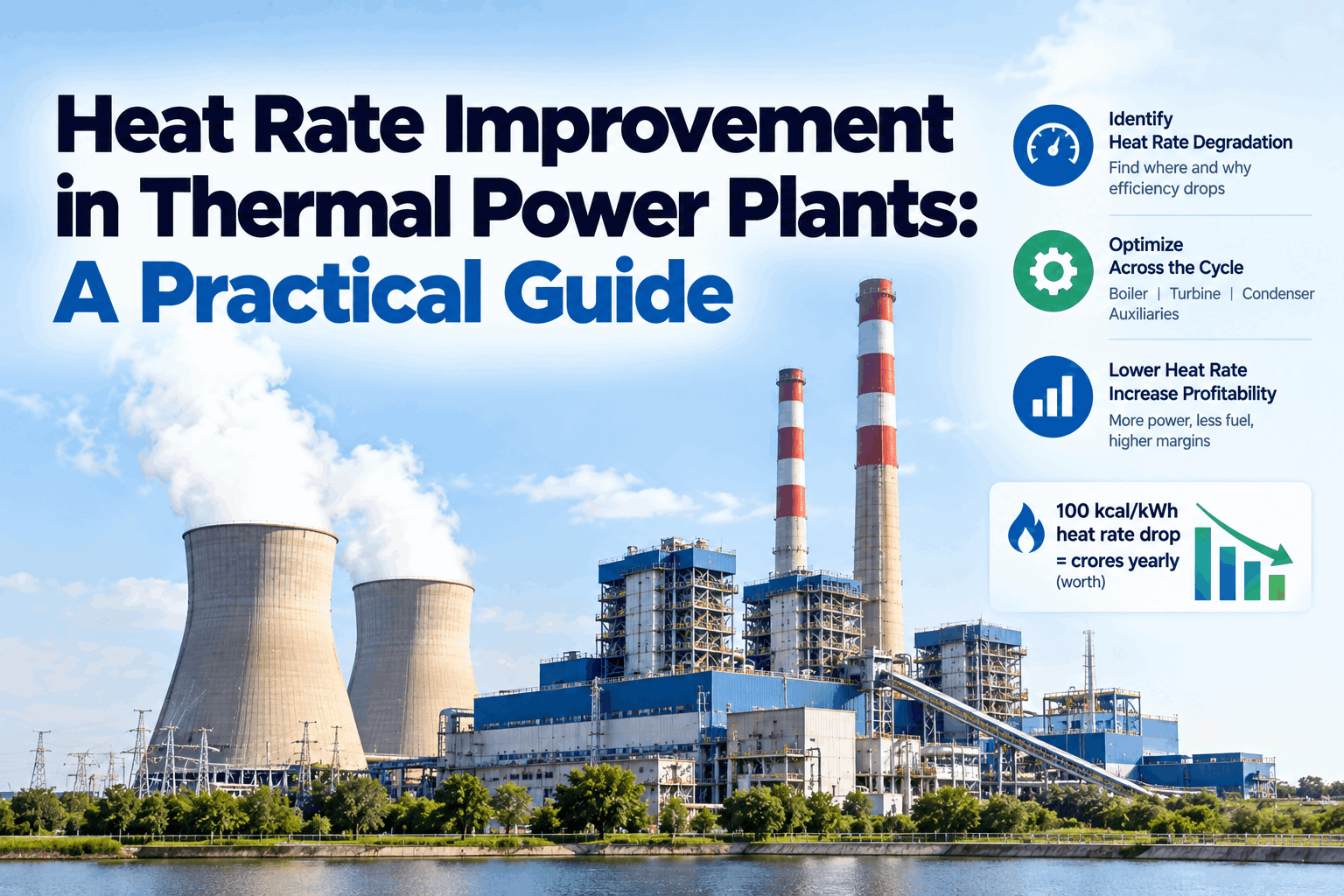
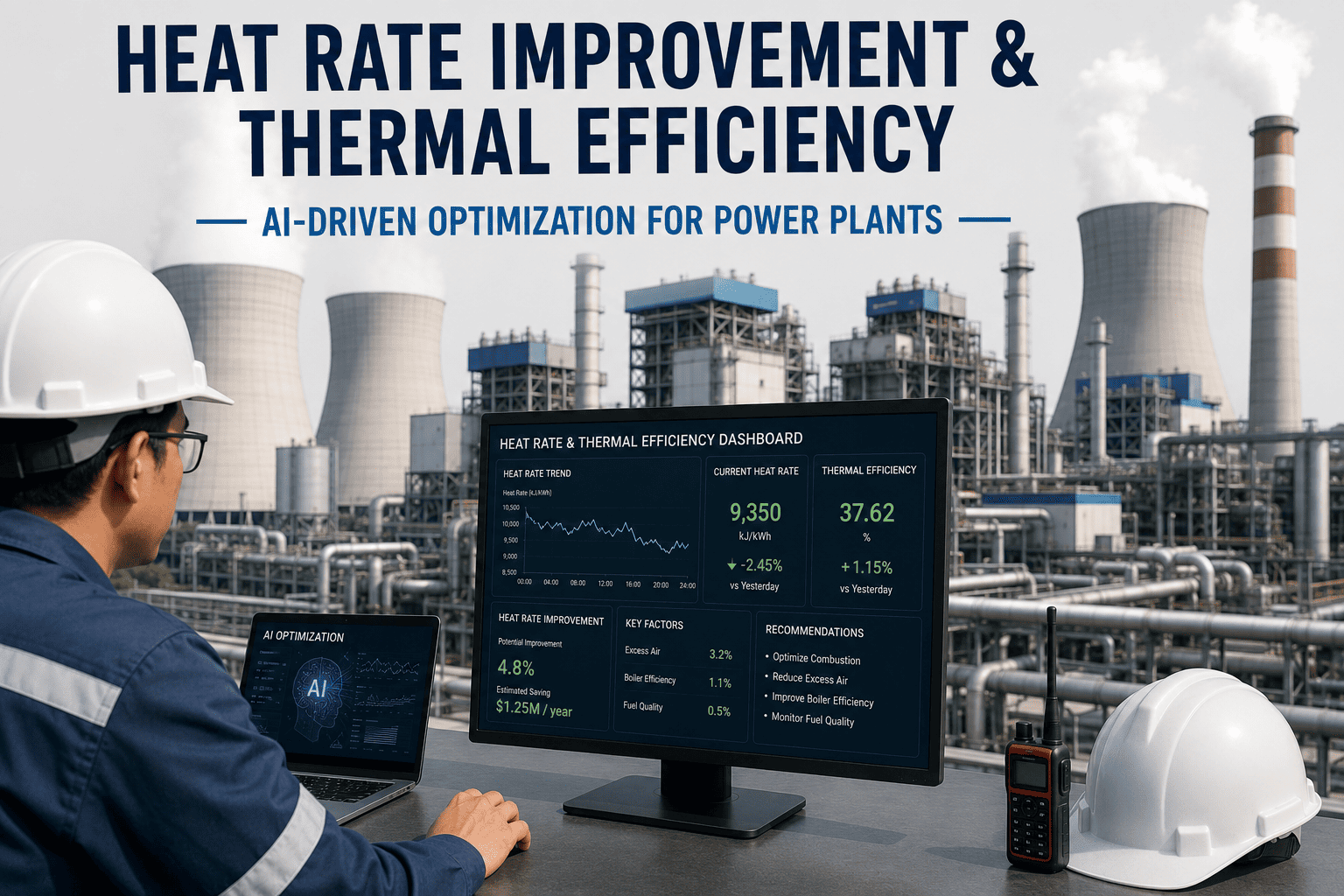
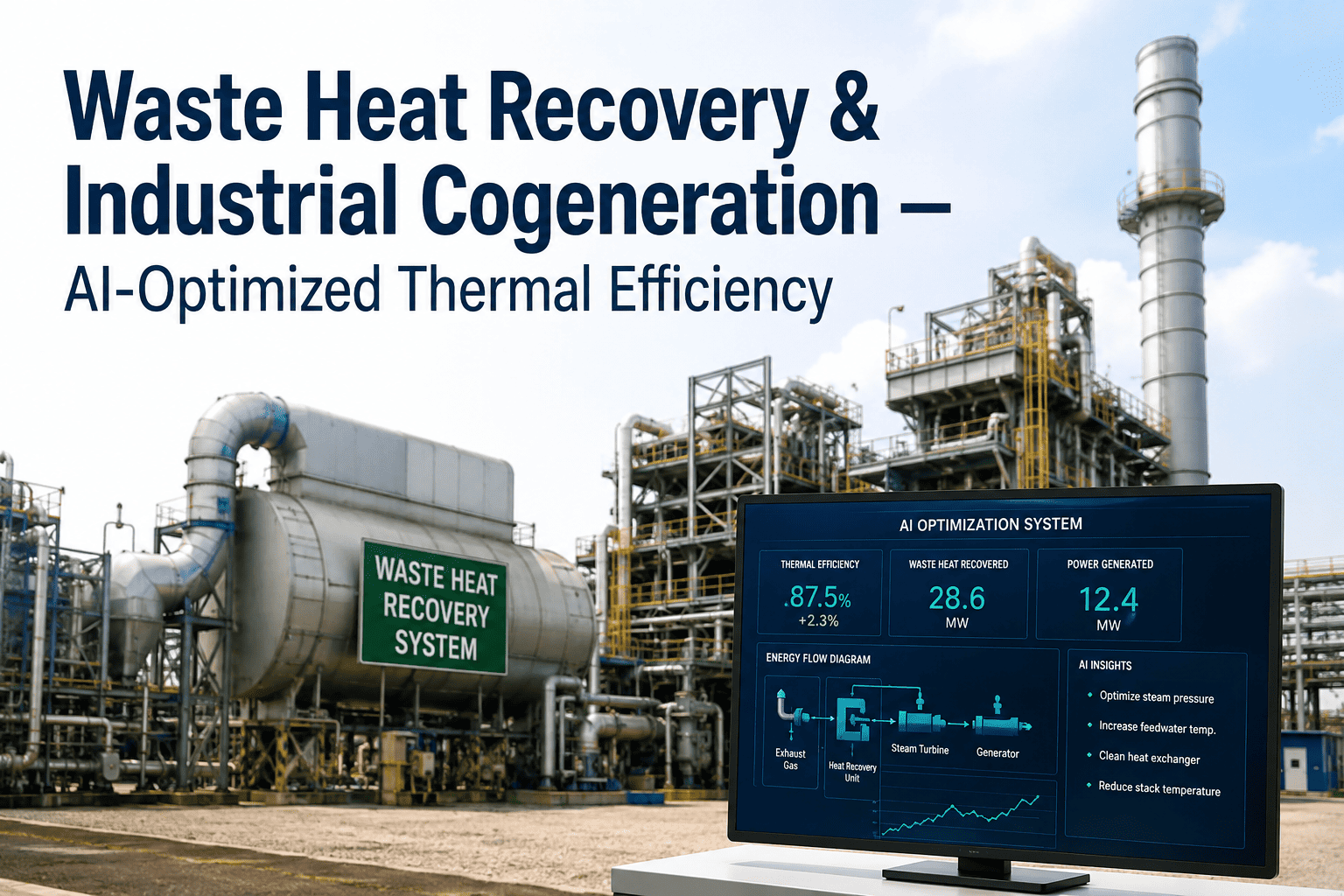
Every percentage point of heat rate degradation in a thermal power plant costs real money — in fuel, in lost generation capacity, and in competitive margin. Yet most plants today are making efficiency decisions based on weekly reports, manual equipment readings, and reactive alarm responses that were never designed to catch the subtle, compounding losses that define the difference between a high-performing plant and an average one AI driven analytics is the missing link between equipment data and energy efficiency action — the plants closing the efficiency gap fastest are doing it not by installing new turbines, but by finally understanding the ones they already have. Book a Free Analytics Demo to see how iFactory surfaces efficiency losses your current tools are missing.
Power Plant Efficiency Analytics 2026
How Analytics Impacts Power Plant Energy Efficiency
Heat Rate Optimisation · Fuel Waste Reduction · Equipment Performance · AI-Driven Efficiency Intelligence
18%
Average Heat Rate Improvement with AI Analytics
$1.8M
Avg Annual Fuel Waste Reduction per Plant
6×
Faster Efficiency Loss Detection vs Manual Reporting
96%
AI Analytics Accuracy on Thermal Performance Trends
The Analytics-Efficiency Link Most Plants Are Missing
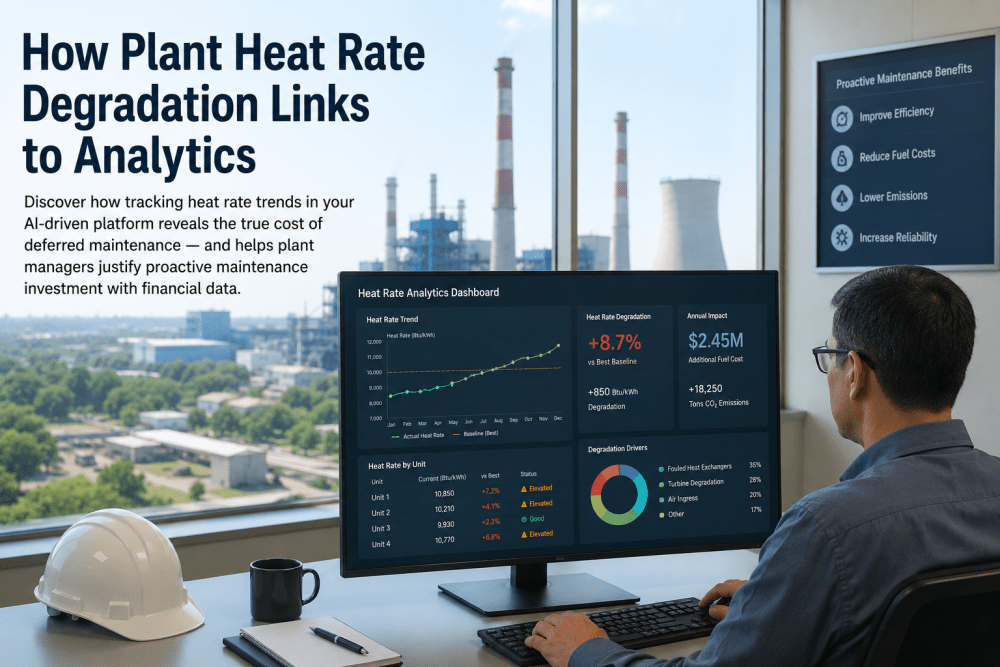
Heat rate is the single most important efficiency metric in thermal power generation — and it is one of the most poorly monitored. A plant running 100 BTU/kWh above its design heat rate is, depending on fuel cost, burning an additional $400,000 to $900,000 per year in unnecessary fuel spend. That gap almost never appears in a single alarm or event. It accumulates invisibly across dozens of contributing factors — fouled heat transfer surfaces, sub-optimal combustion air ratios, turbine blade degradation, condenser back-pressure creep, and auxiliary power consumption drift — none of which generate a SCADA alarm until they've already compounded into a significant efficiency loss.
This is the core problem that AI-driven analytics is designed to solve. Not by replacing existing monitoring systems, but by connecting the data those systems already produce and transforming it from a stream of individual readings into a continuous, cross-correlated efficiency intelligence layer that identifies where energy is being lost, why, and at what cost — before those losses become structural.
Efficiency Factor
Manual / Static Analytics
AI-Driven Analytics
Heat Rate Monitoring
Weekly manual calculations
Continuous real-time tracking with root-cause attribution
Turbine Degradation Detection
Outage inspection only
AI trend detection 3–8 weeks before performance threshold
Combustion Optimisation
Operator experience, periodic tuning
Real-time air-fuel ratio AI optimisation per load point
Condenser Performance
Monthly back-pressure checks
Continuous fouling factor monitoring with cleaning ROI alerts
Auxiliary Power Losses
Not tracked systematically
Automated auxiliary consumption benchmarking vs. load
Efficiency Loss Quantification
Post-outage analysis, months delayed
Real-time $ and BTU/kWh loss by contributing factor
Cross-System Loss Correlation
Manual investigation, siloed data
Automated multi-system interaction analysis
Want to understand which efficiency pathways are costing your plant the most right now?
Schedule a 30-minute Heat Rate Assessment with iFactory's power plant analytics team.
The Six Pathways Through Which Analytics Drives Efficiency Improvement
Energy efficiency losses in thermal power plants do not come from a single source. They accumulate across six distinct operational pathways — each of which requires a different analytics capability to surface and address. The plants achieving the greatest efficiency gains are addressing all six simultaneously through a unified AI analytics platform.
01
Heat Rate Decomposition Analytics
Gross heat rate is a composite metric — it tells you that efficiency has declined but not why. AI-driven heat rate decomposition separates the contribution of each system — steam path, condenser, boiler, feed water heating train, auxiliary loads — and quantifies each component's contribution to the overall heat rate deviation in real time. This transforms heat rate from a lagging indicator into an actionable diagnostic tool, allowing operators to address the highest-impact contributor first rather than treating all inefficiency as equivalent.
Typical impact: 8–14 BTU/kWh heat rate improvement within 90 days of deployment
02
Turbine Isentropic Efficiency Monitoring
Steam turbine internal efficiency degrades gradually through blade erosion, seal wear, and deposit accumulation. A high-pressure turbine running at 88% isentropic efficiency instead of its design 91% represents a fuel penalty of roughly $180,000–$360,000 per year depending on plant size. AI analytics continuously calculates actual isentropic efficiency from live pressure, temperature, and flow data, tracking the degradation curve and projecting the optimal wash or overhaul timing that minimises total cost — not just maintenance cost, but fuel penalty plus maintenance cost combined.
Typical impact: $180K–$360K annual fuel penalty identified and recoverable per HP turbine stage
03
Condenser Back-Pressure Optimisation
Condenser fouling is one of the most consistently under-monitored efficiency losses in thermal power plants. A 1 inHg increase in condenser back-pressure degrades heat rate by approximately 60–100 BTU/kWh — a fuel cost penalty of $120,000–$250,000 per year at typical plant sizes. Fouling accumulates gradually through circulating water contamination, biofilm growth, and tube scaling that is invisible to standard alarm systems until back-pressure reaches a critical threshold. AI analytics tracks the fouling factor continuously, calculating the exact point at which cleaning ROI exceeds cleaning cost — enabling decisions based on actual economics rather than calendar schedules.
Typical impact: 60–100 BTU/kWh heat rate recovery per cleaning cycle, optimally timed
04
Combustion System Efficiency Analytics
Combustion efficiency losses arise from excess air, unburned carbon, and sub-optimal burner configuration that drift from design conditions across operating load cycles. AI analytics continuously monitors excess O₂, CO, flue gas temperature, and unburned carbon in ash to identify combustion inefficiency at specific load points and burner combinations. Real-time recommendations adjust air-fuel ratios and burner patterns to recover efficiency losses that accumulate daily but are rarely caught by periodic combustion testing programmes.
Typical impact: 0.3–0.8% boiler efficiency improvement translating to $95K–$280K annual fuel savings
05
Feed Water System & Cycle Isolation Analysis
Feed water heater performance degradation, valve leakage, and cycle isolation failures are among the most financially significant — and most frequently undetected — efficiency losses in steam plants. A single failed high-pressure feed water heater reduces heat rate by 30–60 BTU/kWh. Valve leakage that bypasses heat recovery pathways is invisible on standard dashboards but detectable through temperature and flow balance analytics. AI models continuously run thermodynamic cycle calculations to identify deviations that indicate isolation failures, fouled heat exchangers, or control valve malfunctions.
Typical impact: 30–60 BTU/kWh heat rate penalty per failed feed water heater, often undetected for months
06
Auxiliary Power Consumption Benchmarking
Station service power — the electricity consumed by pumps, fans, compressors, and plant systems — typically represents 4–8% of gross generation at thermal plants. Degraded pump efficiency, air leaks into the gas path, and oversized fan operation under partial load all inflate auxiliary consumption without triggering alarms. AI analytics continuously benchmarks auxiliary power against load-adjusted expectations, surfacing abnormal consumption patterns that indicate equipment degradation or operational inefficiency worth addressing before they compound into structural fuel cost overruns.
Typical impact: 0.5–1.5% net output improvement through auxiliary power optimisation
Want to understand which efficiency pathways are costing your plant the most right now?
Schedule a 30-minute Heat Rate Assessment with iFactory's power plant analytics team.
Financial Impact: Quantifying the Analytics-Efficiency Connection
The financial case for analytics-driven efficiency improvement is grounded in three measurable categories that most plant finance teams can directly validate against existing operational data within the first quarter of deployment.
82%
of thermal power plants operating with measurable heat rate deviation from design — averaging 3–7% above nameplate efficiency
71%
of heat rate losses at plants without AI analytics go undetected for more than 60 days after onset, compounding fuel waste
$1.8M
average annual fuel waste reduction per 500MW plant after deploying AI-driven heat rate decomposition analytics
88%
of plants that deploy AI efficiency analytics recover full platform cost within 8 months through fuel savings alone
$620K
average annual savings from condenser and feed water system optimisation alone — the most consistently undervalued efficiency opportunity
Important Context: Fuel cost savings from heat rate improvement scale directly with plant size and fuel price. At $4.00/MMBtu natural gas, every 100 BTU/kWh of heat rate improvement at a 500MW plant saves approximately $700,000 per year. At coal plants, the same improvement typically saves $400,000–$600,000 annually depending on coal grade. These calculations should be run against your specific plant parameters to size the opportunity accurately before committing to any analytics investment.
Calculate Your Plant's Specific Efficiency Loss — Free Heat Rate Assessment
iFactory's analytics team runs a no-cost heat rate decomposition assessment using your plant's operational data to identify exactly which efficiency pathways are generating the highest fuel cost penalties — with dollar figures specific to your plant size, fuel type, and dispatch profile.
The Analytics Implementation Pathway for Efficiency Improvement
Deploying AI analytics for energy efficiency improvement follows a structured sequence that prioritises high-value losses first and builds analytical depth progressively. Plants that follow this sequence consistently achieve measurable fuel savings within the first 30 days and full efficiency programme maturity within a single quarter.
01
Baseline Heat Rate Audit & Loss Attribution
Establish current heat rate performance against design curves. Map all existing sensor coverage across steam path, combustion, condenser, and auxiliary systems. Identify data gaps that would prevent accurate thermodynamic calculations. Quantify estimated annual fuel cost of identified efficiency deviations to prioritise deployment focus.
Typical Duration: 1–2 weeks
02
Real-Time Efficiency Data Pipeline Integration
Connect DCS, historian, and auxiliary system data into the AI analytics environment. Align timestamps across disparate systems. Implement thermodynamic model layer that continuously calculates efficiency metrics from raw sensor data — including heat rate by component, isentropic efficiencies, and cycle thermal performance — without requiring manual calculation inputs.
Typical Duration: 2–3 weeks
03
Efficiency Model Calibration & Baseline Validation
Train AI models on 12–18 months of historical operating data across all load regimes. Validate calculated efficiency metrics against known outage findings and test results. Establish load-adjusted normal operating envelopes for all six efficiency pathways. Calibrate alert thresholds to surface genuine losses while eliminating operational noise that would reduce operator trust in the system.
Typical Duration: 3–4 weeks
04
Efficiency Dashboard & Operator Alert Deployment
Deploy role-specific efficiency dashboards for operators, shift supervisors, and plant managers. Configure real-time efficiency loss alerts with dollar-quantified impact and recommended corrective actions. Integrate efficiency insights with CMMS work order generation for maintenance-driven efficiency opportunities. Establish daily heat rate performance review as a standard operational routine.
Typical Duration: 1–2 weeks
05
Continuous Efficiency Optimisation & Outage Planning Integration
Implement feedback loops connecting efficiency model outputs to outage scope planning — ensuring that degradation identified during operation is addressed in the next planned outage window. Schedule quarterly efficiency performance reviews that quantify fuel savings achieved, identify new loss opportunities, and refine AI model accuracy against confirmed findings. Track cumulative heat rate improvement and fuel cost savings against pre-deployment baseline for ongoing ROI reporting.
Ongoing: Quarterly review cycles
Want to understand which efficiency pathways are costing your plant the most right now?
Schedule a 30-minute Heat Rate Assessment with iFactory's power plant analytics team.
Expert Perspective: Why Most Efficiency Programmes Underdeliver
The most consistent finding across independent efficiency research is that the gap between design heat rate and actual operating heat rate at U.S. thermal plants has been widening, not narrowing, despite significant capital investment in efficiency programmes over the past decade. The primary reason is not a lack of investment — it's a measurement problem. Plants are investing in efficiency improvements they cannot accurately measure or attribute.
Research consistently shows that efficiency programmes with real-time analytics outperform those relying on periodic performance testing by a factor of three to five in terms of sustained heat rate improvement. The reason is straightforward: efficiency losses that go undetected for 60+ days become normalised — operators adjust operating procedures around degraded equipment without recognising the fuel cost penalty, and the loss becomes embedded in baseline performance assumptions.
The second critical finding is that the majority of recoverable efficiency losses sit not in major capital components but in the accumulation of sub-threshold degradation across auxiliary systems, cycle isolation, and combustion management that individually fall below the threshold of concern but collectively represent the largest fuel cost opportunity at most plants.
Bottom Line:
Analytics quality is the binding constraint on efficiency programme performance. Plants with real-time AI analytics consistently achieve and sustain 15–25% greater heat rate improvement than those using periodic testing and manual reporting — because they find losses faster, quantify them accurately, and act before they compound.
Frequently Asked Questions
This is one of the most technically important questions in plant efficiency analytics. Direct fuel flow measurement uncertainty at many plants is 1–3%, which is large enough to obscure real heat rate improvements of similar magnitude. AI analytics addresses this through indirect calculation methods — using thermodynamic first principles to compute heat input from temperature, pressure, and enthalpy measurements across the steam cycle, which are typically far more accurate than fuel flow instrumentation. This approach, known as the heat loss or indirect method, produces heat rate calculations with accuracy of 0.3–0.5% — sufficient to detect and confirm genuine improvements of less than 1%. iFactory's platform uses both direct and indirect methods simultaneously and applies cross-validation algorithms to flag measurement anomalies that would corrupt efficiency trend analysis.
Operational optimisation through analytics — adjusting combustion settings, optimising condenser cleaning timing, correcting valve management, and improving auxiliary load dispatch — typically delivers 30–60% of total recoverable heat rate improvement without requiring any capital maintenance expenditure. At a 500MW plant with a 3% heat rate deviation from design, this translates to an analytically recoverable operational improvement of approximately 50–100 BTU/kWh worth $350,000–$700,000 per year. The remaining improvement requires planned maintenance actions — turbine washes, condenser retubing, valve replacements — that analytics identifies and optimally sequences for execution during scheduled outages. Analytics without maintenance delivers meaningful, immediate savings; analytics with maintenance delivers the full programme value.
Yes — and this is an increasingly important use case as state-level carbon pricing mechanisms and EPA performance standards create direct financial consequences for heat rate performance. AI analytics platforms generate continuous heat rate and emissions intensity records with full calculation audit trails — documenting the data sources, calculation methods, and validation checks behind every reported figure. This level of documentation is increasingly required for compliance submissions under carbon trading programmes, PPA efficiency guarantee clauses, and ISO 50001 energy management system certifications. Automated compliance report generation eliminates the manual effort of compiling these records and reduces the risk of calculation errors that can create material misstatements in regulatory filings.
This is a critical capability requirement for modern plants operating in cycling or load-following modes, where heat rate is inherently higher at part load and efficiency losses can be mistaken for normal operating variation. AI analytics solves this through load-conditioned performance models — separate efficiency expectations are established for each distinct operating regime (minimum load, 50%, 75%, 100%, and transitional ramping), and anomaly detection compares actual performance against the load-appropriate baseline, not a single design-point standard. This eliminates the false alarm problem that undermines operator confidence in static threshold monitoring during cycling operation, and enables genuine efficiency loss detection at all operating points regardless of dispatch profile.
The minimum viable data set for meaningful heat rate analytics includes: steam turbine inlet and exhaust conditions (pressure, temperature, flow), condenser pressure and circulating water temperatures, boiler exit gas temperatures and O₂, major feed water heater inlet and outlet conditions, and gross and net generation metering. Most plants with standard DCS instrumentation already have 80–90% of this data available in their historian — the deployment process identifies gaps and either installs targeted additional sensors or implements calculation-based estimates for missing parameters. First actionable efficiency insights are typically available within 2–4 weeks of integration, with full analytics capability operational within 6 weeks. Measurable fuel savings validated against pre-deployment baseline are documented within the first 60 days in most deployments.
Want to understand which efficiency pathways are costing your plant the most right now?
Schedule a 30-minute Heat Rate Assessment with iFactory's power plant analytics team.
Conclusion
The connection between analytics quality and energy efficiency is direct, measurable, and financially significant. Plants that upgrade from periodic manual reporting to continuous AI-driven efficiency analytics do not just see better dashboards — they find losses they did not know existed, quantify them in dollars before acting, and sustain efficiency improvements that erode without continuous monitoring. In an operating environment where fuel cost and carbon intensity are under increasing financial and regulatory scrutiny, analytics is no longer a performance management tool — it is a fuel cost management strategy. The plants that recognise this distinction and act on it in 2026 will hold a structural cost advantage that compounds across the remaining life of their assets.
Start Closing Your Plant's Efficiency Gap — With AI Analytics Deployed in 4 Weeks
iFactory's AI-driven analytics platform gives power plant teams continuous heat rate decomposition, real-time efficiency loss quantification, and automated fuel waste reduction intelligence — fully operational within a single month and delivering measurable fuel savings before the next quarterly report.