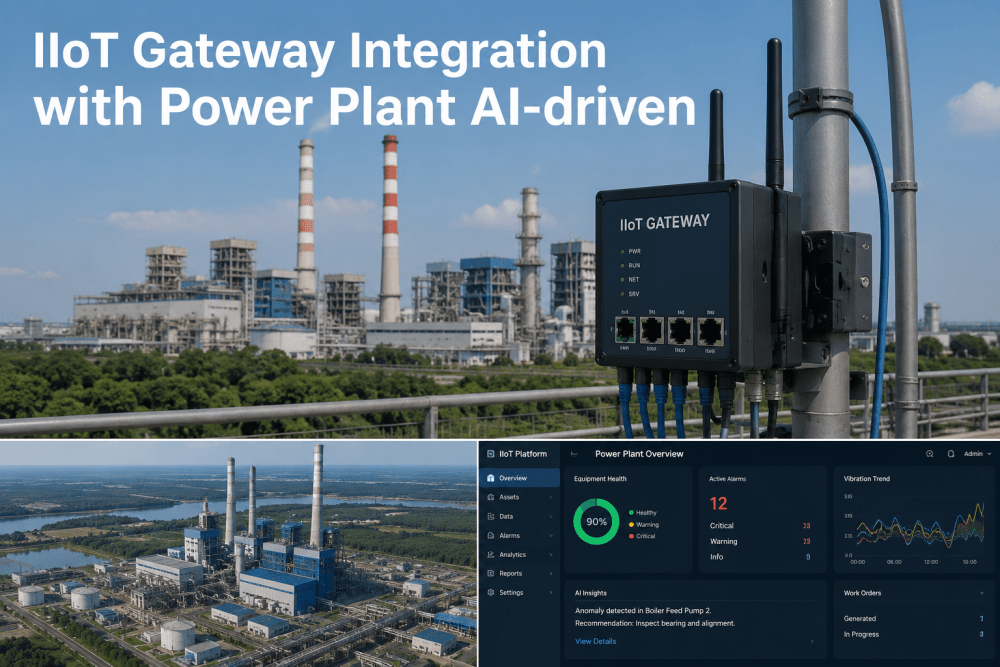
Power plant SCADA systems generate terabytes of operational data every day — turbine speeds, generator loads, boiler temperatures, emission readings, breaker statuses, and protective relay events — but the majority of this data never reaches the AI analytics layer that could transform it into predictive insights. IoT integration platform provides the gateway architecture, protocol translation, edge processing, and data governance framework that connects power plant SCADA systems to AI-driven analytics, digital twin modeling, and predictive maintenance workflows in a single unified data infrastructure.
Is Your Power Plant SCADA Data Trapped Behind Protocol Silos?
iFactory's industrial IoT gateway platform connects legacy Modbus RTU, modern OPC-UA, and MQTT-based edge devices into a unified data pipeline for AI-driven analytics, digital twin modeling, and predictive maintenance — without replacing your existing SCADA infrastructure.
The Four-Layer Architecture of a Power Plant IoT Gateway
An industrial IoT gateway connecting power plant SCADA to AI analytics is not a single device or software component — it is a structured architecture spanning four distinct layers that handle protocol ingestion, edge processing, secure transport, and northbound integration. Each layer addresses specific power plant requirements: deterministic data capture from real-time control networks, protocol translation between incompatible automation systems, cybersecurity isolation between OT and IT domains, and data normalization for AI model consumption.
Protocol Ingestion and Data Acquisition
The ingestion layer connects directly to power plant automation networks through protocol-specific drivers for Modbus RTU and TCP, OPC-UA and OPC-DA, DNP3, IEC 61850, MQTT, and proprietary PLC protocols (Siemens S7, Allen-Bradley CIP, GE SRTP). Multi-protocol support is essential because power plants operate equipment spanning multiple decades
Edge Processing and Data Normalization
Raw SCADA data arrives at varying rates, formats, and quality levels. The edge processing layer performs time-series alignment, unit conversion, quality flagging, and data compression before any northbound transmission. Edge analytics including rolling-window calculations, alarm filtering, and condition-based data retention reduce the volume of data sent to the AI platform by 60 to 80 percent while preserving the information content required for analytics.
Secure Transport and Cybersecurity Isolation
Power plant OT networks require strict cybersecurity isolation from IT and cloud environments. The transport layer implements unidirectional data diodes or bidirectional firewalls with deep packet inspection at the OT-IT boundary, encrypted TLS 1.3 tunnels for cloud connectivity, and granular tag-level access control lists that determine which SCADA data points are permitted to leave the OT network. iFactory's gateway supports DMZ-deployed historian replication
Northbound Integration and API Layer
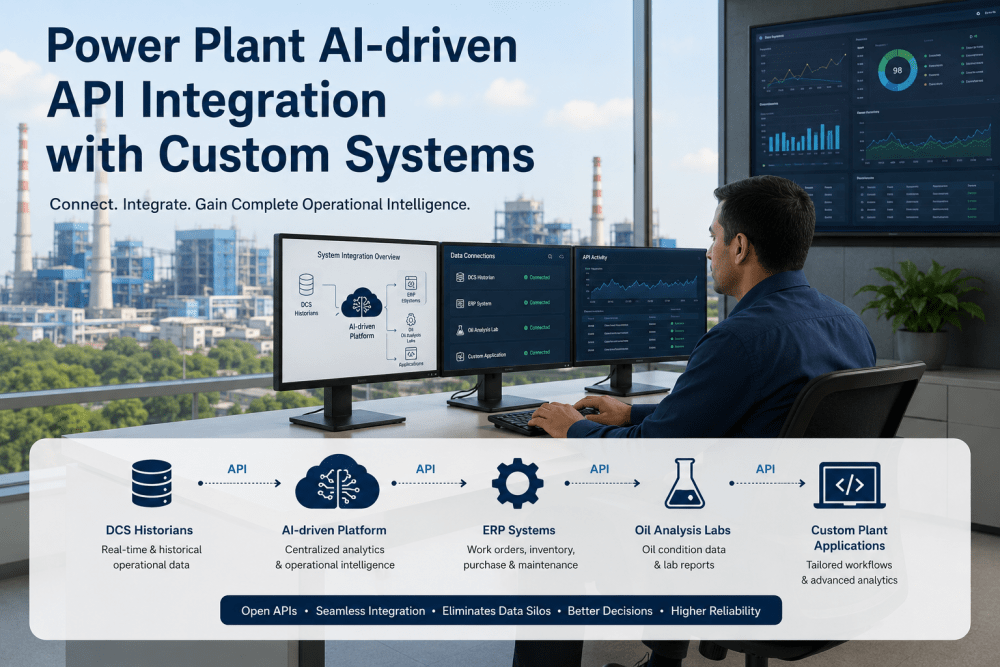
Normalized SCADA data is published to consuming applications through REST API endpoints, MQTT topics, OPC-UA server interfaces, or direct database writes to time-series historians and data lakes. The northbound layer supports multiple simultaneous data destinations — iFactory's AI analytics platform, the plant's existing OSIsoft PI or Canary historian, cloud-based machine learning pipelines, and real-time dashboards
Industrial Protocol Comparison for Power Plant SCADA-to-AI Integration
Selecting the right protocol strategy for each data source in the power plant is the critical architectural decision that determines data quality, latency, and integration complexity. The table below compares the primary industrial protocols used in power plant environments across the dimensions that matter for AI platform integration.
| Protocol | Data Model | Typical Power Plant Application | AI Integration Suitability | Security Model |
|---|---|---|---|---|
| Modbus RTU/TCP | Register-based, no type metadata | Balance-of-plant equipment, auxiliaries, older PLCs | Requires tag mapping and scaling | None in RTU; basic TCP access control |
| OPC-UA | Rich information model with metadata | Turbine controls, DCS systems, modern PLCs | Native — built-in discovery and typing | X.509 certs, encryption, signing |
| MQTT (Sparkplug B) | Topic-based with payload templates | Edge sensors, remote sites, solar inverters | Native — structured payload, birth/death certs | TLS, username/password, client certs |
| IEC 61850 | Object-oriented substation model | Generator protection, substation automation | Requires GOOSE-to-data mapping | IEC 62351 authentication |
| DNP3 | Object-based with time-stamped data | Remote terminal units, SCADA RTUs | Good — includes quality flags and timestamps | Secure authentication (DNP3-SA) |
Legacy Point-to-Point Integration vs. Modern Gateway Architecture
The traditional approach to connecting SCADA systems to higher-level analytics — point-to-point integrations with custom drivers, direct database connections, and manual data mapping — creates an unmanageable integration architecture that cannot scale across the multi-vendor, multi-protocol, multi-generation equipment environment typical of power plants. The comparison below makes the architectural gap explicit.
- Each AI or analytics application builds custom protocol drivers for each SCADA data source
- Protocol translation logic duplicated across every consuming application; integration failures cascade
- No edge processing — raw SCADA data transmitted at full resolution, overwhelming analytics pipelines
- Cybersecurity risk from direct OT-to-cloud connections without buffer or data diode isolation
- Data format inconsistencies between applications require manual reconciliation and data quality investigation
- Adding a new SCADA data source requires weeks of custom integration development per consuming application
- No data buffering during network interruptions — data gaps appear in AI model training and analytics
- Single gateway platform ingests all SCADA data sources; consuming applications read from unified data bus
- Protocol translation centralized in gateway; applications consume normalized data through standard APIs
- Edge processing filters and conditions SCADA data; 60–80% data volume reduction without information loss
- OT-IT boundary enforced through DMZ historian replication; no direct OT network connectivity from cloud
- Data normalized to consistent format, units, and quality flags at the gateway layer; no manual reconciliation
- New SCADA data source added by configuring protocol driver in gateway; all consuming applications access automatically
- Edge gateway buffers up to 72 hours of data during network interruptions; zero data gaps in analytics
5-Step Deployment Process for Power Plant SCADA-to-AI Gateway Integration
Deploying an industrial IoT gateway that connects power plant SCADA systems to AI analytics follows a structured sequence that ensures data integrity, cybersecurity compliance, and analytics readiness at each phase.
SCADA Data Source Discovery and Protocol Audit
iFactory's engineering team conducts an on-site audit of all SCADA-connected equipment and control systems — turbine control platforms, DCS controllers, PLC networks, protective relays, RTUs, and balance-of-plant systems — documenting each data source's protocol, data rate, tag count, and cybersecurity zone. The audit produces a protocol inventory map that identifies which data sources require Modbus, OPC-UA, IEC 61850, DNP3, or MQTT connectivity and prioritizes integration sequencing by data criticality and AI analytics dependency.
Gateway Hardware Deployment and Network Integration
Industrial IoT gateway appliances are deployed in each control system network segment — typically one gateway per DCS or PLC network, with redundant pairs for critical path systems. Gateways are configured with protocol-specific drivers for each identified data source and connected to the plant's OT network through managed switches with port security and VLAN segmentation. Edge processing rules for data filtering, compression, and buffering are configured based on each data source's criticality and the consuming AI application's latency requirements.
Data Normalization and Tag Mapping
SCADA data from different protocols arrives in different formats — Modbus registers require scaling factor application and unit assignment; OPC-UA tags already carry metadata but require namespace mapping; MQTT Sparkplug B payloads require template parsing. The gateway normalizes all data into a consistent time-series format with standardized engineering units, quality flags, and timestamps. Tag mapping configuration is managed through iFactory's centralized tag registry that maintains the master data dictionary linking every SCADA tag to its gateway source, protocol, unit, and destination AI model.
OT-IT Boundary Security Configuration
The gateway's transport layer is configured for the plant's specific OT-IT boundary architecture — unidirectional data diodes for the highest-security environments, DMZ historian replication for standard deployments, or encrypted TLS tunnels with application-layer firewalls for lower-criticality data streams. Tag-level access control lists define precisely which SCADA data points are permitted to cross the OT-IT boundary, with data governance rules for personally identifiable information exclusion and compliance with NERC CIP or equivalent regulatory frameworks.
AI Platform Connection and Data Validation
Normalized SCADA data is published to iFactory's AI analytics platform through REST API or MQTT interfaces, with the AI platform's data ingestion layer automatically discovering new data streams as they appear in the gateway's publication topics. Data validation runs in parallel for a two-week period, comparing gateway-delivered SCADA values against source-system readings to verify data integrity, timestamp accuracy, and unit consistency before any AI model is trained or deployed against the gateway data pipeline. After validation, the gateway operates in production mode with continuous data quality monitoring and automated alerting for any data stream interruption or quality degradation.
Power plants following this structured deployment sequence typically achieve full SCADA-to-AI data connectivity within 30 to 60 days, depending on the number of protocol types and data sources in the facility. Book a Demo to review your plant's SCADA architecture and build a gateway deployment plan with iFactory's integration engineering team.
Unlock Your Power Plant SCADA Data for AI-Driven Analytics
iFactory's industrial IoT gateway architecture connects legacy Modbus equipment, modern OPC-UA control systems, and MQTT edge devices into a unified data pipeline for AI analytics, digital twin modeling, and predictive maintenance — without replacing your existing SCADA infrastructure.
What Integration Engineers Say About SCADA-to-AI Gateway Architecture
The control system integrators and power plant IT-OT architects who have deployed structured gateway architectures between SCADA and AI platforms share a consistent observation: the gateway layer is not merely a data transport mechanism — it is the architectural foundation that determines whether AI analytics succeed or fail in plant operations.
"The most common failure mode I see in power plant AI analytics projects is not the AI model — it is the data pipeline. Plant operators invest heavily in machine learning platforms and data science talent, then connect them to SCADA data through a collection of custom Python scripts running on engineering workstations that were never designed for continuous production data transport. The scripts fail when the SCADA system is patched, the data format changes during a DCS upgrade, or the network path between the control system and the analytics server is reconfigured by the IT team. The result is data gaps in the AI training pipeline that erode model accuracy and operator trust in the analytics outputs.
A structured gateway architecture solves this by decoupling the SCADA data source from the consuming application. The gateway handles protocol translation, data normalization, cybersecurity isolation, and transport reliability as a permanent infrastructure component — not as a project-specific integration script"
Gateway Architecture Is the Missing Layer in Power Plant AI Analytics
The industrial IoT gateway connecting power plant SCADA systems to AI analytics is not a tactical integration point — it is a strategic infrastructure layer that determines the scalability, reliability, and security of every AI-driven initiative in the facility.
iFactory AI's industrial IoT gateway platform provides the complete architecture — from Modbus and OPC-UA protocol ingestion through edge processing and OT-IT boundary security to REST API and MQTT northbound integration — that power plants need to transform their SCADA data into a strategic asset for AI-driven predictive maintenance, digital twin modeling, and operational optimization. Book a Demo to see iFactory's gateway platform configured for your power plant's specific SCADA architecture and protocol environment.
Deploy a Structured IoT Gateway Architecture for Your Power Plant SCADA-to-AI Integration
iFactory connects your legacy Modbus equipment, modern OPC-UA control systems, and MQTT edge devices into a unified, secure, normalized data pipeline for AI analytics — in one platform built for power plant OT-IT integration.
Industrial IoT Gateway for Power Plant SCADA — Frequently Asked Questions
What industrial protocols does the iFactory IoT gateway support for power plant SCADA integration?
iFactory's industrial IoT gateway supports Modbus RTU and TCP, OPC-UA (client and server), OPC-DA, DNP3 (master and outstation), IEC 61850 (client and GOOSE subscriber), MQTT with Sparkplug B payload templates, Siemens S7, Allen-Bradley CIP (EtherNet/IP), GE SRTP, BACnet, and REST API polling. The multi-protocol support is essential for power plant environments where a single gateway may need to read Modbus RTU data from a 1990s coal pulverizer PLC, OPC-UA data from a modern gas turbine control system, and MQTT data from a solar farm inverter network simultaneously — translating all protocols into a unified normalized data stream for the consuming AI analytics platform.
How does the gateway architecture maintain cybersecurity isolation between OT and IT networks?
iFactory's gateway architecture supports three OT-IT boundary security models depending on the plant's cybersecurity requirements and regulatory framework. For the highest-security environments (nuclear plants, critical infrastructure under NERC CIP), unidirectional data diodes provide physical-level data flow control that makes it impossible for any data or command to travel from the IT network back to the OT network. For standard power plant deployments, a DMZ-hosted historian receives data from the gateway on the OT side and serves data to AI analytics platforms on the IT side
Can the iFactory IoT gateway connect to existing OSIsoft PI, Canary, or other time-series historians?
Yes. The northbound integration layer supports direct writes to OSIsoft PI (through PI Web API and PI Buffer Subsystem), Canary Labs (through Canary API), InfluxDB, TimescaleDB, and standard SQL databases. For facilities that already operate a plant-wide historian, the gateway can publish normalized data to the historian's ingestion API as the primary data destination, with the AI analytics platform then reading from the historian rather than directly from the gateway.
What happens to SCADA data if the network connection between the power plant and the AI platform is interrupted?
iFactory's edge gateway includes a local data buffer that stores up to 72 hours of continuous SCADA data at full resolution, retaining all time-series values, quality flags, and timestamps during network interruptions. When the connection is restored, the gateway performs an automated backfill that replays the buffered data in chronological order to the consuming AI platform — ensuring zero data gaps in the AI analytics pipeline regardless of network availability. The buffer operates on solid-state storage within the gateway appliance with configurable retention policies and automated buffer health monitoring.
What is the typical deployment timeline and cost structure for gateway integration across a multi-unit power plant?
A single-unit power plant with one DCS network, one turbine control system, and balance-of-plant PLCs typically achieves full SCADA-to-AI data connectivity within 30 to 45 days from the start of the protocol audit phase. Multi-unit plants (two to six generating units with separate control systems) typically deploy in 45 to 60 days through parallel gateway installations per unit, with a shared northbound integration layer consolidating data from all units into the AI platform. Gateway hardware cost depends on protocol count, tag volume, and redundancy requirements, with typical per-unit gateway appliance costs ranging from $8,000 to $18,000 for standard power plant configurations.