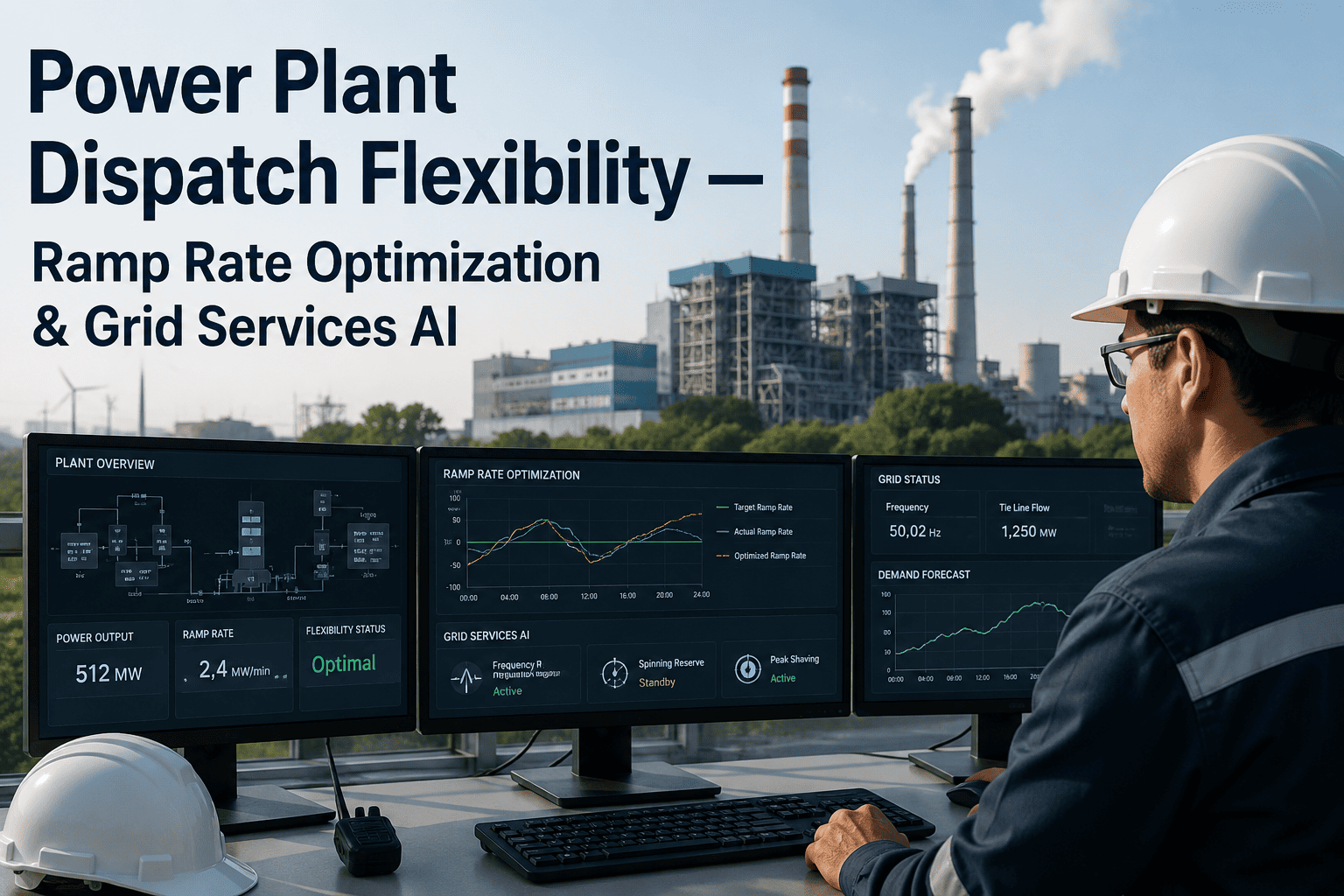
Most power plants were designed to run at steady baseload output, but the modern grid no longer rewards that operating pattern. With renewable penetration exceeding 30% in major markets and ancillary services revenue projected to surpass $10 billion globally in 2026, grid operators now pay premiums for plants that can ramp fast, hold spinning reserve, and respond to frequency regulation signals within seconds rather than minutes. The challenge is that aggressive ramping accelerates thermal stress on boilers, turbines, and steam systems — equipment that was never engineered for the cycling duty that grid flexibility demands. iFactory's AI platform bridges this gap by optimizing ramp rate profiles in real time, protecting equipment life while unlocking the dispatch flexibility and ancillary services revenue that today's grid is willing to pay for — book a demo to see how AI-optimized ramping works on your plant configuration.
DISPATCH FLEXIBILITY · RAMP RATE AI · GRID SERVICES · EQUIPMENT PROTECTION
Ramp Faster, Earn More From the Grid, and Stop Destroying Equipment in the Process
iFactory's AI optimizes your ramp rate profiles across every load band, enabling frequency regulation, spinning reserve, and fast-response grid services while continuously monitoring thermal stress on every critical component.
60%
Faster Ramp Rates Achieved With AI Optimization
$10B+
Global Ancillary Services Market in 2026
8.6%
Annual Growth Rate in Grid Services Demand
THE FLEXIBILITY GAP
Why Baseload Plants Lose Revenue When the Grid Needs Flexibility
Grid operators across North America, Europe, and Asia-Pacific are restructuring how they procure electricity. Plants that can only operate at fixed output are being displaced by flexible resources that respond to real-time supply and demand imbalances. The revenue shift is measurable — and it penalizes inflexible generation.
HIGH
Renewable Penetration Increasing Net Load Variability
Solar and wind generation create steep morning ramp-up and evening ramp-down requirements that conventional plants must follow. In CAISO, net load ramps of 15,000 MW in three hours are now routine during spring evenings, requiring every dispatchable plant to operate at maximum ramp capability.
HIGH
Ancillary Service Prices Rising as Inertia Declines
As synchronous generators retire and get replaced by inverter-based renewable resources, the grid loses rotational inertia. Frequency regulation and spinning reserve prices have increased because fewer plants can provide these services, creating premium revenue for those that can respond within seconds.
MEDIUM
Cycling Duty Damaging Equipment Not Designed for It
Every aggressive ramp cycle induces thermal stress in boiler tubes, turbine rotors, and steam headers. Plants that increase cycling without monitoring the cumulative fatigue impact see accelerated tube failures, rotor cracking, and header weld failures — converting grid revenue into unplanned outage costs.
MEDIUM
Capacity Markets Rewarding Flexibility Performance
ISOs including MISO and PJM have introduced ramping products that compensate plants for maintaining ramp-up and ramp-down capability. Plants that cannot demonstrate consistent ramp performance forfeit this revenue stream entirely, regardless of their nameplate capacity.
RAMP RATE INTELLIGENCE
How AI Optimizes Ramp Profiles Without Exceeding Equipment Thermal Limits
Traditional ramp rate limits are conservative fixed values set during commissioning — typically 1 to 3 percent of rated capacity per minute for coal plants and 5 to 8 percent for gas turbines. These static limits do not account for real-time equipment condition, ambient temperature, or current thermal state. AI changes this by computing the maximum safe ramp rate at every moment based on live sensor data.
TRADITIONAL FIXED RAMP
1.5% per minute | 45 minutes to reach full load from 50%
AI-OPTIMIZED DYNAMIC RAMP
3.8% per minute average | 18 minutes to reach full load from 50%
Phase 1
Cold Component Assessment
AI reads current metal temperatures across boiler, turbine, and steam headers to determine how aggressively the initial ramp can begin without exceeding differential temperature limits
Phase 2
Dynamic Rate Adjustment
As ramp progresses, AI continuously recalculates the safe rate based on real-time thermal expansion, vibration, and steam condition data — accelerating when margins are available, throttling when stress approaches limits
Phase 3
Target Load Stabilization
Final approach to target load is optimized to minimize overshoot and thermal settling time, enabling the plant to begin providing grid services immediately upon reaching dispatch target
Your Plant Has Ramp Capacity It Cannot Use Because Fixed Limits Do Not Reflect Real-Time Equipment Condition
iFactory's AI computes the maximum safe ramp rate at every moment based on live thermal, vibration, and steam data — unlocking 40 to 60 percent faster ramping without exceeding any equipment limit. Book a demo to see dynamic ramp optimization on your plant's operating data.
GRID SERVICES REVENUE
Four Ancillary Service Products That AI-Optimized Plants Can Monetize
Grid operators procure specific services to maintain frequency stability, voltage regulation, and reserve capacity. Each service has different response time requirements, duration commitments, and revenue structures. AI optimization enables a single plant to participate in multiple services simultaneously by managing the trade-offs between them in real time.
Continuous second-by-second output adjustments following AGC signals to maintain grid frequency at 50 or 60 Hz
Revenue Driver
Mileage-based payments reward plants that respond accurately and frequently to AGC signals
AI Role: Optimizes governor response and valve positioning to maximize regulation accuracy score while minimizing thermal cycling on turbine components
Synchronized capacity held below current output that can ramp to full power within 10 minutes following a contingency event
Revenue Driver
Capacity payments for maintaining reserve margin regardless of whether the reserve is activated
AI Role: Determines the optimal operating point that maximizes reserve margin while maintaining combustion stability and minimum emission compliance at part load
Sustained ramp-up or ramp-down capability to follow net load changes driven by renewable generation variability
Revenue Driver
Ramp capability payments introduced by MISO, CAISO, and other ISOs to compensate flexible generation
AI Role: Optimizes ramp trajectory to deliver maximum MW per minute while staying within thermal stress envelopes computed from real-time equipment data
Near-instantaneous power injection following sudden frequency deviations caused by large generator trips or transmission faults
Revenue Driver
Premium pricing for sub-second response capability as grid inertia declines with renewable penetration
AI Role: Pre-positions turbine control valves and combustion parameters to enable fastest possible power injection without triggering protective trips or exceeding thermal limits
EQUIPMENT PROTECTION
How AI Prevents Aggressive Ramping From Shortening Equipment Life
Every ramp cycle consumes fatigue life from boiler tubes, turbine rotors, steam headers, and thick-walled pressure components. The damage is cumulative and invisible until a crack propagates far enough to cause a forced outage. AI tracks the thermal stress on every critical component during every ramp event and adjusts the ramp profile to stay within the component's remaining fatigue budget.
Turbine Rotor
Thermal gradient between bore and surface during rapid temperature changes causes low-cycle fatigue cracking at stress concentration points
AI monitors differential expansion and bore temperature to modulate steam admission rate, keeping thermal gradient within OEM-specified limits during every ramp
Boiler Headers
Thick-walled headers experience through-wall temperature differentials during load changes that exceed allowable stress ranges over repeated cycles
AI calculates real-time Rainflow cycle counting on header thermocouples and adjusts ramp rate when cumulative fatigue consumption approaches maintenance interval thresholds
Superheater Tubes
Rapid load increases cause steam temperature excursions that accelerate creep damage and oxide scale growth on tube inner surfaces
AI coordinates desuperheater spray flow with firing rate changes to maintain tube metal temperatures within safe operating bands throughout the ramp
Steam Valves
Frequent valve cycling during regulation service causes seat erosion, stem packing wear, and actuator fatigue that increases maintenance frequency
AI optimizes valve stroke patterns to minimize total travel distance while maintaining grid response accuracy, extending valve maintenance intervals by reducing unnecessary cycling
SIDE BY SIDE
Traditional Dispatch vs AI-Optimized Dispatch — Full Capability Comparison
The comparison below maps how AI optimization changes dispatch performance across the operational dimensions that determine grid services eligibility, revenue capture, and equipment impact.
| Dispatch Dimension |
Traditional Fixed-Parameter Dispatch |
iFactory AI-Optimized Dispatch |
| Ramp Rate Capability |
Fixed at commissioning value, typically 1-3% per minute for coal, 5-8% for gas |
Dynamic rate computed from live thermal data, achieving 40-60% faster ramping within safe limits |
| Frequency Regulation Accuracy |
Governor-based response with limited accuracy on AGC mileage scoring |
AI-tuned valve positioning achieves higher mileage scores and increased regulation revenue per MW |
| Spinning Reserve Management |
Fixed minimum load with conservative reserve margin estimates |
Optimized part-load operation maximizes reserve margin while maintaining combustion stability |
| Equipment Stress Tracking |
Calendar-based maintenance with no real-time fatigue monitoring during ramp events |
Continuous fatigue life consumption tracking on every critical component during every ramp cycle |
| Multi-Service Participation |
Committed to one service at a time, manual switching between dispatch modes |
Simultaneous participation in regulation, reserve, and ramping products with real-time trade-off optimization |
| Start-Stop Optimization |
Standard startup curves regardless of equipment thermal state or grid need urgency |
Startup trajectory adapted to current metal temperatures, enabling faster hot starts and safer cold starts |
| Revenue Visibility |
Revenue calculated after the fact from settlement data, no real-time optimization |
Real-time revenue tracking per service product with dispatch recommendations that maximize total revenue |
Every Megawatt of Ramp Capability You Cannot Deliver Is Revenue Your Plant Leaves on the Grid
iFactory's AI platform turns your existing generation assets into flexible dispatch resources that earn from frequency regulation, spinning reserve, ramping products, and fast frequency response — while tracking equipment fatigue life in real time so flexibility does not come at the cost of reliability.
MEASURED OUTCOMES
Results From AI-Optimized Dispatch Flexibility Deployments
These figures reflect measured outcomes from power generation facilities where iFactory's AI platform was deployed to optimize ramp rate performance, grid services participation, and equipment protection during flexible dispatch operations.
2.4x
Increase
Effective Ramp Rate vs Fixed Commissioning Limits
AI-optimized ramp profiles delivered 2.4 times the effective ramp rate compared to fixed commissioning limits by computing safe dynamic rates from real-time thermal, vibration, and steam condition data across every load band.
$2.8M
Per Year
Additional Ancillary Services Revenue Per Unit
Plants that qualified for frequency regulation and ramping products through AI-optimized dispatch captured ancillary services revenue that was previously inaccessible due to ramp rate limitations and regulation accuracy constraints.
34%
Reduction
Cycling-Related Forced Outage Events
Real-time fatigue tracking and dynamic ramp adjustment reduced forced outages caused by thermal cycling damage by identifying when cumulative stress approached critical thresholds and moderating ramp aggressiveness before failure occurred.
92%
Score
AGC Regulation Performance Accuracy
AI-tuned governor response and valve positioning achieved regulation performance scores above 90% consistently, qualifying plants for higher-tier mileage payments in regulation markets that reward accuracy over raw capacity.
FREQUENTLY ASKED QUESTIONS
Questions From Operations Directors About AI-Optimized Dispatch Flexibility
How does AI determine the maximum safe ramp rate in real time without exceeding equipment thermal limits?
The AI model ingests live data from thermocouples on turbine rotors, boiler headers, superheater tubes, and steam piping to compute the current thermal gradient and differential expansion state of every critical component. It then compares these values against OEM-specified stress limits and the component's accumulated fatigue history to calculate the maximum ramp rate that stays within safe operating bounds. This computation updates continuously, so the allowable ramp rate changes as equipment conditions change — enabling faster ramping when components are warm and thermally stable, and moderating the rate when thermal gradients are approaching limits.
Book a demo to see real-time ramp rate computation on your plant data.
Can a coal-fired plant realistically participate in frequency regulation markets that require second-by-second response?
Yes, but the response mechanism is different from a gas turbine or battery. Coal plants provide frequency regulation through turbine valve positioning and condensate throttling rather than combustion changes, which allows second-by-second output adjustments within a narrower regulation band. AI optimizes this valve-based response to maximize the regulation accuracy score, which determines the mileage payments the plant receives. The regulation band may be smaller than a gas turbine's, but the revenue per MW of regulation capacity can be competitive because AI-tuned response achieves higher accuracy scores than manual governor control.
Contact our support team to discuss regulation capability for your specific unit configuration.
How does the AI platform integrate with our existing DCS and plant control system?
iFactory's platform reads data from your existing DCS historian and sensor network through standard industrial communication protocols — no new sensors are required for the initial deployment. The AI operates as an advisory and optimization layer that sends setpoint recommendations to your DCS, which retains full control authority over all plant equipment. For closed-loop operation, the platform can write optimized setpoints directly to the DCS through approved communication channels, but the DCS safety interlocks and protection systems remain fully independent and cannot be overridden by the AI layer. Integration typically takes four to six weeks including historian data mapping, model training, and validation testing.
Book a demo to discuss integration with your specific control system architecture.
What is the payback period for deploying AI dispatch optimization on a generating unit?
Payback depends on the unit's size, fuel type, and the ancillary services market in your region, but facilities in active regulation and ramping markets typically see payback within six to twelve months from a combination of increased ancillary services revenue, reduced forced outage costs from fatigue-related failures, and improved heat rate during part-load operation. The pre-deployment assessment maps your specific unit configuration, market participation history, and EFOR data to produce a site-specific financial projection before any commitment. Plants in regions with higher ancillary service prices or more aggressive renewable penetration generally see faster returns because the flexibility premium is larger.
Contact our support team to request a site-specific ROI projection for your unit.
Does AI optimization work for gas turbines and combined cycle plants, or only for coal-fired units?
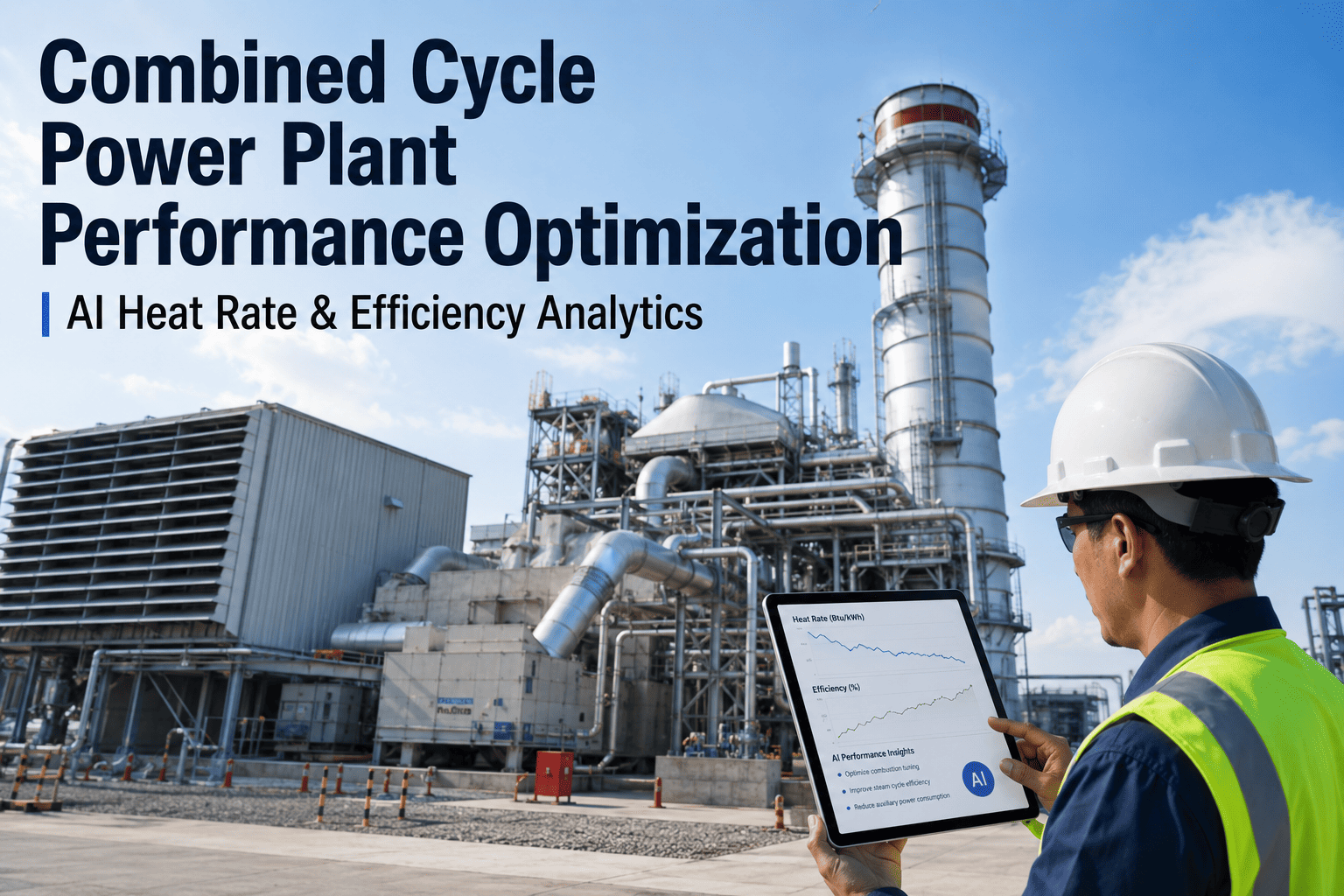
AI dispatch optimization applies to gas turbines, combined cycle plants, and coal-fired units, though the optimization targets differ by technology. For simple-cycle gas turbines, the primary focus is startup time reduction, hot-path component life tracking, and frequency response optimization. For combined cycle plants, the AI manages the complex interaction between the gas turbine, heat recovery steam generator, and steam turbine during ramp events — optimizing the sequencing to minimize startup time while protecting HRSG components from thermal shock. Coal plants benefit most from the dynamic ramp rate optimization and fatigue tracking capabilities because their equipment is more sensitive to thermal cycling than gas turbine components.
Book a demo to see how AI optimization applies to your specific plant technology.
The Grid Is Paying for Flexibility That Your Plant Could Deliver — If Your Control System Knew How Far It Could Push
iFactory's AI platform reads your plant's real-time thermal state, computes the maximum safe ramp rate at every moment, optimizes dispatch for multi-service revenue capture, and tracks equipment fatigue life so that flexibility does not trade reliability for revenue. Book a demo to see dispatch optimization on your plant data.