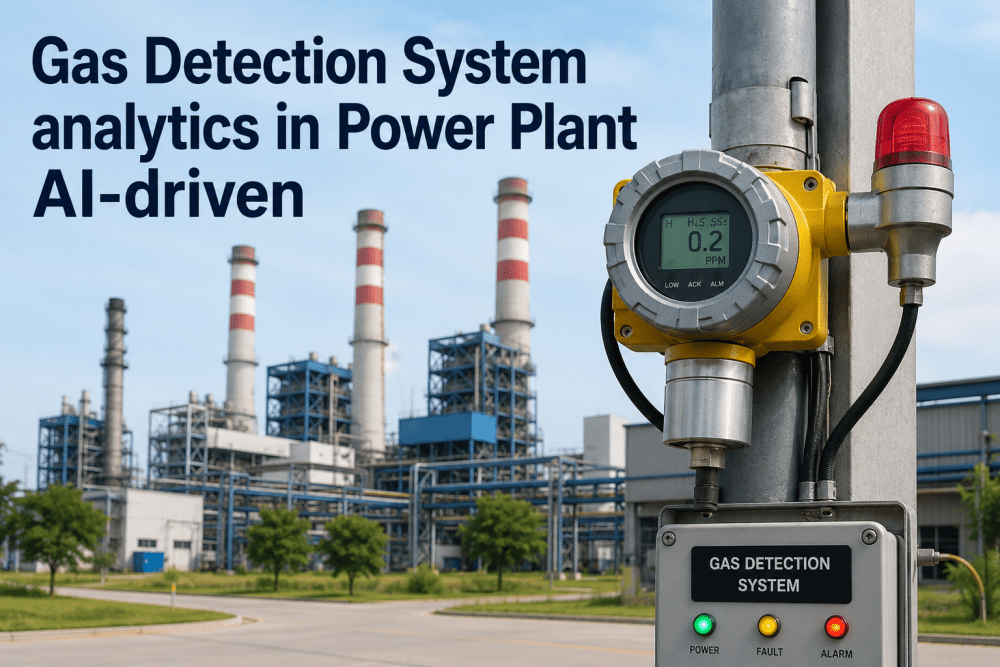
Gas Detection System analytics in Power Plant AI-driven
By James Shakespeare on May 27, 2026
Gas detection failures in power plants do not announce themselves in advance. An H2S sensor that drifted out of calibration six weeks ago provides zero warning when a leak develops in the gas turbine fuel supply area. A CO detector that missed its replacement cycle because the work order was never generated reads normal while carbon monoxide accumulates in a confined boiler space. A fixed detector that failed its last functional test but was closed out as passed because the technician ran the wrong span gas is, in operational terms, no detector at all. The consequences of these failures are not theoretical — they are documented in incident reports from power plants across the United States and globally, in near-miss events and in OSHA citations, and in fatalities that post-incident investigations consistently trace back to the same root cause: gas detection programs managed through disconnected spreadsheets, paper calibration logs, and manual scheduling systems that cannot systematically track sensor status, calibration due dates, functional test results, and corrective action completion across a plant's full detector population. iFactory's AI-driven platform replaces that disconnected infrastructure with a unified gas detection management system — scheduling calibrations automatically, tracking sensor replacement cycles against manufacturer life limits, documenting every functional test with pass/fail status, and generating corrective action work orders from alarm events that are traceable from detection through resolution. For a conversation about how iFactory's gas detection analytics applies to your plant's safety management program, contact our support team.
Power Plant Safety Analytics · Gas Detection Management · 2026
Gas Detection System Analytics: AI-driven Calibration Scheduling, Sensor Lifecycle Tracking, and Alarm-to-Corrective-Action Documentation
iFactory transforms gas detection management from a paper-based compliance burden into a systematic AI-driven safety analytics program — scheduling every calibration, tracking every sensor's life cycle, and creating a complete audit trail from alarm through corrective action closure.
Primary toxic gas hazards tracked: hydrogen sulfide and carbon monoxide in power generation environments
6-Month
Maximum calibration interval for most fixed gas detectors — frequently missed without automated scheduling
2–5 yr
Typical sensor electrochemical cell replacement life — managed against plant-wide replacement schedule
100%
Audit trail documentation target: every calibration, test, alarm, and corrective action closed and traceable
The Problem with Manual Gas Detection Management
Four Systemic Failures in Traditional Gas Detection Programs
Most power plant gas detection programs do not fail catastrophically all at once. They fail incrementally — one missed calibration, one deferred sensor replacement, one corrective action that never got a work order — until the cumulative gap between documentation and actual detector status creates serious safety exposure.
Calibration Interval Gaps
Most electrochemical H2S and CO sensors require calibration every 3–6 months per manufacturer specification and OSHA/NFPA 72 guidance. Manual tracking through spreadsheets or paper logs consistently produces a population of overdue detectors — particularly in plants with 50–200+ fixed detectors — because no systematic notification drives technician action on the specific sensors that are due.
Most common compliance gap
Sensor Life Cycle Failures
Electrochemical sensor cells have a finite life — typically 2–5 years depending on gas type and environmental conditions. Power plants without systematic replacement tracking routinely operate sensors beyond manufacturer-rated life. An expired electrochemical cell provides a response to bump test gases but delivers significantly degraded sensitivity to actual gas concentrations — a failure mode that routine bump tests do not reliably catch.
Silent reliability failure
Alarm-to-Action Traceability Gap
When a gas alarm activates, the required response — investigation, area clearance, root cause determination, corrective action, system restoration — involves multiple steps across multiple people. Without a structured work management system connecting alarm events to corrective action work orders, alarm responses are documented inconsistently, corrective actions fall through scheduling gaps, and repeat alarms from the same equipment recur without root cause resolution.
Audit trail failure
Span Gas and Test Equipment Management
Calibration accuracy depends entirely on using the correct concentration span gas within its certified expiry date and verifying that field calibration equipment is within its own calibration cycle. Plants without integrated span gas inventory tracking and test equipment calibration management routinely discover — during audits, not during tests — that calibrations were performed with expired span gas or out-of-calibration field instruments, invalidating months of compliance documentation.
Documentation validity risk
Safety Compliance Reality
OSHA Process Safety Management (29 CFR 1910.119) and EPA Risk Management Program regulations require that mechanical integrity programs — which include gas detection systems for covered processes — maintain documented inspection and testing records demonstrating that equipment is designed, maintained, and operated within safe limits. An audit that finds gas detectors with overdue calibrations, expired sensor cells, or undocumented alarm responses is not an administrative finding — it is a mechanical integrity violation that can trigger Citations, consent agreements, and in process safety incidents, contribution to criminal liability. iFactory's gas detection analytics program creates the systematic documentation infrastructure that these requirements demand — not as a one-time audit preparation effort, but as continuous operational practice.
What Changes When Gas Detection Management Moves from Spreadsheets to iFactory
The gap between a manual gas detection program and an AI-driven one is not primarily a technology difference — it is a reliability and traceability difference. Here is what that gap looks like in practice.
Manual Gas Detection Program
Compliance by Effort, Not by System
Calibration schedules managed in spreadsheets that are updated only when a technician remembers to update them. Sensor replacement dates recorded on asset tags or in disconnected equipment files with no automatic notification when replacement windows approach. Alarm events logged in shift logbooks that are not connected to work order systems. Span gas inventory managed separately from calibration scheduling — creating routine risk of performing calibrations with expired test gas. Audit preparation requires manually compiling records from multiple disconnected sources, frequently revealing documentation gaps that require retroactive reconstruction.
Every gas detector in the plant registers in iFactory's asset register with calibration interval, sensor type, installation date, and manufacturer-rated cell life. Calibration work orders are generated automatically when due dates approach — 30, 14, and 7 days before deadline — assigned to the responsible technician, and tracked to completion with pass/fail documentation. Alarm events automatically generate investigation work orders. Sensor replacement schedules surface 90 days before replacement is due. Audit package generation is a report export, not a manual compilation exercise. The compliance status of every detector in the plant is visible in a single dashboard view.
Automated calibration schedulingProactive sensor replacement alertsAlarm-to-work-order automationAudit-ready documentation always current
iFactory Gas Detection Analytics Workflow
How iFactory Manages the Complete Gas Detection Lifecycle — From Installation Through Decommission
iFactory's gas detection management workflow covers every phase of a gas detector's operational life — creating a closed-loop documentation record from asset registration through decommission that satisfies OSHA PSM, EPA RMP, and NFPA 72 mechanical integrity requirements. Book a Demo to see this workflow applied to your plant's specific gas detection inventory.
01
Asset Registration: Every Detector in a Single Register
Each gas detector is registered as an individual asset in iFactory's database — with tag number, location, gas type monitored (H2S, CO, CH4, O2, or other), detector technology (electrochemical, catalytic bead, infrared, photoionization), manufacturer, model, serial number, installation date, and area classification. This registration forms the foundation for all downstream scheduling, tracking, and documentation functions. Plants typically complete initial detector registration within 2–4 days for a facility with 100–200 fixed detectors.
Complete detector population visibility from Day 1
02
Automated Calibration Scheduling — 3-Month, 6-Month, and Annual Intervals
Calibration intervals are configured per detector type based on manufacturer requirements, regulatory standards (OSHA 1910.119, NFPA 72, ISA-92 series), and plant-specific risk assessments. iFactory generates calibration work orders automatically at defined lead times before each due date — 30, 14, and 7 days for routine calibrations, longer windows for annual comprehensive tests — assigning them to designated technicians or work groups with the specific span gas concentration and calibration procedure documented on the work order. Overdue calibration alerts escalate automatically through supervisor notification when deadline passes without completion documentation.
Zero overdue calibrations — systematic notification prevents gaps
03
Sensor Replacement Cycle Tracking — Electrochemical Cell Life Management
Electrochemical sensor cells for H2S and CO detection have manufacturer-rated service lives that are frequently exceeded in plants without systematic replacement tracking. iFactory tracks each sensor cell against its rated life — with configurable replacement windows triggered at 90, 60, and 30 days before life limit — generating replacement work orders with the specific sensor part number, required calibration gas, and post-replacement verification procedure. For sensors operating in high-humidity, high-temperature, or corrosive environments (common in power plant service), iFactory supports reduced replacement intervals configured by the safety team based on observed sensor degradation data.
No expired sensor cells in service — proactive replacement documented
04
Alarm Event Management — From Detection Through Corrective Action Closure
When a gas alarm activates — whether from a fixed detector, portable monitor, or manual gas test — iFactory creates a structured alarm event record capturing the detector tag, gas type, concentration level, time of detection, shift crew, and initial response actions. This alarm event automatically triggers the appropriate corrective action work order workflow — area clearance verification, investigation, root cause determination, and repair or process adjustment as required. Each step in the response is documented against the alarm record, creating a complete traceable chain from alarm detection through corrective action completion and system restoration. Repeat alarm analysis across the detector population identifies systematic leak sources or detector performance issues that require engineering attention.
OSHA PSM inspections, EPA RMP audits, insurance carrier loss control inspections, and internal safety audits all require the same fundamental documentation: evidence that gas detection systems are maintained per their design basis through a documented program of calibration, testing, and corrective action. iFactory generates this compliance package on demand — exporting calibration history by detector, sensor replacement records, functional test results, alarm event logs, and corrective action completion records in structured formats suitable for direct audit presentation. The audit package that previously required two days of manual record compilation is now a report generation task that takes 15 minutes.
Audit package generated in 15 minutes — not 2 days
For Power Plant Safety Teams
See iFactory's Gas Detection Dashboard Applied to Your Plant's Detector Population — in 30 Minutes
We configure a demonstration using your plant's detector types, gas hazards, and calibration interval requirements — showing your safety team exactly what the calibration scheduling, sensor tracking, and alarm management workflows look like for your specific program. Most safety managers leave with a prioritized implementation plan they can take to their operations team the same day.
Gas Detection Compliance Requirements: What iFactory Documents for Each Regulatory Standard
Power plants subject to OSHA PSM, EPA RMP, NFPA 72, and plant-specific gas safety procedures face overlapping but distinct documentation requirements. iFactory's gas detection analytics satisfies all of these simultaneously from a single operational record.
Gas Detection Compliance Documentation Matrix — iFactory Coverage
Regulatory Standard
Documentation Requirement
iFactory Module
Audit Evidence Produced
OSHA 29 CFR 1910.119 (PSM)
Mechanical integrity — inspection and testing records for gas detection systems in covered processes
Calibration Scheduling + Test Records
Calibration history per detector, pass/fail records, overdue alerts
EPA 40 CFR Part 68 (RMP)
Prevention program — maintenance procedures and records for safety equipment
Sensor Life Tracking + Work Orders
Sensor replacement records, maintenance work order completion history
NFPA 72 — National Fire Alarm Code
Inspection, testing, and maintenance records for gas detection components of fire/gas systems
Functional Test Documentation
Functional test results, detector response verification, test equipment records
ISA-92 Gas Detector Performance
Calibration to certified span gas concentrations with documented gas cylinder certification
Span Gas Inventory Tracking
Span gas lot numbers, expiry dates, calibration-to-gas linkage
OSHA 1910.146 (Confined Space)
Atmospheric testing records before and during confined space entry
Alarm Event + Portable Monitor Records
Pre-entry atmospheric test records, portable monitor calibration history
Internal Safety Audit
Demonstrated systematic gas detection management program with complete records
All Modules + Compliance Dashboard
Full program documentation package — exportable audit report in 15 minutes
Expert Perspective: Gas Detection Program Management in Power Plants
Power plant safety professionals who have managed gas detection programs through manual systems and then transitioned to AI-driven management consistently identify the same structural improvement: the shift from reactive audit preparation to continuous compliance documentation.
We had a gas detection program that looked good on paper and consistently failed during inspections. The paper looked good because the technicians doing the calibrations were conscientious and the records were generally being made — the problem was that nothing was systematic. There was no automatic notification when a sensor was due for calibration. There was no trigger when a sensor cell approached its rated life. When a gas alarm came in and the operator investigated and found nothing, the event was written in the shift log and that was the end of it — no work order, no root cause investigation, no documentation that the detector was verified as functional after the alarm. When our process safety audit came around, we spent three days trying to reconstruct documentation that in some cases simply did not exist. We received two process safety management findings, one of which required a corrective action plan submitted to our corporate EHS function. After deploying iFactory's gas detection module, our next audit took four hours instead of three days. Every calibration had a completed work order. Every sensor replacement was documented against the manufacturer life limit. Every alarm had a documented response and corrective action closure. The auditor commented that it was one of the most organized gas detection programs he had reviewed at a comparable facility. That outcome was not the result of our team working harder — it was the result of having a system that made it impossible for the required documentation not to be created.
Process Safety Manager, 630 MW Combined Cycle Power Station14 Years Power Plant Safety Management · OSHA PSM Compliance Lead · CCPS Process Safety Fundamentals Faculty · NFPA 72 Technical Committee Participant
100%
Calibration compliance rate — all detectors on schedule with automated reminders
15 min
Audit compliance package generation vs. 2–3 days of manual record compilation
0
Overdue sensor cell replacements — proactive 90-day replacement windows eliminate expired cells in service
100%
Alarm-to-corrective action traceability — every alarm has a documented response and closure record
Book a Demo to see iFactory's gas detection compliance dashboard and discuss how the calibration scheduling, sensor tracking, and alarm management workflows apply to your plant's specific gas hazard profile and regulatory obligations.
Conclusion
Gas Detection Management Is a Life Safety Obligation — iFactory Makes It a System, Not an Effort
The gap between a compliant gas detection program and a non-compliant one is rarely intentional. It is almost always the result of the same structural problem: relying on human memory, manual scheduling, and paper records to manage a population of safety instruments that require systematic, scheduled, documented attention throughout their service lives. iFactory's gas detection analytics module eliminates that structural problem by making systematic management the default — not the exception.
Automated Calibration Work Orders
Calibration work orders generated automatically at configurable lead times before due date — eliminating the scheduling gap that produces overdue detector populations in manual programs.
Scheduling
Sensor Cell Life Tracking
Each electrochemical sensor cell tracked against manufacturer rated life — replacement windows triggered at 90/60/30 days, with specific part number and post-replacement verification on the work order.
Lifecycle
Alarm-to-Work-Order Automation
Gas alarm events automatically generate investigation and corrective action work orders — creating the traceable alarm response record that OSHA PSM and EPA RMP audits require.
Safety Response
Span Gas Inventory Management
Span gas cylinder inventory tracked with lot numbers, certified concentrations, and expiry dates — linked to calibration work orders to flag expired or mismatched span gas before calibration is performed.
Calibration Quality
Escalation and Overdue Notifications
Configurable escalation paths for overdue calibrations, missed functional tests, and open corrective actions — notifying supervisors and safety managers when scheduled work is not completed on time.
Compliance Assurance
Audit Package Export
Complete gas detection compliance documentation exportable on demand — calibration history, sensor replacement records, functional test results, alarm logs, and corrective action records in audit-ready format.
Audit Readiness
Power Plant Safety Teams
iFactory Gas Detection Analytics — Every Calibration Scheduled. Every Sensor Tracked. Every Alarm Documented.
iFactory gives power plant safety teams the systematic gas detection management infrastructure that transforms compliance from a manual effort into a continuous documented practice — satisfying OSHA PSM, EPA RMP, NFPA 72, and audit requirements from a single integrated platform.
Automated calibration scheduling — zero overdue detectors
Sensor cell life tracking — no expired sensors in service
Gas Detection Safety Analytics — Frequently Asked Questions
How does iFactory determine the correct calibration interval for each type of gas detector?
Calibration intervals in iFactory are configurable per detector type and are set by the plant's safety team based on a hierarchy of requirements: manufacturer specification (always the minimum standard), applicable regulatory standard (OSHA 1910.119 for PSM-covered processes, NFPA 72 for gas detection components of fire alarm systems, ISA-92 series for industrial gas detectors), and plant-specific risk assessment (which may require more frequent calibration than the regulatory minimum based on process hazard severity, environmental conditions, or historical detector performance). Most electrochemical H2S and CO detectors in power plant service require calibration every 3–6 months — but infrared flame detectors, catalytic bead combustible gas detectors, and oxygen-deficiency monitors each have their own interval requirements. iFactory does not set default intervals that override plant-specific requirements — it enforces whatever intervals the safety team configures, generates the work orders at the configured lead times, and escalates when those intervals are not met. Book a Demo to see how interval configuration works for a multi-technology detector population.
What documentation does iFactory produce for OSHA PSM mechanical integrity audits covering gas detection systems?
OSHA 29 CFR 1910.119(j) requires that mechanical integrity programs for safety-critical equipment — which includes gas detection systems in covered processes — maintain written procedures for maintaining the ongoing integrity of process equipment, a training program for maintenance employees, inspection and testing of equipment consistent with manufacturer recommendations and good engineering practices, correction of equipment deficiencies before further use or in a safe and timely manner, and quality assurance procedures. iFactory's gas detection module produces documentation addressing all five elements: written calibration and testing procedures are attached to each work order type; technician training records can be maintained in iFactory's personnel qualification module; calibration and functional test records demonstrate inspection and testing per schedule; corrective action work orders document deficiency correction; and span gas lot tracking with equipment calibration records addresses quality assurance. The audit export package compiles all of this into a structured document that directly maps to the PSM mechanical integrity checklist format used by OSHA compliance officers.
Can iFactory track portable gas monitors used by maintenance technicians, not just fixed installed detectors?
Yes — iFactory tracks portable gas monitors as individual assets within the gas detection asset register, with the same calibration scheduling, bump test tracking, and sensor replacement management as fixed detectors. For portable monitors used in confined space entry programs under OSHA 1910.146, iFactory maintains the pre-entry bump test record that OSHA requires — documenting that the monitor was bump-tested with the appropriate span gas on the day of entry and responded within manufacturer specifications. Portable monitor calibration is typically required more frequently than fixed detector calibration (daily bump test, monthly calibration for many instrument types), and iFactory's scheduling system accommodates high-frequency calibration intervals without administrative overhead. Portable monitor location assignment — tracking which technician or crew has responsibility for which instrument — is also configurable, supporting chain-of-custody documentation for instruments used in safety-critical work.
How does iFactory handle gas alarm events that occur when the plant is operating at reduced staffing — nights, weekends, or holidays?
iFactory's alarm event management system operates independent of staffing levels — alarm events can be created from control room DCS integration (where the DCS alarm triggers automatic iFactory event creation), from manual entry by the responding operator on a mobile device or workstation, or from supervisor entry during the post-shift review. For facilities where DCS-to-iFactory integration is configured, alarm events are captured in real time without requiring operator action at the time of the alarm — the investigation and corrective action work orders are generated automatically and queue for assignment when the appropriate personnel are available. Escalation notifications for gas alarm events that remain open without documented response can be configured with time-based triggers — notifying shift supervisors, then plant management, then EHS leadership if an alarm response is not documented within the configured response time window. This escalation function is particularly important during reduced-staffing periods when a gas alarm event that would be immediately escalated during normal operations might otherwise sit without management visibility until the following business day shift review.
How long does it take to implement iFactory's gas detection module for a power plant with 100–150 fixed gas detectors?
A power plant with 100–150 fixed gas detectors can typically complete iFactory gas detection module deployment — from initial asset data entry through first automated calibration work order generation — within 4–6 weeks. The process involves three phases: asset registration (entering each detector's tag, location, gas type, detector technology, installation date, sensor type, and calibration interval — typically 2–4 days with a dedicated data entry resource); calibration interval configuration and initial work order generation (configuring intervals, lead times, and escalation rules for each detector type — typically 1–2 days with iFactory implementation support); and technician training (2–4 hours for maintenance technicians who will receive, execute, and document calibration work orders; 1–2 hours for safety managers using the compliance dashboard and audit export functions). Most plants begin generating automated calibration work orders and operating the alarm event management workflow within 30 days of starting implementation. Book a Demo to get an implementation timeline estimate for your specific detector population and plant configuration.