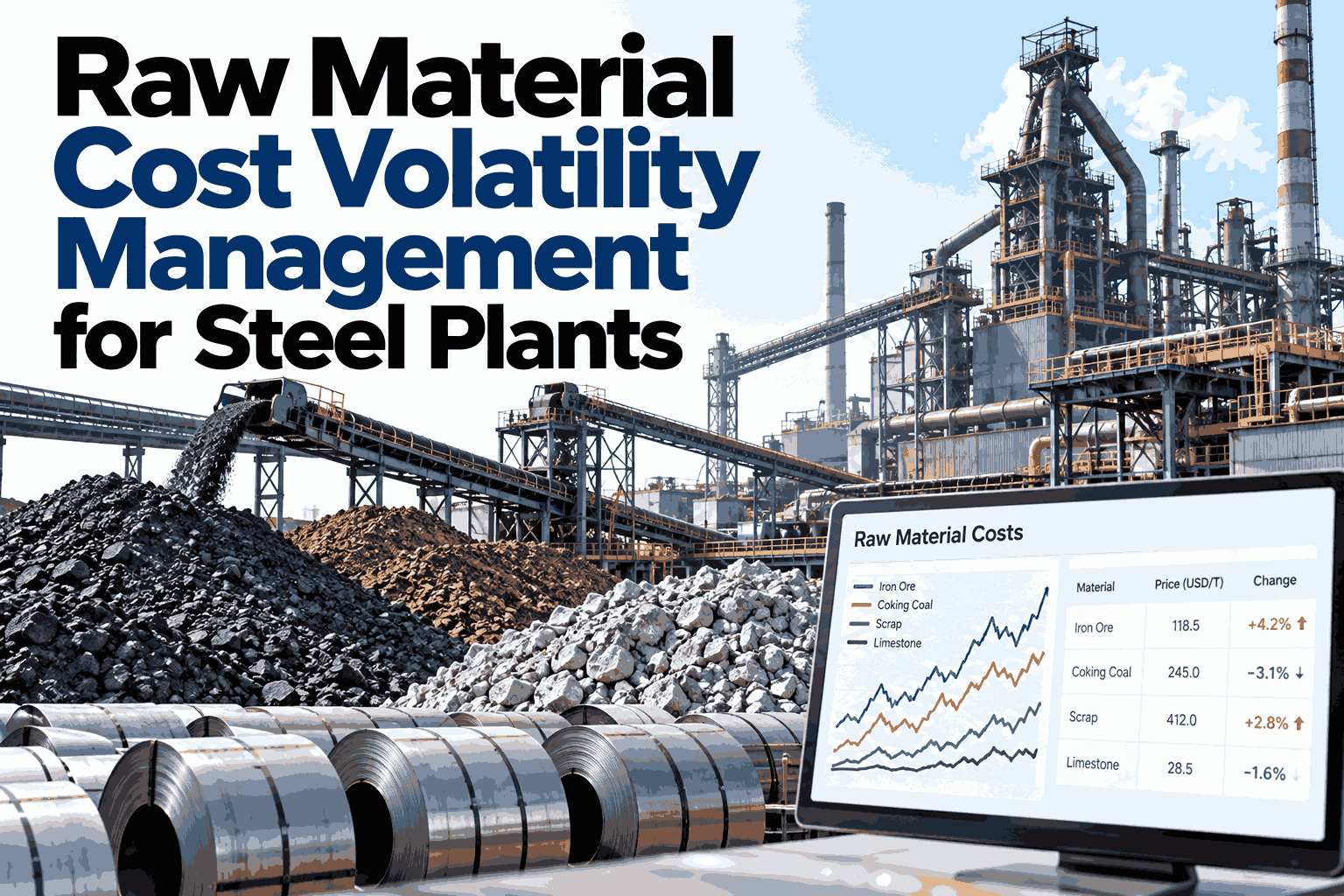
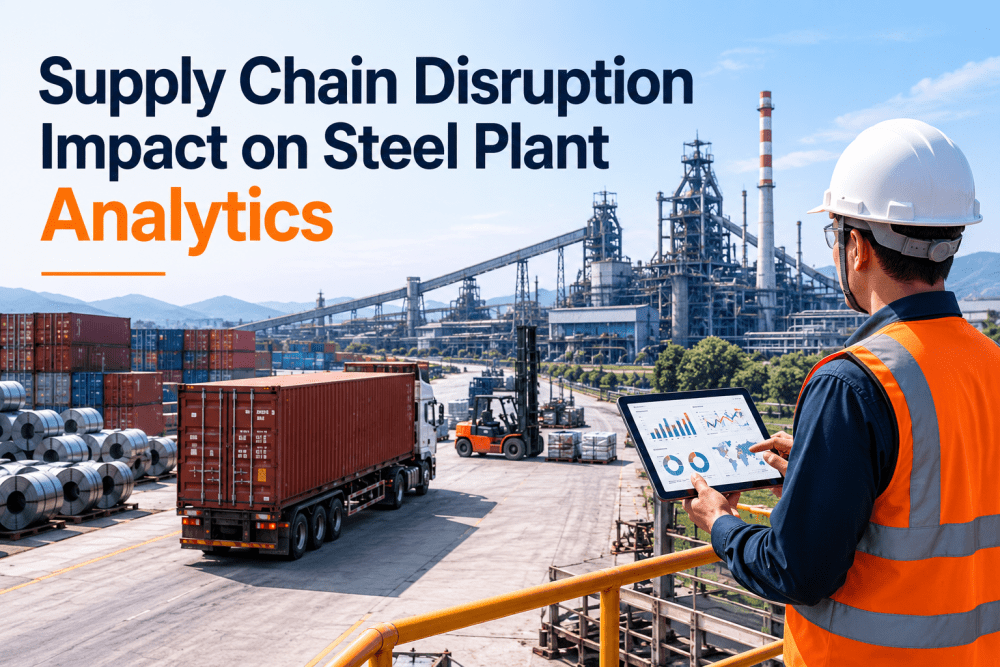
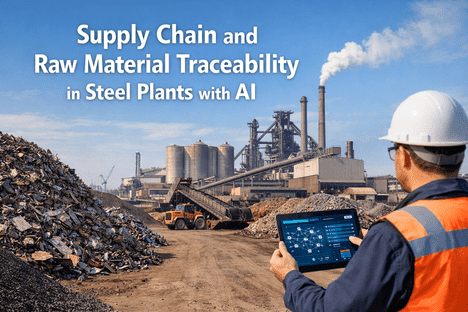
The steel supply chain is among the most volatile and complex in global manufacturing — spanning iron ore mines across continents, coking coal logistics, scrap metal markets, energy-intensive production, and just-in-time delivery to automotive, construction, and infrastructure customers. A single disruption — a port closure energy price spike, raw material shortage, or logistics bottleneck — cascades through the entire value chain within hours, turning profitable operations into margin-destroying crises. Yet most steel producers still manage supply chain risk through spreadsheets, quarterly reviews, and reactive firefighting. In 2026, AI-powered supply chain resilience platforms are giving steel manufacturers something they have never had: real-time visibility, predictive disruption alerts, and automated response playbooks that activate before disruptions hit the bottom line. iFactory's AI platform brings this intelligence to your steel operation. Book a free consultation to see how AI-powered resilience protects your supply chain.
Steel Supply Chain Disruption Management
AI-Powered Resilience Strategies
From iron ore shortages to freight bottlenecks to energy price shocks — steel supply chains face more simultaneous disruption vectors than almost any other industry. This guide covers how AI platforms detect disruptions before they escalate, model alternative sourcing scenarios in minutes instead of weeks, and automate response playbooks that protect margins, maintain customer commitments, and keep production lines running.
Why Steel Supply Chains Are Uniquely Fragile
Steel production depends on a convergence of raw materials, energy, logistics, and market timing that creates multiple simultaneous failure points. Here are the disruption vectors most steel producers are not prepared for.
Raw Material Supply Shocks
Iron ore from Australia and Brazil, coking coal from Mongolia and the US, scrap metal from volatile domestic markets — each input source carries geopolitical, weather, and logistics risk. A single mine closure or export ban can eliminate 10–15% of global supply overnight, sending spot prices surging 30–50% within days.
Logistics and Freight Disruptions
Steel relies on bulk shipping, rail, and trucking networks that operate at near-capacity. Port congestion, canal blockages, rail strikes, container shortages, and fuel price spikes all create bottlenecks that delay raw material delivery and finished product shipment — breaking just-in-time commitments to downstream customers.
Energy Price Volatility
Electric arc furnaces consume massive amounts of electricity. Blast furnaces depend on natural gas and coke. Energy represents 20–40% of total steel production cost. A 50% spike in electricity or gas prices — increasingly common — can instantly flip a profitable order book into negative margins across the entire product mix.
Trade Policy and Tariff Changes
Anti-dumping duties, Section 232 tariffs, carbon border adjustments (CBAM), and export restrictions reshape steel trade flows overnight. A new tariff announcement can make an entire sourcing strategy uneconomic within hours — requiring immediate supplier pivots that most procurement teams take weeks to execute.
Equipment Failures and Plant Outages
A blast furnace reline, BOF converter failure, or rolling mill breakdown does not just affect production — it creates a supply gap that ripples through the entire order book. Customers relying on contracted volumes suddenly need alternative sources, and competitors move to capture those relationships permanently.
Demand Volatility and Customer Shifts
Automotive production cuts, construction slowdowns, infrastructure project delays, and inventory destocking by service centers create demand whiplash that leaves steel producers with excess inventory or unfilled capacity. Demand signals from end markets often arrive too late for production planning to adjust.
How AI Transforms Steel Supply Chain Disruption Management
A six-capability AI framework that shifts your supply chain from reactive firefighting to predictive resilience.
Real-Time Disruption Monitoring
AI continuously scans 10,000+ global data sources — shipping vessel tracking (AIS), commodity exchanges, weather systems, news feeds, regulatory filings, port congestion indices, and social media signals — to detect disruption indicators before they appear in traditional reporting. A port closure in Brazil triggers an alert within minutes, not days.
Disruption Impact Forecasting
When a disruption signal is detected, AI models instantly calculate the downstream impact on your specific supply chain — which raw materials are affected, which production lines will be impacted, which customer orders are at risk, and what the financial exposure looks like across multiple time horizons (7-day, 30-day, 90-day).
Alternative Scenario Modeling
AI generates and evaluates multiple response scenarios simultaneously — alternative suppliers, substitute materials, production schedule adjustments, logistics rerouting, and inventory reallocation. Each scenario is scored for cost impact, lead time, quality risk, and customer delivery compliance. Procurement teams get ranked options, not open-ended problems.
Automated Response Playbooks
Pre-configured playbooks execute automatically when specific disruption thresholds are breached — triggering backup supplier activation, safety stock releases, production schedule modifications, customer communication templates, and logistics rerouting. The system acts in hours instead of the 14 days it takes manual response teams.
Dynamic Inventory and Sourcing Optimization
AI continuously optimizes safety stock levels, reorder points, and supplier allocation based on real-time risk scores — not static calculations from last quarter. High-risk supply routes get higher buffer stock. Stable routes run leaner. The result is lower total inventory cost with higher disruption resilience.
Continuous Resilience Improvement
Every disruption event — whether managed well or poorly — feeds back into the AI system. Response effectiveness is scored, playbooks are refined, supplier reliability ratings are updated, and risk models recalibrate. Your supply chain gets measurably more resilient with every disruption it navigates.
What AI Supply Chain Resilience Delivers for Steel Producers
Faster Disruption Detection
AI detects supply chain disruptions 85% faster than manual monitoring — shifting from 14-day average discovery to under 4 hours. Early detection is the single biggest factor in reducing disruption cost.
Lower Disruption Cost Impact
Automated response playbooks and pre-qualified alternative suppliers reduce the financial impact of each disruption by 50–70%. Faster response means smaller production gaps and fewer emergency procurement premiums.
Reduction in Safety Stock Costs
Dynamic inventory optimization reduces total safety stock by 30–40% while maintaining or improving service levels. Risk-weighted buffers replace one-size-fits-all stock policies that tie up working capital unnecessarily.
Customer Delivery Compliance
Proactive disruption management maintains 95%+ on-time delivery performance even during major supply chain events — protecting customer relationships and avoiding the SLA penalties that compound disruption costs.
Faster Scenario Evaluation
AI evaluates 50+ alternative sourcing and logistics scenarios in the time it takes a procurement team to evaluate 3. Decision speed is the competitive advantage that separates resilient steel producers from reactive ones.
ROI Per Dollar Invested
Steel producers deploying AI supply chain resilience platforms report $2–3 returned for every $1 invested within the first year — driven by avoided disruption costs, lower inventory carrying costs, and reduced emergency procurement premiums.
Manual Supply Chain Management vs. AI-Powered Resilience
Supply Chain Nodes and Risk Vectors Monitored by AI
AI Resilience Strategies by Steel Producer Profile
Integrated Steel Producers (BF-BOF)
The highest supply chain complexity — iron ore, coking coal, limestone, ferroalloys, and energy all flowing into a continuous process that cannot stop and restart easily. AI monitors every input simultaneously, models blast furnace burden optimization under constrained supply scenarios, and maintains 30-day rolling procurement visibility.
EAF Mini Mills
Scrap-dependent operations where scrap availability, grading accuracy, and electricity pricing drive profitability. AI tracks regional scrap market dynamics, optimizes charge mix based on real-time scrap pricing and availability, and hedges energy cost exposure by shifting production schedules to off-peak rate windows.
Steel Service Centers and Distributors
Inventory-intensive businesses where demand volatility, mill lead times, and pricing fluctuations create constant margin risk. AI optimizes inventory positioning across warehouse locations, predicts demand shifts from end-market signals, and identifies optimal timing for mill order placement based on price trend forecasting.
Not Sure Where to Start?
Every steel operation has a unique risk profile based on process route, sourcing geography, customer mix, and market segment. Our supply chain engineers will map your specific vulnerabilities and recommend an AI resilience strategy in a free 30-minute consultation.
Steel Supply Chain AI — Frequently Asked Questions
How quickly does AI detect supply chain disruptions?
AI platforms monitoring global data feeds typically detect disruption signals within 1–4 hours of the triggering event — compared to 7–14 days for manual monitoring. The system scans vessel tracking data, commodity exchanges, news wires, weather systems, and regulatory filings continuously, correlating signals that human analysts would take days to connect. See real-time detection in a live demo.
Does this replace our existing ERP and procurement systems?
No — it layers intelligence on top of your existing SAP, Oracle, or other ERP systems. The AI platform ingests data from your ERP (inventory levels, order book, supplier master data) and enriches it with external risk signals. Recommended actions and alternative scenarios are presented through dashboards and can push approved changes back into the ERP for execution.
How does the system handle multi-tier supplier visibility?
AI maps your supply chain beyond Tier 1 by correlating shipping data, trade records, and supplier disclosure information to identify Tier 2 and Tier 3 dependencies. When a disruption hits a sub-tier supplier that feeds multiple of your Tier 1 sources, the system flags the concentration risk — something invisible in traditional procurement systems that only see direct suppliers.
What data sources does the AI monitor?
The platform monitors vessel tracking (AIS), commodity exchange prices (LME, SGX, Platts), global weather and climate systems, trade policy databases, port congestion indices, rail and trucking utilization data, news and social media (NLP-processed), supplier financial filings, and your internal ERP/inventory data. All sources are correlated in real time to produce a unified supply chain risk score.
How long does implementation take?
A typical deployment runs 8–12 weeks: Phase 1 (weeks 1–3) maps your supply chain nodes and integrates ERP data. Phase 2 (weeks 4–6) connects external data feeds and calibrates risk models. Phase 3 (weeks 7–10) configures response playbooks and trains your team. Phase 4 (weeks 10–12) runs supervised monitoring to validate predictions before full autonomous deployment. Get a deployment timeline for your operation.
What ROI can we expect?
Steel producers report $2–3 returned per $1 invested within the first year. Primary savings come from avoided disruption costs (50–70% reduction per event), lower safety stock carrying costs (30–40% reduction), fewer emergency procurement premiums, and maintained customer delivery compliance that prevents SLA penalties and relationship loss. A single major disruption managed proactively often pays for the entire platform. Get a custom ROI projection.
Ready to Build a Disruption-Proof Steel Supply Chain?
Every day without AI-powered visibility is a day your supply chain is operating blind. Join steel producers who have cut disruption detection time by 85%, reduced disruption costs by 60%, and maintained 95%+ delivery performance through the most volatile supply chain conditions in decades. See the platform configured for your operation in a free 30-minute demo.