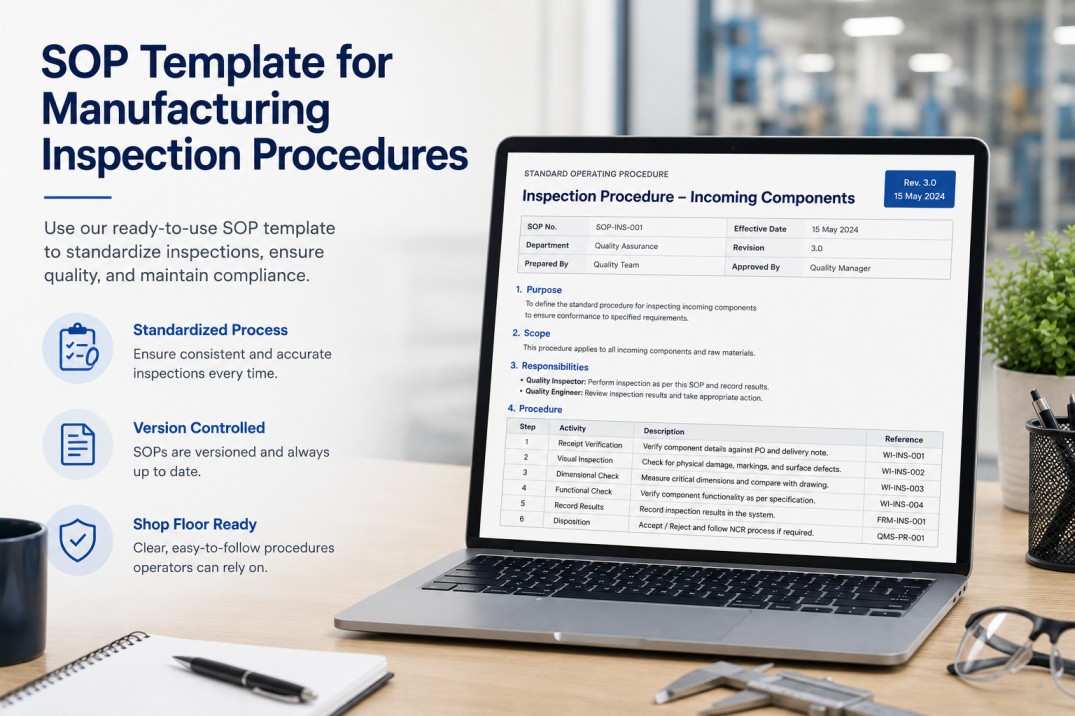
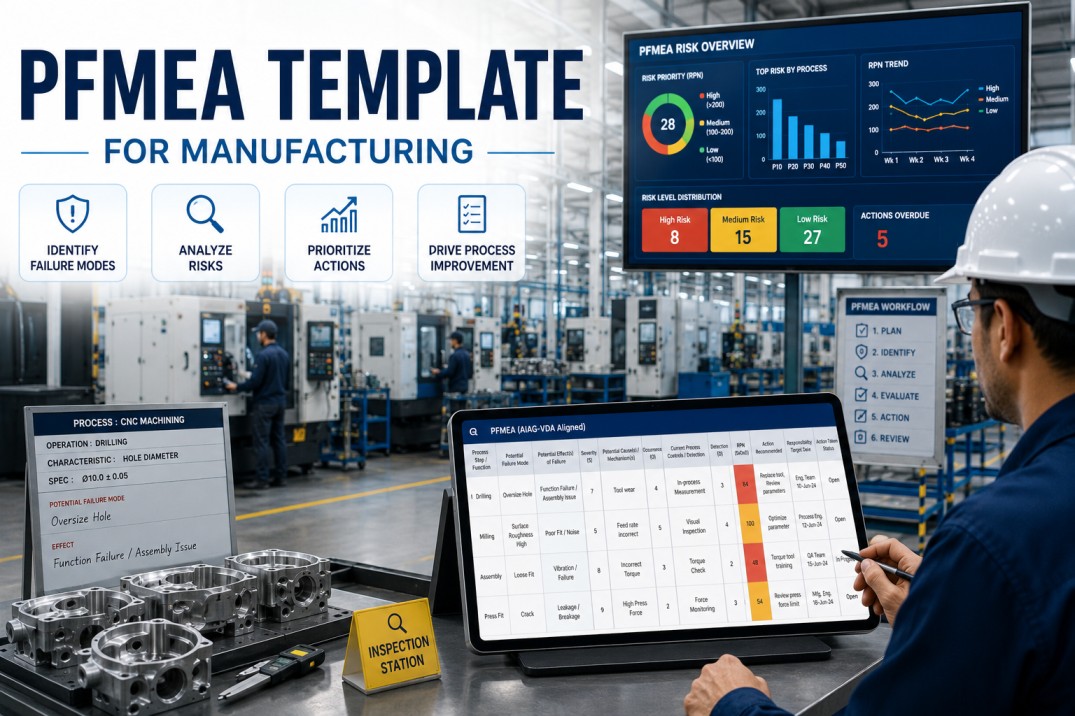
A control plan template is the living document that connects your process design to your production floor — specifying every process step, the characteristics to control at that step, the specification limits, the measurement method, the sample size and frequency, and the reaction plan when results go out of control. An AIAG-aligned control plan is not optional for IATF 16949 suppliers; it is a PPAP deliverable and the reference document that governs in-process inspection on every production run. This page walks through every column of an AIAG control plan format, explains what each field requires, and shows how iFactory makes control plans the living source of truth on the floor rather than a static document that gets updated once a year.
Make Your Control Plan the Live Source of Truth on the Production Floor
iFactory links each control plan row directly to the in-process inspection workflow — so when your IPQC inspector records a measurement, it is automatically referenced against the correct control plan characteristic, specification, and reaction plan.
Control Plan Header — Part and Process Identification
The control plan header identifies the part, process, and revision level and links the document to the associated PFMEA and process flow diagram. Header information must be complete and current at all times — a control plan with an incorrect part revision or an outdated PFMEA reference is non-conforming documentation.
Control Plan Number
Unique document control number for the control plan. Must be traceable in your document management system. Revision history maintained in document footer.
Part Number & Rev
Engineering part number and current drawing revision. Must match the active revision in document control. Updated via change control on every design change.
Part Name / Description
Part name and description as it appears on the engineering drawing. Consistent naming across control plan, PFMEA, and process flow.
Supplier / Plant
Supplier name and DUNS number (if applicable), manufacturing plant location, and plant code. Required for multi-site manufacturing organizations.
Date (Original / Revised)
Original issue date and most recent revision date. Revision date must be updated any time the control plan content changes.
Core Team
Names of the cross-functional team responsible for the control plan — engineering, quality, manufacturing, and customer representatives where applicable.
AIAG Control Plan Column Structure
The AIAG control plan format specifies a defined column structure that all automotive OEMs recognize. Each column serves a specific function — together they document the complete surveillance and reaction framework for every production operation. Missing columns or substituted column headers are flagged by OEM quality auditors as evidence of a non-AIAG-compliant control plan format.
| Column | Field Name | What to Enter | Example |
|---|---|---|---|
| 1 | Part / Process Number | Sequential number or routing operation number | Op 30 |
| 2 | Process Name / Operation Description | Name of the manufacturing operation | CNC Drilling — Spindle 2 |
| 3 | Machine / Device / Jig / Fixture | Equipment ID used for this operation | VMC-04 / Fixture F-19 |
| 4 | Characteristic Number | Balloon number from drawing or PFMEA characteristic reference | Char. 14 |
| 5 | Product / Process Characteristic | Specify whether characteristic is Product (dimensional, functional) or Process (speed, temperature, pressure) | Product |
| 6 | Special Characteristic Classification | SC, KPC, CC, or blank — per AIAG and customer-specific definitions | SC (Safety Critical) |
| 7 | Product / Process Specification / Tolerance | Nominal value and tolerance from drawing or process specification | 12.50mm ±0.05 |
| 8 | Evaluation / Measurement Technique | Gauge type and gauge ID number | CMM / Bore gauge BG-07 |
| 9 | Sample Size | Number of pieces per sample — from AQL table or defined in control plan | 5 pieces |
| 10 | Sample Frequency | How often the sample is taken — per shift, per hour, per lot, or 100% | Every 60 min |
| 11 | Control Method | How the process is controlled: SPC, attribute chart, visual, or mistake-proofing | X-bar R chart |
| 12 | Reaction Plan | Specific action to take when results go out of control or out of spec | Stop run, notify supervisor, 100% inspect suspect lot since last good sample |
Special Characteristic Classification
Special characteristics are product or process characteristics for which reasonably anticipated variation could significantly affect the safety, compliance, fit, function, performance, or subsequent processing of the product or part. All special characteristics must be identified on the engineering drawing, carried through the PFMEA, and controlled in the control plan with tighter monitoring than standard characteristics. Customer-specific requirements define which symbols apply — AIAG, Ford, GM, and Stellantis each have their own classification conventions.
Common Special Characteristic Symbols
- CC (Critical Characteristic): Ford — safety, regulatory, or functional. 100% inspection or validated poka-yoke required.
- SC (Significant Characteristic): Ford/GM — important to fit, function, or customer satisfaction. Cpk ≥ 1.67 required.
- KPC (Key Product Characteristic): GM — requires SPC with Cpk ≥ 1.67.
- KCC (Key Control Characteristic): GM — process parameter that must be monitored and controlled.
- Safety / Regulatory Symbol: AIAG inverted delta (▽) — drawing callout for safety-critical features.
Control Requirements by Classification
- CC / Safety: 100% inspection or validated mistake-proofing. No sampling. Cpk data required at PPAP.
- SC / KPC: SPC with X-bar R or I-MR chart. Cpk ≥ 1.67 at PPAP. Ongoing Cpk monitoring reported to customer.
- Standard Dimensional: Sampling per AQL or defined frequency. Cpk ≥ 1.33 for PPAP approval.
- Process Parameters: Defined monitoring frequency. Control limits based on process capability study. OCAP required.
Reaction Plan — The Most Neglected Column
The reaction plan is the most neglected column in most control plan templates. Entries like "contact supervisor" or "check process" are not reaction plans — they are non-answers that provide no guidance to an operator or inspector facing an out-of-control condition at 2 AM on a weekend shift. A complete reaction plan specifies: stop or continue, who to contact, what to do with suspect product, and what constitutes a return-to-normal condition.
1. What happens to the process — stop or continue? 2. What happens to the product produced since the last good measurement — hold, sort, or scrap? 3. Who is notified, and how? 4. What must happen before the process is restarted? Every reaction plan that cannot answer all four questions is incomplete.
A generic reaction plan applied to all characteristics is not a control plan — it is a placeholder. The reaction plan for a dimensional characteristic out of tolerance is different from the reaction plan for an SPC point outside control limits, which is different from the reaction plan for a poka-yoke failure. Each requires a specific, written response.
The best way to verify a reaction plan is actionable is to walk an operator through it before a real event occurs. Reaction plans that require the operator to find a document they have never seen, contact a person whose number is not posted, or take an action that requires equipment they do not have access to will not be followed in production conditions.
Link Your Control Plan to Live Inspection Results on the Floor
iFactory connects each control plan row to the IPQC inspection workflow — so your control plan defines the inspection frequency and sample size that appear on the inspector's device, and results are automatically compared against the control plan specification.
Control Plan Checklist — 25 Items
Use this checklist to audit a control plan for AIAG column completeness, special characteristic coverage, reaction plan quality, and PPAP submission readiness before customer submission or internal audit.
| # | Checklist Item | Type | Priority | Photo | Required | Critical |
|---|---|---|---|---|---|---|
| 1 | Control plan number and revision level assigned — traceable in document management system | Pass/Fail | High | — | ✓ | ✓ |
| 2 | Part number and current drawing revision match active document control revision | Pass/Fail | High | — | ✓ | ✓ |
| 3 | Linked PFMEA number and revision level recorded in header | Pass/Fail | High | — | ✓ | ✓ |
| 4 | Original issue date and most recent revision date both present | Pass/Fail | Med | — | ✓ | — |
| 5 | Core team members listed — engineering, quality, and manufacturing represented | Pass/Fail | Med | — | ✓ | — |
| # | Checklist Item | Type | Priority | Photo | Required | Critical |
|---|---|---|---|---|---|---|
| 6 | All 12 AIAG columns present — no substituted or missing column headers | Pass/Fail | High | — | ✓ | ✓ |
| 7 | Every active process operation in the routing has at least one control plan row | Pass/Fail | High | — | ✓ | ✓ |
| 8 | Product vs. Process characteristic type specified for each row | Pass/Fail | High | — | ✓ | ✓ |
| 9 | Specification/tolerance column shows nominal value and tolerance — not "per drawing" | Pass/Fail | High | — | ✓ | ✓ |
| 10 | Gauge / measurement technique column includes gauge ID number | Pass/Fail | High | — | ✓ | ✓ |
| 11 | Sample size and frequency columns both populated for every row | Pass/Fail | High | — | ✓ | ✓ |
| # | Checklist Item | Type | Priority | Photo | Required | Critical |
|---|---|---|---|---|---|---|
| 12 | All special characteristics from drawing and PFMEA carried into control plan | Pass/Fail | High | — | ✓ | ✓ |
| 13 | Correct customer symbol applied — CC, SC, KPC per customer-specific requirements | Pass/Fail | High | — | ✓ | ✓ |
| 14 | Special characteristics have tighter sample size or 100% inspection — not standard sampling | Pass/Fail | High | — | ✓ | ✓ |
| 15 | SPC chart type specified for KPC/SC characteristics — X-bar R or I-MR | Pass/Fail | High | — | ✓ | ✓ |
| # | Checklist Item | Type | Priority | Photo | Required | Critical |
|---|---|---|---|---|---|---|
| 16 | Reaction plan column populated for every row — not left blank | Pass/Fail | High | — | ✓ | ✓ |
| 17 | Reaction plan specifies stop/continue decision for the process | Pass/Fail | High | — | ✓ | ✓ |
| 18 | Reaction plan specifies disposition of suspect product since last good sample | Pass/Fail | High | — | ✓ | ✓ |
| 19 | Reaction plan names who to notify — not generic "contact supervisor" | Pass/Fail | High | — | ✓ | ✓ |
| 20 | Reaction plan states restart condition — what must happen before resuming production | Pass/Fail | High | — | ✓ | ✓ |
| # | Checklist Item | Type | Priority | Photo | Required | Critical |
|---|---|---|---|---|---|---|
| 21 | Control plan updated and reissued when any process or tooling change occurs | Pass/Fail | High | — | ✓ | ✓ |
| 22 | Customer approval obtained before implementing any control plan change affecting submitted characteristics | Pass/Fail | High | — | ✓ | ✓ |
| 23 | All detection controls in control plan match corresponding PFMEA column 8 entries | Pass/Fail | High | — | ✓ | ✓ |
| 24 | Control plan included in PPAP submission package — current revision | Pass/Fail | High | — | ✓ | ✓ |
| 25 | Gauge IDs in control plan match current calibration database — no retired gauges listed | Pass/Fail | Med | — | ✓ | — |
Frequently Asked Questions
What is a control plan and why is it required?
A control plan is a document that describes the systems for controlling part and process quality during production and service. It is required by IATF 16949 as a PPAP deliverable, by AS9100 for production process control, and by most automotive OEM customer-specific requirements. The control plan documents every characteristic to be controlled at each production operation, the specification, the measurement method, the sample size and frequency, and the reaction plan when results are out of control. Without a current control plan, a production operation is uncontrolled from a quality standpoint.
What is the AIAG control plan format?
The AIAG control plan format is the column structure defined by the Automotive Industry Action Group in the APQP and Control Plan reference manual (4th Edition). It specifies the standard header fields (part number, revision, PFMEA reference, date) and the 12 operational columns: part/process number, operation description, equipment, characteristic number, characteristic type, special characteristic classification, specification/tolerance, measurement technique, sample size, frequency, control method, and reaction plan. All automotive OEM customers — Ford, GM, Stellantis, BMW, Toyota — accept the AIAG format.
How often must a control plan be updated?
A control plan must be updated whenever a change is made to the product design, manufacturing process, equipment, material, tooling, or measurement method that affects any controlled characteristic. The control plan must also be reviewed periodically — typically annually — as part of the management review process. IATF 16949 requires that the control plan be approved by the customer before shipment for any change that affects characteristics on a submitted control plan. Changes made without customer notification or approval are a major non-conformance.
What is the link between PFMEA and the control plan?
The control plan is a direct output of the Process FMEA (PFMEA). Every prevention and detection control listed in the PFMEA for a given failure mode should appear as a monitored characteristic in the control plan, with the corresponding measurement method, frequency, and reaction plan. Special characteristics identified in the PFMEA must carry through to the control plan with the correct classification symbol. A control plan that cannot be traced back to a PFMEA row is missing its quality rationale and will be questioned in any customer audit.
How does iFactory use the control plan in production?
iFactory uses the control plan as the source of truth for IPQC inspection — when an inspector opens an inspection on iFactory for a given operation, the system displays the characteristics defined in the control plan for that operation, along with the nominal value, tolerance, sample size, and measurement method. Results are entered against the control plan specification, and the system alerts immediately when any result is outside the control limit. The reaction plan text is available to the inspector directly in the workflow. Book a Demo to see it running. Book a Demo
Replace Your Control Plan Excel Template with a Live Digital Document
iFactory makes the control plan a living document that drives production floor quality — not a file that sits in a quality folder and gets updated once a year. AIAG-aligned control plan template, linked to PFMEA and connected to live IPQC inspection results.