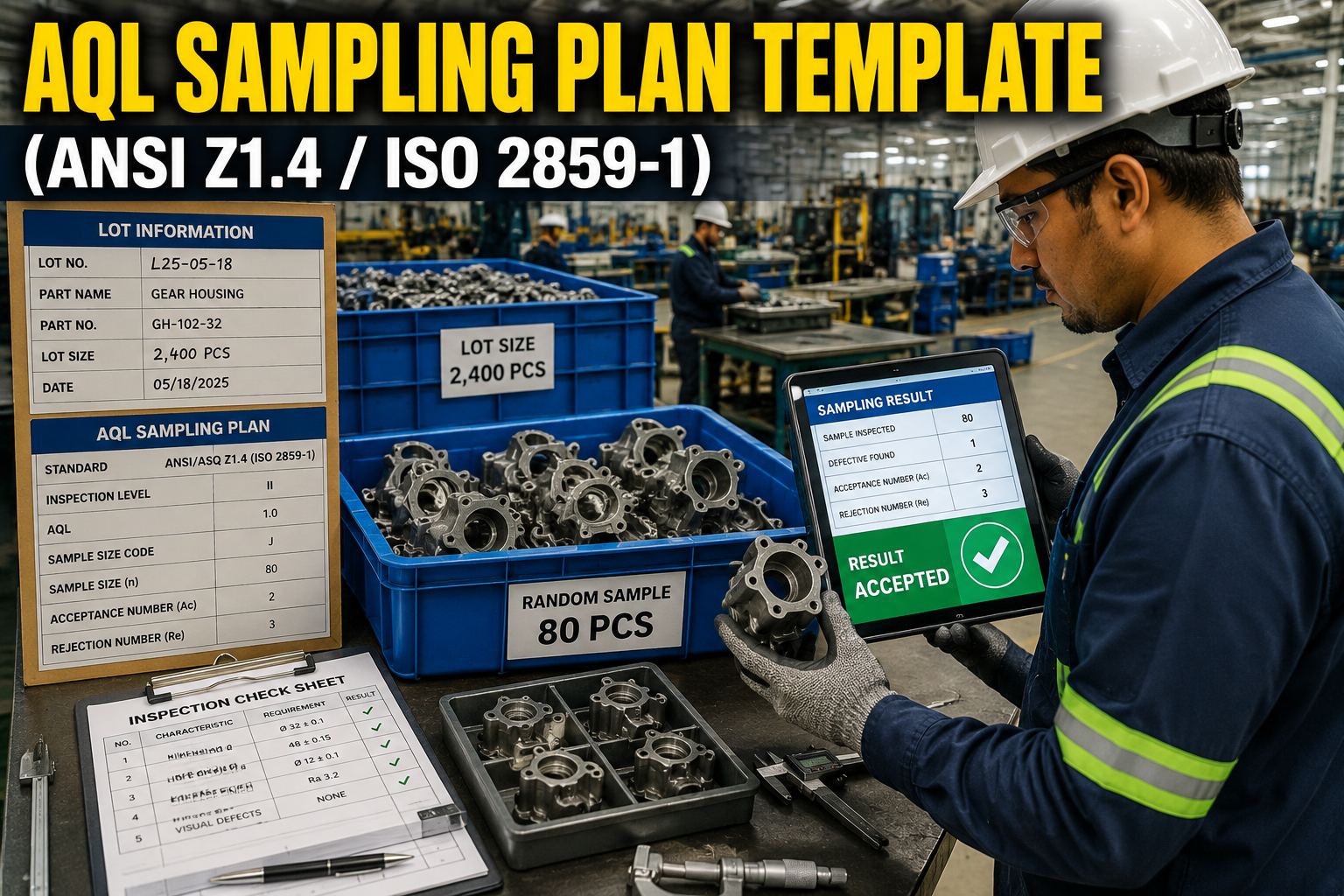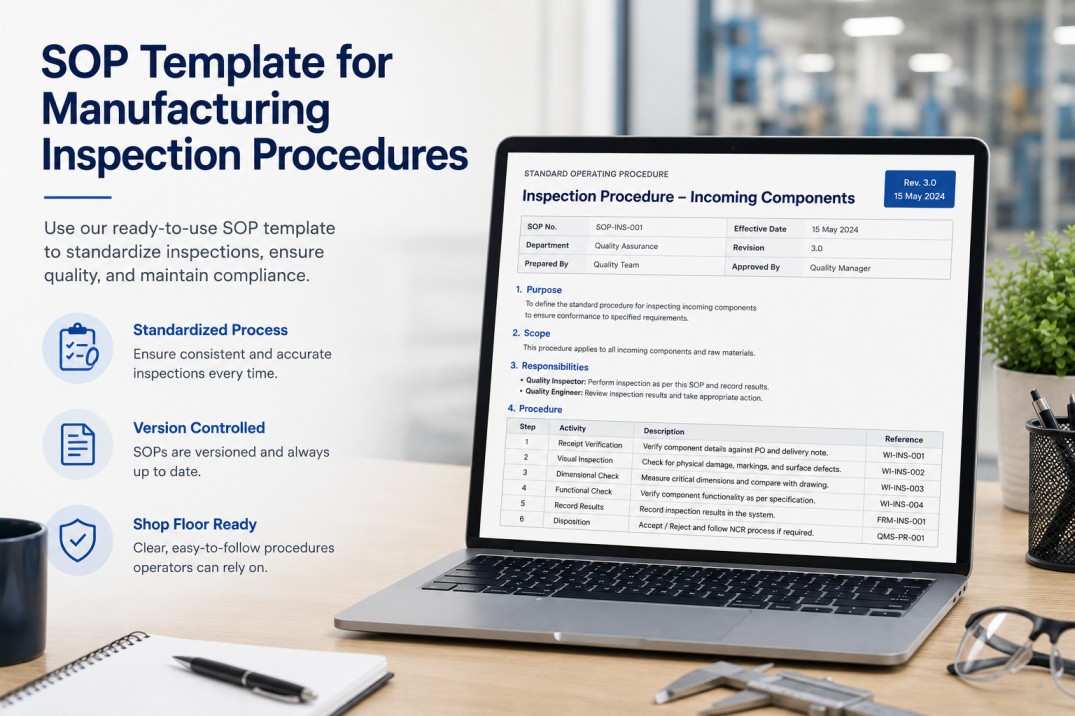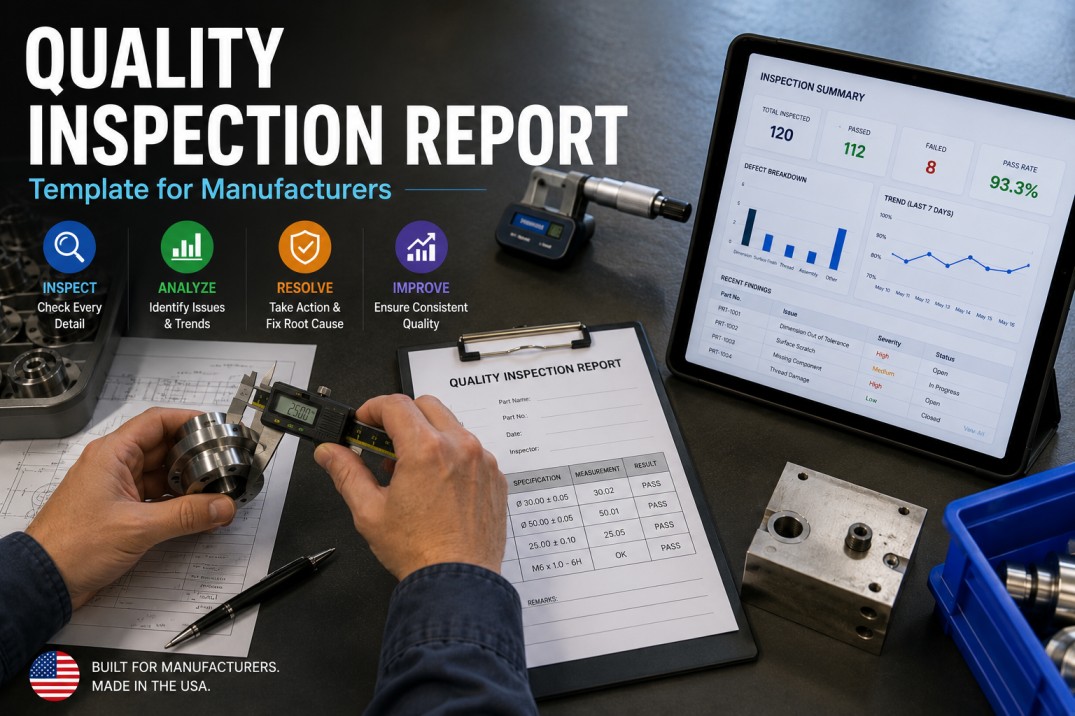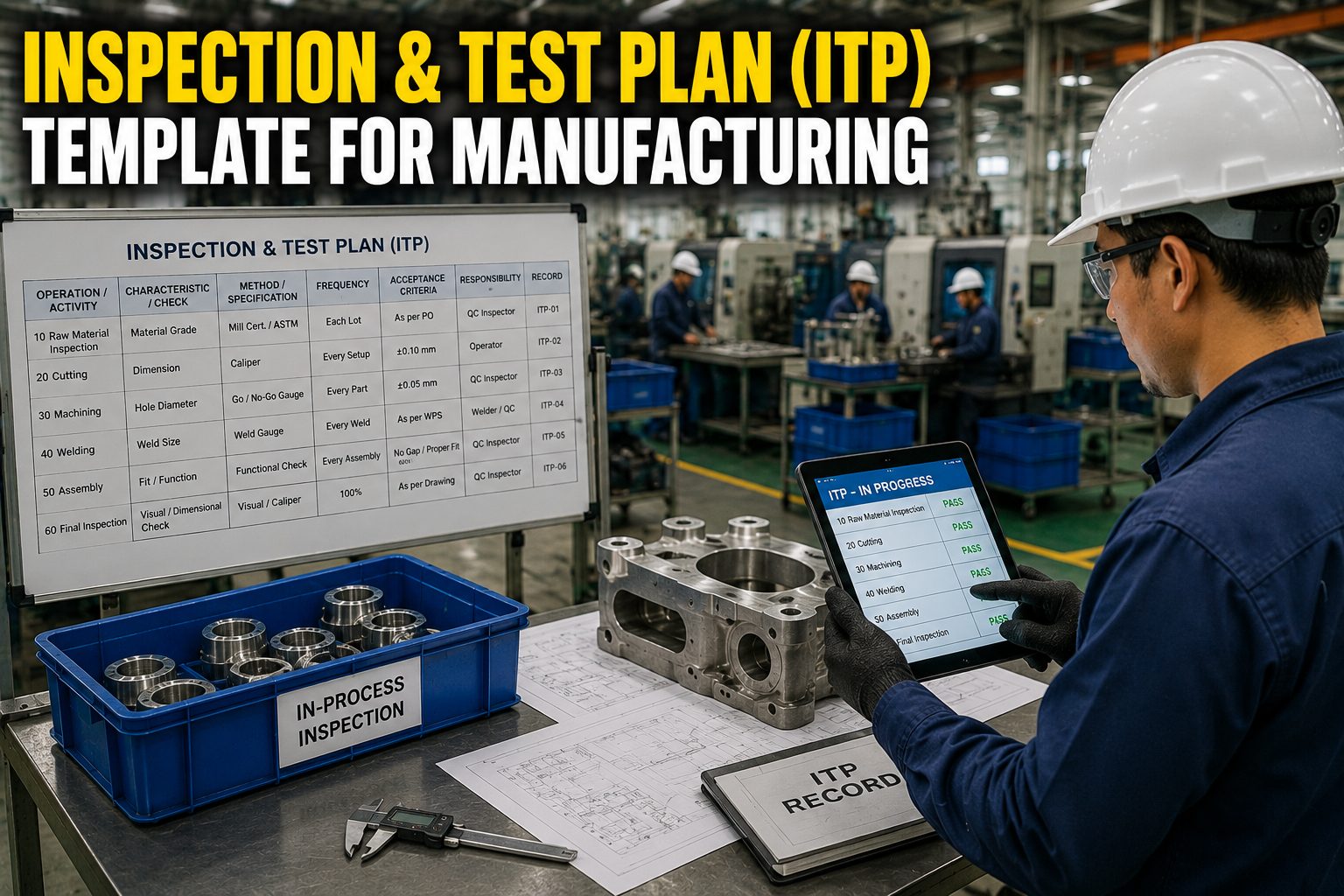
An Inspection and Test Plan (ITP) aligns every manufacturing operation with an inspection activity, ensuring no critical characteristic passes unchecked. It defines what to inspect, which method to use, acceptance criteria, and hold points. Without a structured ITP, traceability gaps create rework and compliance risk. This template provides seven ITP components: a scoreboard, a 12-operation table, component cards, a workflow, a process flow, method reference cards, and FAQ.
Audit Your Current ITP Against Best-Practice Standards
Is Your ITP Missing Critical Inspection Points? Benchmark Your Inspection and Test Plan Against Industry Standards for ASME, API, and ISO 9001 Compliance.
iFactory’s quality module includes a pre-built ITP assessment tool that compares your current inspection plan against best-practice standards derived from ASME Section VIII, API Q1, ISO 3834, and AWS D1.1 requirements. Upload your existing ITP or build from scratch using standardised templates for pressure vessels, piping, structural steel, and general fabrication. The tool identifies gaps in hold point coverage, missing acceptance criteria, and inconsistent method selection, then generates a prioritised remediation plan. Assessment and gap analysis takes one to two hours for a typical 50–100 operation ITP, and the results are presented as an actionable improvement register with severity-ranked findings.
ITP Coverage Scoreboard
The scoreboard provides a high-level view of your ITP’s completeness and coverage across the manufacturing process. Operations Mapped shows the total number of production steps that have corresponding inspection activities, Inspection Points tracks the combined count of hold (H), witness (W), and review (R) points defined in the plan, Acceptance Criteria reflects the total number of quantified pass-fail standards documented across all inspection characteristics, and ITP Compliance measures the percentage of inspection points that are completed and signed off against the planned schedule over the reporting period. These four metrics give quality managers and plant leadership an instant read on whether the ITP is comprehensive, properly resourced, and being followed on the line.
Full Inspection & Test Plan: Operations, Methods, and Acceptance Criteria
The ITP table lists every production operation in sequence with its corresponding inspection activities, methods, sample sizes, acceptance criteria, responsible parties, and record references. Each row represents one operation-inspection pair, and operations are grouped by production stage from raw material receipt through fabrication, welding, post-weld processing, testing, and final release. The table serves as the working document for operators, inspectors, and quality engineers on the production floor, and is referenced during internal audits, client inspections, and third-party certification reviews. Scroll horizontally to view all nine columns across the full ITP scope.
| Item # | Operation Description | Inspection Characteristic | Inspection Method | Frequency | Sample Size | Acceptance Criteria | Responsible | Record |
|---|---|---|---|---|---|---|---|---|
| 010 | Receive & verify raw material certs | Material grade, heat number, mill cert | Visual / Document Review | Each lot | 1 per lot | Cert matches PO, no damage | QA Inspector | R-001 |
| 020 | Surface prep & cleaning | Surface finish, cleanliness, no defects | Visual Inspection | 100% | Each unit | No rust, pitting, scratches >0.3 mm | Operator | R-002 |
| 030 | Tack weld assembly | Weld size, position, alignment | Visual / Dimensional | 100% | Each joint | Per WPS, gap <1.5 mm, offset <1.0 mm | Welder | R-003 |
| 040 | Full weld — root pass | Penetration, porosity, undercut | Visual / NDT (PT) | 100% | Each weld | No cracks, porosity <3% of area | Welder / NDT Tech | R-004 |
| 050 | Full weld — fill & cap | Weld profile, reinforcement height | Visual / Dimensional | 100% | Each weld | Reinf 1.0–2.5 mm, no slag | Welder | R-005 |
| 060 | UT inspection of welds | Internal discontinuities, bond integrity | NDT (UT) | 25% random | Per WPS | Per ASME Sec V, no linear indications >3 mm | NDT Level II | R-006 |
| 070 | RT inspection of critical welds | Volumetric soundness | NDT (RT) | 100% critical joints | Per WPS | Per ASME Sec VIII, Div 1 | NDT Level III | R-007 |
| 080 | Dimensional check after welding | Length, width, squareness, bolt pattern | Dimensional (CMM) | 100% | Each unit | Per drawing ±1.0 mm / ±0.5 mm critical | QA Technician | R-008 |
| 090 | Hydrostatic pressure test | Leak tightness at 1.5× design pressure | Pressure Test | 100% | Each unit | No drop >1% over 30 min hold | QA Inspector | R-009 |
| 100 | Final surface treatment (paint/coating) | DFT, adhesion, colour, gloss | Visual / Dimensional | 100% | Each unit | DFT per spec ±15%, adhesion class 3 min | Operator / QA | R-010 |
| 110 | Functional test assembly | Cycle time, torque, alignment | Functional Test | 100% | Each unit | Per test procedure, all criteria met | Assembly Lead | R-011 |
| 120 | Final inspection & release | Complete ITP sign-off, record review | Document Review | 100% | Each unit | All records complete, all H/W points signed | QA Manager | R-012 |
ITP Component Cards: Understanding Each Section of the Plan
An effective ITP comprises several interconnected components that together provide complete inspection coverage. The six component cards below explain the purpose, application, and best-practice usage of hold points (where production must stop for mandatory inspection), witness points (where the inspector must be notified), review points (for documentation sign-off), inspection method codes, acceptance criteria types, and record references. Each card includes a concrete example from a typical fabrication ITP to illustrate real-world application.
Watch How iFactory Makes ITPs Executable on the Line
From Paper Binder to Live Workflow: See How iFactory Transforms Your ITP into a Digital Gatekeeper That Enforces Hold Points, Tracks Sign-Offs, and Builds the Record Package Automatically.
Watch our on-demand demo to see how iFactory’s quality module ingests your ITP and converts it into a live, enforceable workflow on the production floor. The demo walks through a complete ITP lifecycle: importing the plan, assigning inspection tasks to operators and inspectors with mobile-enabled checklists, enforcing hold points that block the next operation until sign-off is complete, sending automated witness point notifications with acknowledgment tracking, and compiling the final inspection and test record package with one click when all points are closed. The demo runs approximately 12 minutes and covers the full digital ITP deployment from plan upload to audit-ready documentation.
Five-Step ITP Creation Workflow
Creating a robust ITP follows a structured five-step process that transforms your manufacturing process map into a comprehensive inspection and test plan. Each step builds on the previous one, starting with operations mapping and ending with hold point assignment. The workflow involves cross-functional input from process engineering, quality assurance, design, NDT services, and client representatives. Use the five-step flow below as a checklist when building or revising your ITP for any product or project.
ITP Quality Gate Flow: Production Stages with Hold and Witness Points
The quality gate flow diagram shows the five major production stages with their corresponding inspection gates marked as H (Hold) or W (Witness). Raw material receipt requires witness of MTR review and material identification. Welding operations have hold points for root pass UT inspection and cap pass visual verification before proceeding. Post-weld operations require hold points for dimensional inspection and RT of critical joints. Final testing is a mandatory hold point before dispatch clearance. The visual flow helps production teams, inspectors, and client representatives understand at a glance where inspection activities occur along the production sequence and which gates require mandatory stop before proceeding.
Inspection Method Reference: Codes, Applications, and Standards
The inspection method reference cards provide a quick-reference guide to the eight most commonly used inspection codes in manufacturing ITPs. Each card shows the method code and name, a description of what the method detects, typical applications in production, and the relevant acceptance standard. Operators and inspectors can use this reference to ensure the correct method is applied at each inspection point, and quality engineers can refer to it during ITP development to select the appropriate technique for each characteristic.
Frequently Asked Questions
What is an Inspection and Test Plan (ITP) in manufacturing?
An Inspection and Test Plan (ITP) is a quality management document that defines the sequence of inspections, tests, and verification activities required at each stage of a manufacturing process. The ITP maps every production operation to its corresponding inspection activity, specifies the inspection method, acceptance criteria, sample size, frequency, and responsible party, and designates hold points (H), witness points (W), and review points (R) where work must stop or be observed before proceeding. ITPs are widely used in industries subject to quality codes and standards, such as ASME, API, ISO 9001, and AWS, where traceable evidence of inspection and testing is required for certification and regulatory compliance. The ITP serves as the single source of truth for quality control planning and is referenced throughout production by operators, inspectors, and quality engineers.
What is the difference between a hold point and a witness point in an ITP?
A hold point (H) is a mandatory stop in the production process where work cannot proceed until the designated inspection or test has been completed, results have been reviewed against acceptance criteria, and the hold point has been formally signed off by the authorised inspector or client representative. If the hold point is not released, the next operation cannot begin. A witness point (W) requires the inspector or client representative to be notified and given the opportunity to attend the inspection or observe the operation. However, if the inspector does not attend within the agreed notification period (typically 24–48 hours), production may proceed after documented deferral. Review points (R) are documentation checks where inspection records and test reports are reviewed and approved before the next operation begins. Hold points are assigned to the most critical operations where the risk of proceeding unchecked is unacceptable — such as pressure testing, NDT of welds, and final dimensional verification.
How do I create an ITP for my manufacturing process?
Creating an ITP involves five main steps. First, map your entire manufacturing process as a sequence of operations from raw material receipt to final dispatch, identifying every step that requires inspection or testing. Second, for each operation, identify the inspection characteristics — what specific parameters or attributes must be verified (dimensional accuracy, weld quality, material properties, surface finish, etc.). Third, define the inspection method for each characteristic: visual inspection, dimensional measurement, non-destructive testing (UT, MT, PT, RT), pressure testing, leak testing, or functional testing. Fourth, set quantified acceptance criteria for each characteristic, referencing the governing code, standard, or drawing specification. Fifth, designate hold points (H) for critical operations, witness points (W) where client attendance may be required, and review points (R) for documentation sign-off. Assign responsibility for each inspection (operator, QA inspector, NDT technician) and define the record reference for traceability. iFactory’s quality module includes a pre-built ITP template that guides you through each step with standardised code references and acceptance criteria libraries.
What standards and codes govern ITP formats in manufacturing?
ITP formats are governed by the applicable product or process code that defines the minimum inspection and testing requirements for the specific industry and application. Common standards include: ASME Boiler & Pressure Vessel Code Section VIII Division 1 for pressure vessels, ASME B31.3 for process piping, API 6D for pipeline valves, AWS D1.1 for structural welding, ISO 3834 for welding quality requirements, and ISO 9001 clause 8.1 for operational planning and control. In aerospace and defence, AS9100 and NADCAP define ITP requirements. In the oil and gas industry, API Q1 and ISO TS 29001 specify quality management and inspection planning. While the specific format varies by industry and company, all effective ITPs share common elements: a sequential operation list, defined inspection characteristics, specified methods and acceptance criteria, clear hold/witness/review point designation, and traceable record references. The ITP format should be agreed upon between the manufacturer and the client or third-party inspection agency before production begins.
How does digital ITP management improve upon paper-based ITPs?
Digital ITP management transforms a static document into a live workflow that enforces inspection sequences, tracks completion status in real time, and provides immediate visibility into hold point status across all active production units. A paper-based ITP requires manual tracking of signatures, physical handover of inspection records, and reactive status updates — often leading to delays, lost records, and gaps in traceability. Digital ITP management in iFactory automates hold point enforcement (the system blocks the next operation until the hold point inspection is completed and signed off), sends notifications for witness point schedules, links each inspection result directly to its record reference, and provides a real-time dashboard showing ITP completion status by unit, operation, and inspection point. Digital ITP also enables instant access to historical inspection data for trend analysis, reduces the time spent on administrative record-keeping, and ensures that the complete inspection and test record package is audit-ready at any time. Plants that move from paper-based to digital ITP management typically report 40–60% reduction in inspection cycle time and 100% improvement in record completeness for final documentation packages.
Make Your ITP a Live Workflow — Deployed in Weeks
Your ITP Should Be More Than a PDF. Transform Your Inspection Plan into a Digital Quality Gate System That Enforces Standards, Tracks Compliance, and Delivers Audit-Ready Records.
iFactory enables you to deploy your ITP as a live digital workflow in two to three weeks without custom coding or complex system integration. The platform accepts existing ITP spreadsheets and converts them into enforceable inspection sequences with automated hold point control, real-time completion tracking, and digital signature capture. Each inspection result is linked to its reference record, and the complete ITP record package is compiled automatically as work progresses. Quality managers gain instant visibility into ITP completion status by unit, operation, and inspection point, while production teams work from mobile-enabled checklists that ensure no step is missed. Book a personalised demo to see how your ITP can become a live quality assurance system on the plant floor.