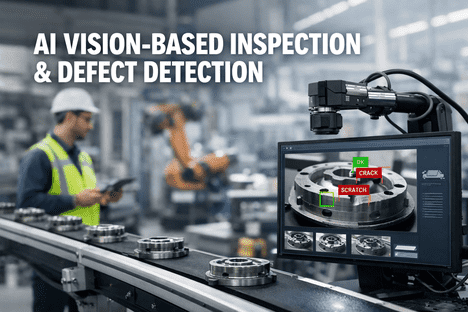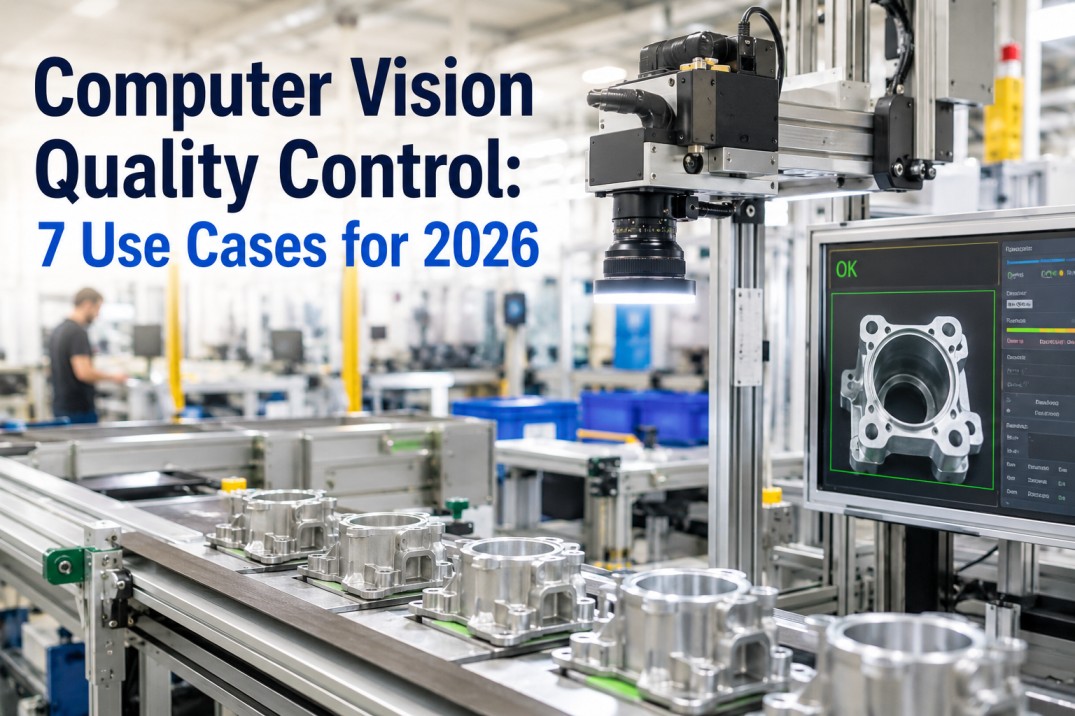
Computer vision quality control has moved from pilot projects to production-line standard in 2026. Cameras, edge processors, and deep learning models now inspect every part on high-speed lines — detecting surface defects, verifying assembly, reading codes, measuring dimensions, and grading finishes at line speed without slowing production. iFactory's computer vision platform runs inference at the edge, using industrial cameras connected to on-device AI that classifies defects in milliseconds and feeds results directly into your quality dashboard, SPC charts, and traceability database. No cloud dependency, no data scientists on staff, no retrofitting existing lines. This guide covers seven proven use cases that manufacturers are deploying today with iFactory computer vision.
Deploy Edge AI Computer Vision on Your Line — No Cloud, No Data Science Team
iFactory computer vision runs inference at the edge with industrial cameras connected to on-device AI. Surface defect detection, OCR, assembly verification, dimensional measurement, and more — all feeding directly into your quality dashboards and SPC charts. Deployment in days, not months.
Surface Defect Detection — Finding Scratches, Dents, and Cracks at Line Speed
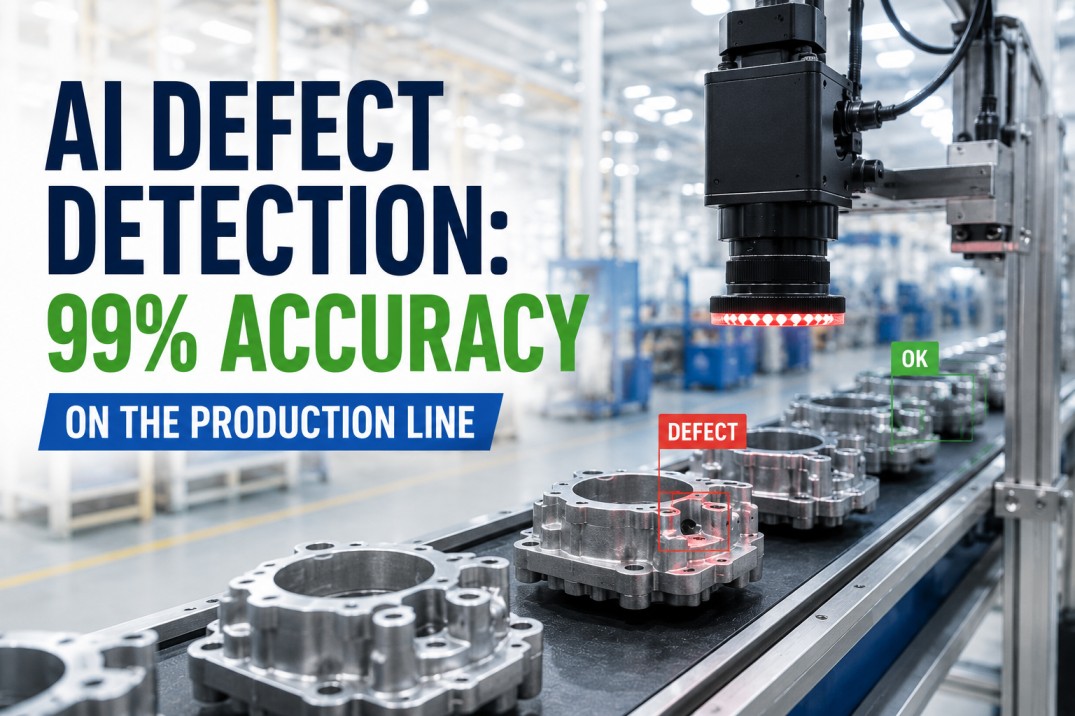
Surface quality inspection is the most deployed computer vision use case in manufacturing. Human visual inspectors typically catch 70-80% of surface defects during a shift, with detection rates dropping sharply after the first two hours. iFactory computer vision systems inspect 100% of parts at full line speed with consistent detection accuracy above 99% for trained defect classes.
iFactory CV detects scratches, dents, cracks, pitting, corrosion, burrs, and surface contamination across metals, plastics, glass, ceramics, composites, and coated surfaces. The system learns normal surface variation from as few as 50 good parts and flags any deviation beyond the configured threshold. Defect images and locations are logged automatically with part serial numbers, enabling traceability and root-cause analysis. Real-time alerts notify operators and quality engineers when defect rates exceed acceptable limits, allowing immediate process intervention.
Dimensional Measurement — Real-Time Gauging Against Tolerances
Manual dimensional inspection with callipers, gauges, and CMM machines samples only a fraction of production and introduces measurement variation between operators. iFactory computer vision measures every part passing the inspection station, comparing critical dimensions against engineering tolerances in real time and flagging out-of-spec conditions before they become a run of bad parts.
iFactory CV measures length, width, height, diameter, roundness, concentricity, hole position, edge profile, gap, flushness, and thread presence. The system supports both absolute measurement against CAD tolerances and comparative measurement against a master reference part. Measurement data streams into SPC charts in real time, showing CPK trends, X-bar and R charts, and early-warning signals before parts drift out of spec. For high-precision applications, sub-pixel interpolation and telecentric optics achieve repeatable accuracy down to ±2 microns.
Optical Character Recognition (OCR) — Lot Numbers, Date Codes, and Serialisation
Traceability regulations in automotive, aerospace, medical devices, and electronics demand reliable reading of lot numbers, date codes, batch IDs, and serial numbers on every part or package. iFactory CV reads direct-mark (DPM), inkjet, laser-etch, dot-peen, thermal-transfer, and embossed codes at line speed, with automatic validation against expected formats and databases.
iFactory OCR and OCV (optical character verification) reads dot-matrix, continuous, and stylised characters in any orientation, including curved surfaces, angled markings, and low-contrast printing. The system validates that the read character string matches the expected format — date logic (month/day validity), sequential serial number integrity, lot code structure — and flags mismatches or unreadable marks in real time. Every read is logged with part, station, and timestamp for full downstream traceability. Neural OCR models handle degraded marks, partial obstructions, and lighting variation that defeat traditional machine-vision OCR.
Assembly Verification — Validating Presence, Position, and Orientation
Missing components, incorrect parts, wrong orientation, and incomplete assemblies are among the most costly quality issues in manufacturing — often discovered downstream or by the customer. iFactory CV verifies every assembly station, confirming that all required components are present, correctly oriented, and fully seated before the part advances to the next operation.
iFactory CV inspects for component presence (all fasteners installed), correct part number verification via OCR or pattern match, orientation (polarised connectors, keyed components, label direction), seating depth, clip engagement, wire routing, and connector lock verification. The system compares each assembly against a golden-reference image or a CAD-derived model, flagging deviations in milliseconds. Multi-camera setups cover complex assemblies from multiple angles in a single pass. Results are tied to serial numbers and station IDs for full genealogy, enabling downstream CAPA and supplier quality tracking.
Label & Packaging Inspection — Print Quality, Barcode, and Seal Integrity
Label and packaging defects — smudged print, missing text, unreadable barcodes, incorrect labels, or compromised seals — trigger chargebacks, regulatory findings, and customer complaints. iFactory CV inspects every label and package station at line speed, validating print quality, data accuracy, barcode readability, and package seal integrity simultaneously.
iFactory CV validates label presence, position, and skew; checks print quality for smudges, streaks, and missing ink; reads 1D barcodes (Code 128, UPC, EAN, ITF) and 2D codes (Data Matrix, QR) for readability and data accuracy; verifies lot numbers and date codes via OCR against expected values; inspects heat-seal and adhesive-seal integrity through thermal imaging and visual gap analysis; and confirms shrink-sleeve registration and tamper-evident band presence. The system rejects defective packages instantly and logs images for supplier quality and compliance reporting.
Weld & Joint Inspection — Porosity, Penetration, and Discontinuity Detection
Welding defects compromise structural integrity and often require expensive post-process X-ray or ultrasonic inspection. iFactory CV performs real-time visual inspection of welds and joints during or immediately after the welding process, detecting surface-level defects that correlate strongly with internal weld quality — enabling immediate rework before the part moves to downstream operations.
iFactory CV detects surface porosity, incomplete fusion, undercut, overlap, spatter, crater cracks, lack of fill, burn-through, and weld seam width variation. For laser and resistance welding, the system monitors the weld pool geometry and keyhole dynamics in real time via high-speed imaging, flagging deviations that predict internal void formation. Inspection results are correlated with weld parameters (current, speed, wire feed) for process optimisation and traceability. The system integrates with robotic welding cells, providing real-time feedback to adjust parameters before out-of-spec welds are produced.
Color & Texture Grading — Finish Consistency and Color Space Matching
Color and finish variation is a leading cause of customer rejection in automotive interiors, consumer electronics, appliances, building materials, and textiles. Human visual assessment of color is subjective, inconsistent across shifts and inspectors, and impossible to quantify in a way that supports statistical process control. iFactory CV measures color and texture objectively against defined standards.
iFactory CV measures colour in multiple colour spaces (CIE Lab, RGB, HSV, spectral reflectance) and grades parts against user-defined tolerance windows. The system detects colour shifts, banding, mottling, gloss variation, orange peel, and texture inconsistency across flat and contoured surfaces. For textured materials — leather, fabric, cast metal, powder coat — the system analyses surface topography and grain pattern uniformity. Multi-angle and multi-illuminant measurements ensure colour consistency under different lighting conditions that match real-world viewing environments. Results are logged with CPK calculations and trend data for proactive process adjustment.
See iFactory Computer Vision on Your Parts in a Live Demo
We will set up a camera on your production line or sample parts and show you defect detection, OCR, dimensional measurement, or assembly verification running in real time — connected to your quality dashboard, no cloud upload required.
Use Case Summary — Camera, Metrics, and Typical Deployments
The table below summarises all seven computer vision use cases, including recommended camera configurations, accuracy benchmarks, and typical deployment scenarios on the plant floor. Use this as a quick reference to identify which use cases apply to your production lines.
| Use Case | Camera Type | Typical Accuracy | Common Industries |
|---|---|---|---|
| Surface Defect Detection | Area-scan or line-scan — 5 to 25 MP | >99% detection, <1% false positive | Automotive, aerospace, electronics, metals, plastics |
| Dimensional Measurement | Telecentric area-scan or multi-camera arrays | ±2–25 µm repeatability >99.7% | Machined parts, stamped components, medical devices |
| OCR / OCV | Area-scan with high-mag optics | >99.5% read rate on well-formed codes | Automotive, pharma, food & beverage, electronics |
| Assembly Verification | Single or multi-camera arrays | >99.8% detection, <0.5% false reject | Electronics, automotive, consumer goods, medical |
| Label & Packaging | Area-scan or line-scan; thermal for seal | >99.5% print defect, >99.8% barcode | Food & beverage, pharma, CPG, logistics |
| Weld & Joint | High-speed area-scan with narrow-bandpass | >98% surface defect detection | Automotive, structural steel, battery, pipe & tube |
| Color & Texture | Multi-spectral area-scan; spectrophotometer | ΔE < 0.5, >97% texture accuracy | Automotive interior, textiles, building materials, appliances |
Frequently Asked Questions About Computer Vision Quality Control
How much data is required to train a computer vision model for defect detection?
Can iFactory computer vision run on existing cameras or does it require specialised hardware?
How does edge-based computer vision differ from cloud-based inspection systems?
What happens when the model encounters a new defect type it was not trained on?
How does iFactory computer vision integrate with existing quality systems and dashboards?
What is the typical ROI and payback period for computer vision quality control?
Ready to Bring Computer Vision Quality Control to Your Line?
Book a 30-minute discovery call. We will review your inspection requirements, recommend the right camera configuration, and show you iFactory computer vision running on your parts — in days, not months.