The daily inspection report captures what happened on every shift, across every line, in every area that affects quality. Without a structured report, supervisors rely on memory and critical findings slip through cracks. This template provides a scoreboard, a report card with shift banner, a 10-area checklist, section cards, a workflow, a rollup SVG from daily to executive views, and FAQ.
Assess Your Daily Inspection Process Today
Find Out Where Your Inspection Process Stands — Evaluate Coverage, Compliance, and Completion Rates Across Every Shift and Line.
Take a structured assessment of your current daily inspection process to identify areas where inspections are being missed, where findings are not being escalated, and where supervisors spend excessive time on paperwork instead of walking the floor. iFactory’s daily inspection template connects directly to your plant systems, giving you real-time visibility into inspection completion rates, defect findings, corrective action status, and rollup reporting. Start with a free assessment and receive a tailored maturity score across five dimensions: coverage, compliance, timeliness, escalation, and digital readiness. The assessment takes 15 minutes and delivers actionable recommendations for strengthening your daily inspection discipline.
Daily Inspection Health Scoreboard
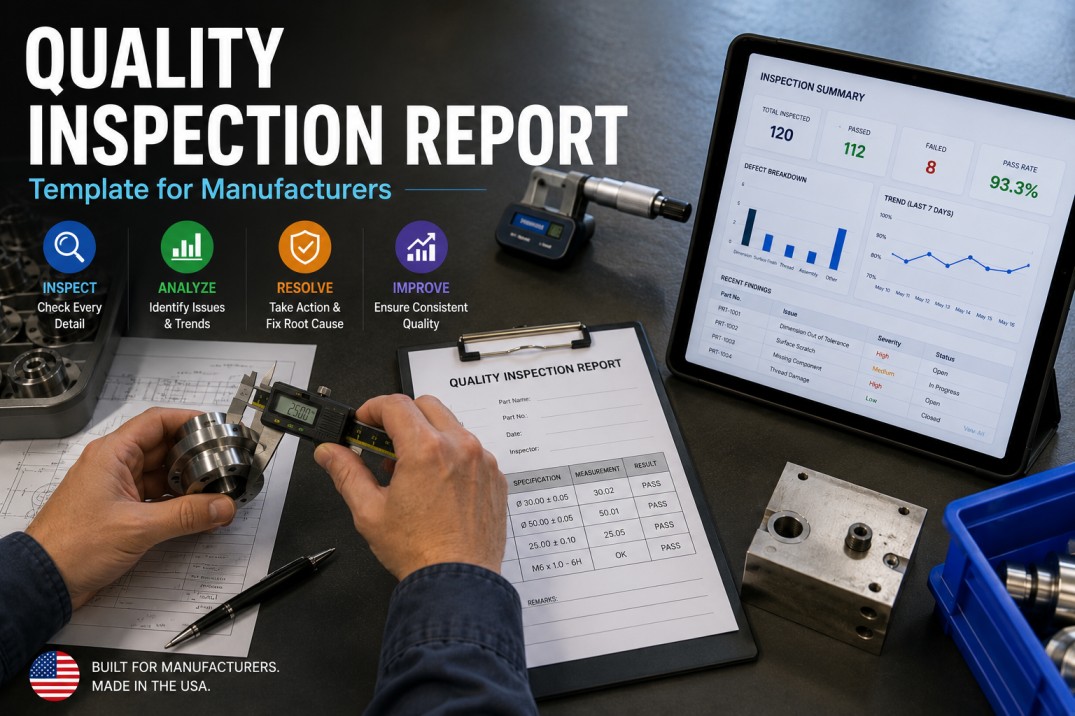
The scoreboard provides a snapshot of your daily inspection programme’s overall health through four critical metrics: the number of inspections completed across all lines today, the number of open corrective action items awaiting closure, the inspection compliance rate showing the percentage of required inspections completed on time, and the week-over-week trend in compliance rate. These metrics help plant supervisors and managers assess whether inspection discipline is improving or declining and identify areas where additional attention or resources are needed to maintain consistent coverage.
Main Daily Inspection Report Card: Shift Information and Production Stats
The main inspection report card combines the shift information banner — showing the date, shift, supervisor name, and line or area covered — with four production stat cards that capture the key output and quality numbers for the shift: production quantity in units, total defects found, rework quantity, and scrap quantity. Each stat card includes an inline indicator icon colour-coded to its performance category, making it easy to scan the report and immediately understand the shift’s production and quality performance at a glance.
Daily Walkthrough Checklist: 10-Area Inspection Coverage
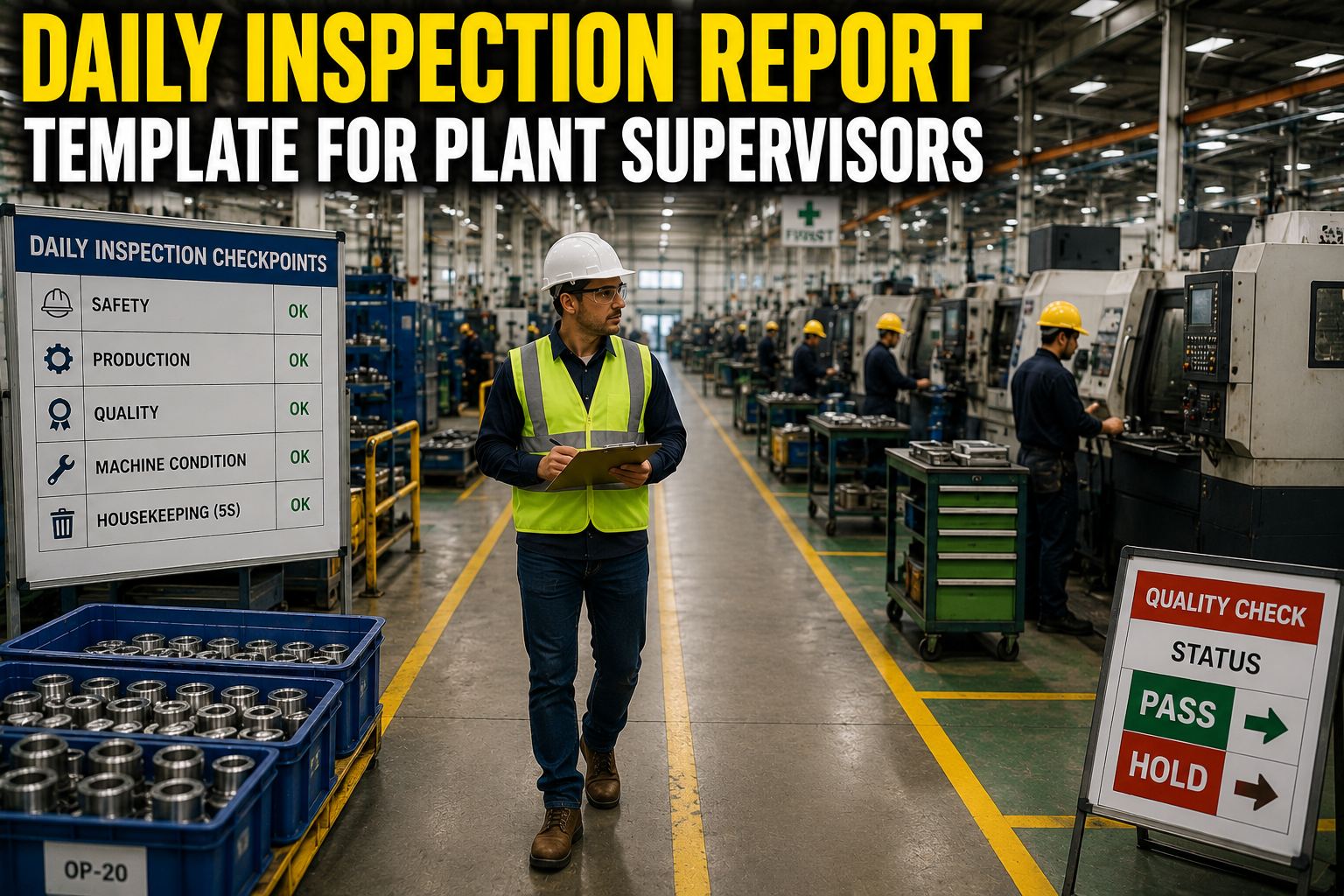
The daily walkthrough checklist provides a structured inspection pathway covering all critical areas of the plant, from the receiving dock through production lines, packaging, quality lab, storage, maintenance, safety, and 5S audit points. Each check item specifies the observation or verification required, the inspection result (Pass, Fail, or Not Applicable), notes from the inspection, and any corrective action initiated when a failure is found. This structured approach ensures that every shift inspection covers the same areas with the same criteria, eliminating coverage gaps and providing consistent data for trend analysis.
| Area / Station | Check Item | Status | Notes | Corrective Action |
|---|---|---|---|---|
| Receiving Dock | Verify incoming material paperwork matches PO | Pass | All docs verified | — |
| Production Line 1 | Check line speed vs standard; no abnormal vibration | Pass | Running at 98% of standard speed | — |
| Production Line 2 | Verify defect count within control limits | Fail | 3 defects above limit on unit 42 | Adjust forming press temperature |
| Production Line 3 | Confirm changeover completed within standard time | Pass | Changeover: 14 min vs 15 min target | — |
| Packaging Area | Inspect seal integrity and label accuracy | NA | Line not running during inspection window | — |
| Quality Lab | Review SPC charts for out-of-control signals | Pass | All charts in control; no signals | — |
| Raw Material Storage | Verify FIFO compliance and bin organisation | Fail | 2 bins with expired date codes found | Rotate stock immediately |
| Maintenance Shop | Check PM schedule adherence for this week | Pass | 4 of 5 PMs completed for the week | — |
| Safety Station | Inspect PPE compliance and eyewash station | Pass | All PPE present; eyewash tested ok | — |
| 5S Audit Point | Assess workstation organisation and cleanliness | Pass | Workstations organised; floors cleaned | — |
Six Essential Sections of the Daily Inspection Report
A complete daily inspection report comprises six standard sections, each covering a distinct dimension of plant operations. Each section captures specific data, follows a defined frequency, and feeds into different parts of the weekly and monthly reporting cycle. Understanding what each section records and why helps supervisors complete reports efficiently and ensures that the inspection report becomes a comprehensive operations document rather than a simple checklist.
See the Template in Action — Book a Live Demo
Live Demonstration of a Connected Daily Inspection Report — From Shift Start Notification to Executive Dashboard Rollup.
Watch how iFactory’s daily inspection template transforms the supervisor’s end-of-shift routine from a 45-minute paperwork exercise into a 10-minute digital recording process with real-time visibility for plant leadership. The demo walks through each of the six report sections, shows how findings are automatically escalated when failures are recorded, demonstrates the mobile inspection interface that supervisors use on the plant floor, and illustrates the one-click rollup into weekly and monthly reports. Book a 30-minute session tailored to your plant type and see how your current inspection process compares to the structured template.
Five-Step Daily Inspection Process: From Shift Start to Report Submission
The daily inspection process follows a structured five-step workflow that guides each supervisor from the start of their shift through to completed report submission. Each step has a defined duration and set of activities that ensure nothing is missed. The workflow integrates naturally with the shift schedule — the line walk occupies the first portion of the shift, findings are recorded immediately, escalations happen in real time, and the report is submitted before the shift ends, creating a complete handover document for the next shift.
Daily Report Rollup Flow: From Shift-Level Detail to Executive View
The daily inspection report is not an isolated document — it is the foundation of the plant’s entire reporting hierarchy. This rollup flow illustrates how individual daily reports aggregate into weekly summaries, monthly management reviews, and ultimately the executive dashboard. Each level of the hierarchy adds context and extracts trends while preserving the granularity needed for root cause analysis. A well-structured daily inspection programme ensures that every level of the organisation has access to current, accurate data for decision-making.
Frequently Asked Questions
How often should daily inspection reports be completed?
Daily inspection reports should be completed at least once per shift for every active production line and support area. Most plants with two or three shifts complete a separate report for each shift, ensuring that every operating period has its own record of inspection findings, production metrics, and safety observations. High-risk areas such as chemical handling, food processing, or pharmaceuticals may require inspections at more frequent intervals, such as every two to four hours. The key principle is that the inspection cadence should match the risk profile of the operation — the more frequent the changeover, operator rotation, or process variability, the more frequently inspections should be performed. Many plants supplement full-shift reports with abbreviated mid-shift walkthroughs that focus on critical checkpoints without duplicating the complete inspection checklist. Digital inspection platforms make it easy to configure different cadences for different areas and adjust them as operational needs evolve.
What is the difference between paper-based and digital daily inspection reports?
Paper-based daily inspection reports are physical checklists completed with pen and paper, typically stored in binders at the supervisor station or a central document cabinet. Digital daily inspection reports are completed using mobile devices, tablets, or workstation terminals and are stored in a central database with automated rollup to dashboards and historical tracking. Digital reports offer several advantages: real-time visibility of findings across shifts and plants, automatic escalation of critical issues to supervisors and managers, elimination of manual data entry and transcription errors, built-in photo and annotation capture, configurable checklists that update instantly across all devices, and seamless integration with quality management and maintenance systems. Paper reports remain in common use in plants without digital infrastructure, but they introduce latency, risk of lost documents, and require manual data aggregation for weekly and monthly reporting. The transition from paper to digital typically takes two to four weeks and delivers immediate productivity gains from eliminated transcription work.
How do daily inspection reports roll up into weekly and monthly reports?
Daily inspection reports feed into weekly summaries by aggregating findings, defects, safety observations, and corrective actions across all shifts for a given week. The weekly summary extracts trends, recurring issues, and open action items, and serves as the basis for the weekly operations review meeting. Monthly reports consolidate all weekly data into a broader view of plant performance across the month, highlighting shifts in defect rates, safety incidents, inspection compliance rates, and corrective action closure performance. The rollup hierarchy ensures that plant management, operations leadership, and executives each receive information at the appropriate level of granularity — supervisors work with daily detail, plant managers with weekly trends, and executives with monthly performance summaries. Digital inspection systems automate this rollup entirely, eliminating the manual consolidation work that consumes hours of supervisor time each week and ensuring that every level of the organisation has access to current data without delay.
What should be included in a daily inspection checklist?
A comprehensive daily inspection checklist should cover all areas and activities that affect production quality, safety, and operational efficiency. Core elements include incoming material verification at receiving, production line parameters (speed, temperature, pressure vs standard), defect rate monitoring against control limits, changeover time tracking, seal integrity and label checks in packaging, SPC chart review in the quality lab, raw material FIFO compliance and bin organisation in storage, preventive maintenance schedule adherence in the maintenance shop, PPE compliance and eyewash station inspection at safety stations, and 5S workstation organisation scoring. Each checklist item should define the acceptance criteria, the observation method (visual inspection, measurement, system check), and the documentation requirement. Checklists should be reviewed quarterly and updated when processes, equipment, or quality standards change. Digital checklists allow plant leadership to update items across all devices instantly, ensuring every shift uses the latest version.
What are the key benefits of digitising daily inspection reports?
Digitising daily inspection reports delivers measurable benefits across multiple dimensions. First, it eliminates the 30–60 minutes per shift that supervisors spend manually transcribing paper inspection findings into spreadsheets or reports. Second, it provides real-time visibility — plant managers can see inspection completion rates, open findings, and safety observations as they are recorded, without waiting for end-of-shift report submission. Third, it enables automated escalation of critical findings, such as safety hazards or quality deviations, directly to the responsible manager via mobile notification. Fourth, it creates a searchable, auditable historical record that supports root cause analysis, trend reporting, and compliance audits. Fifth, it supports standardisation across multiple lines and shifts, ensuring that every inspection follows the same checklist and scoring criteria. Plants that digitise daily inspection reporting typically see a 20–30% reduction in report preparation time and a 15–25% improvement in corrective action closure rates due to real-time visibility and accountability.
Deploy Digital Daily Inspection Reports Across Your Plant
Replace Paper Checklists and Spreadsheets with a Structured Digital Inspection System in Two to Three Weeks.
iFactory’s daily inspection template is ready to deploy across all lines and shifts in your plant. The system includes configurable checklists for each inspection area, mobile interfaces for supervisors on the plant floor, automatic escalation of failed check items, real-time visibility for plant management, and one-click rollup into weekly and monthly reports. Deployment takes two to three weeks and includes checklist configuration, user training, and integration with existing production and quality systems. Book a demo to see the template configured for your plant type and start your digital inspection transformation today.

.jpg)