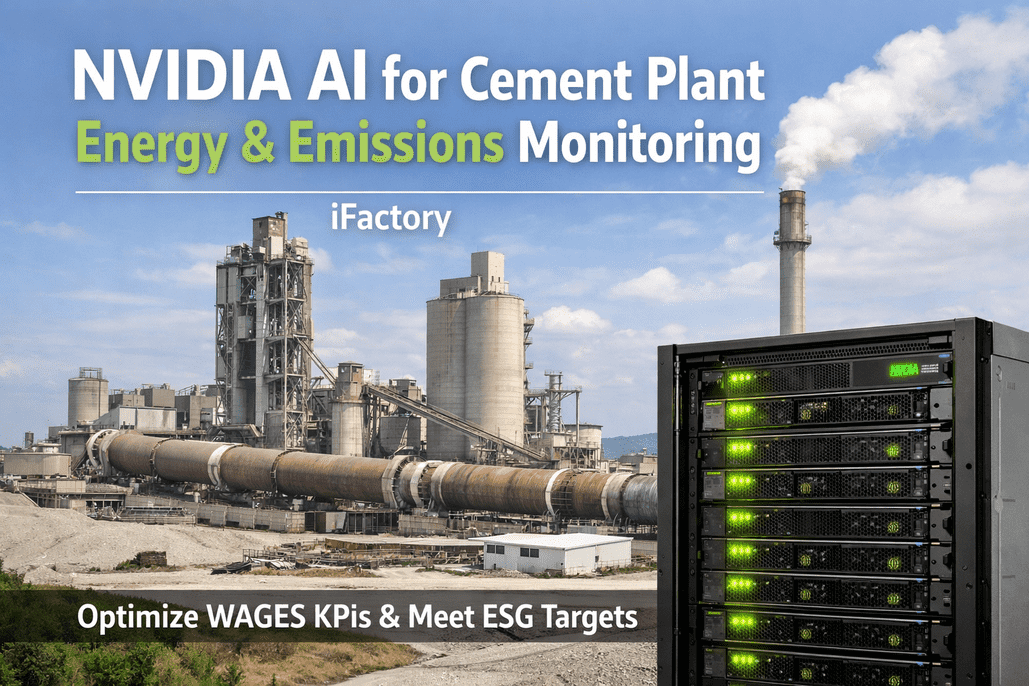
A single rotary kiln consumes fuel worth $4-8M annually, operates at 1,450°C around the clock, and produces 2,000-10,000 tonnes of clinker per day. Yet most cement plants still rely on lab samples taken every 2-4 hours and operator judgment to control kiln performance — creating a blind spot where quality problems compound, fuel is wasted through conservative over-burning, and equipment degradation goes undetected until emergency shutdown. NVIDIA GPU-accelerated AI changes this equation entirely. Machine learning models trained on thousands of hours of process data predict clinker quality in real-time (not hours later), optimize combustion parameters continuously (not periodically), and detect kiln shell hot spots, bearing wear, and girth gear degradation weeks before failure. Cement plants deploying AI kiln controls are documenting 6-15% fuel reductions, $200K-$1.5M+ annual savings per kiln, and clinker quality stability that eliminates the costly gap between production and laboratory verification. Book a 30-minute demo to see NVIDIA-powered kiln optimization running on cement plant data.
AI-Powered Rotary Kiln Optimization
The rotary kiln is a continuous chemical reactor with dozens of interdependent variables — feed chemistry (LSF, silica modulus, alumina modulus), fuel feed rate, kiln speed, ID fan draft, secondary air damper position, burning zone temperature, preheater cyclone temperatures, and calciner conditions. Traditional PID controllers and expert systems cannot simultaneously optimize across these variables because the relationships are non-linear and change with raw material composition, ambient conditions, and equipment wear. GPU-accelerated AI processes all variables simultaneously, identifying relationships that operators and rule-based systems miss.
Preheater Cyclones
AI monitors stage temperatures, pressure drops, and material flow across 4-6 cyclone stages. Predicts blockages 2-4 hours ahead. Optimizes heat recovery to minimize fuel demand downstream.
AI: Blockage prediction, heat recovery optimizationCalciner
20-30% of total fuel is consumed here. AI optimizes fuel split between calciner and kiln, adjusting for raw meal moisture and chemistry variations. Maximizes calcination rate while minimizing fuel waste.
AI: Fuel split optimization, calcination rate controlBurning Zone (Rotary Kiln)
The heart of clinker formation. AI maintains optimal burning zone temperature by adjusting fuel feed, kiln speed, and air distribution in real-time. Predicts free lime content 15-30 minutes ahead, eliminating conservative over-burning that wastes 30-50 kcal/kg of clinker.
AI: Free lime prediction, combustion optimization, temperature stabilityClinker Cooler
AI optimizes grate speed, airflow distribution, and cooling rate to maximize heat recovery and stabilize clinker mineralogy. Returns recovered heat to preheater, reducing overall thermal energy demand.
AI: Cooling rate optimization, heat recovery maximizationWant to see AI optimization applied to your specific kiln configuration? Book a free kiln efficiency assessment — we'll analyze your process data and estimate savings per zone of your pyroprocessing line.
NVIDIA GPU for Clinker Quality Prediction
Free lime (f-CaO) is the single most critical quality indicator for cement clinker. It must stay between 0.5-1.5% — too high wastes energy and creates quality issues, too low reduces product strength. Traditional plants sample every 2-4 hours and wait for lab results. By the time operators learn of a deviation, tonnes of off-spec material have been produced. NVIDIA GPU-accelerated soft sensors predict free lime in real-time from existing DCS data — no new instrumentation required.
| Quality Parameter | Traditional Method | AI Prediction Method | Accuracy | Lead Time Improvement |
|---|---|---|---|---|
| Free Lime (f-CaO) | Lab sample every 2-4 hours | Neural network on DCS data (temps, fuel, O2, feed rate) | 96% classification; R² = 0.99 | 2-4 hrs → 15-30 min |
| Liter Weight | Lab sample every 4-6 hours | Regression on burning zone profile + cooling rate | 94-97% | 4-6 hrs → real-time |
| Clinker Mineralogy (C3S, C2S) | XRD analysis (6-12 hours) | Physics-informed neural network on process + chemistry data | 92-96% | 6-12 hrs → 30-60 min |
| 28-Day Compressive Strength | Physical test (28 days) | Predictive model from clinker properties + grinding parameters | 90-94% | 28 days → same-day estimate |
Fuel Consumption Reduction with AI Models
Fuel accounts for 20-30% of total cement production costs. A 5,000 TPD plant spends $4-8M annually on kiln fuel alone. AI targets the root causes of thermal inefficiency: unstable burning zone temperatures, suboptimal air-fuel ratios, delayed responses to raw material variability, and conservative operator tendencies that lead to over-burning. McKinsey documented up to 10% throughput and energy efficiency improvement at a North American cement plant using autonomous AI control.
Spending $4M+ annually on kiln fuel? Book a demo to see how AI-optimized combustion control applies to your fuel mix, raw material profile, and kiln configuration.
Kiln Shell Temperature Monitoring & Alerts
Kiln shell hot spots indicate refractory erosion — the most dangerous and expensive failure mode in a rotary kiln. A refractory breakthrough can cause catastrophic kiln shell damage, weeks of unplanned downtime, and $2-10M in emergency repair costs. NVIDIA GPU-powered thermal monitoring processes continuous infrared scanner data across the entire kiln shell length, detecting the early stages of refractory thinning weeks before hot spots become critical. Vision AI classifies kiln states as Healthy, Hot (potential overheating), or Dusty (poor combustion) in real-time.
| Monitoring Method | Coverage | Detection Lead Time | False Alarm Rate | Integration |
|---|---|---|---|---|
| Traditional IR Scanner | Single line along kiln length | Hours (operator interprets manually) | High (operator-dependent thresholds) | Standalone display in control room |
| AI-Enhanced IR Monitoring | Full shell circumference × length | 7-21 days (pattern recognition of refractory wear) | Under 3% (ML-calibrated thresholds) | DCS alerts + CMMS work orders + digital twin |
| AI Vision (Kiln Camera) | Burning zone flame and clinker bed | Real-time state classification (Healthy/Hot/Dusty) | Under 5% | Closed-loop to fuel and air controls |
Predictive Maintenance for Kiln Bearings & Girth Gear
The rotary kiln is supported by massive roller bearings (support rollers/trunnion rollers) and driven by a girth gear and pinion system. These components carry hundreds of tonnes of rotating mass at temperatures that cause significant thermal expansion. Failure of any bearing or the girth gear means weeks of unplanned downtime and $1-5M in repair costs. GPU-accelerated predictive maintenance monitors vibration, temperature, oil analysis, and alignment data to predict degradation weeks before failure.
Support Roller Bearings
AI monitors vibration spectra (radial and axial), bearing temperature trends, lubrication oil condition, and thermal crown profile. Models trained on historical failure data predict bearing surface fatigue, misalignment, and thermal distortion 14-30 days before intervention is needed.
GPU: Vibration spectral analysis at 25.6 kHz on NVIDIA L40S edgeGirth Gear & Pinion
Gear mesh frequency analysis, backlash monitoring, and tooth wear patterns detected through vibration and acoustic emission sensors. AI correlates gear condition with kiln thermal expansion and alignment data to predict gear tooth failure and optimize lubrication intervals.
GPU: Multi-sensor fusion model on NVIDIA L4 edge computingKiln Drive Motor & Reducer
Motor current signature analysis (MCSA) detects rotor bar faults, bearing wear, and insulation degradation. Reducer monitoring tracks gear wear, oil contamination, and temperature anomalies. Combined model predicts drive system failures 7-21 days ahead.
GPU: MCSA + vibration fusion on edge; training on NVIDIA A100Refractory Lining
Physics-informed neural networks (PINNs) model heat transfer through the kiln wall, combining shell temperature scanner data with thermal imaging to estimate remaining refractory thickness at every point. Enables planned relining instead of emergency shutdowns.
GPU: PINN training on NVIDIA H100; real-time updates on L40SIntegration with Cement Plant DCS & SCADA
AI kiln optimization operates in two modes — advisory and autonomous. In advisory mode, the system recommends setpoint changes to operators. In autonomous mode, AI writes optimized setpoints directly to the DCS. Both modes integrate through the plant's existing automation infrastructure via standard industrial protocols.
See NVIDIA AI Kiln Optimization on Your Plant Data
iFactory deploys GPU-accelerated AI across the full pyroprocessing line — from preheater to cooler — predicting clinker quality, optimizing fuel, monitoring kiln shell, and scheduling maintenance. All integrated with your existing DCS.
Frequently Asked Questions
Every Calorie Wasted in the Kiln Is Money Burned
AI predicts clinker quality 15-30 minutes ahead, optimizes fuel in real-time, and detects kiln shell hot spots weeks before failure. See it on your plant data today.