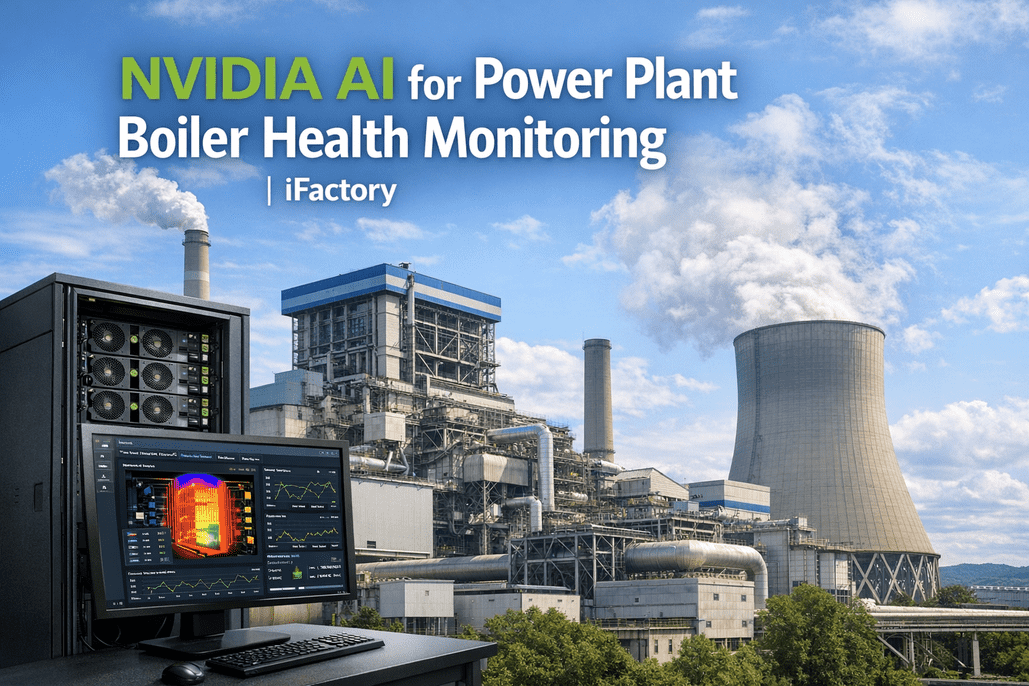
Boiler tube failures have been the leading cause of forced outages in thermal power plants for decades — approximately 60% of all boiler outages are the result of tube failure, and tube leaks alone account for 52% of forced outages in coal-fired facilities. A single tube failure in a 500 MW unit can exceed $3 million in combined repair costs and lost generation revenue. The typical 5.8-hour forced outage translates to $1.7 million in direct losses, with emergency repair premiums running at 4.8x the cost of planned maintenance. Corrosion, erosion, fatigue, slagging, and creep progressively thin tube walls over months — but most plants only discover the problem when steam starts leaking and the unit trips. AI research has demonstrated that hybrid CNN-LSTM approaches achieve boiler tube leak detection accuracy exceeding 99% while minimizing false positives, detecting degradation 1-3 weeks before rupture. NVIDIA GPU-accelerated AI processes thousands of temperature, pressure, acoustic, and water chemistry signals simultaneously, identifying the subtle patterns that precede tube failures months before they become forced outages. iFactory deploys NVIDIA-powered boiler health monitoring across waterwalls, superheaters, reheaters, economizers, and auxiliary systems — transforming boiler maintenance from reactive repairs to predicted interventions. Schedule a demo to see how AI predicts boiler failures weeks before they happen.
Boiler Health Monitoring Challenges in Power Plants
Power plant boilers operate under extreme conditions — pressures exceeding 3,500 psi in supercritical units, steam temperatures above 600 degrees Celsius, and corrosive flue gas environments from coal, gas, or biomass combustion. These conditions attack every tube surface simultaneously through multiple degradation mechanisms that interact and accelerate each other. Thermal cycling from load-following duty has intensified as plants ramp faster to support grid integration of intermittent renewables — making tube fatigue failures more frequent than ever.
Multiple Simultaneous Degradation Modes
Corrosion, erosion, fatigue, creep, and hydrogen damage attack different tube zones simultaneously. No single sensor or measurement catches all failure mechanisms — only multi-parameter AI fusion provides comprehensive coverage.
Waterwalls, superheaters, reheaters, and economizers each fail differentlyShort Detection Windows
Boiler tube weaknesses typically become visible only 1-3 weeks before rupture using conventional monitoring. By the time operators notice abnormal steam/water balance shifts, significant damage has already occurred and the outage is imminent.
AI extends detection window to 4-12 weeks with multi-variable analysisEscalating Cycling Duty
Grid integration of renewables forces thermal plants into faster ramping and more frequent start-stop cycles — accelerating fatigue damage on tube-to-header welds, expansion joints, and high-stress zones that were designed for baseload operation.
Tube failure frequency is increasing as cycling intensity growsMassive Data Volumes
A typical 500 MW boiler has 500+ temperature sensors, dozens of pressure transmitters, water chemistry analyzers, and acoustic monitoring arrays — generating terabytes of data that traditional DCS alarm systems cannot analyze for subtle degradation patterns.
NVIDIA GPUs process thousands of signals simultaneously in real timeExperiencing increasing tube failure frequency from cycling duty? Schedule a boiler health assessment — our team will identify which tube zones are highest risk based on your operating profile and fuel type.
NVIDIA GPU for Tube Leak Prediction Models
iFactory's tube leak prediction combines four monitoring dimensions into a unified AI model running on NVIDIA GPUs — processing data from temperature arrays, pressure differentials, acoustic sensors, and water chemistry analyzers simultaneously to detect the multi-variable patterns that precede tube failure.
Waterwall Temperature Arrays
Hundreds of temperature sensors on waterwall tubes create a thermal map of the furnace. AI detects localized hot spots, temperature differential patterns, and tube metal creep indicators that signal wall thinning months before rupture. GPU-accelerated CNN models process the full thermal array in real time.
Detects wall thinning 4-12 weeks before ruptureSteam/Water Mass Balance
The ratio of feedwater flow to steam flow is a primary leak indicator. AI monitors this ratio against load, ambient conditions, and historical patterns — detecting the subtle divergence that signals a developing leak before conventional mass balance alarms trigger.
Detects leaks up to 2 weeks before forced shutdownAcoustic Leak Detection
High-frequency acoustic sensors detect the sound signature of steam escaping through tube wall thinning — even at micro-leak levels undetectable by mass balance methods. GPU-powered spectral analysis distinguishes leak signatures from normal boiler noise in real time.
Detects micro-leaks days before visible steam lossWater Chemistry Correlation
Water chemistry excursions often precede tube failures by weeks. AI correlates dissolved oxygen, pH drift, conductivity changes, and iron/copper transport with tube metal condition — providing early warning that chemical attack is accelerating tube degradation.
Chemistry signals precede physical failure by 2-6 weeksWant to see real-time tube leak prediction running on NVIDIA GPU models? Book a live demo — we'll demonstrate multi-parameter AI fusion using your boiler's actual sensor configuration.
Slagging & Fouling Detection with AI
Slagging and fouling reduce boiler heat transfer efficiency, increase tube metal temperatures (accelerating creep and corrosion), and can cause mechanical damage when large slag deposits detach and impact lower tubes. Traditional sootblowing schedules waste steam and don't target the areas that need cleaning most. NVIDIA AI optimizes sootblowing based on actual deposition conditions — cleaning where it's needed, when it's needed.
Furnace Slagging Detection
AI analyzes waterwall temperature differentials, heat absorption patterns, and flue gas temperature profiles to map slagging severity across furnace zones. Deep learning models trained on your coal/fuel characteristics predict slagging propensity under varying load and fuel blend conditions.
Convective Pass Fouling
Superheater, reheater, and economizer fouling tracked through stage-by-stage heat transfer coefficient trending. AI detects fouling progression rate and predicts when cleaning is required — before tube metal temperatures exceed design limits and accelerate creep damage.
Intelligent Sootblowing
AI-optimized sootblowing schedules — targeting specific zones based on actual deposition severity rather than fixed time intervals. Reduces steam consumption by 15-25% while improving cleaning effectiveness and preventing tube erosion from unnecessary sootblowing.
Combustion Optimization for Fuel Efficiency
Combustion efficiency directly impacts fuel cost — the largest operating expense in thermal power generation. A 1% improvement in boiler efficiency on a 500 MW coal unit saves approximately $1-2 million annually in fuel costs. NVIDIA AI optimizes combustion parameters in real time, balancing efficiency, emissions, and tube protection simultaneously.
AI continuously adjusts overfire air, secondary air distribution, and fuel flow to maintain optimal stoichiometry across load ranges — reducing excess air while preventing CO formation and localized reducing atmospheres that cause waterwall corrosion.
Flame scanner data and furnace temperature profiles analyzed by GPU-powered models to detect flame impingement on waterwalls, uneven heat distribution, and burner-to-burner imbalances that cause localized overheating and tube damage.
NOx, SOx, CO, and particulate emissions optimized simultaneously with combustion efficiency. AI finds the operating envelope that meets emission permits at minimum fuel consumption — not the conservative derating that most operators default to.
When fuel quality varies (coal blend changes, biomass co-firing, natural gas switching), AI adjusts combustion parameters automatically based on real-time fuel analysis and furnace response — maintaining efficiency without manual retuning.
Burning variable coal blends or co-firing biomass? Schedule a combustion optimization assessment — AI adapts to fuel variability in real time, maintaining efficiency without manual retuning.
Corrosion Rate Prediction & Remaining Life
Boiler tube corrosion is a race against time — the question isn't whether tubes will corrode, but how fast and where. Traditional wall thickness measurements taken during outage inspections provide a single snapshot in time. NVIDIA AI predicts corrosion progression between inspections by correlating operating conditions with material degradation models, enabling condition-based tube replacement instead of time-based guesswork.
Wall Thickness Trending
UT thickness data from outage inspections combined with operating condition history to project wall thinning rates between inspections. AI predicts when each tube zone will reach minimum allowable thickness — enabling planned replacement during the next scheduled outage.
Fireside Corrosion Modeling
AI correlates reducing atmosphere exposure (from combustion imbalances), tube metal temperature history, and coal ash chemistry to predict fireside corrosion rates per tube zone. Identifies which boiler regions are corroding fastest and why.
Creep Life Assessment
For high-temperature superheater and reheater tubes operating near creep limits, AI tracks cumulative thermal stress exposure and predicts remaining creep life. Physics-informed models use actual temperature history — not design assumptions — for accurate life prediction.
Hydrogen Damage Detection
Hydrogen damage from water chemistry excursions causes internal tube wall cracking invisible to external inspection. AI monitors chemistry events, correlates with tube metal temperature history, and flags tubes at risk of hydrogen-induced failure for targeted NDE during outages.
Planning a boiler outage and need to prioritize tube inspections? Schedule a pre-outage planning session — AI identifies the highest-risk tube zones so your inspection crews focus where failures are most likely.
Reducing Forced Outages with Predictive Analytics
The financial case for AI-powered boiler monitoring is straightforward: preventing even one unplanned tube failure per year justifies the entire investment. Plants implementing predictive analytics on boiler systems report 30-50% reduction in forced outages and 85% of failures becoming preventable with sufficient lead time.
iFactory connects to your existing DCS (ABB, Emerson, Honeywell, Siemens, Yokogawa), historian (OSIsoft PI, PHD, IP.21), and CMMS (SAP PM, Maximo, Infor EAM) through standard OPC-UA and Modbus protocols. Predictive alerts auto-generate work orders with recommended actions, parts lists, and optimal maintenance timing. No DCS modification required — iFactory reads data without impacting control loop performance. Typical deployment: 2-4 weeks for connectivity, 4-8 weeks for AI model calibration, first predictive alerts within 6-8 weeks.
Frequently Asked Questions
Every Boiler Tube Is Telling You Its Health. Are You Listening?
iFactory deploys NVIDIA GPU-accelerated AI across your boiler systems — processing thermal arrays, mass balance, acoustics, and chemistry data to predict tube failures weeks before they force a shutdown, saving millions in emergency costs and protecting generation availability.