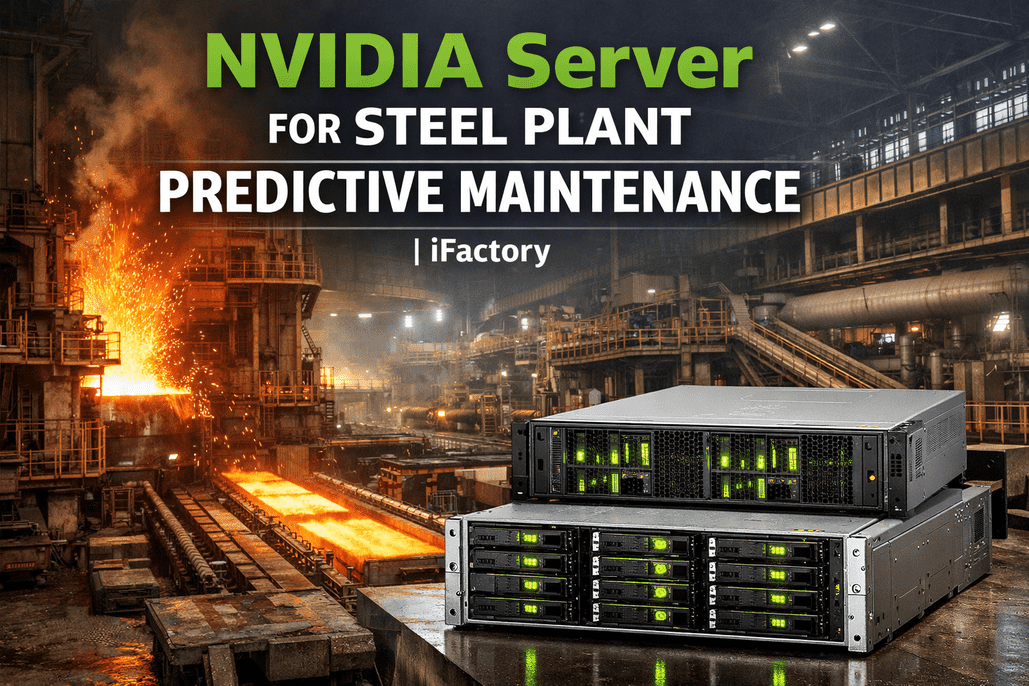
A single hour of unplanned downtime on a hot strip mill costs $150K-$500K. A blast furnace reline triggered by an unpredicted failure costs $5-15M and takes 2-3 months. A conveyor breakdown cascades into hours of stalled production across the entire plant. Steel manufacturing generates massive volumes of sensor data — vibration, temperature, acoustic, current, pressure — from equipment operating in extreme conditions: 1,600°C melt temperatures, 24/7 continuous operation, and environments that destroy conventional IT hardware. NVIDIA GPU-accelerated AI turns this data into failure predictions 7-21 days before breakdown — long enough to schedule repairs during planned maintenance windows instead of emergency shutdowns. iFactory deploys and manages the complete NVIDIA AI infrastructure for steel plants: from GPU server specification and high-heat hardening through model training, edge inference, and CMMS-integrated work order automation. Book a 30-minute demo to see predictive maintenance running on your steel plant's asset profile.
AI Use Cases in Steel Plant Predictive Maintenance
Steel plants are uniquely suited for GPU-accelerated predictive maintenance because they generate enormous volumes of multivariate sensor data from equipment operating under extreme stress. Traditional threshold-based monitoring catches failures only after symptoms are obvious — by then, damage is done and emergency shutdowns are unavoidable. Deep learning models running on NVIDIA GPUs analyze complex patterns across thousands of sensor streams simultaneously, identifying degradation signatures that rule-based systems miss entirely.
| Steel Plant Zone | Critical Equipment | AI Prediction Target | Prediction Lead Time | Cost of Unplanned Failure |
|---|---|---|---|---|
| EAF / BOF Melt Shop | Electrodes, transformer, hydraulics, cooling systems | Electrode breakage, cooling circuit blockage, transformer faults | 7–14 days | $100K–$500K per event |
| Blast Furnace | Tuyeres, staves, hearth lining, gas cleaning | Hearth erosion, stave failure, tuyere burnout, gas leak | 14–21 days | $5M–$15M (reline) |
| Continuous Casting | Mold, oscillator, segments, spray cooling | Mold wear, segment misalignment, spray nozzle blockage | 7–14 days | $200K–$1M per breakout |
| Hot Strip Mill | Work rolls, bearings, drives, coilers, descalers | Bearing degradation, roll surface defects, drive faults | 10–21 days | $150K–$500K per hour |
| Material Handling | Conveyors, cranes, ladle cars, transfer cars | Belt wear, motor degradation, crane hoist failure | 7–14 days | $50K–$200K per cascade |
Which zones generate the most unplanned downtime in your plant? Book a demo — we'll show AI failure prediction running on your specific equipment types and sensor configurations.
NVIDIA GPU for Rolling Mill Failure Prediction
Rolling mills are the throughput backbone of every steel plant — and the primary source of unplanned downtime. Work roll bearings, drive spindles, hydraulic actuators, and descaler nozzles operate under extreme mechanical stress at temperatures above 900°C. Traditional vibration monitoring catches failures only at advanced degradation stages. GPU-accelerated deep learning models analyze vibration, temperature, current draw, and acoustic signatures simultaneously across hundreds of sensors — detecting bearing inner race defects, spindle misalignment, and hydraulic pressure drift 10-21 days before functional failure.
Blast Furnace Health Monitoring with AI
Blast furnace failures are the highest-cost events in steelmaking — an unplanned reline costs $5-15M and takes 2-3 months of lost production. POSCO's AI-powered blast furnace uses over 260 algorithms analyzing video feeds, temperature readings, and charge composition in real-time to automatically adjust blast and fuel supply — increasing daily output by 240 tons while reducing fuel consumption. GPU-accelerated thermal modeling tracks hearth wall erosion rates, stave cooling efficiency, and tuyere condition by correlating thousands of temperature sensors with gas composition and charge data.
Running blast furnaces or EAFs? Schedule a demo to see how iFactory deploys GPU-accelerated thermal monitoring and failure prediction for your furnace configuration.
Conveyor & Material Handling Predictive Analytics
Material handling failures cascade — a single conveyor belt tear or crane hoist failure stalls production across multiple upstream and downstream processes. Steel plants run miles of conveyors, dozens of overhead cranes, and fleets of ladle and transfer cars. GPU-accelerated computer vision monitors belt surface condition in real-time, detecting tears, edge wear, and splice degradation before they cause stoppage. Motor current signature analysis on crane hoists and conveyor drives detects winding degradation, bearing faults, and gearbox wear weeks before failure.
Managing GPU Infrastructure in High-Heat Environments
Steel plants present extreme challenges for GPU infrastructure — ambient temperatures near furnaces exceed 60°C, airborne particulates clog filters, electromagnetic interference from arc furnaces disrupts signals, and vibration from rolling mills affects precision components. Standard data center GPUs fail rapidly in these conditions. iFactory designs and manages ruggedized GPU deployment specifically for heavy industry:
See Predictive Maintenance Running on Your Steel Plant Profile
iFactory deploys NVIDIA GPU-accelerated AI for rolling mills, blast furnaces, casters, and material handling — with hardened infrastructure built for steel plant conditions.
ROI: Reduced Unplanned Downtime in Steelworks
| Metric | Before GPU-Accelerated AI | After Deployment | Impact |
|---|---|---|---|
| Unplanned Downtime | 800+ hours/year (industry avg.) | 480-560 hours/year | 30-40% reduction |
| Maintenance Costs | Reactive + calendar-based PM | Condition-based + predictive | 15-25% cost reduction |
| Failure Prediction Lead | Hours (threshold alerts) | 7-21 days (deep learning) | 10-50x earlier warning |
| Prediction Accuracy | Traditional ML baseline | GPU-accelerated deep learning | 4-5x improvement |
| Energy Consumption | Baseline | AI-optimized furnace + mill ops | 10-15% reduction |
| Quality Defects | Manual inspection + sampling | AI vision at line speed | 20%+ defect reduction |
| Annual Savings (750K ton) | — | $8M-$15M combined | ROI in 6-12 months |
Want the ROI model for your plant? Book a demo — we'll model savings for your specific asset base, production volume, and maintenance costs.
Frequently Asked Questions
Every Hour of Unplanned Downtime Costs $150K–$500K
NVIDIA GPU-accelerated AI predicts failures 7-21 days ahead. iFactory deploys and manages the entire stack — hardened for steel plant conditions.