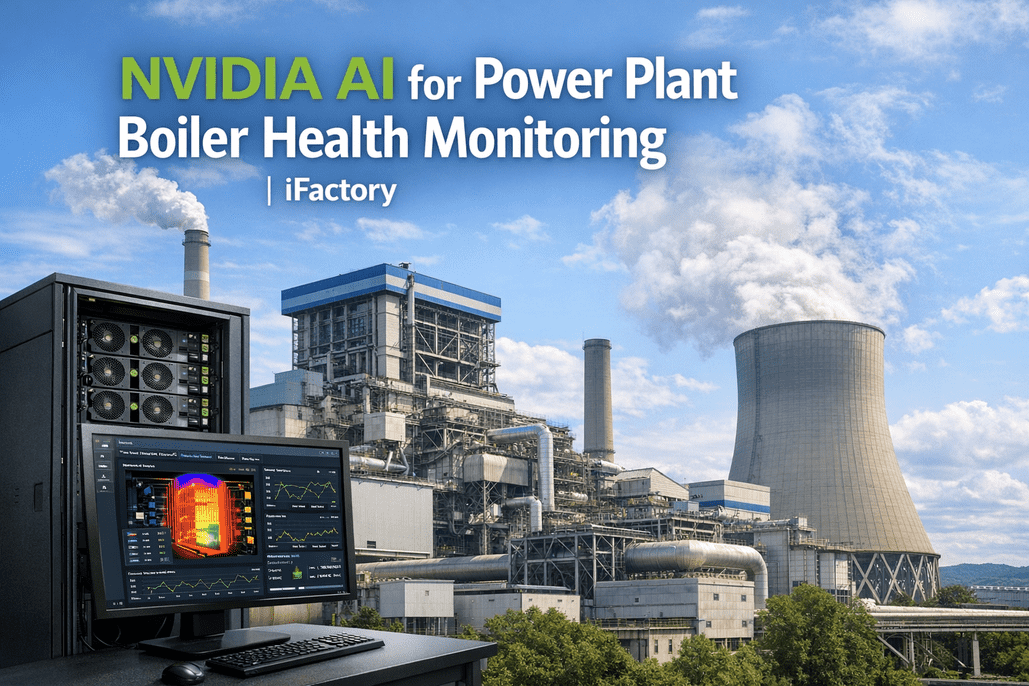
A single gas turbine forced outage event costs between $500,000 and $2.5 million when factoring in emergency repair premiums at 4.8x planned rates, lost generation revenue, replacement power purchases, grid penalty charges, and cascade damage to downstream HRSG components. Turbines account for 43% of all power plant equipment failures, yet 70% of power plants still lack real-time visibility into when critical equipment is approaching failure. Globally, unplanned downtime costs utilities an estimated $1.4 trillion annually — representing 11% of total revenues. The gas turbine MRO market alone exceeds $15.6 billion in 2025, with predictive maintenance adoption growing at 22% year-over-year as operators recognize that condition-based intelligence prevents the emergency calls that drain budgets and jeopardize grid commitments. NVIDIA GPU-accelerated AI transforms turbine maintenance from calendar-based guesswork into physics-informed prediction — processing vibration spectra, thermal profiles, bearing signatures, and performance parameters in real time to detect degradation 4-16 weeks before failure. iFactory deploys NVIDIA-powered predictive maintenance across gas turbines, steam turbines, generators, and combined-cycle balance-of-plant systems — giving power plant operators the intelligence to schedule maintenance during planned windows instead of scrambling during peak demand. Schedule a demo to see NVIDIA-powered turbine intelligence in action.
AI-Driven Turbine Predictive Maintenance
Gas and steam turbines operate under extreme conditions — firing temperatures exceeding 1,400 degrees Celsius, rotational speeds of 3,000-3,600 RPM, and thermal cycling that stresses every component from hot-section blades to compressor seals. Calendar-based maintenance either replaces components too early (wasting parts with remaining useful life) or too late (suffering unplanned failures at 4-5x planned repair costs). With approximately 77 GW of global gas-fired capacity now over 50 years old and over 672 GW less than ten years old, the maintenance landscape demands a smarter, condition-based approach powered by AI.
How much is calendar-based maintenance costing your plant in premature replacements and unexpected failures? Schedule a predictive maintenance assessment — our team will quantify the gap between your current approach and AI-driven condition monitoring.
NVIDIA GPU for Vibration & Thermal Analysis
Turbine vibration and thermal analysis generates massive data volumes — a single turbine with 50+ sensors sampling at 20 kHz produces over 100 GB of raw data per day. Traditional monitoring systems can display trends but cannot perform the real-time spectral decomposition, pattern recognition, and multi-variable correlation that catches subtle degradation signatures weeks before failure. NVIDIA GPUs process this data in real time, running LSTM neural networks, CNN-based spectral classifiers, and physics-informed models simultaneously.
Vibration Spectral Analysis
GPU-accelerated FFT and wavelet transforms decompose vibration signals into frequency components in real time. AI identifies shaft imbalance (1x RPM), misalignment (2x RPM), bearing defect frequencies (BPFO, BPFI, BSF), and blade pass frequencies — distinguishing normal operating signatures from developing faults 4-12 weeks before failure.
Lead time: 4-12 weeks before mechanical failureThermal Profile Analysis
Exhaust gas temperature spread, bearing metal temperatures, casing thermal profiles, and cooling system effectiveness monitored continuously. A sustained 14-degree F rise above baseline signals imminent intervention needs. AI detects thermal asymmetries across turbine stages that indicate hot-section component degradation.
Lead time: 2-8 weeks before thermal failureAcoustic Emission Detection
High-frequency acoustic signatures detect internal steam leaks, blade rubbing, crack propagation, and seal degradation at micro-levels — structural issues invisible to both vibration and thermal analysis. GPU processing enables real-time analysis of ultrasonic frequency bands.
Lead time: 2-6 weeks before structural failurePerformance Analytics
Compressor pressure ratio degradation, heat rate trending, and efficiency loss calculations identify fouling, erosion, and clearance changes in real time. A 3-8% efficiency loss from undetected compressor fouling translates directly to wasted fuel cost — visible in the performance model long before it appears in monthly reports.
Continuous efficiency optimizationWant to see how NVIDIA GPU processing transforms your existing turbine sensor data into predictive intelligence? Book a live demo — we'll show you real-time vibration spectral analysis running on GPU-accelerated models.
Gas Turbine Hot Path Component Monitoring
The hot gas path — combustion liners, transition pieces, first-stage nozzles, and turbine blades — operates at the extreme thermal and mechanical limits of material capability. These components account for 60-70% of gas turbine maintenance costs and are the primary source of forced outages. NVIDIA AI monitors every measurable signature of hot path degradation in real time.
Combustion Dynamics
Flame instability, crossfire tube cracking, combustor liner distortion, and transition piece wear detected through acoustic and vibration pattern analysis. AI predicts combustion issues 2-8 weeks ahead of component failure.
Forced outage cost: $500K-$1.5M per eventTurbine Blade Health
Blade path temperature spread analysis, tip clearance monitoring, and exhaust gas pattern recognition detect blade erosion, coating loss, and crack initiation. Remaining useful life (RUL) models predict blade replacement windows with 90%+ confidence.
Single blade failure: 10-21 day forced outageCompressor Degradation
Fouling, inlet guide vane actuator drift, stall precursors, and surge margin erosion tracked through pressure ratio trending and efficiency calculations. 3-8% efficiency loss from undetected fouling translates to thousands per day in wasted fuel.
Efficiency loss: $2,000-$8,000/day per percentage pointExhaust System & HRSG
Exhaust diffuser cracking, expansion joint failures, and HRSG tube leaks impact both turbine performance and combined-cycle efficiency. Temperature profiling catches thermal stress patterns months ahead of component failure.
HRSG tube leak: $200K-$500K repair + lost generationOperating F-class or H-class gas turbines? Schedule a hot path monitoring consultation — our team specializes in AI-driven combustion dynamics and blade health prediction for modern high-efficiency gas turbines.
Steam Turbine Bearing & Seal Health
Steam turbine bearings and seals operate under extreme pressure differentials and rotational forces. Journal bearing wear, thrust bearing degradation, rotor imbalance, and seal clearance changes produce measurable signatures in vibration, temperature, oil condition, and shaft position data — all detectable weeks before the failure event that would otherwise result in an $800K+ forced outage.
Journal Bearing Monitoring
Vibration trending and oil debris analysis detect bearing metal deterioration, babbitt fatigue, and oil film instability 6-16 weeks before seizure risk. AI correlates bearing temperature with load, speed, and oil condition to distinguish normal variation from degradation.
Thrust Bearing & Axial Position
Axial thrust position and shaft eccentricity measurements catch rotor bowing, thrust bearing wear, and differential thermal expansion issues that precede catastrophic rotor-stator contact events — the most expensive steam turbine failure mode.
Seal Clearance & Leakage
Labyrinth seal and carbon ring seal degradation detected through stage-by-stage pressure drop trending. Increasing seal clearance reduces turbine efficiency progressively — AI quantifies the efficiency impact and recommends optimal seal replacement timing.
Oil Condition Analysis
Real-time oil quality monitoring for water contamination, acid number trending, particle count, and wear metal analysis — providing complementary diagnostic data that confirms vibration and temperature findings and detects lubrication system degradation.
Blade Inspection & Remaining Useful Life (RUL)
Turbine blade replacement decisions involve millions of dollars — replace too early and you waste blade life, replace too late and you risk catastrophic failure and cascade damage. NVIDIA GPU-powered AI models calculate Remaining Useful Life for every blade row based on actual operating history, not generic OEM intervals.
Operating History Integration
Actual fired hours, start-stop cycles, load profile, fuel type, and ambient temperature history compiled from DCS/historian — not just clock hours but weighted equivalent operating hours (EOH) reflecting true thermal stress accumulation.
Real-Time Degradation Tracking
Blade path temperature spread, exhaust gas pattern analysis, and performance model deviations continuously update the degradation trajectory. AI detects coating loss, erosion progression, and creep deformation through indirect measurement correlation.
Borescope Data Fusion
Periodic borescope inspection images are fed into AI vision models that quantify coating loss area, crack length progression, and erosion depth — creating a digital twin of blade condition that updates between physical inspections.
RUL Prediction & Optimal Timing
Physics-informed AI models predict remaining useful life with confidence intervals — "Row 1 blades: 4,200 EOH remaining (90% confidence), recommended replacement window: next planned outage in Q3 2026." Maintenance is scheduled during planned windows, not forced by unplanned failures.
Spending millions on OEM-recommended blade replacements based on generic intervals? Schedule a blade life optimization consultation — AI-driven RUL models typically extend blade life 15-30% beyond OEM intervals while maintaining safety margins.
Integration with Power Plant DCS & Historian
iFactory's NVIDIA-powered predictive maintenance platform layers on top of your existing control systems — no rip-and-replace required. The platform connects to legacy DCS, SCADA, historian, and CMMS systems through standard industrial protocols, creating a unified AI analytics layer without disrupting plant operations.
Distributed Control System
OPC-UA, OPC-DA, and Modbus TCP connections to ABB, Emerson, Honeywell, Siemens, Yokogawa, and GE Mark VIe control systems — reading real-time process data without impacting control loop performance.
Process Data Historian
Direct integration with OSIsoft PI, Honeywell PHD, AspenTech IP.21, GE Proficy, and Wonderware InSQL — accessing years of historical process data for AI model training without migrating data out of your existing historian.
Maintenance Management
Auto-generated work orders push directly to SAP PM, IBM Maximo, Infor EAM, or your existing CMMS — with recommended actions, spare parts lists, and optimal maintenance timing. Predictive alerts become maintenance actions without manual intervention.
Wireless Sensor Overlay
For turbine locations without existing instrumentation, iFactory deploys wireless vibration, temperature, and acoustic sensors that complement DCS data — filling monitoring gaps on auxiliary equipment, balance-of-plant systems, and legacy turbine models.
Running ABB, Emerson, Siemens, or GE control systems? Book a demo to see how iFactory connects to your existing DCS and historian without disrupting plant operations. Need integration specs? Visit iFactory support.
Frequently Asked Questions
Every Turbine Tells You When It's About to Fail. Are You Listening?
iFactory deploys NVIDIA GPU-accelerated AI across your gas and steam turbines — processing vibration, thermal, acoustic, and performance data in real time to predict failures 4-16 weeks before they happen, saving millions in emergency costs and protecting grid commitments.