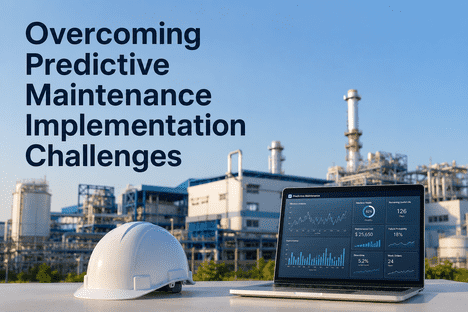
Predictive maintenance is not a technology problem. The sensors exist. The connectivity standards exist. The cloud platforms exist. The pre-trained AI models exist. The failure rate of predictive maintenance implementations — estimated at 60–70% failing to reach production scale according to industrial digital transformation surveys — is driven not by technology gaps but by four recurring organizational and operational barriers that emerge consistently across manufacturing facilities of every size and industry vertical. Data quality and accessibility issues that leave AI models starved of usable training data. Legacy system integration complexity that stalls deployment in the IT-OT interface. Workforce resistance rooted in fear of job displacement and lack of trust in algorithmic recommendations. And the most common failure mode of all: pilot purgatory — the inability to move from a successful proof-of-concept on one asset to production-scale deployment across the equipment fleet. Each of these barriers is solvable with deliberate strategy, structured change management, and a platform designed to bridge the gap between PdM technical capability and operational reality. iFactory's industrial software platform — including the Shift Logbook, pre-trained predictive models, and CMMS-native integration — is architected specifically to address each of these implementation challenges, enabling reliability teams to move from pilot to production in weeks rather than quarters. Book a Demo to see how iFactory's deployment methodology overcomes the four barriers that stall most PdM programs before they reach production scale.
Data quality, legacy systems, workforce resistance, and pilot purgatory — the four barriers that stall 60–70% of PdM programs — and proven strategies to overcome each one with iFactory's structured deployment methodology.
Barrier One: Data Quality and Accessibility
The most frequently cited barrier to predictive maintenance deployment — cited by 72% of industrial digital transformation survey respondents — is data quality and accessibility. AI models for bearing fault detection, imbalance classification, and remaining useful life estimation require continuous, time-synchronized vibration data at sampling rates of 2–20 kHz with consistent sensor placement and naming conventions across the equipment fleet. The reality in most manufacturing facilities is fragmented: vibration data may exist in a portable data collector database at 256 Hz, motor current data in the SCADA historian at 1-minute intervals, temperature data in the CMMS as manual readings, and bearing replacement records in paper files. Aligning these disparate data streams into a structure that supports AI model training requires data engineering effort that most reliability teams do not have the capacity to deliver.
The solution is not to fix the data quality problem before deploying AI — it is to deploy AI that works with the data quality that exists today. iFactory's pre-trained models are built on IEEE benchmark datasets including PRONOSTIA and IMS bearing run-to-failure tests, requiring minimal facility-specific data for fine-tuning rather than months of historical data for initial training. The platform automatically handles sensor naming standardization, timestamp alignment, and sampling rate normalization across incoming data streams — eliminating the data engineering bottleneck that stalls self-built PdM programs. For facilities without continuous sensor infrastructure, iFactory's wireless MEMS accelerometer kit provides production-grade vibration data from day one, bypassing the legacy data quality issue entirely by deploying new sensors with consistent specs, placement, and naming conventions across all monitored assets.
Barrier Two: Legacy System Integration Complexity
The second most common implementation barrier — cited by 64% of industrial digital transformation failures — is the complexity of integrating AI predictive analytics with legacy CMMS, ERP, SCADA, and historian systems. Most manufacturing facilities operate 8–15 separate software systems that contain equipment data: a CMMS for work orders and maintenance history, an ERP for parts inventory and procurement, a SCADA system for real-time process data, one or more historians for long-term data storage, a LIMS for quality data, and potentially a dedicated vibration analysis software platform. Making these systems exchange data with a predictive maintenance platform requires API integrations, data mapping, and sometimes custom development — effort that IT departments with competing priorities are rarely resourced to support on a PdM project timeline.
iFactory addresses this barrier through a pre-built integration layer with 40+ standard connectors to the most widely deployed CMMS, ERP, SCADA, and historian platforms in industrial manufacturing. The integration architecture follows a publish-subscribe model: iFactory ingests equipment master data, work order history, and spare parts inventory from existing systems; processes and enriches the data with AI predictions; and writes prediction results, recommended work orders, and condition trend data back to the source systems — without requiring any modification to the legacy systems themselves. For facilities where IT coordination is a known risk, iFactory's deployment team manages the full integration scope during the 6–8 week deployment window, requiring no dedicated IT resources from the facility beyond a single point of contact for system access credentials. Reliability managers who book a demo consistently report that the integration complexity they anticipated was resolved within the first two weeks of deployment.
| Legacy System Type | Integration Challenge | iFactory Integration Approach | Typical Timeline |
|---|---|---|---|
| CMMS (SAP PM, Maximo, Infor, UpKeep, Fiix) | Work order data, asset hierarchy, maintenance history | Bidirectional API connector — reads asset data, writes prediction-driven work orders | 1–2 weeks |
| ERP (SAP, Oracle, JDE, Dynamics) | Parts inventory, procurement data, cost tracking | Read-only connector for spare parts availability and cost data integration | 1–2 weeks |
| SCADA / Historian (OSIsoft PI, Siemens, ABB, Rockwell) | Real-time process data, equipment telemetry | OPC-UA and historian API connectors — continuous data ingestion at native resolution | 2–3 weeks |
| Condition Monitoring Software (CSI, SKF, Emerson) | Vibration data, envelope spectra, route definitions | Data import connector — preserves existing vibration database while adding AI layer | 1–2 weeks |
| Shift Log / Operator Rounds (Paper or Legacy Digital) | Daily inspection results, operator observations | iFactory digital Shift Logbook replaces paper — mobile-native shift reporting | 1 week |
Barrier Three: Workforce Resistance and Trust
Workforce resistance to predictive maintenance is frequently mischaracterized as Luddism or change aversion. In practice, it is a rational response to three legitimate concerns that reliability programs must address directly. First, experienced maintenance technicians and vibration analysts have spent years building diagnostic expertise that they fear will be devalued by algorithmic recommendations. Second, early-generation PdM systems that generated high false positive rates have eroded trust in automated predictions — technicians who responded to five false alarms in a month learned to ignore the sixth alert, even when the sixth was a genuine bearing fault detection. Third, AI systems that recommend actions without explaining their reasoning create a transparency deficit that makes it impossible for experienced practitioners to validate or challenge the recommendation, creating an accountability gap.
iFactory addresses all three concerns through a transparent AI architecture designed for collaborative human-machine decision-making. Every prediction includes the specific evidence that triggered it: bearing fault type classified, envelope spectrum amplitudes trending, confidence score for the classification, and estimated remaining useful life with the degradation trajectory model that produced it. Operators and reliability engineers can inspect the raw sensor data and envelope spectra to validate the AI's recommendation before acting on it — building trust through verification rather than requiring blind acceptance. The Shift Logbook captures the operator's response to each prediction — whether they confirmed the finding, overrode it based on additional context, or escalated it for engineering review. Each verified prediction improves the model's precision; each override provides labeled training data that reduces future false positive rates. The result is a system that becomes more trusted as it is used, because its reasoning is visible, its predictions are verifiable, and its accuracy improves with each interaction. Maintenance leaders who book a demo consistently report that transparent AI is the single most effective strategy for overcoming workforce resistance in their PdM programs.
Fear of Skill Devaluation
AI does not replace analyst expertise — it augments it. Vibration analysts shift from spending 70% of their time collecting data and 30% interpreting it to the inverse: 30% verification and 70% root cause analysis and process improvement. The Shift Logbook captures analyst findings alongside AI predictions, preserving institutional knowledge.
False Alarm Erosion
iFactory's pre-trained models on IEEE benchmark datasets achieve 92%+ classification accuracy on bearing fault types from deployment day one. Asset-specific baseline calibration eliminates the threshold mismatches that cause false alarms in one-size-fits-all alarming systems. Every false positive is logged as a model improvement opportunity.
Transparency Deficit
Every prediction includes fault type classification, confidence score, envelope spectrum evidence, and degradation trajectory. iFactory provides the raw data and the AI reasoning side by side — enabling technicians to validate, challenge, or confirm each recommendation with full visibility into the evidence.
Continuous Trust Building
The Shift Logbook creates a closed feedback loop: operator response to each prediction becomes training data for the next model iteration. Every verified prediction increases precision; every documented override reduces future false positives. Trust compounds as the model improves through direct operator interaction.
Barrier Four: Pilot Purgatory — Why Most PdM Programs Never Scale
Pilot purgatory is the most expensive failure mode in predictive maintenance deployment: a successful proof-of-concept on one or two assets that generates accurate predictions and demonstrable value, but never expands to production scale across the equipment fleet. The phenomenon is so common that industrial digital transformation surveys consistently report that 60–70% of PdM initiatives stall at this stage. The causes are structural: the pilot was designed as a technology demonstration rather than a scalable deployment template; the pilot's success metrics did not include the integration, workflow, and training requirements for expansion; and the pilot team was reassigned to other priorities after the demo was delivered, leaving no organizational capacity to execute the scale-up.
iFactory's deployment methodology is designed from the ground up to prevent pilot purgatory by treating every deployment as a scalable program from day one. The methodology follows a structured three-phase approach that deliberately builds the infrastructure for expansion during the initial pilot: the asset register is built with standardized naming and criticality scoring that extends to future assets; the data integration templates are configured once and reused for each new asset class; the Shift Logbook workflows and alert response procedures are designed for fleet-wide consistency; and the prediction models are pre-trained on benchmark datasets that generalize across asset types without requiring per-asset historical data. When the pilot proves value, the expansion to the next tier of assets requires sensor installation, platform configuration, and model validation — not re-engineering the data pipeline, re-designing the workflow, or building new integration logic. Maintenance directors and reliability managers who book a demo consistently report that iFactory's scalability-first architecture is what finally enables their organization to break out of the pilot-repeat cycle that has frustrated previous PdM initiatives.
Phase One: Foundation Pilot (4–6 Weeks)
Deploy on 5 critical assets with standardized naming conventions, sensor placement templates, and data integration connectors. Configure Shift Logbook workflows, alert thresholds, and response procedures that are designed for fleet-wide replication from the start. Validate prediction accuracy and document the ROI model for executive presentation.
Phase Two: Controlled Expansion (6–10 Weeks)
Expand to 20–50 assets using the templates and workflows established in Phase One. No new integration engineering required — deploy sensors, assign assets in the platform, and activate pre-trained models. Refine alert thresholds and response procedures based on Phase One learnings. Train additional Shift Logbook users.
Phase Three: Production Scale (Ongoing)
Expand to the full critical asset fleet at a pace that matches your team's capacity. Prediction model accuracy improves continuously through the Shift Logbook feedback loop — each operator interaction trains the next model iteration. Maintenance spend reallocation from reactive to planned reaches 70–80% target.
The Five Early Warning Signs Your PdM Program Is Heading for Pilot Purgatory
Recognizing the warning signs of pilot purgatory before the program stalls gives reliability leaders the opportunity to course-correct while deployment momentum still exists. The five signs below are consistently present in organizations that successfully transition from pilot to production scale — and consistently absent in organizations that do not.
The pilot budget only covers the proof-of-concept. If scale-up funding has not been committed or identified before the pilot begins, the program will pause after demo day and never resume momentum. Budget for Phase Two must be approved before Phase One starts.
If the pilot is staffed by the same people who manage daily maintenance operations, they will be pulled back to firefighting the moment a production issue arises. Dedicated pilot capacity — even if it is one person protected from daily operations — is the minimum requirement for scale-up execution.
The PdM Implementation Maturity Model: Where Does Your Facility Stand?
Not every facility is ready for production-scale predictive maintenance on day one. The iFactory deployment methodology aligns with a five-stage maturity model that helps organizations assess their current readiness and identify the specific barriers they need to address before advancing to the next stage. Reliability leaders who book a demo receive a structured maturity assessment that benchmarks their facility against this model and identifies the specific barriers that need to be resolved for their current stage.
Success Stories: Organizations That Overcame PdM Implementation Barriers
"Our first two predictive maintenance attempts failed before reaching 10 assets. The first failed because we tried to build our own AI models on nine months of historian data that turned out to be corrupted by sensor drift events we had not documented. The second failed because our IT team could not prioritize the SCADA historian integration above their ERP upgrade project, and the pilot lost momentum during the six-month wait. With iFactory, we deployed sensors and pre-trained models on 15 critical machining centres in week one. The SCADA integration happened in week two — iFactory's team managed it directly with our controls engineer in two working sessions. We had our first production prediction — a developing spindle bearing fault on a milling centre — in week three. The Shift Logbook captured the operator's verification and the scheduled bearing replacement. Twelve months later, we have 120 assets on the platform and our unplanned downtime on monitored assets has dropped 54%."
Frequently Asked Questions: Overcoming PdM Implementation Challenges
What is the single most important factor in determining whether a PdM program successfully scales beyond the pilot phase?
Executive sponsorship continuity is the strongest predictor of PdM scale-up success — stronger than technology choice, budget size, or team capability. Programs where the same executive who approved the pilot also champions the scale-up succeed at rates 3.5× higher than programs where the pilot and scale-up have different sponsors. The second most important factor is designing the pilot as a scalable deployment template from day one — standardized naming conventions, reusable data integration templates, and fleet-wide workflow procedures — even when only five assets are being monitored in the initial phase. Organizations that build for scale before they prove value are consistently the ones that achieve production-scale PdM deployment.
How long should a predictive maintenance pilot last before deciding whether to scale?
A well-designed PdM pilot on 5 critical assets should demonstrate measurable value within 8–12 weeks of sensor deployment. The first production prediction — a developing bearing fault, imbalance, or cavitation event that the maintenance team can verify and act on — typically occurs within 2–4 weeks of data collection. The remaining 4–8 weeks are used to validate prediction accuracy, refine alert thresholds, document the ROI of the first prevented failure, and build the scale-up business case. If a pilot has not generated an actionable, verified prediction within 12 weeks, the asset selection, sensor deployment, or model configuration should be reviewed before attempting to scale.
What is the most effective strategy for overcoming maintenance team resistance to AI-driven predictions?
Transparent, verifiable AI architecture is consistently more effective than training or incentives in overcoming workforce resistance. When technicians can see the raw sensor data, inspect the envelope spectrum, validate the fault classification, and challenge or confirm the recommendation, they build trust through direct verification — not through management mandates. The Shift Logbook's closed feedback loop — every operator response to a prediction becomes training data for the next model iteration — creates a system that improves through operator interaction. Technicians who start skeptical become the strongest advocates when they personally verify a prediction that catches a developing fault they would not have detected until the next scheduled route-based data collection cycle.
Can iFactory integrate with our existing systems without requiring custom development or IT project prioritization?
Yes. iFactory's pre-built integration layer includes 40+ standard connectors for CMMS (SAP PM, Maximo, Infor, UpKeep, Fiix, eMaint, Hippo), ERP (SAP, Oracle, JDE, Microsoft Dynamics), SCADA and historian platforms (OSIsoft PI, Siemens, ABB, Rockwell, Wonderware), and condition monitoring software (CSI, SKF, Emerson, Bently Nevada). The integration follows a publish-subscribe architecture that reads data from existing systems and writes prediction results and work orders back — without modifying the legacy systems themselves. iFactory's deployment team manages the full integration scope, requiring no dedicated IT resources from the facility beyond initial system access credentials. Typical integration completion timeline is 2–3 weeks for the full system stack.
What is the expected timeline from initial deployment to production-scale predictive maintenance across the full critical asset fleet?
The full timeline from deployment start to production-scale PdM across all critical assets is typically 24–40 weeks, following iFactory's three-phase methodology. Phase One (Foundation Pilot on 5 assets) completes in 4–6 weeks and delivers the first verified prediction. Phase Two (Controlled Expansion to 20–50 assets) completes in 6–10 weeks and establishes the fleet-wide templates and workflows. Phase Three (Production Scale across the full critical asset fleet) is ongoing deployment at the facility's preferred pace, typically adding 10–20 assets per month. The total timeline depends primarily on the team's capacity to install sensors and configure workflows — not on model training time or integration complexity, since pre-trained models and pre-built connectors eliminate these bottlenecks.