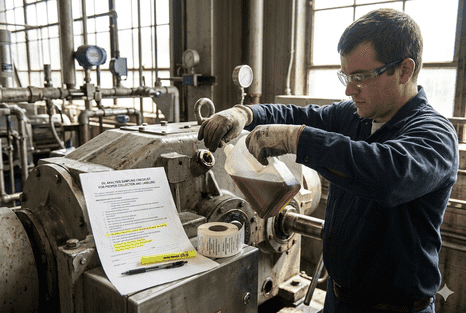
Oil analysis is one of the most powerful condition monitoring tools available for industrial machinery — but only when the oil sample is collected correctly, labelled properly, and transported under controlled conditions. A contaminated or mislabelled sample produces laboratory results that are worse than no results at all: they trigger false alarms that waste maintenance budgets on unnecessary oil changes, or worse, they miss genuine wear debris and contamination that signal impending bearing failure, gear degradation, or hydraulic system distress. ASTM D4057 and ISO 3170 establish the standard practices for manual sampling of petroleum products, specifying sample container selection, flush volumes, sampling point purging, and chain-of-custody documentation requirements that ensure laboratory results accurately represent the oil condition inside the machine. Without a standardised oil analysis sampling checklist that enforces these protocols at every collection point — from CNC spindle oil reservoirs to hydraulic power units, gearboxes, and circulating lube systems — maintenance teams cannot trust the data driving their lubricant condition decisions. iFactory's Shift Logbook and CMMS platform integrates oil sampling route definitions, container specification templates, flush volume calculators, label generation, chain-of-custody tracking, and lab result correlation into a unified workflow that connects oil analysis data directly to asset reliability analytics and predictive maintenance models. Book a Demo to see how iFactory digitises your oil analysis sampling programme and connects lubricant condition data to predictive maintenance intelligence.
Standardised Oil Sampling Protocols for Reliable Laboratory Results
Sampling point identification · flush volume procedure · container selection · label generation · chain of custody · lab submission · All integrated with iFactory Shift Logbook & CMMS.
Why Standardised Oil Sampling Procedures Are Critical for Reliable Condition Monitoring
Oil analysis results are only as reliable as the sample collection method that produced them. A single procedural error — failing to flush a sampling valve before collection, using a non-clean sample bottle, labelling the sample with the wrong asset ID, or exposing the sample to direct sunlight during transport — can produce laboratory data that misrepresents the actual oil condition by orders of magnitude. The financial consequences are significant: false positive wear metal results trigger unnecessary oil changes costing $2,000–$15,000 per hydraulic or gearbox system, while false negatives allow progressive bearing wear to advance undetected until catastrophic failure occurs. ASTM D4057 mandates specific practices for each sampling scenario: sampling from recirculating systems requires the system to be operating at normal temperature and load for at least 30 minutes before collection; sampling from storage drums requires the use of a dedicated thief or sampling tube inserted to the correct depth; sampling from dead-leg sampling valves requires a flush volume of three to five times the valve dead volume before the sample is collected. iFactory's Shift Logbook stores the sampling procedure for each asset defined according to ASTM D4057 and validates that the technician has completed each step before accepting the sample into the laboratory submission workflow.
Sampling Point Identification
Unique point ID mapped to asset · valve or port location documented · access requirements noted · point condition checked before collection
Flush Volume Procedure
Dead volume calculated · 3x–5x flush volume defined · waste oil captured · purge verified before sample collection · flush validation recorded
Container Handling & Labelling
Clean dedicated bottle per sample · label generated with asset ID, date, oil grade · cap sealed immediately · no pre-wash with sample oil
Transport & Lab Submission
Sample stored in cool dark container · lab submission form attached · chain of custody signed · shipment within 48 hours · results auto-correlated
Essential Components of an Oil Analysis Sampling Checklist
A comprehensive oil analysis sampling checklist must address six procedural categories essential for reliable, repeatable, and auditable oil sample collection from industrial machinery — including CNC machine tool lubrication systems, hydraulic power units, gearboxes, circulating oil systems, and transformer oil compartments. Each category maps to specific ASTM D4057 requirements and must be documented at every sampling event to ensure laboratory results reflect true oil condition. Maintenance managers who have already standardised their oil sampling documentation across all technician shifts consistently report this is the single most impactful step in their lubricant condition monitoring programme.
| Checklist Category | Documentation Requirements | Quality Criteria | iFactory Integration |
|---|---|---|---|
| Pre-Sampling Preparation | Sampling kit clean · bottle type correct · labels printed · PPE available · lockout-tagout verified · machine operating condition confirmed | All items verified before approaching sampling point | Shift Logbook pre-sampling checklist |
| Sampling Point Access | Point ID matched to route definition · valve/port cleaned externally · dead volume calculated · drip tray positioned · waste oil container ready | Point ID cross-referenced with asset register | Mobile point reference with location photo |
| Flush & Purge Procedure | Flush volume 3x–5x dead volume · oil purged at normal flow rate · purge observed for clarity · no air entrainment · indicator of system condition noted | Flush completed immediately before sample collection | Flush volume calculator per sampling point |
| Sample Collection | Bottle filled to 75–85% capacity · no headspace air contamination · cap sealed immediately · no bottle pre-wash with sample oil · collection timestamp recorded | Sample representative of circulating oil condition | Barcode label generated with sample metadata |
| Label & Documentation | Asset ID · sampling point ID · oil grade and viscosity · machine hours since last oil change · collection date and time · technician name · lab test codes requested | All fields completed before sample leaves site | Auto-populated label from asset register |
| Chain of Custody & Transport | Sample sealed in transport container · chain of custody form signed · shipment scheduled within 48 hours · cool dark storage maintained · lab receipt confirmed | Unbroken custody trail from point to lab | Tracking barcode · shipping notification · result auto-import |
Flush Volume Calculations and Dead-Leg Purging for Representative Samples
The most common source of non-representative oil samples from industrial machinery is inadequate flushing of the sampling point before sample collection. Sampling valves and ports on circulating lubrication systems, hydraulic power units, and gearboxes have a dead volume — the volume of oil trapped between the main oil flow path and the sampling valve outlet — that may be stagnant, oxidised, or contaminated. If the technician collects the sample without first purging this dead volume, the laboratory results reflect the condition of the stagnant oil rather than the circulating oil, producing misleading data on viscosity, acid number, water content, and wear particle concentration. ASTM D4057 requires the sampling point to be flushed by allowing oil to flow freely through the open valve until at least three to five times the dead volume has been displaced, and until the flowing oil appears visually clean and free of visible contamination. iFactory's Shift Logbook includes a flush volume calculator that uses the sampling point geometry — valve bore diameter, port length, and fitting type — to compute the exact flush volume required for each sampling point, and validates that the technician has purged the calculated volume before proceeding to sample collection. Maintenance supervisors who Book a Demo consistently identify inadequate flushing as the leading cause of non-representative oil analysis results in their condition monitoring programmes.
Identify Sampling Point Geometry
Determine the sampling valve type (ball valve, needle valve, quick-connect), internal bore diameter, and port length between the main oil passage and the valve outlet. Record these dimensions in the asset register for flush volume calculation.
Calculate Dead Volume
Compute the internal volume of the sampling port using the formula for cylindrical volume (π × r² × h). For a typical 6 mm bore valve with a 50 mm port length, the dead volume is approximately 1.4 mL. iFactory Shift Logbook automates this calculation.
Execute Flush at 3x–5x Dead Volume
Open the sampling valve fully and allow oil to flow into a waste container until the cumulative volume reaches 3x (minimum) to 5x (recommended) the calculated dead volume. For the 1.4 mL dead volume example, flush 4–7 mL before collecting the sample.
Verify Flush Quality
Observe the flushed oil for visual clarity, colour consistency with fresh oil of the same grade, and absence of visible particulate, water droplets, or discolouration. Record flush quality observations in the Shift Logbook.
Collect and Seal Sample
Immediately after completing the flush and without closing the valve, position the clean sample bottle under the flow and fill to 75–85% capacity. Cap the bottle immediately, apply the pre-printed barcode label, and record the collection timestamp in the Shift Logbook.
Container Selection, Sample Handling and Labelling Requirements per ASTM D4057
The selection of the correct sample container and the application of a complete, accurate label are as critical to oil analysis reliability as the collection procedure itself. ASTM D4057 specifies that sample containers must be clean, dry, and made of material that does not contaminate the sample or react with any oil constituent — typically clear or amber glass bottles for most industrial lubricants, or high-density polyethylene bottles for samples that will not be analysed for dissolved metals. The container must be filled to 75–85% capacity to leave sufficient headspace for thermal expansion during transport while minimising the air volume that can promote oxidation and water condensation. Labels must include the asset identification number, sampling point identifier, oil brand and ISO viscosity grade, machine operating hours at the time of collection, sample collection date and time, technician name, and the specific laboratory tests requested. iFactory's Shift Logbook generates pre-printed barcode labels from the asset register, auto-populating all required fields and ensuring that every sample is uniquely traceable from collection point through laboratory analysis to result correlation. The platform validates that all label fields are complete before the sample is accepted into the chain-of-custody workflow, eliminating the common problem of unidentifiable samples that must be discarded at the laboratory.
Using HDPE bottles for samples requiring wear metal analysis by ICP spectrometry — the plastic can adsorb trace metals and produce falsely low concentration results for iron, copper, and lead.
Rinsing the sample bottle with the oil being collected before filling — this introduces residual contaminants and moisture from the bottle walls into the sample, invalidating cleanliness and water content results.
Filling the bottle to 100% leaves no expansion headspace, causing pressure build-up and potential cap leakage during transport. Under-filling leaves excess air that promotes oxidation and moisture absorption.
Sample label missing the unique asset identification number means the laboratory results cannot be correlated to the correct machine, rendering the analysis useless for condition monitoring.
Without the specified oil brand and viscosity grade on the label, the laboratory cannot verify that the correct oil is in service or assess whether viscosity results are within the expected range.
Without the collection date and time, trend analysis comparing consecutive oil samples cannot account for the operating hours and elapsed time between samples, invalidating wear rate calculations.
Chain-of-Custody Documentation and Laboratory Submission Protocol
The chain of custody for oil analysis samples — from collection point through transport to laboratory receipt and analysis — must be documented without gaps to ensure the integrity of the analytical data used for maintenance decision-making. A sample that is collected correctly but left on a technician's workbench for three days before shipment, or transported in a vehicle boot exposed to 60°C direct sunlight, will produce laboratory results that do not represent the oil condition at the time of collection. ASTM D4057 and ISO 3170 require the chain-of-custody record to document the sample identity, collection point, collection date and time, sample condition at collection, transport conditions, laboratory receipt date and time, and the identity of every person who handled the sample between collection and analysis. iFactory's Shift Logbook generates a digital chain-of-custody record for every oil sample, with barcode tracking at each handover point, temperature monitoring during transport using data logger integration, and automatic notification to the laboratory when the sample is dispatched. The platform imports laboratory results directly when analysis is complete, correlating the data with the original sample metadata and updating the asset reliability dashboard with the new oil condition parameters including viscosity, acid number, water content, particle count, and wear metal concentrations.
Sample Collection and Sealing
Collect sample per ASTM D4057 flush procedure. Fill bottle to 75–85%. Cap immediately. Apply pre-printed barcode label. Scan label in Shift Logbook to initiate chain-of-custody record with collection timestamp.
Temporary Storage
Place sample in designated cool storage container (4–10°C) if shipment will not occur within 2 hours. Record storage location and temperature in Shift Logbook. Max storage duration before shipment: 48 hours.
Shipping Dispatch
Transfer sample to shipping container with ice pack if ambient temperature exceeds 25°C. Complete chain-of-custody form with handover signature. Generate shipping label. Record courier and tracking number in Shift Logbook.
Laboratory Receipt
Laboratory scans barcode upon receipt, confirming sample condition and temperature. Shift Logbook records receipt timestamp and sample condition assessment. Any damage or temperature excursion is flagged automatically.
Results Import and Correlation
Laboratory analysis results are imported automatically into iFactory platform and correlated with the asset and sampling point that generated the sample. The asset reliability dashboard is updated with new oil condition parameters and trend data.
"Standardising our oil sampling procedures with iFactory's Shift Logbook eliminated the sample quality issues that were plaguing our laboratory results. Our technicians now follow the ASTM D4057 flush procedure at every sampling point, labels are complete and accurate, and our chain-of-custody tracking has eliminated sample loss during transport — resulting in a 40% reduction in unnecessary oil changes from false positive results."
Common Gaps in Oil Analysis Sampling Programmes
Most industrial facilities pursuing improvements to their oil analysis condition monitoring programmes encounter a predictable set of procedural and documentation gaps. Understanding these gaps before deploying a digital oil sampling platform dramatically improves implementation success and helps lubrication managers allocate training and equipment budgets more strategically across their asset portfolio. Reliability engineers who start early in their programme modernisation cycle consistently achieve faster sampling standardisation and stronger laboratory data correlation outcomes.
Technicians routinely flush sampling valves for varying durations without a standardised flush volume calculation, producing samples that may represent stagnant dead-leg oil rather than circulating system oil condition.
Hand-written labels on sample bottles frequently omit critical fields — asset ID, oil grade, machine hours, collection timestamp — making laboratory results impossible to correlate with the correct asset and sampling point.
Sample bottles are pre-washed with the sample oil, filled to incorrect levels, or stored in direct sunlight during transport — all practices that degrade sample integrity and produce non-representative laboratory data.
Samples sit on technician workbenches for days before shipment, are transported without temperature control, or arrive at the laboratory without a complete chain-of-custody record — invalidating the analytical results.
Laboratory results arrive as PDF reports that must be manually correlated with the asset and sampling point — a process that is frequently delayed or omitted, reducing oil analysis to a compliance exercise rather than a predictive tool.
Without a centralised oil analysis data repository with automated trend charting, gradual changes in viscosity, acid number, and wear metal concentration — the early indicators of lubricant degradation — go undetected.
Integrating Oil Analysis Data Into iFactory's Predictive Maintenance Platform
One of the most technically demanding aspects of oil analysis programme modernisation is the integration of laboratory data — viscosity, acid number, water content, particle count, wear metal concentrations (Fe, Cu, Pb, Sn, Al, Ni, Cr, Mo, Ag, Ti, V), and additive element levels (Zn, P, Ca, Mg, Na, B, Mo) — into a unified asset reliability platform that connects lubricant condition data to predictive models, work order systems, and compliance documentation. iFactory provides the AI software intelligence layer that ingests oil analysis laboratory results in standard formats (CSV, LIMS export, lab portal API), maps each test parameter to the specific asset and sampling point in the equipment register, and generates automated trend charts that compare current results against baseline values and historical data for each parameter. The Shift Logbook captures the complete oil sampling lifecycle — from route definition and sample collection through chain-of-custody tracking to laboratory result import and reliability dashboard update — creating a fully traceable audit trail that satisfies ASTM D4057, ISO 3170, and regulatory compliance requirements.
Key iFactory Capabilities for Oil Analysis Sampling Programmes
Pre-configured oil sampling routes with point-level flush volume calculations, container type specifications, and barcode label generation for each asset's lubrication system.
Digital chain-of-custody tracking with barcode scanning at each handover, temperature monitoring during transport, and automatic laboratory notification when samples are dispatched.
Automated import of laboratory analysis results via CSV, LIMS API, or lab portal — with real-time correlation to asset, sampling point, and historical trend data for every parameter.
Automated trend charts for viscosity, acid number, water content, particle count, and wear metal concentrations — with baseline comparison and early-warning alerts for lubricant degradation.
Standardise Your Oil Analysis Sampling Programme Today
Deploy a unified oil sampling platform that integrates standardised point-level procedures, flush volume calculators, ASTM D4057-compliant labelling, chain-of-custody tracking, laboratory result auto-import, and automated lubricant condition trending — built specifically for industrial machinery reliability programmes.
Oil Analysis Sampling Checklist — Common Questions Answered
What is the correct sample bottle material for industrial oil analysis?
For comprehensive oil analysis including wear metals by ICP spectrometry, clear or amber glass bottles are recommended because plastic containers (HDPE, PET) can adsorb trace metal ions and produce falsely low iron, copper, and lead concentrations. For samples requiring only physical property testing — viscosity, acid number, water content — high-density polyethylene bottles are acceptable. All bottles must be clean and dry before use. Never use bottles that have contained cleaning solvents, coolants, or other chemical residues, as these will contaminate the sample and produce misleading laboratory results.
How much oil should be flushed from the sampling valve before collecting the sample?
ASTM D4057 recommends flushing at least three to five times the dead volume of the sampling valve and port assembly before collecting the sample. The dead volume depends on the valve bore diameter and port length — for a typical 6 mm ball valve with a 50 mm port, the dead volume is approximately 1.4 mL, requiring a flush of 4–7 mL. For sampling points with long capillary tubes or small-bore needle valves, the dead volume can be significantly larger, and the required flush volume should be calculated from the port geometry. iFactory's Shift Logbook includes a flush volume calculator that automates this computation for each sampling point based on the recorded valve dimensions.
Can iFactory integrate oil analysis results from multiple laboratories into a single trend dashboard?
Yes. iFactory supports automated import of oil analysis results from all major commercial laboratories (Bureau Veritas, Intertek, ALS, TestOil, Spectro, Analysts, WearCheck) via CSV file upload, laboratory portal API integration, or direct LIMS-to-platform data exchange. The platform normalises parameter names and units across different laboratory reporting formats, ensuring consistent trend charts regardless of which laboratory processed the sample. Results from different laboratories analysing samples from the same asset are displayed on a single unified trend dashboard, enabling maintenance teams to track oil condition trends across laboratory switches without data discontinuity.
What oil analysis parameters are most important for CNC machine tool spindle oil condition monitoring?
For CNC spindle oil systems — where the oil serves both as a lubricant for high-speed bearings and as a coolant for the spindle motor and bearings — the critical oil analysis parameters are: kinematic viscosity at 40°C (ISO 3448), water content by Karl Fischer titration (ASTM D6304), particle count by automatic particle counter (ISO 4406 cleanliness code), acid number by potentiometric titration (ASTM D664), and wear metals including iron, copper, tin, and lead by ICP spectrometry (ASTM D5185). Viscosity deviation exceeding 10% from the fresh oil specification, water content above 200 ppm, or an ISO 4406 cleanliness code worse than 18/16/13 indicates that the oil requires attention or replacement to protect spindle bearing reliability.
How often should oil samples be collected from hydraulic systems versus gearboxes versus circulating lubrication systems?
Sampling frequency depends on the criticality of the asset, the severity of the operating environment, and the oil volume in the system. For critical hydraulic systems (die casting machines, injection moulding machines, press hydraulics) operating continuously, monthly sampling is recommended. For gearboxes in continuous service, quarterly sampling is standard, with monthly sampling for gearboxes operating in high-temperature environments or with known contamination risks. For large circulating lubrication systems serving multiple machine tools, quarterly sampling of the main reservoir is sufficient, with monthly sampling of individual machine return lines if contamination or cross-contamination is suspected. iFactory's Shift Logbook manages sampling schedules with automated task assignment to technicians and escalation of overdue samples to lubrication programme management.
What information must be included on an oil sample label to ensure laboratory results can be correlated with the correct asset?
At minimum, the sample label must include: unique asset identification number (from the equipment register), sampling point identifier, oil brand and ISO viscosity grade or OEM specification number, machine operating hours at the time of collection or hours since last oil change, sample collection date and time, technician name, and the specific laboratory test codes requested. iFactory's Shift Logbook generates pre-printed barcode labels that auto-populate all required fields from the asset register and sampling point configuration, ensuring that every sample is uniquely traceable from collection point through laboratory analysis to result correlation. The platform validates all label fields before the sample is accepted into the chain-of-custody workflow.