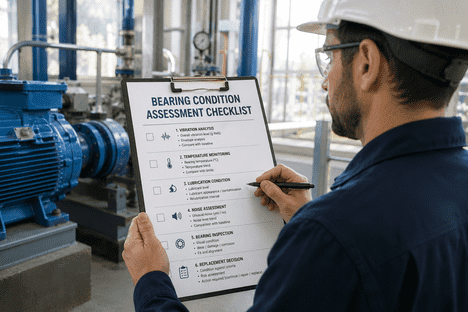
Rolling element bearings are the most critical mechanical components in industrial rotating equipment — and the leading cause of unplanned production downtime when their degradation goes undetected. A structured bearing condition assessment is the foundation of every effective predictive maintenance programme, yet most plants lack a standardised methodology that covers the five essential evaluation dimensions: vibration envelope spectrum analysis, temperature trending against thermal baselines, lubrication condition assessment, acoustic noise characterisation, and structured replacement decision criteria aligned with remaining useful life estimates. This checklist provides a comprehensive bearing condition assessment framework based on SKF bearing assessment methodology and ISO 20816-3 vibration evaluation guidelines — designed for reliability engineers using iFactory's AI predictive maintenance platform, which fuses accelerometer telemetry, envelope spectrum analysis across BPFO, BPFI, BSF, and FTF frequency bands, temperature trends, and Shift Logbook inspection records into machine learning models that forecast bearing failures 2–3 weeks in advance. Book a Demo to see how iFactory automates bearing condition assessment across your rotating equipment fleet.
Bearing Condition Assessment Checklist — Five Dimensions of Bearing Health
Vibration envelope spectrum analysis · Temperature trending · Lubrication condition · Acoustic noise assessment · Replacement decision criteria — all structured for a repeatable bearing inspection workflow using iFactory's AI predictive maintenance platform and Shift Logbook.
Understanding Bearing Degradation — The Four Failure Stages
Before conducting a bearing condition assessment, every reliability engineer must understand the four-stage bearing failure progression model. Each stage produces distinct vibration envelope spectrum signatures, temperature profiles, and acoustic characteristics that determine which assessment methods are appropriate and what intervention timeline is available. Stage 1 (incipient) presents ultrasonic emissions above 20 kHz detectable only by high-frequency accelerometers. Stage 2 (moderate) shows BPFO, BPFI, BSF, or FTF harmonics appearing in the envelope spectrum with amplitudes 2–5× above baseline. Stage 3 (advanced) exhibits broadband floor elevation, multiple harmonic families, and sideband modulation at shaft speed. Stage 4 (pre-failure) shows broadband noise, significant cage frequency components, and measurable temperature rise. AI models trained on IEEE PRONOSTIA and IMS benchmark datasets detect Stage 1–2 transitions that manual periodic analysis routinely misses. Managers who have already booked a demo consistently report that iFactory's envelope spectrum analysis catches incipient faults 2–3 weeks earlier than their previous route-based vibration programme.
Incipient — Ultrasonic Emissions
Subsurface fatigue initiation. Detectable only by high-frequency accelerometers (>20 kHz). No measurable temperature rise. No audible noise change. Intervention window: 3–6 weeks before functional failure.
Moderate — Envelope Spectrum Harmonics
Spall initiation detected via envelope spectrum. BPFO/BPFI harmonics 2–5× baseline. Slight temperature rise (2–5°C above baseline). Lubrication analysis shows debris. Intervention window: 2–4 weeks.
Advanced — Broadband Elevation
Multiple harmonic families with shaft-speed sidebands. Broadband noise floor elevation. Temperature rise 5–10°C. Audible noise change — distinct rhythmic sound. Intervention window: 1–2 weeks.
Pre-Failure — Imminent Seizure
Broadband vibration noise with significant cage frequency components. Temperature rise >10°C. Loud audible noise. Intervention window: hours to days. Emergency replacement required.
1. Vibration Envelope Spectrum Analysis
Vibration envelope spectrum analysis is the primary diagnostic tool for rolling element bearing condition assessment. Unlike overall velocity measurements per ISO 10816 — which are designed for imbalance and misalignment detection — envelope spectrum analysis isolates bearing fault frequencies by demodulating the high-frequency carrier signal generated by impacts between spalled surfaces and their mating raceways. Each bearing geometry generates unique characteristic frequencies that must be calculated from the bearing dimensions and operating speed: ball pass frequency outer race (BPFO), ball pass frequency inner race (BPFI), ball spin frequency (BSF), and fundamental train frequency (FTF). The envelope spectrum assessment compares measured amplitude at each fault frequency against established baseline values and industry severity thresholds to classify defect stage and estimate remaining useful life.
| Fault Frequency | Formula (N = balls, RPM = shaft speed) | What It Detects | Severity Threshold (× Baseline) | Typical Lead Time |
|---|---|---|---|---|
| BPFO | (N/2)×RPM×(1−(Bd/Pd)×cosθ) | Outer race spalling — fixed race fault | 2× caution · 5× critical | 14–28 days |
| BPFI | (N/2)×RPM×(1+(Bd/Pd)×cosθ) | Inner race spalling — rotating race fault | 2× caution · 5× critical | 10–21 days |
| BSF | (Pd/Bd)×RPM×(1−((Bd/Pd)×cosθ)²) | Rolling element spalling | 3× caution · 7× critical | 7–14 days |
| FTF | (RPM/2)×(1−(Bd/Pd)×cosθ) | Cage damage — rapid failure propagation | Any FTF amplitude >baseline | 5–10 days |
The envelope spectrum assessment should be conducted at each bearing measurement point using a minimum of 800-line FFT resolution at a maximum frequency of 10× the highest fault frequency of interest. For bearings operating below 300 RPM, stress wave analysis or acoustic emission techniques should supplement standard accelerometer measurements. Book a Demo to see how iFactory's platform automatically calculates all four fault frequencies from bearing part numbers and shaft speed, then tracks amplitude trends continuously across every bearing in your fleet.
2. Temperature Trending Assessment
Bearing temperature is a lagging indicator — it rises after mechanical damage has already initiated — but it is an essential confirming parameter that distinguishes a genuine fault from a false positive in the envelope spectrum. A bearing with elevated BPFO amplitude that shows no corresponding temperature rise is more likely to be exhibiting a false positive from electrical interference or structural resonance than a true bearing defect. Conversely, a bearing where both envelope spectrum amplitude and temperature are trending upward provides high-confidence fault confirmation. Temperature trending should capture bearing housing surface temperature (or RTD reading where installed) at the same measurement point as the vibration reading, always taken at the same operating condition for trend validity.
Record bearing housing temperature at stable operating condition (full speed, normal load, after 30+ minutes of steady operation). Baseline is the average of three readings taken on different days at the same operating point.
Normal: ±2°C of baseline. Caution: +2–5°C above baseline (Stage 2). Alarm: +5–10°C above baseline (Stage 3). Critical: +10°C or more above baseline (Stage 4 — imminent failure).
Measure rate of change: gradual rise over weeks indicates progressive wear; rapid rise over hours indicates lubrication failure or imminent seizure. Trend velocity overrides absolute threshold in severity classification.
Always measure ambient temperature at the same time as bearing temperature. Corrected delta T = bearing surface temperature − ambient temperature. Seasonal ambient variation of 10–20°C will mask bearing temperature rise if not compensated.
Compare temperature readings across identical bearings on the same machine or same asset class. A single bearing running 5°C hotter than its peer on the same shaft is cause for investigation even if absolute temperature is within limits.
For each assessment, capture an infrared camera scan of the bearing housing and surrounding structure. Document the thermal image in iFactory's Shift Logbook alongside vibration readings, creating a visual thermal baseline for future comparison.
3. Lubrication Condition Assessment
Lubrication condition is the most frequently overlooked dimension in bearing condition assessment — and the most actionable. An estimated 40–50% of all bearing failures are lubrication-related, and the majority of these are preventable through structured grease condition monitoring or oil analysis. The lubrication assessment covers three parameters: contamination level (particle ingress from worn seals or environmental exposure), lubricant degradation (oxidation, thermal breakdown, or water contamination), and lubricant quantity (under-lubrication causing metal-to-metal contact or over-lubrication causing churning and temperature rise). iFactory's Shift Logbook captures lubrication event records — regrease date, grease type, quantity applied — alongside vibration and temperature trends, enabling correlation analysis that identifies when lubrication condition changes precede vibration amplitude increases.
Grease Condition — Visual & Consistency Check
Inspect grease escaping from seals for discoloration (dark brown indicates oxidation; milky indicates water contamination; metallic sheen indicates wear debris). Check consistency — grease that has hardened or separated indicates degradation.
Oil Analysis — Where Applicable
For oil-lubricated bearings, collect an oil sample and test for viscosity, acid number, water content, and particle count. Compare against ISO 4406 cleanliness targets for the specific bearing type and operating environment.
Relubrication Interval Compliance
Verify that relubrication intervals have been followed per manufacturer recommendations. For grease-lubricated bearings, verify the correct grease type and quantity was applied at each interval. Document any interval deviations in the Shift Logbook.
Seal Condition Inspection
Inspect bearing housing seals for wear, cracking, or hardening. Worn seals are the primary pathway for contaminant ingress that accelerates bearing wear by 3–10×. Document seal condition with photographs in the Shift Logbook.
Grease Sampling & Spectroscopy (Quarterly)
For critical bearings, submit grease samples for quarterly spectroscopy analysis. Wear element concentration trends — iron, chromium, copper — provide earlier fault detection than vibration analysis for slow-speed bearings and heavily contaminated environments.
4. Acoustic Noise and Audible Assessment
Audible bearing noise assessment is the oldest bearing condition monitoring technique — and remains one of the most valuable when performed systematically. The human ear, trained on bearing-specific acoustic signatures, can detect subtle changes in bearing sound that envelope spectrum analysis at routine measurement intervals may miss between data collection points. A structured acoustic assessment uses a mechanic's stethoscope or ultrasonic probe at the bearing housing and classifies the sound character into one of five categories: smooth rolling (normal), intermittent clicking (incipient spall), rhythmic knocking (advanced spall), grinding or scraping (contamination or inadequate lubrication), and whistling or squealing (lubrication starvation or incorrect grease type).
Acoustic Assessment Classification Guide
Consistent low-level rolling sound with no periodic impacts or tonal components. Action: Continue routine monitoring. No intervention required.
Irregular clicking sounds at rates matching bearing fault frequency calculations. Action: Escalate to envelope spectrum analysis. Schedule inspection within 2 weeks.
Regular, repetitive knocking at BPFO or BPFI rate. May be audible without stethoscope. Action: Immediate bearing replacement planning. Order replacement bearing.
Harsh, irregular sound indicating abrasive particle contamination or inadequate lubrication. Action: Inspect seals, relubricate, and monitor closely. Reassess after lubrication.
5. Replacement Decision Criteria — When to Schedule the Intervention
The output of a bearing condition assessment must be a decision — not just a diagnosis. The replacement decision framework integrates the outputs of all four assessment dimensions into a structured recommendation with three possible outcomes: continue monitoring at standard interval (all dimensions normal), escalate monitoring frequency and schedule near-term replacement (one or more dimensions in caution range), or schedule immediate replacement (any dimension in critical range). This decision framework prevents the two most common bearing replacement errors: premature replacement that wastes 30–50% of remaining useful life, and delayed replacement that results in catastrophic failure with collateral damage to shafts and housings.
| Decision Outcome | Criteria | Action Required | Timeline |
|---|---|---|---|
| Continue Monitoring | All envelope spectrum amplitudes <2× baseline · Temperature <+2°C · Normal acoustic signature | Standard route-based data collection · Routine lubrication · No action required | Standard interval |
| Escalate Monitoring | Any envelope spectrum amplitude 2–5× baseline · Temperature +2–5°C · Intermittent clicking | Increase data collection frequency to weekly · Order replacement bearing · Schedule planned replacement within 3–4 weeks | 3–4 weeks |
| Schedule Immediate Replacement | Any envelope spectrum amplitude >5× baseline · Temperature >+5°C · Rhythmic knocking or grinding | Generate emergency work order in CMMS · Confirm spare bearing availability · Schedule replacement during next available maintenance window | Within days |
iFactory's Shift Logbook automates this decision framework by continuously scoring every bearing across all five condition dimensions and generating a structured replacement recommendation with lead time, confidence score, and recommended replacement bearing part number. Book a Demo to see how iFactory's bearing condition assessment module integrates vibration envelope data, temperature trends, lubrication records, and replacement decisions into a single Shift Logbook workflow.
Deploy iFactory's Bearing Condition Assessment Workflow Across Your Fleet
Pre-built bearing condition assessment templates with envelope spectrum analysis for BPFO, BPFI, BSF, and FTF frequency bands — integrated with temperature trending, lubrication tracking, acoustic classification, and automated replacement decision logic in iFactory's Shift Logbook.
Bearing Condition Assessment — Common Questions Answered
How often should bearing condition assessments be performed?
The assessment frequency depends on bearing criticality, operating speed, and failure history. For critical rotating equipment — main process pumps, cooling tower fans, compressor trains, and crane gearboxes — a full five-dimension assessment should be performed monthly, with continuous vibration monitoring via online accelerometers feeding iFactory's AI platform for daily envelope spectrum analysis. For non-critical bearings on standby or intermittent-duty equipment, quarterly assessment is sufficient with route-based data collection between assessments.
What is the difference between ISO 10816 overall velocity and envelope spectrum analysis?
ISO 10816 measures overall vibration velocity in mm/s RMS across a broad frequency range (10–1,000 Hz typically), which captures imbalance, misalignment, and looseness effectively but is largely insensitive to early-stage bearing faults. Envelope spectrum analysis demodulates the high-frequency carrier signal generated by bearing impacts (typically 5–20 kHz) and converts it to a low-frequency spectrum where bearing fault frequencies — BPFO, BPFI, BSF, FTF — are clearly visible. A bearing can have a Stage 2 inner race spall producing 10× BPFI amplitude in the envelope spectrum while showing zero change in ISO 10816 overall velocity, which is why envelope analysis is essential for bearing-specific condition assessment.
How does iFactory handle bearing condition data from multiple sensor types?
iFactory is sensor-agnostic — it ingests envelope spectra from online accelerometers, periodic route-based vibration data collectors, temperature RTDs, ultrasonic probes, and oil analysis lab reports into a unified bearing health model. The platform normalises data from each sensor type using bearing-specific calibration metadata stored in the Shift Logbook, applies the same five-dimension assessment framework regardless of data source, and generates consistent condition scores and replacement recommendations across the entire bearing fleet. This means a bearing monitored by an online accelerometer on one machine and a monthly route-based data collector on another machine of the same type receives the same assessment methodology and decision framework.
What is the minimum data required to establish a bearing condition baseline?
Per ISO 13373-1 guidelines, the minimum baseline for a bearing condition assessment programme requires: (1) three envelope spectrum measurements taken on different days at the same operating condition (speed, load, temperature), (2) three bearing housing temperature readings concurrent with the vibration readings, (3) a documented lubrication condition assessment including grease type, last relubrication date, and visual condition, (4) an acoustic classification using the five-category system, and (5) an infrared thermal image of the bearing housing and surrounding structure. iFactory's Shift Logbook stores all five baseline dimensions with full operating context and traceability for audit and model training purposes.