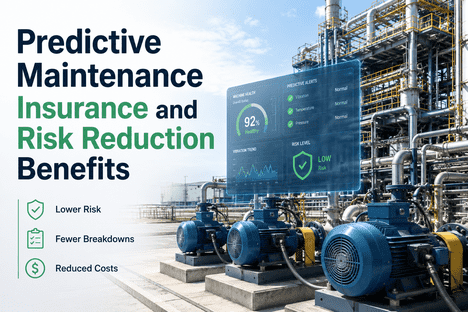
Insurance premiums for industrial facilities are not fixed costs — they are risk-adjusted pricing calculated against the facility's loss history, equipment maintenance practices, safety record, and risk mitigation infrastructure. For manufacturing plants, warehouses, and processing facilities with rotating equipment fleets exceeding 500 critical assets, property and business interruption insurance represents an annual expenditure of $500,000–$3,000,000 depending on asset replacement value, industry classification, and loss history. Predictive maintenance programs directly reduce the frequency and severity of equipment failures — the primary driver of property damage claims and business interruption losses. Insurers including FM Global, Travelers, Chubb, Zurich, and Liberty Mutual now offer 5–15% premium reductions for facilities with documented, validated predictive maintenance programs deploying AI-based condition monitoring, vibration analysis, thermography, and oil analysis across critical equipment populations. iFactory's predictive maintenance platform — including the Shift Logbook, AI fault classification engine, and CMMS-native work order automation — provides the auditable maintenance documentation, failure reduction metrics, and risk mitigation data that insurers require for premium credit qualification. Book a Demo to see how iFactory's documented PdM program satisfies insurance risk engineering requirements and unlocks measurable premium reductions.
Documented PdM programs qualify for 5–15% premium reductions · reduce equipment failure frequency by 50–70% · lower total cost of risk across your entire industrial portfolio.
How Insurance Underwriters Evaluate Equipment Maintenance Risk
Industrial insurance underwriting is fundamentally an assessment of failure probability and failure consequence across the insured facility's equipment fleet. The underwriter's question is not whether a failure will occur — it is how frequently failures occur, how severe their consequences are, and what systems are in place to detect and intervene before failure happens. Property insurers evaluate five specific maintenance risk factors during underwriting and renewal: equipment age and replacement value, historical loss frequency and severity per asset class, current maintenance program structure (reactive vs. preventive vs. condition-based), inspection and testing interval compliance, and the availability of documented condition monitoring data that demonstrates proactive risk management.
| Insurance Risk Factor | Without Documented PdM | With iFactory AI PdM Platform | Underwriting Impact |
|---|---|---|---|
| Equipment failure frequency | 3–8 failures per 100 critical assets annually | 1–2 failures per 100 critical assets annually | Lower loss frequency drives lower experience modification |
| Average claim severity per event | $85,000–$450,000 including BI | $12,000–$45,000 (predicted, planned intervention) | Lower severity per claim reduces aggregate loss exposure |
| Maintenance program maturity | 60–80% reactive spend; limited condition monitoring | 70–80% planned/condition-based; AI-driven detection | FM Global recommends 70%+ planned for best premium tier |
| Inspection interval compliance | 65–80% of routines completed on schedule | 95%+ with automated CMMS work order generation | Demonstrates management control system effectiveness |
| Condition monitoring documentation | Paper records or fragmented spreadsheet data | Unified digital record with full traceability and trending | Verifiable risk mitigation for underwriter submission |
iFactory's platform addresses every factor on this matrix through continuous data ingestion from vibration sensors, bearing temperature probes, motor current transducers, and thermal imaging systems — all logged with full traceability in the Shift Logbook alongside operator inspection records, shift handover notes, and automated work order outcomes. The result is a maintenance data fabric that satisfies the most rigorous insurance risk engineering submission requirements while simultaneously reducing the failure events that drive claim costs.
The Premium Reduction Mechanics: What Insurers Actually Require
Premium credits for predictive maintenance programs are not automatic. Insurers require documented evidence that the PdM program meets specific criteria for coverage scope, data quality, and demonstrated effectiveness. The FM Global Property Loss Prevention Data Sheet 7–45 and similar insurer guidelines define the minimum requirements for a PdM program to qualify for premium consideration. iFactory's platform is purpose-built to satisfy each of these requirements with auditable, exportable data that underwriters accept without additional validation burden on the insured facility.
Insurer requirement: documented list of all critical equipment covered by the PdM program with asset IDs, manufacturers, and monitoring methods applied to each. iFactory's asset register module maintains the complete equipment inventory with criticality scoring, sensor deployment status, and monitoring method per asset — exportable in the format required by each carrier's risk engineering submission portal.
Insurer requirement: minimum 12 months of continuous condition monitoring data demonstrating trend analysis and threshold-based alerting for covered equipment. iFactory retains all sensor telemetry, envelope spectrum data, fault classification records, and trend reports with configurable retention periods that satisfy carrier requirements up to 5+ years.
Insurer requirement: evidence that PdM-generated work orders are completed within defined timeframes with documented findings. iFactory automates work order creation, tracks completion against SLA, and records inspector findings, parts replaced, and residual condition — closing the loop from sensor alert to verified maintenance action with full timestamps.
Insurer requirement: year-over-year comparison of equipment failure frequency and severity before and after PdM deployment. iFactory's analytics dashboard tracks failure events, mean time between failure (MTBF) trends, and cost per failure — generating the trend reports underwriters require for premium credit renewal submission each policy period.
Insurer requirement: documented operator inspection records with dates, findings, and follow-up actions. iFactory's digital Shift Logbook captures daily operator entries, inspection checklists, and equipment status reports with full traceability — replacing paper logs that insurers cannot validate with auditable digital records that satisfy underwriting due diligence.
Insurer requirement: evidence that maintenance spend allocation meets the 70%+ planned threshold preferred by underwriters. iFactory's spend analytics module tracks reactive vs. planned cost allocation automatically and generates the trend reports that demonstrate program maturity improvement over successive policy periods.
How Equipment Failure Reductions Translate to Insurable Risk Reduction
The insurance industry quantifies risk through two primary metrics: loss frequency (how often failures occur) and loss severity (how much each failure costs). Predictive maintenance programs that reduce both metrics simultaneously are the most powerful risk mitigation investment a facility can make from an insurer's perspective. The table below documents the direct relationship between specific PdM capabilities and the insurance risk metrics they improve — with the premium impact that FM Global and similar carriers have published in their underwriting guidelines.
Real-World Premium Reduction Case Studies
FM Global's published loss prevention data, alongside case studies from Travelers, Zurich, and Chubb, document the premium impact of documented predictive maintenance programs across multiple industrial sectors. The following representative cases — drawn from industry publications and insurer loss prevention data sheets — demonstrate the range of premium outcomes achievable with properly deployed AI predictive maintenance platforms.
Want to model your facility's specific premium reduction potential based on your current loss experience modifier and equipment profile? Book a Demo for a confidential premium impact assessment using your carrier's underwriting parameters.
Three Deployment Paths for Insurance-Grade PdM Documentation
The premium credit qualification path depends on your current maintenance program maturity, existing CMMS and condition monitoring infrastructure, and the documentation quality your insurance carrier's risk engineering team requires. iFactory's three deployment paths align with the three most common facility starting points for insurance-focused PdM programs.
The Total Cost of Risk Impact: Beyond Premium Reduction
Insurance premium reduction — while the most visible financial benefit of documented PdM programs — represents only one component of total cost of risk (TCOR) improvement. TCOR includes insurance premiums, retained losses (deductibles and self-insured retentions), loss control engineering costs, administrative expenses, and business interruption costs not covered by insurance. Predictive maintenance programs reduce TCOR across every component simultaneously, creating a cumulative financial impact that typically exceeds the premium reduction alone by a factor of 3–5x.
Expert Perspective
Vendor Evaluation Framework — Insurance-Focused Questions
Generic predictive maintenance vendors focus on sensor hardware and alert generation. Insurance-aware vendors address the documentation, auditability, and underwriting submission requirements that convert PdM technical capability into premium reduction. Eight criteria separate platforms that generate insurance value from platforms that generate maintenance data only.
Conclusion: Your Predictive Maintenance Program Is an Insurance Asset
The financial case for insurance-focused predictive maintenance deployment is structurally different from the traditional maintenance cost reduction case. Traditional PdM ROI models focus on maintenance budget savings — reduced labor, optimized parts spend, extended equipment life. The insurance case adds a parallel financial stream: premium reduction at 5–15% annually, retained loss avoidance at 50–70% reduction in unplanned failure events, and total cost of risk improvement at 3–5x the premium impact alone. For a facility with $1,500,000 in annual property and business interruption premiums, a 10% premium credit delivers $150,000 in annual savings before the first equipment failure is prevented. The failure reduction savings — fewer deductibles, less business interruption, lower self-insured retentions — add another $200,000–$500,000 in annual retained loss avoidance depending on current failure frequency and severity. The combined TCOR improvement of $350,000–$650,000 annually recovers the iFactory platform investment multiple times in the first policy period. The documentation infrastructure that generates this financial outcome — continuous sensor telemetry, automated work order records, Shift Logbook digitalization, carrier-format reporting — is the same infrastructure that delivers the maintenance reliability improvements that production and engineering teams value independently. There is no trade-off between insurance value and maintenance value. They are the same investment with two independent financial return streams.