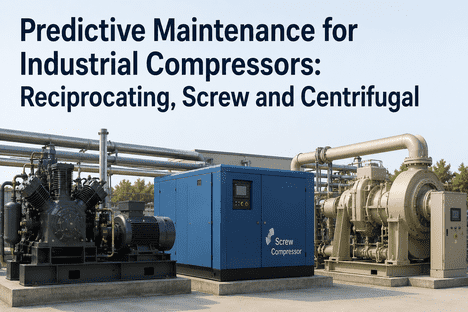
Predictive Maintenance for Industrial Compressors: Reciprocating, Screw and Centrifugal
By Daniel Carter on June 7, 2026
Industrial compressors are the most critical rotating assets in plant utilities, process gas handling, and air supply systems — consuming 70–80% of total lifecycle cost through energy use alone while supporting production processes that halt completely when compressed air or gas supply is interrupted. A single unplanned compressor failure can cost $50,000–$500,000 in lost production, emergency repairs, and secondary damage to downstream equipment. Traditional preventive maintenance based on calendar intervals or running hours cannot account for the variability in gas composition, load cycling, ambient conditions, and duty cycles that accelerate compressor degradation across different installations. A reciprocating compressor running on dry nitrogen in a climate-controlled facility bears no resemblance to the same model handling wet sour gas in an outdoor installation. Predictive maintenance powered by AI and IoT telemetry is transforming how plant operators manage compressor asset health: valve signature analysis detects reciprocating valve leakage before capacity drops, vibration spectrum analysis identifies screw compressor rotor contact, surge margin monitoring prevents centrifugal compressor catastrophic failure, and oil analysis tracks bearing and gear degradation months in advance. iFactory AI's industrial software platform, including its Shift Logbook and predictive maintenance engine, enables industrial operators to deploy AI-native predictive maintenance across every compressor class without replacing existing SCADA, CMMS, or ERP systems. Book a Demo to see how iFactory applies predictive maintenance for industrial compressors. This guide covers critical failure modes, compressor-specific AI techniques, and the practical deployment path for reliability engineers evaluating modernization.
Predictive Maintenance for Industrial Compressors: Reciprocating, Screw & Centrifugal
AI-driven valve failure prediction · surge margin monitoring · bearing prognostics · oil analysis fusion — reducing unplanned downtime, extending mean time between overhauls, and improving specific power consumption across every compressor class.
Why Traditional Compressor Maintenance Is Hitting Its Ceiling
The traditional approach — scheduled valve replacement, calendar-based oil changes, and manual vibration readings — treats every compressor identically regardless of actual operating conditions. A reciprocating compressor on clean dry air at 50% load may run 40,000 hours between valve overhauls; the same model on wet sour gas at 90% load may fail valves at 6,000 hours. A centrifugal compressor running on stable base load with clean inlet air experiences dramatically different degradation than one on variable-speed pipeline service with frequent load changes. Fixed-interval maintenance either over-serves healthy compressors (wasting valve kits, bearings, and labour) or under-serves compressors approaching failure (risking catastrophic rotor failure, oil fires, and process gas releases). Four specific ceilings are visible across every industrial compressor fleet.
01
Fixed Overhaul Windows
Calendar-based compressor overhauls ignore actual wear. A reciprocating compressor on clean service may need valve inspection every 8,000 hours; the same model on dirty service needs it at 3,000. AI models use valve signature, vibration, and performance data per compressor.
Gap: Calendar-based vs Condition-based
02
No Cross-Fleet Learning
Each compressor's maintenance history lives in isolation. Patterns — a specific valve model failing on wet gas service, or bearing degradation correlating with high discharge temperature — remain invisible. AI models learn across the entire compressor fleet.
Gap: Siloed vs Fleet-wide
03
Reactive Surge Response
Centrifugal compressor surge events cause catastrophic rotor damage within seconds to minutes. Manual surge control systems react after surge begins. AI predicts surge margin degradation 14–30 days before risk threshold is breached, enabling proactive control tuning.
Gap: Reactive vs Predictive Protection
04
Fragmented Monitoring Data
Vibration data lives in one system, performance curves in the DCS, oil analysis in a lab database, valve signatures in a portable collector, and maintenance records in the CMMS. No unified view connects compressor health to process conditions. AI-native platforms fuse all streams into single compressor health dashboards.
Gap: Fragmented vs Unified
What AI Predictive Maintenance Actually Adds to Compressor Reliability Programs
The misconception some reliability engineers carry: predictive maintenance replaces existing CMMS or condition monitoring programs. It doesn't. Your CMMS continues handling work orders and parts inventory. Your existing vibration and performance monitoring continues collecting data. What changes is the intelligence layer feeding those systems. Time-based valve replacement and oil change schedules migrate to AI-driven condition-based predictions. Vibration alarm thresholds gain predictive context. The existing CMMS receives higher-quality input — not just "compressor failed — overhaul" but "reciprocating compressor 3B shows valve signature elevation on cylinder 2 at 94% confidence — estimated 22 days remaining useful life — root cause: progressive valve plate fatigue — recommended valve kit pre-ordered for next planned shutdown." iFactory AI's Shift Logbook provides operators and maintenance teams with a unified interface for shift handovers, compressor status, and AI-generated maintenance recommendations integrated with existing workflows.
Capability
Traditional Maintenance
AI Predictive Maintenance
Service trigger
Calendar / running hours
Predicted remaining useful life per compressor
Valve monitoring
Temperature check / post-failure teardown
Continuous AI analysis of valve signature from dynamic pressure
Failure notification
After capacity drop / valve failure
14–42 day predictive lead time before failure
Surge protection
Reactive surge control valve response
Predictive surge margin monitoring — proactive control
Oil analysis
Quarterly lab sampling
Continuous AI fusion of online oil sensors + vibration
Fleet coverage
Critical compressors only
All instrumented compressors plant-wide
Operator interface
Paper logs + SCADA alarms
Mobile dashboards + shift logbook + AI copilot
Critical Compressor Failure Modes — What AI Catches That Manual Inspections Miss
Industrial compressors fail through specific mechanical and thermodynamic processes that leave identifiable signatures in sensor data before they become visible to operators or inspectors. AI models trained on these signatures detect degradation 14–42 days before failure — the window that separates planned intervention from catastrophic compressor failure.
R
Reciprocating
Valve plate fatigue, piston ring wear, cylinder/packing leakage, crosshead pin wear, connecting rod bearing degradation, unloader mechanism failure. AI analyzes dynamic pressure, rod drop, vibration, and temperature per cylinder.
Predictive lead time: 14–28 days
S
Screw Compressors
Rotor contact/scuffing, bearing wear, oil/coolant system degradation, timing gear backlash increase, shaft seal failure, suction check valve leakage. AI fuses vibration, oil temperature, pressure differential, and power data.
Predictive lead time: 21–42 days
C
Centrifugal
Surge margin erosion, impeller erosion/fouling, diffuser fouling, dry gas seal degradation, blade fatigue cracking, bearing wear, balance drum damage. AI correlates vibration, flow, head, and speed data.
Predictive lead time: 14–30 days
A
Auxiliary Systems
Lubrication oil pump failure, cooling water system fouling, intercooler degradation, moisture separator failure, inlet filter loading, control valve positioner drift, anti-surge valve degradation.
Predictive lead time: 14–30 days
The Keep / Retire / Transform / Replace Decision Matrix
Migration discipline starts here. Every compressor reliability artifact in your current operation falls into one of four categories. Getting the categorization right in week one of the workshop saves quarters of debate later.
Keep
Core reliability foundations
CMMS work order engine
Existing vibration monitoring hardware
Parts inventory & procurement
ERP financial integration
Safety management systems
Established capabilities. No business case to replace. AI predictive maintenance writes recommendations and work orders to these systems.
Retire
Legacy inspection layers
Fixed calendar-based valve replacement
Manual vibration data collection rounds
Quarterly oil sample programs only
Paper performance curve trending
Email-based alarm notification
Replaced by AI-driven condition-based predictions and unified interface. 70–90% reduction in manual monitoring effort.
Transform
Analysis workflows
Compressor health scoring
Valve signature trending
Surge margin monitoring
Specific power trending
Shift handover reporting
Become AI model invocations grounded in real-time compressor data. Intelligence upgraded via iFactory Shift Logbook.
Replace
Alert & notification layer
Legacy alarm notification gateways
Manual escalation workflows
Standalone compressor protection relays
Paper-based shift logs
Siloed performance monitoring reports
Event-driven AI alert engine replaces manual notification. Compressor-critical alerts with automated work order creation.
Want this matrix applied to your specific compressor fleet in a working session? Book a Demo to walk through every compressor class and prioritize your predictive maintenance rollout.
Three Deployment Paths for Compressor Predictive Maintenance
Same starting point, three valid destinations. The right path depends on compressor criticality, process gas hazard exposure, installed sensor density, and current condition monitoring program. Reliability engineers that pick the wrong path spend 12 months in pilot purgatory. Engineers that pick the right path deploy in 6–10 weeks.
Path A
Augment in Place
6–8 weeks
AI predictive monitoring runs alongside existing PM programs. Shadow mode for 4 weeks. Alerts flow to CMMS for review. No legacy systems retired.
Best fit
Hazardous gas service · risk-averse operations · first AI deployment in compressor reliability
Wk 1–2 Sensor data federation
Wk 3–5 Shadow mode AI
Wk 6–8 CMMS integration live
Path B
Hybrid Migration
8–12 weeks
AI predictive layer replaces fixed valve/overhaul schedules. Legacy dashboards retire for unified mobile UX. SCADA, CMMS, and ERP preserved. Performance data federated.
Best fit
Mature reliability programs · moderate budget authority · sponsorship for digital transformation
Wk 1–3 Discovery · matrix
Wk 4–8 Deploy AI prediction layer
Wk 9–12 Mobile UX migration · cutover
Path C
Full Modernization
10–14 weeks
Legacy fixed-interval programs retired. iFactory platform provides full predictive capability. CMMS retained. All compressor classes covered against matrix.
Best fit
Large multi-plant operations · siloed legacy systems · strategic platform consolidation
Generic predictive maintenance vendors handle the AI math. Compressor-aware vendors handle the integration reality — reciprocating, screw, and centrifugal compressor diversity, API 618/619 compliance, valve signature analysis, surge margin algorithms, and zero-disruption deployment. Eight criteria separate vendors who've done compressor reliability modernizations from vendors selling a demo.
01
Compressor class coverage
Ask:
"Does your platform support reciprocating, screw, and centrifugal compressor types with distinct failure models for each?"
Each compressor class has unique failure modes and sensor signatures. Platforms using a single rotating equipment model for all compressor types cannot accurately predict reciprocating valve fatigue or centrifugal surge margin erosion.
02
Valve signature analysis
Ask:
"Can your platform detect reciprocating compressor valve degradation from dynamic pressure signatures 14–28 days before failure?"
Valve failures account for 35% of reciprocating compressor downtime. Platforms that only monitor overall vibration miss the cylinder-specific pressure signature that precedes valve failure.
03
Surge margin prediction
Ask:
"Does your platform provide predictive surge margin monitoring for centrifugal compressors using actual operating data vs theoretical curves?"
Surge margin erodes as impellers foul and seals degrade. Platforms without surge algorithms miss the most catastrophic centrifugal compressor failure mode.
04
Reciprocating rod drop monitoring
Ask:
"Does your platform integrate with proximity probe data for reciprocating compressor rod position and drop monitoring?"
Rod drop is the leading indicator of crosshead wear and piston rod separation — a catastrophic failure mode unique to reciprocating compressors.
05
Oil analysis fusion
Ask:
"Does your platform fuse online oil condition sensors with vibration and performance data for bearing and gear health assessment?"
Oil analysis detects bearing spalling and gear wear 30–60 days before vibration increases. Platforms that don't fuse oil data miss the earliest degradation indicators.
06
Specific power monitoring
Ask:
"Does your platform track compressor specific power (kW per unit flow) as a leading indicator of mechanical degradation?"
Specific power increases measurably before failure as internal clearances grow and valves leak. Platforms without efficiency trending miss a key leading indicator.
07
Dry gas seal monitoring
Ask:
"Does your platform integrate with dry gas seal monitoring systems for centrifugal compressors — seal gas flow, pressure, and temperature?"
Dry gas seal failure on centrifugal compressors causes catastrophic process gas release. Platforms without seal monitoring integration miss the highest-safety-critical sub-system.
08
Deployment timeline commitment
Ask:
"When does the first validated compressor predictive alert reach our CMMS in production?"
8–12 weeks is the production-grade benchmark. Path A is 6–8 weeks. Path C is 10–14 weeks. Vendors quoting 6+ months are building custom development.
The ROI Math — What Predictive Maintenance Delivers for Compressor Reliability
The business case for AI-native predictive maintenance for compressors isn't about software cost — it's about cost avoidance on unplanned compressor failures, process gas releases, energy waste, and secondary damage to downstream equipment. Reliability teams moving from preventive to AI-native predictive maintenance see measurable improvements across four metrics in the first quarter post-deployment.
−35–55%
Unplanned compressor downtime reduction
AI identifies compressor degradation 14–42 days before failure. Emergency repairs shift to planned valve replacements and overhauls during scheduled outages.
−20–40%
Maintenance cost reduction
Condition-based service eliminates unnecessary valve replacements and overhauls while catching failures before cascading damage inflates repair costs.
−3–8%
Specific power reduction
AI efficiency monitoring identifies degradation causing increased power consumption — enabling valve adjustments, seal replacements, or impeller cleaning.
6–12 mo
Typical ROI payback
Full investment recovery through downtime avoidance, energy savings, extended overhaul intervals, and reduced secondary damage to piping and drivers.
Expert Perspective
"The single biggest mistake reliability engineers make in compressor predictive maintenance modernization is treating it as a CMMS replacement project. It isn't. Your work order engine, vibration monitoring program, and procurement processes work as designed — there's no business case to replace them. What needs to change is the intelligence layer feeding those systems. Calendar-based valve replacement schedules and fixed-interval overhaul programs need to migrate to AI model invocations running remaining useful life predictions across reciprocating, screw, and centrifugal compressor classes. Valve signature analysis that currently relies on quarterly portable collector data needs to stream continuously into fusion models that predict valve failure 30 days before capacity drops. Surge margin that operators check manually once per shift needs real-time AI monitoring that predicts margin erosion weeks before risk thresholds are breached. The architectural decision isn't CMMS-or-AI — it's CMMS-plus-AI-plus-valve-signature-plus-surge-margin-plus-oil-analysis. Reliability teams that frame it correctly deploy in 8–12 weeks. Teams that frame it as rip-and-replace spend 12 months in pilot purgatory."
— Compressor Reliability Engineering Practice, 2026 industry insight
8–12 wk
hybrid deployment with pre-configured compressor templates
70–90%
reduction in custom deployment scope with templates
Zero rip
of existing CMMS, SCADA, or ERP required
Conclusion: The Modernization Decision Has Three Right Answers
Calendar-based compressor maintenance programs aren't failing — they're hitting an architectural ceiling that fixed-interval analysis can't cross. AI-native predictive maintenance adds the condition-based intelligence layer that traditional programs were never designed to deliver: remaining useful life predictions across reciprocating, screw, and centrifugal compressor classes, valve signature analysis for early failure detection, surge margin monitoring for centrifugal protection, oil analysis fusion with vibration for bearing prognostics, self-updating models from operator confirmations, and mobile-native operator interfaces grounded in real-time compressor data. The modernization conversation has three valid answers depending on compressor criticality and process gas hazard exposure — augment in place (6–8 weeks), hybrid migration (8–12 weeks), or full modernization (10–14 weeks). All three keep existing CMMS intact and reuse current sensor infrastructure. All three deliver 35–55% reduction in unplanned compressor downtime and 20–40% reduction in maintenance costs within the first quarter. The decision worth making in 2026 isn't whether to adopt AI predictive maintenance for compressors — it's which of the three paths fits your specific fleet. Book a Demo to walk through your specific compressor classes and predictive maintenance requirements.
Run the Predictive Maintenance Workshop Built for Your Compressor Fleet
iFactory AI's compressor reliability practice runs a 90-minute workshop against your real compressor classes, sensor coverage, and CMMS configuration. You leave with a defended path recommendation, the keep/retire/transform/replace matrix applied to your compressor fleet, and a cost reduction projection grounded in your maintenance history.
Does predictive maintenance replace our existing compressor condition monitoring program?
No. Your existing vibration monitoring, performance trending, and oil analysis programs continue collecting valuable data — these are mature practices with no business case to replace. What changes is that all sensor data now feeds AI models that predict compressor failures 14–42 days in advance, in addition to the alarm thresholds your reliability engineers already monitor. The predictive layer fuses vibration, dynamic pressure, performance, oil, and process data into unified compressor health assessments. Deployment does not require any changes to compressor control logic or anti-surge protection systems.
What compressor failure modes can AI actually predict?
Production-grade AI predictive maintenance for compressors covers reciprocating compressors (valve plate fatigue, piston ring wear, cylinder/packing leakage, crosshead pin wear, connecting rod bearing degradation, unloader mechanism failure), screw compressors (rotor contact, bearing wear, oil/coolant system degradation, timing gear wear, shaft seal failure), centrifugal compressors (surge margin erosion, impeller erosion/fouling, diffuser fouling, dry gas seal degradation, blade fatigue, balance drum damage), and auxiliary systems (lubrication pump failure, intercooler degradation, inlet filter loading, anti-surge valve degradation). Each failure mode has a characteristic sensor signature detectable 14–42 days before catastrophic failure.
Does deployment require new sensors on existing compressors?
No. Production-grade predictive maintenance platforms integrate with existing instrumentation already installed on most industrial compressors — vibration probes, temperature transmitters, pressure sensors, flow meters, motor current transformers, and dynamic pressure transducers. iFactory's federation layer reuses current instrument data through existing SCADA, DCS, and PLC infrastructure. For older compressors without continuous monitoring, retrofittable wireless vibration and temperature sensor kits are available, but the platform is designed to extract maximum value from existing instrumentation first.
How does predictive maintenance improve compressor safety outcomes?
Safety improvements come through three mechanisms. First, compressor gas leaks and casing breaches follow identifiable precursor patterns in vibration, pressure, and seal data — AI models detect these patterns 14–42 days before failure, enabling intervention before hazardous gas release. Second, centrifugal compressor surge prediction prevents catastrophic rotor damage that can cause casing rupture and flying debris. Third, maintenance teams receive prescriptive alerts with confidence scores — reducing the cognitive load of evaluating multiple alarm streams during critical operations. Facilities deploying compressor predictive maintenance typically see 50–70% reduction in compressor-related safety incidents within the first year.
Which deployment path fits a refinery with critical hydrogen compressors best?
Path A (Augment in Place) is the right starting point for refineries with critical hydrogen service compressors, where reliability directly determines production uptime and hydrogen balance. The platform runs alongside existing PM programs for 4 weeks in shadow mode, generating predictions logged for review but not triggering automatic work orders. Reliability teams compare AI predictions against actual events, document performance, and approve cutover with full traceability. No legacy systems retire in Path A — existing valve replacement schedules and overhaul programs continue running as a control comparison. After 6–12 months, most refineries progress to Path B or C to capture additional efficiency gains across the full compressor fleet.