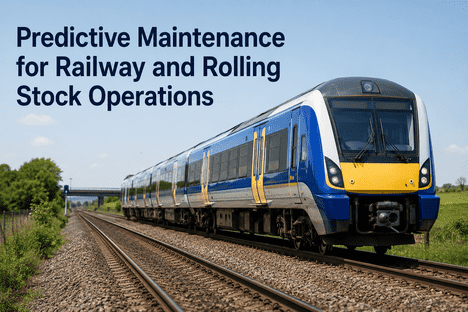
Predictive Maintenance for Railway and Rolling Stock Operations
By Ethan Walker on June 6, 2026
The question rail operators and rolling stock maintenance teams are asking in 2026 isn't whether to deploy AI predictive maintenance — it's where to start, how to evaluate vendors, and how fast the ROI materialises. A single in-service wheel bearing failure on a passenger coach costs $12,000–$45,000 when unplanned wheelset replacement, track access charges, cancelled service penalties, and delay compensation are factored in — and a catastrophic gearbox or traction motor failure during peak service can strand an entire train for 24+ hours, triggering cascading schedule disruption across the network. Meanwhile AI-powered rolling stock monitoring now detects wheel bearing degradation, gearbox wear, traction motor insulation breakdown, and brake system faults 20–60 days before failure with 85–95% accuracy, integrates with existing telematics (Knorr-Bremse, Siemens, Alstom, Hitachi) via standard protocols, and typically pays back full investment in 4–8 months on fleets of 30+ vehicles. This guide is for rolling stock maintenance managers and fleet engineers evaluating predictive maintenance for rail operations — what each vehicle system delivers, where ROI lands first, how to evaluate vendor claims, and what deployment actually looks like across your fleet. Book a Demo to walk through a deployment plan built around your fleet's top three failure categories.
Predictive Rolling Stock Maintenance Deployment Map
Six Vehicle Systems That Determine Rail Fleet Uptime
Each system earns ROI differently. The smartest deployments start with one high-impact system, prove the case, then expand to the others.
01
Wheel Bearings
Raceway wear · cage fracture · acoustic signature
02
Gearboxes
Tooth wear · bearing play · oil debris · temp
03
Traction Motors
Winding temp · insulation · bearing vibration
04
Brake Systems
Pad wear · disc thickness · pneumatic leak
05
Pantograph
Contact strip · carbon wear · uplift force
06
Auxiliary HVAC
Compressor · fan motor · condenser temp
All six systems feed the same inference engine, the same depot health screen, and the same audit trail.
Why the Business Case for Predictive Rolling Stock Maintenance Has Tipped
Three things changed in the last 24 months that make AI predictive maintenance the default rather than the upgrade for rail fleets. Edge AI inference costs dropped to where a fleet-wide deployment pays back in months. Pre-trained rolling stock models reduced deployment time from years to weeks. And the cost of a single wheel bearing or gearbox failure during peak service climbed past $45,000 when delay compensation, track access penalties, and reputational costs are included — which means a single prevented failure on a high-utilisation route pays for the entire platform investment. The buyer's calculus shifted from "can we afford this" to "can we afford not to."
85-95%
AI Detection Accuracy
Versus reactive fault codes that only trigger after a component has already begun failing. The gap widens on intermittent faults that onboard diagnostics alone miss entirely.
35-55%
Fewer In-Service Failures
Documented reduction after AI predictive deployment across rail fleets. Each prevented failure saves $12,000–$45,000 in direct and delay-related costs.
25-35%
Lower Maintenance Spend
Condition-based scheduling eliminates over-servicing waste while preventing emergency repairs. Parts and labour costs shift from premium to planned rates.
4-8 mo
Typical ROI Payback
Full platform cost recovery through failure reduction, delay penalty elimination, emergency repair savings, and over-servicing waste removal.
The Six Rolling Stock Systems — Where Each Earns ROI
Not all rolling stock systems pay back equally when monitored. Wheel bearing and gearbox faults cause the highest-cost in-service failures (high consequence, lower frequency). Brake pad and pantograph wear cause the most frequent depot interventions (lower consequence, higher frequency). Traction motor and HVAC failures strand entire train sets with unpredictable lead times. Understanding which system matters most for your specific fleet profile is how you choose where to start.
Wheel bearing failures are the highest-cost single rolling stock failure category. Early detection of raceway wear and cage fracture prevents $45,000+ in-service wheel replacement and track access costs.
System 02
Gearboxes & Drivetrains
Detects
Gear tooth wear patterns, bearing play progression, oil debris concentration, temperature trend deviation, vibration envelope anomalies
ROI driver
Gearbox failures strand train sets for 48+ hours minimum. Predictive lead time enables planned R&R during scheduled depot downtime rather than emergency line-side replacement.
System 03
Traction Motors
Detects
Winding temperature rise, insulation resistance decline, partial discharge activity, bearing vibration, cooling fan degradation
ROI driver
Traction motor failures during peak service strand entire formations. Predictive winding temp and insulation alerts prevent burnouts and enable planned rewind scheduling.
System 04
Brake Systems
Detects
Pad wear rate, disc thickness variation, pneumatic pressure drop, brake response time degradation, cylinder leakage trends
ROI driver
Brake faults cause the most frequent depot intervention and safety-related downtime. Predictive compliance prevents service disruption and regulatory inspection findings.
System 05
Pantograph & Catenary Interface
Detects
Contact strip wear rate, carbon thickness degradation, uplift force deviation, arcing frequency trend, collector head temperature
ROI driver
Pantograph failures cause catenary wire damage and extended line blockages. Predictive contact strip alerts prevent overhead line entanglement events that strand multiple trains.
System 06
HVAC & Auxiliary Systems
Detects
Compressor motor current, fan bearing vibration, condenser approach temp, refrigerant pressure trends, evaporator coil temp differential
ROI driver
HVAC failures in passenger rolling stock cause service cancellation and passenger compensation claims. Predictive compressor alerts prevent in-service comfort failures.
What to Evaluate When Comparing Vendors — The Buyer's Framework
The AI predictive rolling stock maintenance market in 2026 has dozens of vendors making similar-sounding claims. The differences that matter for rail operations aren't in the marketing decks — they're in eight specific evaluation criteria that determine whether the deployment delivers ROI in 4 months or fails to deliver at all. Here's the checklist most fleet managers wish they'd had before signing.
Swipe horizontally to compare evaluation criteria
Evaluation criterion
Acceptable
What you want
Prediction accuracy
≥80%
85-95% with documented false-positive rate <5%
Alert lead time
<10 days
20-60 days before failure with severity-graded alerts
Onboard integration
Custom protocol work required
Native integration with Knorr-Bremse, Siemens, Alstom, Hitachi, Stadler onboard systems
Health scoring
Basic fault code display
Pre-service health scores: Service-Ready, Monitor, Grounded
Workflow automation
Email alerts only
Auto-generate work orders, check parts inventory, assign depot technicians
Depot system integration
Standalone maintenance module
Connected to depot planning — train sets rescheduled automatically for predicted failures
Deployment timeline
4-8 months
21-45 days with pre-configured rolling stock connectors
Continuous learning
Static models, manual retrain
Auto-improving from repair outcome feedback, monthly accuracy gains
A 30-Minute Demo Worth the Calendar Slot
iFactory will walk through every criterion in the evaluation table against your fleet's specifications — vehicle count, OEM, current failure rates, existing depot management and CMMS stack. You leave with a deployment plan, an ROI projection, and clarity on which rolling stock system earns first.
How Predictive Data Flows Into Your Rolling Stock Maintenance Stack
The biggest operational question after "does it work" is "does it work with what we already have." The honest answer for rail fleets in 2026 is yes — predictive maintenance integration patterns are mature and predictable. Here's what the connection looks like across the four systems that rolling stock intelligence must talk to.
Onboard Monitoring / TCMS
MVB · TRDP · CANopen · HTTP
AI ingests onboard telematics from Train Control and Monitoring Systems via MVB, TRDP, CANopen, or REST APIs. Wheel bearing acoustic sensors, gearbox vibration, traction motor winding temps, brake system pressures, and pantograph current data stream in real time. Compatible with all major OEM onboard architectures.
CMMS / EAM
REST API · Webhooks · SQL
Predictive alerts auto-generate work orders with required tasks, parts lists, and suggested depot technician assignments. Parts inventory is checked and purchase orders raised if stock is below threshold — all without manual intervention.
Depot Management / TMS
REST API · Webhooks · EDI
Pre-service health scores — Service-Ready, Monitor, Grounded — update in real time on the depot console. Grounded train sets are excluded from service allocation. High-utilisation routes are automatically protected from failure risk at the allocation decision point.
Shift Logbook
REST API · Mobile app
iFactory's Shift Logbook captures driver defect reports, pre-service inspection notes, maintenance handovers, and depot supervisor observations alongside sensor-generated predictions. Every alert, repair, and inspection event creates a searchable, audit-ready trail tied to each vehicle and shift.
The Five-Phase Deployment Path — What 21 to 45 Days Actually Looks Like
Deployment is the part most buyers under-estimate. Not the technology itself but the disciplined sequence of phases that turns a vendor demo into a production-grade rolling stock intelligence layer. Here's the path iFactory walks every rail customer through, and what each phase delivers.
Phase 01
Day 1-5
Data Connection & Baseline Setup
Connect onboard TCMS telemetry via MVB, TRDP, or CANopen. Integrate wheel bearing acoustic sensors, gearbox vibration pickups, and brake system pressure transducers. Import asset records, maintenance history, and parts inventory from existing CMMS. Establish per-vehicle health baselines from historical telematics data.
Phase 02
Day 5-12
Model Tuning & Shadow Mode
Pre-trained rolling stock models fine-tuned on your fleet's specific vehicle classes, OEM configurations, and operating conditions. Shadow mode: predictive alerts generated and logged but not acted on. Compare against actual in-service failure events. Tune confidence thresholds per rolling stock system.
Phase 03
Day 12-21
Health Scoring & Depot Integration
Activate pre-service health scoring on depot management console. Integrate with depot planning for automated service allocation based on vehicle health status. Train depot engineers on Service-Ready, Monitor, and Grounded workflows. Validate health scores against workshop inspection results.
Phase 04
Day 21-30
Workflow Automation Activation
Connect predictive alerts to CMMS for auto-generated work orders. Enable parts inventory check and PO creation. Integrate with Shift Logbook for driver defect report correlation. Monitor alert-to-repair cycle times and false-positive rates.
Phase 05
Day 30-45
Continuous Learning & ROI Tracking
Establish continuous learning feedback loop: repair outcomes feed back into model improvement. Track delay minute reduction, in-service failure frequency decline, maintenance spend change. Document baseline vs. post-deployment metrics. Plan Phase 2 expansion to additional vehicle classes and depots.
Expert Perspective
"The most successful AI predictive maintenance deployments in rail don't try to monitor every rolling stock system at once. They start with one system — typically wheel bearings for operators whose top cost driver is in-service wheelset failure, or brake systems where safety compliance and delay minutes are the dominant concern — prove the ROI within a single quarter, and expand from there. The technology is now mature enough that the decision isn't whether predictive maintenance works — it's whether the depot team is disciplined enough about phased rollout to capture the ROI in 4 to 8 months rather than 12 to 18. Fleets that implement now build a 12-18 month data intelligence advantage — models trained on more historical fault data — over operators who wait. The ROI of early adoption compounds with every month of operation."
— iFactory Rolling Stock Intelligence Practice, 2026 industry insight
$45,000+
total cost of a single preventable in-service wheel bearing failure
20-60 days
advance warning AI predictive maintenance delivers on rolling stock failures
35-55%
reduction in in-service failures across documented rail fleet deployments
Conclusion: The Question Has Shifted from "Whether" to "Where First"
AI predictive maintenance has crossed the maturity threshold for rolling stock fleet management. Detection accuracy beats reactive onboard fault-code monitoring by a documented margin. In-service failure prevention alone justifies the platform investment on fleets of 30+ vehicles. Pre-trained rolling stock models compress deployment from months to weeks. TCMS and depot management integration is standardised. Compliance evidence builds itself. The fleet manager's question has fundamentally shifted — from whether to deploy predictive maintenance to which rolling stock system to monitor first, how fast it pays back, and which vendor delivers the cleanest integration into existing onboard telematics and depot workflows. Fleet operators who delay the decision through 2026 risk being the only operation in their network without predictive intelligence during the next peak service period. Fleet operators who move now capture the first-mover advantage of fewer in-service failures, lower maintenance spend, and structurally higher fleet availability. The deployment math favours action. Book a Demo to see exactly what AI predictive maintenance would look like on your rolling stock fleet.
Walk Through a Vendor Evaluation Built for Your Fleet
iFactory's rolling stock intelligence practice runs a 30-minute working session through every evaluation criterion against your fleet's specs — vehicle class count, OEM, current failure rates, and existing depot management/CMMS stack. You leave with a deployment-priority recommendation, ROI projection, and a clear path through the five deployment phases.
Which rolling stock system should a rail fleet monitor first?
The right starting point depends on which failure category is currently producing the highest operational cost. Fleets whose top cost driver is in-service wheelset failure should start with wheel bearing acoustic and thermal monitoring — raceway wear and cage fracture typically provide 3-8 week lead times before failure. Operators where brake-related delay minutes and safety compliance findings are the dominant concern should start with the brake system — pad wear rate and pneumatic integrity are highly predictable and directly impact operational performance. Fleets managing high-frequency commuter services with tight turnaround windows should start with traction motor winding temperature monitoring — these cause the most unpredictable in-service failures that trigger cascading schedule disruption. The pattern across hundreds of rolling stock deployments: pick the one system that addresses your top recurring problem, prove the ROI within 90 days, then expand to adjacent systems one at a time. Trying to monitor all six systems simultaneously delays first ROI capture and complicates threshold tuning.
What ROI should a rail fleet realistically expect from predictive maintenance?
Documented rail fleet results show 4-8 month payback periods with multiple ROI streams compounding. In-service failure reduction typically lands in the 35-55% range after deployment. Maintenance spend decreases 25-35% as condition-based scheduling replaces calendar-based over-servicing and eliminates emergency repair premiums. A single prevented wheel bearing or gearbox failure saves $12,000-$45,000 when delay compensation, track access penalties, and operational disruption are included — meaning 4-8 prevented failures per year typically recovers the full platform cost for a 30-vehicle fleet. Extended component life — wheel bearings, gearbox components, and brake pads last 15-25% longer under condition-based replacement — adds ongoing savings that compound year over year.
Do we need to install new sensors or hardware for predictive maintenance to work?
Most modern rolling stock fleets in 2026 already have the necessary data infrastructure in place. Newer generation trains (2022+) are factory-equipped with wheel bearing acoustic sensors, gearbox vibration pickups, traction motor winding RTDs, brake system pressure transducers, and pantograph monitoring systems — all streaming data through the Train Control and Monitoring System via MVB or TRDP protocols. For older fleets, retrofit sensor kits are available for wheel bearing acoustic monitoring, gearbox vibration, and brake system pressure at minimal cost per vehicle. iFactory's platform ingests the onboard telemetry data you already generate and turns it into predictive intelligence without adding hardware complexity.
Does this replace existing CMMS, depot management, or shift reporting systems?
No. iFactory sits above existing rolling stock maintenance infrastructure, integrating through standard APIs and webhooks. Predictive alerts flow into your existing CMMS as auto-generated work orders with parts lists and depot technician assignments. Pre-service health scores appear on your existing depot management console — depot engineers see Service-Ready, Monitor, or Grounded status for every vehicle before service allocation, every morning. The Shift Logbook captures driver defect reports and maintenance handovers alongside AI-generated alerts. iFactory adds an intelligence layer on top of the systems you already operate — it doesn't replace any of them. That's why deployment runs 21-45 days rather than the multi-month rip-and-replace projects buyers sometimes fear.
What separates a serious AI predictive maintenance vendor from a marketing claim?
Eight criteria distinguish production-grade vendors from demo-grade ones: prediction accuracy with documented false-positive rates (real vendors disclose both, marketing-grade ones only disclose the headline number); alert lead time of 20-60 days with severity-graded alerts; native onboard integration with Knorr-Bremse, Siemens, Alstom, Hitachi, and Stadler TCMS without custom adapters; pre-service health scoring with Service-Ready/Monitor/Grounded status; automated work order generation with parts inventory check; depot management integration for service allocation adjustment; 21-45 day deployment timeline with pre-configured rolling stock connectors; and continuous-learning architecture that improves the model from repair outcome feedback rather than requiring annual manual retrains. Any vendor unwilling to commit to specific numbers on all eight is selling the demo, not the deployment.