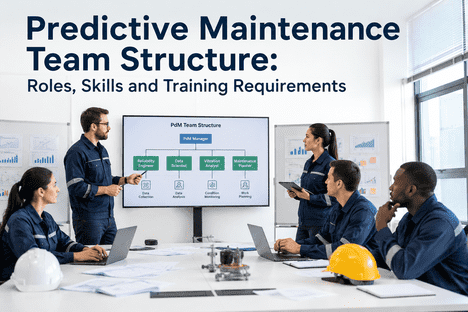
Predictive maintenance programs fail far more often from team structure gaps than from technology limitations. Industry surveys consistently show that 55% of organizations lack the AI and data science skills required for PdM model deployment, 46% cite data silos that prevent cross-functional collaboration, and 70% of the current maintenance workforce is over 50 years old — facing a knowledge retirement wave that will strip plants of decades of institutional expertise. Yet the most common response to these gaps is to hire a data scientist and buy a software platform, expecting technology alone to deliver reliability outcomes. The reality is more structural: a PdM program requires a layered team architecture spanning condition monitoring technicians who collect and validate sensor data, vibration analysts who diagnose fault frequencies across envelope spectra, reliability engineers who translate findings into strategy, data scientists who build and tune anomaly detection models, and maintenance planners who convert AI-generated predictions into ready-to-execute work orders with parts and labor pre-positioned. Each role requires distinct skills, certifications, and career progression paths — and each must be integrated into a workflow that closes the loop from sensor reading to repair confirmation to model improvement. iFactory AI's Shift Logbook and predictive maintenance platform provides the workflow layer that connects every role in the PdM team, from the technician logging inspection findings to the reliability engineer reviewing model confidence scores to the planner scheduling the intervention. Book a Demo to see how iFactory's team-integrated platform connects every role in your PdM workflow.
Why PdM Team Structure Determines Program Success or Failure
Organizations that deploy predictive maintenance technology without first building the team architecture to consume its output consistently fail to achieve ROI. The pattern is documented across hundreds of industrial deployments: a vibration analysis platform is installed, sensor data streams in, anomaly alerts fire — but no role is explicitly responsible for reviewing the alerts, validating the diagnosis, creating the work order, and closing the feedback loop. Within six months, the platform is generating alerts that no one acts on, technician trust erodes, and the program is classified as a failed pilot. The root cause is never the technology. It is the absence of a structured team with defined role boundaries, clear escalation paths, and closed-loop workflows connecting detection to intervention to model improvement. The metrics below quantify the gap between organizations with structured PdM teams and those operating without one.
Core Roles in a Predictive Maintenance Team
A production-grade PdM team spans five functional layers, each with distinct responsibilities, skills, and certification paths. Not every organization needs every role as a full-time headcount — small plants may combine roles or outsource specialist functions — but each function must be explicitly assigned and integrated into the closed-loop workflow. The role definitions below are derived from the PHM Society, SMRP Body of Knowledge, and ISO 18436 standards for condition monitoring and diagnostics.
Skills Matrix and Certification Requirements by Role
Each PdM role requires a distinct combination of domain knowledge, technical skills, and formal certifications. The matrix below maps the essential skill areas against each role, with certification requirements drawn from the Vibration Institute ISO 18436 standards, SMRP CMRP body of knowledge, and industry practice for infrared thermography and lubricant analysis. Organizations building PdM teams should use this matrix to assess current capability gaps and prioritize training investments.
| Skill Area | Reliability Engineer | Vibration Analyst | Data Scientist | Planner | CM Technician |
|---|---|---|---|---|---|
| Failure physics / P-F curve | Expert | Advanced | Intermediate | Basic | Basic |
| Vibration analysis (ISO 18436) | CAT II–III | CAT I–IV | Basic understanding | — | CAT I–II |
| Thermography / ultrasonics | Intermediate | Intermediate | — | — | Level I |
| Statistical analysis / Weibull | Expert | Intermediate | Expert | — | — |
| FMEA / FMECA / RCM | Expert | Intermediate | — | — | — |
| Python / ML frameworks | Intermediate | — | Expert | — | — |
| CMMS administration | Intermediate | Basic | Basic | Expert | Basic |
| Work order management | Intermediate | — | — | Expert | Intermediate |
| Sensor selection / placement | Expert | Advanced | Intermediate | — | Basic |
| Root cause analysis (RCA) | Expert | Intermediate | Intermediate | — | Basic |
| Oil analysis / lubrication | Intermediate | Basic | — | — | MLA I–II |
Certification cost benchmarks: CAT I: $1,500–$2,500 · CAT II: $1,800–$3,000 · CAT III: $2,000–$3,500 · CAT IV: $2,500–$4,000 · CMRP exam: $300–$470 · Thermography Level I: $1,500–$2,500 · 31% of sites spend >$100K annually on PdM team training.
Three Team Structure Models for Different Organization Sizes
Same PdM functions, three organizational models. The right model depends on asset count, criticality mix, budget, and current maturity level. Small plants combine roles and outsource specialist functions. Medium plants build a dedicated PdM team within the maintenance organization. Large plants establish a centralized Reliability Center of Excellence that serves multiple production units. Each model preserves the five functional layers while adjusting headcount and reporting structure to match organizational scale.
Not sure which model fits your organization's current state? Book a Demo to discuss your asset profile, team composition, and PdM maturity level with our reliability practice team.
Training Paths and Certification Roadmaps
Building PdM team capability requires a structured multi-year training plan aligned with each role's career progression. Vibration analysts progress through four ISO 18436-2 certification levels over 5–8 years. Reliability engineers pursue CMRP certification within their first 12–18 months. Data scientists entering the industrial space invest in domain fundamentals — P-F curve, failure modes, rotating equipment physics — alongside their ML expertise. The roadmaps below show the typical timeline and milestone certifications for each core role.
How iFactory AI Supports Your PdM Team
iFactory AI's Shift Logbook and predictive maintenance platform serves as the workflow layer that connects every role in the PdM team. For condition monitoring technicians, the Shift Logbook provides mobile inspection checklists, sensor data validation tools, and one-tap defect logging with photo and voice note attachment. For vibration analysts, the platform ingests continuous accelerometer telemetry, applies envelope spectrum analysis across BPFO, BPFI, BSF, and FTF frequency bands, and surfaces only the exceptions requiring expert review — reducing manual spectrum review effort by 80–90%. For reliability engineers, the platform provides asset health dashboards, model confidence scores, and automated work order recommendations with RUL estimates and recommended parts lists. For planners, AI-generated predictions arrive as structured work packages with pre-allocated labor estimates, part numbers from the inventory system, and suggested scheduling windows. For the data scientist, the platform captures every closed work order outcome as a labeled training event, feeding a continuous learning loop that improves model precision over time without manual data labeling effort. Every interaction across every role is recorded in the Shift Logbook with full traceability — creating an auditable chain from sensor reading to operator observation to analyst diagnosis to planner schedule to repair confirmation to model improvement.
Expert Perspective: Why PdM Team Structure Matters More Than Technology
In 22 years of reliability program assessments across chemical, refining, and manufacturing facilities, I have seen the same pattern repeat: a plant spends $200,000 on vibration analysis software, wireless sensors, and a CMMS integration project — and eighteen months later, the program is classified as a failure. The technology was never the problem. The problem was that no one on the team was explicitly responsible for reviewing the alerts the system generated. The reliability engineer was assigned to the project part-time and was pulled into firefighting before the model produced its first actionable prediction. The planner had no training in interpreting PdM outputs. The technician collecting data was not empowered to flag anomalies. The data scientist had never set foot on the plant floor and did not understand the P-F curve. A PdM program is not a technology deployment. It is a team architecture project that happens to involve software. When you define every role's explicit responsibility in the alert-to-action workflow before you install the first sensor, the program succeeds. When you install the sensors first and ask who will manage the output later, it fails. I have never seen an exception to this rule in two decades of practice.
Conclusion: Your PdM Program Is Only as Strong as Your Team Architecture
Predictive maintenance technology — vibration sensors, AI models, CMMS integrations — is widely available and increasingly affordable. The bottleneck in PdM program success is no longer technology access; it is team capability and role clarity. Organizations that define clear role boundaries, invest in structured certification pathways, and deploy a closed-loop workflow connecting every PdM function consistently achieve 50–70% reduction in unplanned downtime within the first year. Organizations that skip the team architecture step and go directly to sensor installation spend 12–18 months in pilot purgatory, then abandon the program as a failed experiment. The three models presented here — combined role for small plants, dedicated PdM team for medium organizations, and Reliability Center of Excellence for large enterprises — provide a starting point calibrated to asset count, criticality, and maturity level. iFactory's Shift Logbook and predictive maintenance platform provides the workflow layer that connects every role in whichever model fits your organization. The decision to build starts with a structured assessment of your current team against the capabilities required for your target maturity level.
Frequently Asked Questions
For a small plant with 100–500 assets and 15–49 technicians, the minimum viable PdM team is four roles that may be filled by three people: a Maintenance Manager serving as PdM program lead, a Reliability Engineer at 0.5 FTE (shared with other responsibilities), a Maintenance Planner who also serves as CMMS administrator, and one condition monitoring technician with CAT I certification. Specialist functions requiring CAT III+ vibration analysis capability are outsourced to a service provider during the startup phase. With a managed-service AI platform like iFactory, the in-house data science role is eliminated — model tuning, anomaly threshold configuration, and CMMS integration are handled by the platform provider. Organizations at this scale typically deploy PdM on 10–30 critical assets in the first phase, then expand as confidence and capability grow. Total annual investment for a startup PdM program at this scale: $5,000–$15,000 for platform plus $1,500–$2,500 per person for initial certification.
The most impactful certification depends on the role. For vibration analysts, ISO 18436-2 certification through the Vibration Institute is the industry standard — progressing through CAT I (data collection, 30 hours training), CAT II (basic diagnostics, 38 hours), CAT III (program direction, 38 hours), and CAT IV (advanced dynamics, 64 hours). For reliability engineers, the SMRP Certified Maintenance and Reliability Professional (CMRP) credential is the most broadly recognized global standard, covering five pillars: Business and Management, Equipment Reliability, Manufacturing Process Reliability, Organization and Leadership, and Work Management. For technician-level staff, the SMRP Certified Maintenance and Reliability Technician (CMRT) provides a structured competency framework. For thermography, ISO 18436-4 Level I–III certification through the Infrared Training Center is standard. For oil analysis, ICML Machine Lubricant Analyst (MLA) certification is the recognized credential. For data scientists entering the industrial space, no formal PdM certification exists — but completing CAT I vibration training (30 hours, $1,500–$2,500) to understand the physics of rotating equipment failure is strongly recommended before building production models.
iFactory AI's platform changes the skills profile of a PdM team in four ways. First, continuous telemetry ingestion and automated envelope spectrum analysis reduce manual data collection effort by 80–90%, meaning condition monitoring technicians spend more time on exception-based investigation and less on route walking. Second, AI-based fault classification with confidence scores reduces the vibration analysis skill level required for routine screening — a CAT I technician with platform support can achieve what previously required a CAT III analyst for standard bearing fault detection. Third, automated work order generation with RUL estimates and parts recommendations reduces the planner's analysis time per prediction from hours to minutes, enabling a single planner to support 25 technicians instead of 15. Fourth, the managed-service model eliminates the need for an in-house data scientist — model tuning, threshold configuration, and CMMS integration are handled by iFactory's reliability engineering team. The net effect is that a small plant can deploy production-grade PdM with three people and a medium plant can cover 500+ critical assets with a team of four to six. The skill that increases in importance across every role is human-in-the-loop validation — knowing when to trust the AI recommendation and when to override it based on contextual knowledge.
Building a fully qualified PdM team from scratch with no existing certified personnel typically requires 3–5 years to reach production-grade capability across all roles. The critical path is the vibration analyst pipeline: CAT I certification requires 6 months of field experience (achievable in year 1), CAT II requires 18 months (year 2), CAT III requires 36 months (year 3–4), and CAT IV requires 60 months (year 5). The reliability engineer path is faster for the core credential — CMRP certification can be achieved within 12 months of dedicated study if the candidate has pre-existing plant maintenance experience — but building the deep failure analysis and RCM facilitation skills requires 2–3 years of mentored practice. Data scientists entering from academic backgrounds require 6–12 months of domain immersion before they can build production-grade models. Organizations that cannot wait 3–5 years for organic capability building have two accelerating options: hire certified personnel from the market (CAT III+ analysts command $95,000–$130,000 and are in short supply), or deploy a managed-service PdM platform where iFactory's reliability engineers handle the specialist analysis while the in-house team focuses on workflow execution and exception management. The managed-service model compresses the deployment timeline to 8–12 weeks for production-grade PdM capability on critical assets.
Industry benchmarks from SMRP and Allied Reliability provide clear ratio targets. Planner-to-technician ratio: world-class target is 1 planner per 15–20 technicians. With AI platform support that automates work order generation and parts selection, this ratio improves to 1:25. Supervisor-to-technician ratio: 1 supervisor per 10 technicians is the world-class target. Reliability engineer-to-critical-assets ratio: 1 RE per 50–80 critical assets is the benchmark. With AI platforms handling routine anomaly screening, this extends to 1:80. Reliability engineers per production unit: 2–3 per unit is the SMRP industry recommendation for organizations at Level 3 maturity and above. Condition monitoring technician-to-critical-assets: 1 technician per 10–15 critical assets. Most organizations underestimate these ratios — a plant with 300 critical assets and one reliability engineer is significantly understaffed regardless of software platform. The team structure assessment that iFactory conducts includes ratio benchmarking against your specific asset count and criticality profile, producing a recommended headcount plan calibrated to your target maturity level.