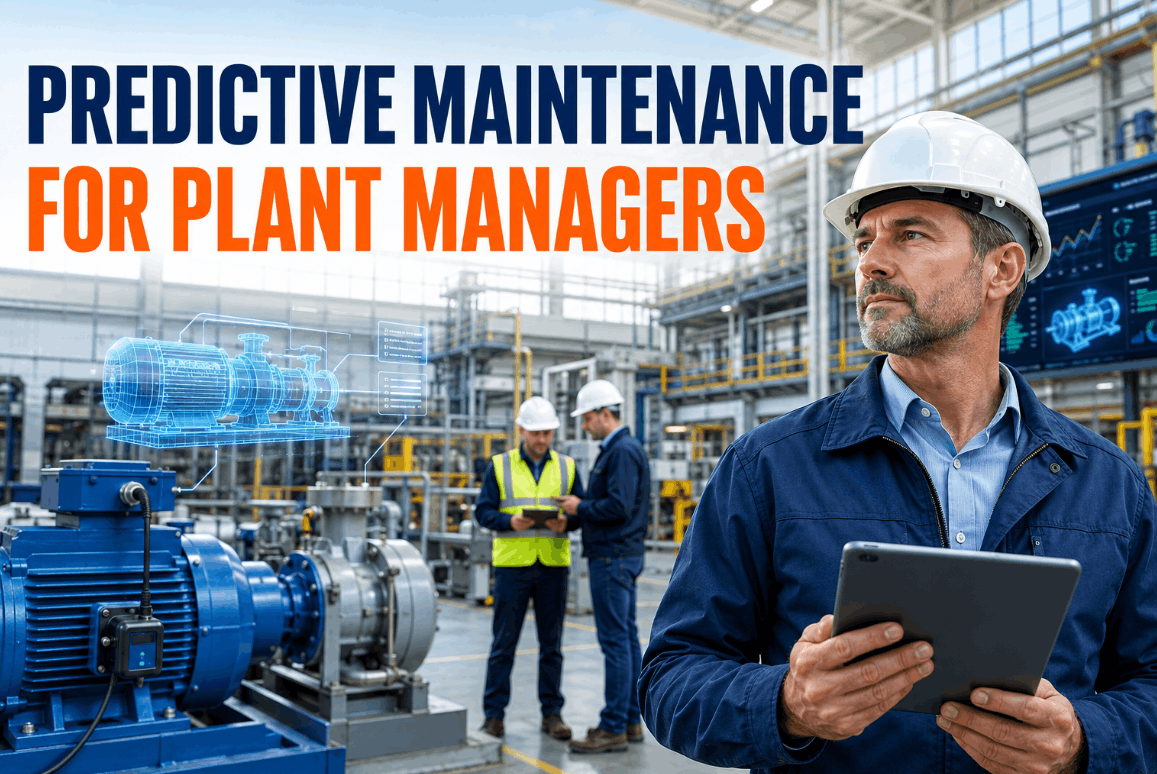
Most plant managers don't lose ground on predictive maintenance because they lack ambition—they lose ground because the implementation plan never gets past the pilot. A compressor that fails during peak production, a conveyor that trips a line for six hours, or a hydraulic press that blows a seal on third shift: these are not random events. They are the predictable result of running assets without condition intelligence. Predictive maintenance (PdM) powered by AI closes that gap—but only when deployed strategically, with proper asset prioritization, team alignment, and a phased rollout that doesn't disrupt your existing operations. To see how iFactory's AI-driven predictive maintenance platform maps directly to your facility's asset mix, Book a Demo with our manufacturing reliability team today.
Where Most Plant Managers Are on the Maintenance Maturity Curve
Reactive, Preventive, or Predictive? Knowing Your Starting Point
Before you deploy a single sensor, you need an honest read on where your facility sits today. The maintenance maturity spectrum runs from reactive (run-to-failure), to time-based preventive, to condition-based monitoring, and finally to AI-driven predictive. Most U.S. manufacturing plants in 2025 are operating somewhere between preventive and condition-based—which means they are spending budget on parts that don't yet need replacing while simultaneously missing the slow-developing failures that cause catastrophic downtime. The goal of a PdM implementation is not to reach "predictive" on every asset in year one. It is to move your highest-criticality assets to predictive intelligence first, then scale methodically. iFactory's platform is designed to integrate into this maturity journey without forcing a "rip-and-replace" of your existing CMMS or historian infrastructure.
Asset Prioritization: The Strategic Decision That Determines Your ROI
Not Every Asset Deserves a Sensor on Day One
The most common PdM implementation mistake is attempting to instrument every machine simultaneously. This creates data overload, overwhelms your maintenance team, and obscures the ROI signal that secures leadership buy-in for broader rollout. The right approach is a structured asset criticality matrix. Assets should be scored against three dimensions: production impact (what does a failure cost per hour?), failure frequency (how often has this asset failed in the last 24 months?), and repair lead time (how long does it take to source and install replacement parts?). Assets scoring high across all three are your Tier-1 targets. For most manufacturing plants, this initial set is 3–7 machines. iFactory's platform includes an out-of-the-box asset criticality scoring module, so your maintenance team can Book a Demo and generate a prioritized asset list in the first session.
| Asset Category | Typical Monitoring Method | Failure Lead Time (with PdM) | Avg. Downtime Cost (per event) | PdM Priority Tier |
|---|---|---|---|---|
| Centrifugal Pumps & Motors | Vibration + Current Signature | 4–8 weeks | $35K – $120K | Tier 1 — Critical |
| Air Compressors | Vibration + Temp + Pressure | 3–6 weeks | $80K – $320K | Tier 1 — Critical |
| CNC Machines / Spindles | Triaxial Vibration + Torque | 2–5 weeks | $20K – $90K | Tier 1 — Critical |
| Conveyor & Drive Systems | Motor Current + Belt Tension | 3–7 weeks | $15K – $60K | Tier 2 — High |
| HVAC & Cooling Systems | Refrigerant Pressure + Acoustics | 4–10 weeks | $8K – $40K | Tier 2 — High |
| Hydraulic Presses | Pressure Transients + Temp | 2–4 weeks | $25K – $80K | Tier 2 — High |
The Phased Implementation Roadmap for Plant Managers
A Four-Phase Rollout That Protects Production While Building PdM Capability
A phased rollout is not a compromise—it is the proven path to enterprise-scale PdM adoption. Each phase is designed to validate ROI, build team confidence, and refine AI model accuracy before expanding scope. The following framework reflects how iFactory structures successful deployments across discrete and process manufacturing environments.
Change Management: The Human Side of PdM Adoption
Why Technology Is the Easy Part
Every experienced plant manager knows that the hardest part of any new technology deployment is not the integration—it is the people. Maintenance technicians who have spent years developing intuitive machine knowledge can view AI-driven alerts with healthy skepticism, or outright resistance. This is not a problem to be eliminated; it is an asset to be harnessed. The most successful PdM rollouts pair AI alert data with technician confirmation loops: when the AI flags a developing bearing fault, a trained technician physically verifies the finding before any maintenance action is taken. Over 90 days, this process builds mutual trust—the AI learns from technician corrections, and technicians build confidence in the system's accuracy. iFactory's platform is built for this collaborative feedback model. Book a Demo to see how our alert-confirmation workflow is designed to drive adoption, not resistance.
How iFactory AI Accelerates Your PdM Implementation
Platform Capabilities Mapped to Plant Manager Priorities
iFactory's predictive maintenance suite is engineered for the operational realities of U.S. manufacturing plants—not research labs. The platform integrates with your existing OT infrastructure (SCADA, historians, CMMS) without requiring a parallel IT project to stand up. Key capabilities include physics-informed machine learning models pre-trained on industrial asset failure modes, mobile technician interfaces for real-time alert review and confirmation, automated work order generation integrated with major CMMS platforms, and asset-level OEE dashboards that connect maintenance performance directly to production output. You don't need a data science team to operate iFactory. The platform is designed to be owned and managed by your maintenance and reliability engineers from day one. Book a Demo and see how your specific asset mix maps to our platform's monitoring capabilities.
| Plant Manager Priority | iFactory Capability | Business Outcome |
|---|---|---|
| Reduce unplanned downtime | AI failure prediction with 4–6 week lead time | Maintenance planned during scheduled shutdowns |
| Lower maintenance spend | Condition-based work order generation | Parts replaced on degradation signal, not schedule |
| Improve technician productivity | Mobile alert interface with diagnostic guidance | Faster fault isolation; fewer wasted site visits |
| Justify capital for new equipment | Remaining Useful Life (RUL) forecasting | Data-backed capital planning vs. gut-feel replacement |
| Integrate with existing systems | Native CMMS, SCADA, and ERP connectors | No parallel IT project; faster time to value |
| Prove ROI to leadership | Avoided failure cost tracking dashboard | Quantified savings report for every AI-prevented event |
Frequently Asked Questions
How do I decide which assets to instrument first in a PdM pilot?
Score assets on three dimensions: production impact per hour of downtime, failure frequency over the past 24 months, and parts lead time. Tier-1 assets scoring high across all three should be your starting cohort—typically 3–5 machines representing your highest-risk failure scenarios.
How long before iFactory's AI generates reliable failure predictions?
Most plants see validated predictions within 4–8 weeks of baseline data collection. iFactory's models are pre-trained on industrial failure signatures, which significantly reduces the cold-start period compared to custom-built AI solutions.
Will iFactory integrate with our existing CMMS and historian systems?
Yes. iFactory connects natively with major CMMS, SCADA, and ERP platforms (including SAP, Maximo, and OSIsoft PI) through standard OPC-UA and REST API interfaces—no parallel IT infrastructure project required.
How do we handle technician resistance to AI-driven maintenance recommendations?
Start in advisory mode: AI alerts are visible to technicians for review and confirmation before any work orders are auto-generated. This 90-day trust-building phase consistently produces high adoption rates because technicians build confidence through verified prediction accuracy before automation is introduced.
What KPIs should plant managers track to measure PdM program success?
Track MTBF (Mean Time Between Failures), MTTR (Mean Time to Repair), unplanned downtime as a percentage of total production hours, maintenance cost per production unit, and avoided failure cost—the last metric is the most compelling for leadership ROI reporting.