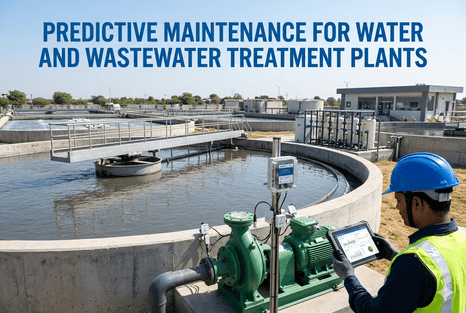
At 4:37 AM at a 20 MGD municipal water treatment plant, the #3 raw water intake pump begins to vibrate at 11.4 kHz — a frequency the reliability engineer would recognize as the onset of bearing fatigue in the thrust bearing. But the engineer won't see the SCADA trend until the morning review, six hours from now. By then, the bearing will have accumulated 3.2 million additional stress cycles, pump efficiency will have dropped 8%, and the plant will be facing a choice: risk a catastrophic failure during peak demand at 7 AM, or perform an emergency shutdown that reduces treatment capacity by 25% for 14 hours. For water utility operators managing pumps, blowers, clarifiers, and chemical feed systems that must deliver 24x7 compliance with EPA discharge permits, unplanned downtime is not a maintenance problem — it is a public health and regulatory crisis. Book a Demo to see how iFactory predicts rotating equipment failures in water treatment 72–96 hours before they force an emergency shutdown.
Predictive Maintenance for Water Treatment: Cut Unplanned Pump & Equipment Downtime by 47%
iFactory monitors your raw water pumps, blowers, clarifier drives, chemical feed systems, and effluent pumps in real time — predicting failures 72–96 hours before they impact treatment capacity. On-premise AI. Zero cloud dependency. No data leaving your facility.
What Predictive Maintenance Delivers in Water Treatment Facilities
These are actual ranges of outcomes across iFactory deployments in municipal and industrial water treatment plants — not projections from a white paper.
Why Unplanned Downtime Costs Water Treatment Plants $680K+ Per Facility Per Year
Water treatment plants operate 24x7 with compliance deadlines that don't wait for repairs. Every hour of unplanned downtime at a 20 MGD plant risks permit violations, booster pump failures, and chemical feed disruptions. Here is how that breaks down across a typical facility.
Raw Water Intake Pump Failure Threatens Plant Capacity
A thrust bearing failure on a 500 hp vertical turbine intake pump forces the plant to reduce flow from 20 MGD to 14 MGD for 14 hours. The bypassed demand creates low-pressure events in the distribution system, triggering boil-water advisories for 12,000 customers. The combined cost of emergency repair, overtime labor, replacement water purchase, and regulatory notification: $94,000 per event.
Aeration Blower Degradation Increases Energy Consumption by 17%
A multistage centrifugal blower in the aeration basin operates with worn impeller clearances for 11 weeks before the efficiency loss triggers an alarm. During that time, the blower consumes 17% more energy — $63,000 in excess electricity costs — while delivering decreasing dissolved oxygen to the biological treatment process, risking BOD permit violations.
Clarifier Drive Failure Stops Solids Handling for 36 Hours
A gearbox failure on a primary clarifier drive mechanism stops the sludge collection system. Without continuous sludge removal, the clarifier fills with settled solids in 8 hours, forcing the plant to bypass primary treatment. The 36-hour repair window includes gearbox removal, crane rental, and replacement — costing $127,000 plus the cost of bypassing EPA permit limits.
Chemical Feed Pump Inaccuracy Causes Permit Violations
A progressive cavity polymer feed pump develops stator wear, reducing chemical dosing accuracy from ±2% to ±14%. The under-dosing causes flocculation failure in the sedimentation basin, increasing effluent turbidity above the 0.3 NTU permit limit. Each violation notice carries a $12,500 fine plus mandatory public notification costs of $8,000.
Maintenance Teams Are Trapped in a Break-Fix Cycle
Planned maintenance compliance averages 58% across water treatment plants. The other 42% of maintenance hours are reactive — emergency repairs on pumps, blowers, clarifiers, and chemical feed systems that already failed. Plant managers report that 40% of their O&M budget goes to unplanned repairs and overtime, leaving no capacity for condition-based monitoring or preventive optimization.
Reactive maintenance costs water treatment plants $680K+ per facility per year. iFactory predicts rotating equipment failures 72–96 hours in advance. Book a 30-min walkthrough and see iFactory on your plant's pump and blower data.
From SCADA Data to Failure Prediction in 6–12 Weeks
iFactory connects to your existing SCADA system, vibration monitors, and pump controllers — no new sensors required. The platform ingests data on your plant network, trains predictive models, and delivers alerts on an on-premise NVIDIA appliance.
Connect Your Existing Plant Data
We connect to your SCADA historian, pump vibration monitoring system, motor control centers, and chemical feed controllers — no new sensors or field wiring required. iFactory ingests data over your plant control network without internet connectivity.
AI Trains on Your Equipment Signatures
Our AI learns the normal operating envelope for each pump, blower, clarifier drive, and chemical feed system from 60–90 days of historical data — vibration signatures, motor current profiles, bearing temperature gradients, and flow rate baselines.
Maintenance Gets 72–96 Hour Alerts
When the model detects a pattern that precedes a failure — bearing frequency shift, pump cavitation signature, blower efficiency trend — it alerts the maintenance team via the plant dashboard, mobile device, or CMMS work order.
Close the Loop With Root Cause Correlation
Every alert links to the sensor data that triggered it. Engineers see "Raw water pump #3 bearing degradation detected — vibration amplitude trending up 12% over 72 hours — schedule inspection within 96 hours." No more hunting through SCADA logs after the failure.
Predictive Maintenance Features for Water Treatment Facilities
iFactory's AI-native platform delivers capabilities purpose-built for water treatment rotating equipment and process systems — all running on-premise with zero cloud dependency.
Raw Water & Effluent Pump Monitoring
iFactory models vibration signatures, bearing temperatures, motor current, and flow rates on every vertical turbine, centrifugal, and positive displacement pump. When bearing fatigue, cavitation, or impeller wear patterns emerge, the system alerts operators 72 hours before a capacity-limiting failure.
Aeration Blower & Compressor Diagnostics
By correlating blower vibration, discharge pressure, motor power, and inlet temperature, iFactory predicts impeller wear, bearing degradation, and efficiency loss 96 hours before performance drops below aeration demand.
Clarifier & Solids Handling Drive Monitoring
Gearbox vibration, torque load, and motor current data feed iFactory's predictive models. A gear tooth wear pattern or bearing temperature trend triggers an alert 72 hours before a clarifier drive failure stops solids handling.
Chemical Feed System Accuracy Prediction
iFactory analyzes pump stroke rate, discharge pressure, and motor current on chemical metering pumps. When stator wear or check valve degradation reduces dosing accuracy, the system alerts maintenance before the deviation causes a permit violation.
100% On-Premise — No Cloud Dependency
iFactory runs on an NVIDIA appliance inside your plant control network. Zero data leaves the facility. No cloud connectivity required. Fully compliant with EPA CIP, state drinking water regulations, and utility cybersecurity requirements.
6–12 Week Pilot to Live Model
iFactory's engineers connect to your SCADA historian, train models on your critical assets, and deliver a working pilot in 6–12 weeks. No data science team required on your end. The pilot targets measurable availability and energy improvement within the first quarter.
iFactory Delivers Predictive Maintenance Without the Complexity
End-to-End Turnkey Deployment
You provide data-source access to your SCADA historian and vibration monitoring system. We deliver a working pilot on your critical pumps and blowers in 6–12 weeks. No integration consultants, no custom code, no data scientists.
100% On-Premise — Air-Gapped & Secure
iFactory runs on an NVIDIA appliance inside your plant control network. Zero data egress. No cloud connectivity. No internet dependency. Fully compliant with EPA CIP, AWWA, and state drinking water cybersecurity requirements.
Pilot-to-ROI in One Quarter
Every deployment targets measurable availability, energy efficiency, and maintenance cost improvement within 90 days. If we don't hit the agreed targets, you don't pay for the pilot.
Works With Existing Plant Systems
iFactory connects to Rockwell, Siemens, Emerson, ABB, Schneider Electric, and any OPC-UA or Modbus-compatible SCADA and PLC. No rip-and-replace of your existing control or monitoring systems.
24x7 Managed Service Included
Our operations team monitors your predictive models and appliance infrastructure around the clock. If a model drifts or a data feed drops, we fix it before your next shift starts. You don't need an on-site data science team.
Scalable Across All Plants and Pump Stations
Once the model works on one pump station or treatment train, iFactory replicates it across your entire water network — all treatment plants, booster stations, and distribution pump stations. Standardized predictive maintenance at every site.
Questions From Every Water Treatment Operations Team
Stop Reacting to Pump Failures. Start Predicting Them.
iFactory gives your operations team a 72–96 hour look-ahead on pump, blower, clarifier, and chemical feed failures — and saves your plant $680K+ per year in avoided downtime and emergency repairs. The pilot takes 6–12 weeks. The ROI shows up in one quarter.