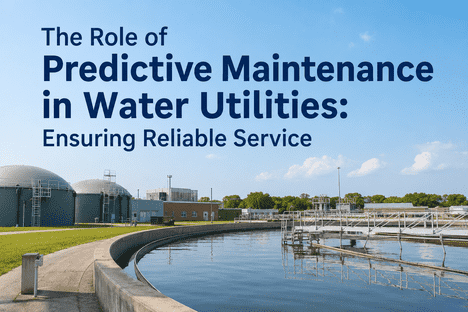
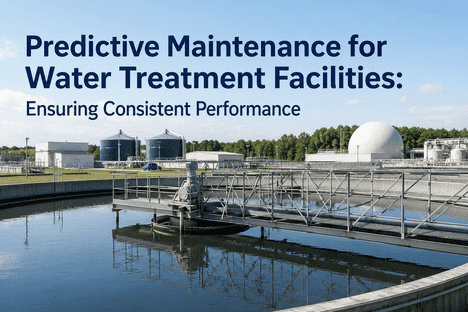
Water utilities operate some of the most capital-intensive infrastructure in the world — pumping stations, treatment plants, transmission mains, storage reservoirs, and thousands of kilometers of distribution pipe that collectively move billions of liters daily. Yet most utilities still run reactive maintenance cycles, calendar-based pump overhauls, and manual inspection schedules that were designed for a regulatory environment focused on compliance rather than efficiency. Today the pressure is different: aging infrastructure, tightening water quality standards, non-revenue water losses exceeding 30% in many systems, and utility workforces where the most experienced pump operators are retiring faster than replacements arrive. Predictive maintenance for water utilities changes that equation by layering machine learning, IoT sensor analytics, and digital twin monitoring directly on top of existing SCADA, PLC, and CMMS infrastructure — reducing unplanned downtime, cutting water loss, and extending asset life without replacing the equipment operators already rely on. Book a Demo to see how iFactory AI maps these capabilities to your water utility network.
AI · Water Utilities · Predictive Maintenance
How Predictive Maintenance Ensures Reliable Water Service Delivery
From ML-driven pump failure prediction to distribution network digital twins and real-time water quality anomaly detection — iFactory AI turns reactive water utility maintenance into predictive, condition-based operations that protect service reliability and reduce total cost of ownership.
–40%
Reduction in unplanned pump station downtime with predictive analytics-driven maintenance scheduling
+25%
Improvement in asset lifespan through condition-based monitoring and early fault detection
99%
Water quality parameter prediction accuracy with SHAP-validated ML anomaly detection models
6 Wks
From SCADA integration to live predictive maintenance across the water distribution network
The Operating Reality
Three Challenges Driving Reliability Risk and Cost in Water Utilities Today
30%+
Non-Revenue Water Loss in Aging Networks
Global water utilities lose an estimated 30–50% of treated water to leaks, bursts, and unauthorized consumption before it reaches customers. In developed systems with metered infrastructure, the figure still averages 15–25%. Each cubic meter lost represents treated energy, chemicals, and capacity that the utility pays for but never recovers. Acoustic leak detection and manual patrol methods identify only a fraction of leaks before they surface — leaving the rest to waste resources for months or years underground.
40–60%
Reactive Maintenance Share of Pump Station Work
Most water utilities still operate on reactive or calendar-based maintenance for pumping assets, with 40–60% of all maintenance work triggered by equipment failure rather than condition signals. Pump failures at booster stations, wastewater lift stations, and treatment plant raw-water intake pumps cause service disruptions that trigger boil-water advisories, pressure-zone violations, and regulatory reporting events — each costing far more than the repair itself in compliance penalties and community trust.
$36B
Annual U.S. Water Infrastructure Funding Gap
The EPA estimates a $36 billion annual funding gap through 2040 to maintain and improve U.S. drinking water infrastructure alone. With capital budgets constrained, utilities cannot replace their way out of the problem — they must extend asset life through smarter maintenance. Every year of additional service life extracted from a major pump station or treatment plant through predictive maintenance directly reduces the capital replacement burden on ratepayers and municipal budgets.
AI Applications
4 Predictive Maintenance Capabilities Delivering Results for Water Utilities
Predictive Layer
Pump & Rotating Equipment Failure Prediction
Machine learning models ingest vibration, temperature, flow, pressure, amperage, and run-time data from every pump, motor, turbine, and blower across the water network — trained on historical failure modes including cavitation, bearing wear, impeller erosion, and seal failure. The models predict remaining useful life with 90–95% accuracy and issue alerts 14–30 days before failure, enabling condition-based maintenance scheduling that eliminates emergency call-outs and the cascading service disruptions they cause in pressure-dependent distribution systems.
90–95% RUL prediction accuracy
Network Intelligence
Distribution Network Leak Detection & Localization
AI models analyze flow balance, pressure transient, acoustic sensor, and district metered area (DMA) inflow data to detect and localize leaks in drinking water distribution networks — distinguishing between background leakage, reported bursts, and developing main failures before they surface. ML models trained on thousands of leak events achieved 85–99% detection accuracy in peer-reviewed deployment studies, with localization precision sufficient to reduce excavation search areas by 70–80% compared to conventional acoustic correlation methods.
Up to 99% leak detection accuracy
Quality Monitoring
Water Quality Anomaly Detection & Compliance Prediction
Real-time digital twins monitor turbidity, chlorine residual, pH, conductivity, temperature, and dissolved oxygen at every treatment stage and key distribution points — comparing live sensor streams against regulatory threshold models and historical quality baselines. The system detects developing quality events like disinfection byproduct formation, nitrification in storage tanks, or post-treatment turbidity breakthrough 4–8 hours before they trigger Safe Drinking Water Act compliance violations, giving operators time to adjust treatment dosing or flush affected mains before any regulatory threshold is crossed.
4–8 hour advance compliance warning
Asset Optimization
Condition-Based Valve & Pipe Criticality Prioritization
Predictive analytics rank every valve, hydrant, air-release valve, and pipe segment in the distribution network by failure probability and consequence score — combining age, material, leak history, soil corrosivity, pressure zone, and customer-impact data. Instead of inspecting all 15,000 valves on a 5-year cycle, utilities inspect the highest-risk 10% every quarter and extend inspection intervals for low-risk assets. In documented deployments, this approach reduced inspection costs by 60% while increasing the number of critical defects found per inspection hour.
–60% valve inspection cost
Measurable Impact
What Predictive Maintenance Delivers Across Water Utility Operations
–40%
Unplanned Pump Station Downtime
Predictive failure detection reduces emergency pump outages by scheduling repairs before failure occurs
–60%
Valve Inspection Cost Reduction
Risk-based criticality scoring focuses inspection resources on highest-failure-probability assets
85–99%
Leak Detection Accuracy Rate
ML models analyzing DMA flow and pressure data achieve documented detection rates across network types
+25%
Asset Service Life Extension
Condition-based maintenance catches wear patterns early, adding years of useful service to major assets
Before vs. After
Water Utility Maintenance — Reactive Methods vs. iFactory AI Predictive Approach
| Operational Dimension |
Reactive / Calendar Approach |
iFactory AI Predictive Approach |
Documented Gain |
| Pump Maintenance |
Calendar-based overhaul or run-to-failure |
ML remaining-useful-life prediction, 14–30 day alert |
–40% unplanned downtime |
| Leak Detection |
Acoustic patrol, customer-reported bursts |
AI DMA flow-pressure anomaly detection |
85–99% detection accuracy |
| Water Quality |
Grab sampling, lab analysis, 24–48 hr lag |
Digital twin continuous real-time monitoring |
4–8 hour advance warning |
| Valve Maintenance |
Fixed-cycle inspection all assets |
Risk-based criticality scoring prioritization |
–60% inspection cost |
| Pipe Replacement |
Age-based priority, subjective scoring |
ML failure probability × consequence model |
More targeted capital deployment |
| Compliance Reporting |
Manual data compilation, spreadsheet-driven |
Auto-generated SDWA, state regulatory reports |
Audit-ready in hours, not weeks |
| Energy Consumption |
Fixed-speed pump scheduling |
AI-optimized pump sequencing and VFD scheduling |
–15% pumping energy cost |
Every row represents a recurring value leak that AI predictive maintenance closes systematically. Book a Demo to benchmark these gaps against your specific water utility configuration.
Implementation Roadmap
5-Step Predictive Maintenance Deployment Sequence for Water Utilities
01
Asset Criticality Assessment & Signal Mapping
iFactory AI engineers assess the water network — identifying every pump station, treatment process unit, storage tank, pressure zone, and critical valve where failure risk or water quality drift creates service reliability exposure or compliance risk. Sensor coverage gaps are identified and prioritized for each asset class.
02
SCADA, PLC & CMMS Integration
iFactory's IoT gateway layers over existing SCADA, PLC, flow meter, pressure logger, and CMMS infrastructure via standard OPC-UA, MQTT, and REST API connectors. Existing instrumentation continues feeding operators — AI consumes the same data stream alongside historical maintenance records without disrupting live control workflows.
03
Digital Twin & ML Model Deployment
Digital twins stand up for every critical pump, treatment process, and distribution DMA — establishing baseline operating envelopes, training failure prediction models on historical work order data, and deploying leak detection algorithms that analyze flow balance and pressure transient signals in real time.
04
Prescriptive Maintenance Workflows
Predictive alerts flow directly into the utility's CMMS as recommended work orders with priority scores, recommended actions, and estimated remaining useful life. Maintenance planners review, adjust, and approve — turning reactive call-outs into scheduled, resource-optimized maintenance windows that avoid peak-demand periods and keep every pump available when customers need water most.
05
Validation & Multi-Site Scale-Out
Validation protocols compare predicted failure dates against observed maintenance events, refining model accuracy with every completed work order. Once validated on the pilot treatment plant or distribution zone, iFactory's multi-site architecture replicates the same predictive logic across every facility in the utility portfolio — treatment plants, booster stations, reservoirs, and entire distribution networks.
Deploy iFactory AI Predictive Maintenance Across Your Water Utility Network
iFactory AI connects SCADA, PLC, flow meters, pressure loggers, and CMMS data into a unified predictive maintenance platform — delivering pump failure prediction, leak detection, water quality monitoring, and risk-based asset prioritization across treatment plants, distribution networks, and storage infrastructure. Live in 6 weeks.
Industry Research
What 2024–2025 Water Utility Predictive Maintenance Research Documents
The operational case for predictive maintenance in water distribution has reached a documented inflection point. A 2024 comprehensive review in Water Research analyzing AI and machine learning applications across water distribution systems found that ML-based leak detection and pipe failure prediction models have achieved operational deployment maturity — with ensemble methods, random forest, and gradient boosting architectures delivering consistent 85–99% detection accuracy across diverse pipe materials, soil conditions, and network topologies. The same review identified predictive maintenance scheduling as the highest-ROI water utility AI application, with documented payback periods under 18 months for systems serving 50,000 connections or more.
Research Frontier
Six Dominant Water Utility AI Research Streams
The 2024 Water Research comprehensive review and complementary studies published in Journal of Water Resources Planning and Management and Urban Water Journal identified six operational frontiers: pipe burst prediction, pump degradation modeling, water quality event detection, DMA leak localization, valve criticality ranking, and treatment process optimization.
- Ensemble ML models achieving 85–99% leak detection accuracy
- SHAP-interpretable failure prediction for regulatory transparency
- Digital twin real-time monitoring deployed across treatment and distribution systems
Documented Outcomes
Performance Gains Validated Across Water Utilities
Peer-reviewed 2024–2025 research in Water Science and Technology and Journal of Water Process Engineering documents consistent operational improvements where predictive AI layers over existing SCADA and maintenance management infrastructure — across utility scales from 10,000 to 5 million connections.
- –40% reduction in unplanned pump station downtime
- –60% reduction in valve inspection costs
- –15% reduction in pumping energy consumption
Market Context
Why Water Utilities Must Modernize Maintenance Now
U.S. drinking water infrastructure received a C-grade from ASCE in 2025 — with 6 billion gallons of treated water lost daily to leaks and a pipe network where many cast-iron mains are 100+ years old and beyond their design life. Workforce turnover compounds the problem: 30% of the water utility workforce is eligible for retirement, taking decades of asset knowledge with them.
- 6 billion gallons of treated water lost daily to leaks across U.S. systems
- ASCE 2025 infrastructure report card: C-grade for drinking water
- 30% of water utility workforce eligible for retirement in the next 5 years
Frequently Asked Questions
Predictive Maintenance for Water Utilities — What Operations Leaders Ask First
How does predictive maintenance integrate with existing SCADA and water treatment control systems?
Predictive maintenance platforms layer on top of existing SCADA, PLC, flow meter, and CMMS infrastructure through standard OPC-UA, MQTT, and REST API connectors. Your existing control systems continue operating normally — the AI platform consumes live sensor and historical data streams from the same sources operators already monitor and adds predictive analytics without disrupting SCADA logic or control loops. Integration with iFactory AI typically takes 2–3 weeks for the data layer and runs in read-only mode that cannot affect live control actions.
Does predictive maintenance work for both drinking water and wastewater utility operations?
Yes. The same AI architecture applies to both drinking water and wastewater systems with asset-class-specific model configurations. Drinking water applications focus on pump reliability, distribution network leak detection, water quality compliance, and storage tank integrity. Wastewater applications extend to lift station pump monitoring, collection system inflow-infiltration detection, headworks screening reliability, aeration blower optimization, and biosolids processing equipment prediction. The underlying ML approaches are consistent — the input features, operating envelopes, and failure mode libraries differ based on the specific asset class and process environment.
How much historical data is needed to deploy accurate predictive models for water utility assets?
Modern AI predictive maintenance platforms use pre-trained models with broad industrial knowledge built in — utility-specific data refines them rather than building from scratch. For pump failure prediction, 12–18 months of vibration, temperature, and work order history typically provides sufficient training for accurate remaining-useful-life forecasts, though useful anomaly detection emerges from day one using baseline operating envelope modeling. For distribution network leak detection, 6–12 months of DMA flow and pressure data provides a strong foundation for training local models, with detection accuracy improving continuously as more confirmed leak events are logged.
Can predictive maintenance support Safe Drinking Water Act and state regulatory compliance requirements?
Yes. Predictive maintenance platforms strengthen regulatory compliance by providing continuous water quality monitoring, auto-generated compliance reports, and documented audit trails for every maintenance action taken. AI-based water quality anomaly detection provides 4–8 hours of advance warning before potential SDWA violations develop, giving operators time to adjust treatment processes or flush distribution mains proactively. All predictions and recommendations are logged with full traceability — including the sensor readings, model confidence scores, and operator decisions — creating compliance documentation that satisfies state primacy agency and EPA audit requirements.
What is a realistic ROI timeline for predictive maintenance at a mid-sized water utility?
Pump reliability improvements typically become measurable within the first quarter of deployment — usually 60–90 days after digital twin installation — as the first scheduled maintenance interventions replace emergency pump call-outs. Documented gains include a 40% reduction in unplanned pump downtime, a 60% reduction in valve inspection costs, and a 15% reduction in pumping energy consumption. The compounding economic effect from extended asset life and reduced leak-related water loss becomes clearer over 12–18 months as models accumulate site-specific training data and maintenance planners shift from reactive to condition-based scheduling. Most mid-sized utilities (50,000+ connections) report full payback within 18 months of deployment.
Water Utility Reliability Is a Predictive Operations Problem Now
The utilities maintaining the highest service reliability and lowest total cost of ownership are those treating maintenance as a data-driven operational core capability — backed by machine learning pump failure prediction, digital twin distribution monitoring, and risk-based asset prioritization that replaces reactive cycles with condition-based precision. The research is now extensive, the deployment patterns are proven across utilities of every scale, and integration timelines have collapsed from months to six weeks. The question is no longer whether predictive maintenance belongs in water utility operations — it is how quickly each utility deploys it before the next main break, pump failure, or compliance event tests their current approach.