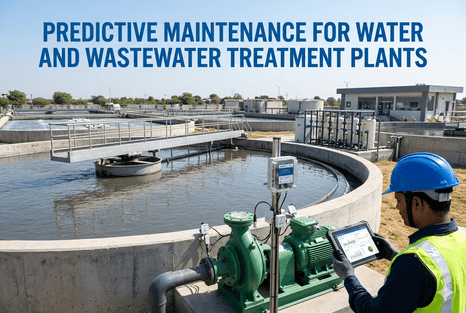
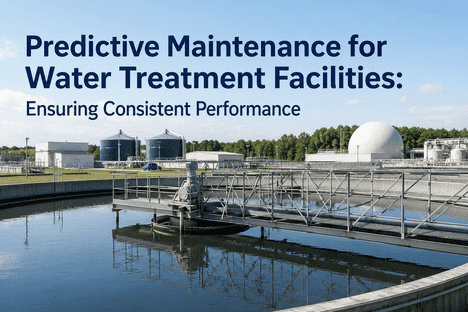
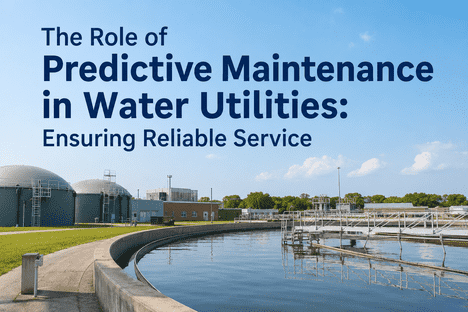
Municipal water utility pump stations operate under conditions that make them structurally different from industrial rotating equipment — variable demand cycles that shift with residential, commercial, and industrial consumption patterns; raw water quality fluctuations with seasonal runoff, algal blooms, and turbidity events; and distributed asset geography that makes route-based condition monitoring logistically impractical and economically inefficient. A single unplanned pump failure at a raw water intake station serving a 200,000-resident system can reduce treatment plant throughput by 40–60% for 5–14 days, requiring emergency interconnection agreements with neighbouring utilities at premium pricing of $0.25–$0.60 per 1,000 gallons purchased. A wastewater lift station pump failure during a wet weather event can trigger a sanitary sewer overflow (SSO) that costs $50,000–$500,000 in EPA fines, environmental remediation, and public notification compliance. Traditional time-based water utility maintenance — semi-annual pump bearing greasing, annual motor megger testing, calendar-driven seal replacement — cannot address the variable conditions that accelerate wear across distributed pump stations: raw water grit and sand content that spikes with storm events (accelerating impeller wear by 3–5x), wastewater hydrogen sulfide concentration that corrodes motor windings faster in warm weather, finished water pumping hours that double during summer peak demand periods, and variable-speed drive cycling frequencies that differ by an order of magnitude between a constant-speed deep well pump and a variable-speed distribution booster. iFactory AI's predictive maintenance platform fuses pump motor current signatures, casing vibration, bearing temperature, discharge pressure and flow trends, wet well level telemetry, and shift log inspection records into machine learning models that forecast pump bearing failure, mechanical seal degradation, motor winding breakdown, and check valve sticking 2–4 weeks in advance across the entire 42-station water utility distribution and wastewater collection system. Book a Demo to see how iFactory connects your municipal water pump station telemetry to predictive intelligence.
Why Time-Based Water Utility Maintenance Is Structurally Inefficient
Municipal water utilities operate under a maintenance model inherited from an era before continuous condition monitoring was economically viable: semi-annual pump station inspection visits, annual motor and bearing replacement for critical stations, and reactive emergency repair for everything else. A typical water utility with 40+ pump stations across a 200-square-mile service area dispatches route-based maintenance crews to each station on a fixed calendar schedule — regardless of whether the station's pumps have accumulated 500 or 5,000 operating hours since the last visit. The result is a structurally inefficient allocation of maintenance resources: 60–70% of calendar-triggered inspections find no actionable defects on pumps that are operating well within their safe wear limits, while 30–40% of pump stations operating under high-demand or poor water quality conditions accumulate damage between inspection intervals and fail before the next scheduled visit arrives.
The telemetry coverage gap in water utilities compounds the problem. Most municipal water systems have SCADA telemetry for tank levels, system pressure, and flow rates — but the detailed condition monitoring data that indicates pump health (motor current signature, bearing casing vibration, pump discharge pressure pulsation, winding temperature) is not collected continuously for the vast majority of pump stations. Emergency callouts triggered by SCADA alarms — low pressure, high wet well level, pump failure to start — are reactive responses to failures that have already occurred, with the utility paying emergency service rates of $150–$250 per hour for after-hours contractor response plus parts premiums of 30–50% above standard pricing. The gap between what SCADA monitors (system-level parameters) and what PdM monitors (equipment-level condition) is the gap where 55% of preventable pump failures occur.
- Semi-annual route-based inspection — 70% of visits find no actionable defects
- Emergency callouts driven by SCADA alarms — after failure has already occurred
- Motor and bearing replacement on calendar schedule — 40–60% of remaining useful life wasted
- Pump seal failures detected by visible leakage — gland leakage already in advanced stage
- Check valve failures detected by backflow events — pressure surge damage already done
- Emergency repair spend: $85,000–$120,000 per year per 10 pump stations
- Continuous condition monitoring — defects detected at Stage 1, before functional failure
- Emergency callouts reduced 70% — planned intervention during normal working hours
- Condition-based replacement — 30–50% average bearing and seal life extension achieved
- Pump seal degradation detected by motor current signature and casing vibration 14+ days before leakage
- Check valve degradation detected by pressure decay rate and flow reversal signature
- Annual emergency repair spend reduced by $340K across 42 pump stations
The Four Pump Station Failure Categories iFactory Predicted — and Prevented
The 42-station water utility deployment focused on four pump failure categories that historically accounted for 82% of unplanned pump station downtime and 78% of emergency maintenance spend. Each category required distinct monitoring parameters and AI model architectures calibrated to the specific failure physics of that pump type and service condition.
How iFactory Deployed PdM Across 42 Distributed Pump Stations — No Crew Dispatch Required
The defining challenge of water utility PdM deployment is asset geography: 42 pump stations spread across 200+ square miles, with some raw water intake stations accessible only by unimproved roads and wastewater lift stations in residential neighbourhoods with limited parking and working space. A deployment strategy requiring on-site sensor installation visits to every station would have consumed 4–6 months and $200,000+ in installation labour before generating a single prediction. iFactory solved the geography problem through a two-path connectivity strategy: direct OPC-UA integration with existing SCADA PLCs for stations already equipped with current transformers, pressure transmitters, and level sensors (28 stations — connected remotely without site visits), and wireless MEMS accelerometer and current transducer kits for stations lacking instrumentation (14 stations — installed during one scheduled visit per station averaging 90 minutes).
The Keep / Retire / Transform / Replace Decision Matrix for Water Utility Pump Station Maintenance
Every water utility pump station maintenance programme element falls into one of four categories. Getting the categorisation right in week one determines whether the PdM deployment completes in 10 weeks or stalls in pilots for 10 months. Book a Demo to run this matrix for your water utility pump station fleet.
| Category | Elements to Keep | Elements to Retire | Elements to Transform | Elements to Replace |
|---|---|---|---|---|
| Data Infrastructure | Existing SCADA PLCs, pressure/flow/level sensors, historian databases | Paper-based operator round sheets collected at each station | Manual SCADA data review for condition trends | Email-based alarm notification for pump failure |
| Maintenance Programme | CMMS work order system, parts inventory, contractor relationships | Semi-annual route-based inspection visits generating 70% no-defect findings | Condition-based replacement intervals from AI RUL estimates | Calendar-triggered pump and motor replacement schedule |
| Operator Interface | Operator experience and institutional knowledge of station behaviour | Paper-based shift logbooks stored in station control panels | Digital Shift Logbook capturing operator findings alongside AI predictions | Standalone pump test reports not linked to CMMS or historian |
| Emergency Response | Emergency contractor relationships for major pump rebuilds | After-hours emergency callout as primary failure response model | Planned intervention scheduling from AI predictive alerts | SCADA-alarm-only detection of pump failures |
Year 1 Business Case: $340K Maintenance Spend Reduction in Detail
The $340,000 in Year 1 maintenance spend reduction was independently verified by the utility's financial control group and distributed across three categories:
The $195K in emergency repair reduction was driven by the elimination of 70% of after-hours callouts (from an average of 3.2 per month in the 12-month baseline to 0.9 per month in Year 1). Each avoided emergency callout saved $4,200–$9,800 in after-hours labour premiums, overtime, and expedited parts markups. The $98K in prevented production loss was concentrated in four events: two raw water intake pump failures that would have reduced treatment plant throughput by 40–50% for 5–7 days (avoided water purchase premium: $22,000–$35,000 per event), and two distribution booster failures during summer peak demand that would have triggered customer pressure complaints and boil-water advisory reporting (avoided PR cost and regulatory reporting: $12,000–$18,000 per event). The $47K in maintenance optimisation savings came from extending average bearing replacement intervals from 24 months (fixed calendar) to 34 months (condition-based) and average mechanical seal replacement intervals from 18 months to 26 months — reducing parts consumption and PM labour across the 42-station fleet.
Expert Perspective: What Makes Water Utility PdM Different from Industrial PdM
I spent 14 years in industrial rotating equipment reliability before moving to the municipal water sector, and the difference that surprised me most was not the technology gap — it was the operational model. In industrial plants, maintenance decisions are made by reliability engineers who understand vibration analysis and bearing fault frequencies. In water utilities, maintenance decisions are made by utility managers who were promoted from operations and whose primary performance metric is regulatory compliance — not equipment reliability. The result is a maintenance culture that over-invests in calendar-driven PM (because it reliably passes audit scrutiny) and under-invests in condition monitoring (because the capital request for sensors and analytics competes with water quality compliance projects that have regulatory deadlines attached). The utility in this case study broke that pattern by framing the PdM investment not as a technology upgrade but as an emergency cost reduction programme with a guaranteed 12-month payback — which is a language that utility financial managers understand. The $340K Year 1 saving was real, verified, and has been rolled into the next budget cycle for expansion to 30 additional stations. The lesson I took from this deployment is that industrial PdM technology is directly transferable to water utilities — but the business case framing has to be different because the decision-maker, the operating constraints, and the regulatory environment are all fundamentally different from what industrial reliability teams navigate.
FAQ
No. iFactory federates data from existing SCADA PLCs, motor current transducers, pressure transmitters, and level sensors already installed at most pump stations. In this deployment, 28 of 42 stations had sufficient existing instrumentation to begin continuous monitoring without any new sensor installation. For the 14 stations lacking instrumentation, iFactory provided wireless MEMS accelerometer and temperature sensor kits that install in under 90 minutes per station with no conduit, cabling, or PLC programming required. The total incremental sensor investment for all 14 previously uninstrumented stations was $18,200 — less than 6% of the $340K Year 1 savings.
Production-grade AI models cover the full range of municipal water utility pump types: vertical turbine pumps (deep well raw water, finished water transfer), horizontal split-case centrifugal pumps (distribution booster stations, finished water pumping), end-suction centrifugal pumps (chemical feed, backwash, washwater), submersible wastewater pumps (lift stations, effluent pumping), and axial-flow and mixed-flow pumps (stormwater, raw water intake). The platform automatically adapts its model architecture to each pump's hydraulic characteristics, duty cycle pattern, and failure history — a vertical turbine pump with 50+ start-stop cycles per day in a distribution booster receives different monitoring parameters and alert thresholds than a raw water intake pump running continuously for weeks at constant speed. Station configuration — single pump, duty-standby, duty-assist, or multi-pump parallel — is incorporated into the model to distinguish pump condition changes from operating mode transitions.
iFactory connects to water utility SCADA platforms (Wonderware, Rockwell, GE iFIX, Siemens WinCC, Telvent OASyS) through standard OPC-UA and Modbus TCP integration — reading PLC tags for motor current, discharge pressure, flow rate, wet well level, and pump run status. No changes to existing SCADA configuration or PLC logic are required. CMMS integration (IBM Maximo, SAP EAM, Lucity, Cityworks, AssetWorks) is through REST API, generating work orders with pump asset ID, fault classification, severity score, RUL estimate, and recommended part number. The Shift Logbook provides a mobile-optimised operator interface for capturing defect reports, shift handover notes, and maintenance intervention outcomes — synchronised with the CMMS for complete asset history. In this deployment, the SCADA integration was completed in 6 days, and the CMMS integration in 4 days — no utility IT resources required beyond network access coordination.
Yes — seasonal variation is the primary reason calendar-based PM fails in water utilities, and iFactory's models are specifically designed to distinguish seasonal operating pattern changes from actual equipment degradation. The baseline calibration period of 30 days captures the initial operating profile, but the model continuously adapts its threshold baselines as seasonal patterns emerge: higher discharge pressures during summer peak demand, elevated motor currents during raw water high-turbidity events, increased pump starts during wet weather inflow events. Seasonal baseline drift is tracked separately from degradation trend — a pump that draws 5% more current in August than in February is flagged only if the current increase exceeds the adaptive seasonal model's confidence interval for that pump at that ambient temperature and flow condition. This seasonal adaptation is what separates AI PdM from fixed-threshold SCADA alarming in water utility applications — and it is the reason iFactory achieved 87% precision in this deployment while generating only 0.3 false alerts per station-week.
For a municipal water utility with 30–50 pump stations — raw water, distribution, wastewater, and finished water — the full PdM deployment timeline is 10–14 weeks and breaks into the five stages documented in this case study. The total investment for a 42-station deployment ranges from $85,000 to $145,000 depending on existing sensor coverage (28 stations with existing telemetry vs. 14 requiring wireless sensor kits), CMMS integration complexity, and the utility's network security requirements for remote SCADA connectivity. The investment includes: SCADA data audit and OPC-UA connectivity ($18,000–$32,000), wireless sensor kits for uninstrumented stations ($12,000–$28,000), iFactory platform configuration with pump-specific model training ($35,000–$55,000), CMMS integration and Shift Logbook deployment ($12,000–$18,000), and training and commissioning ($8,000–$12,000). ROI is typically demonstrated within the first 90 days from the first prevented pump failure — and the $340K Year 1 savings at this utility exceeded the total programme investment by a factor of 2.5–3.5x in Year 1 alone. An ROI assessment for your specific pump station fleet — using your actual emergency maintenance spend, pump failure frequency, and station configuration data — is available at no cost.