What You Get: Hardware, Software, Training and Support in One PdM Package
By Christopher Hayes on June 18, 2026
Most industrial AI vendors sell a model. iFactory delivers a working factory. The difference shows up in the parts of the deployment nobody puts in their pitch deck — the cable from the PLC panel to the OPC-UA gateway, the firewall rule that lets the historian write back, the SAP RFC that posts the work order, the operator who needs the dashboard explained on Tuesday's night shift. We do all of that. The customer signs one purchase order; our team handles wire, network, cybersecurity zoning, model training, ERP integration, validation evidence, and operator handover. iFactory ships a pre-racked NVIDIA AI server with pre-loaded predictive maintenance software, production-tested connectors to your MES, ERP, PLCs, SCADA, and historian, and on-site operator training — all in a single fixed-price package. Power and internet are the only things you provide. From PO to production AI running on your floor: 6 to 12 weeks. For reliability engineers, plant managers, and maintenance leaders evaluating a move from periodic vibration analysis to continuous AI-native condition monitoring, this page breaks down exactly what ships, what integrates, what trains, and what deploys — and who handles every wire and every screen.
iFactory AI · Turnkey Predictive Maintenance · 2026
What You Get: Hardware, Software, Training and Support in One PdM Package
Pre-racked NVIDIA AI server · Pre-loaded PdM software stack · MES/ERP/PLC/SCADA integration in scope · On-site operator training · 24/7 remote monitoring — one fixed price, one PO, one go-live date.
Why Most AI Predictive Maintenance Pilots Never Reach Production
A plant manager evaluates an AI vendor on a Tuesday. The pitch deck is impressive. By the third meeting they discover the "AI platform" needs a GPU cluster they don't own, an MLOps team they haven't hired, six months of cloud data egress, an MES integration project they don't have budget for, and a security review their CISO hasn't started. The pilot slips from Q2 to Q4. The deployment gets re-scoped twice. Eighteen months later there's a slide deck full of dashboards but the line operators are still using the same Excel sheets they used in 2023. According to research published in the Proceedings of the IEEE, over 60% of manufacturers cite data integration as the primary barrier to smart factory implementation, and survey data on agentic ERP rollouts shows only 14% pilot success rates revealing implementation discipline gaps. iFactory is built around the opposite arc. The hardware ships racked, pre-loaded, and configured. Plug power and Ethernet — AI is live. The integration to your MES, ERP, PLCs, SCADA, and historian is part of scope, not a separate professional services contract. Operators are trained in the same window. Total elapsed time from PO to your floor running production AI: 6 to 12 weeks.
What Ships in the Turnkey Predictive Maintenance Package
Every deployment includes the same five-layer stack. Nothing is optional because everything is required for a production-grade rollout. The hardware arrives pre-configured. The software arrives pre-loaded. The integrations are built and tested before the server leaves our facility. Your team provides power, network, and access credentials. Our team handles everything else.
Hardware
NVIDIA AI Server Appliance
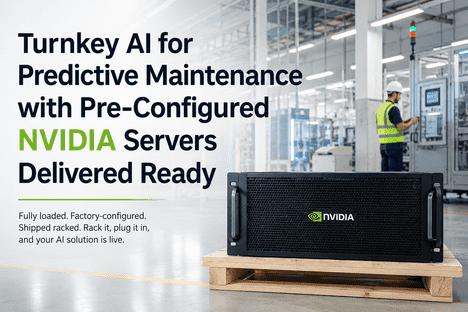
Pre-racked NVIDIA Jetson + RTX PRO 6000 Blackwell server or IGX Thor. Burn-in tested. Configured with IEC 62443 SL-3 OT cybersecurity zoning. Ships racked, wired, and ready. You provide power and Ethernet; models begin inferencing within hours of arrival.
Software
Predictive Analytics AI Stack
Pre-loaded LSTM + FFT envelope + multi-sensor fusion models for bearing faults, gearbox tooth wear, pump impeller degradation, and fan blade failures. iFactory Shift Logbook for operator dashboards. Auto work order generation to CMMS. No software installation required on your end.
Integration
MES · ERP · PLC · SCADA · Historian
Pre-built production-tested connectors to Siemens, Allen-Bradley, Schneider, ABB PLCs; SAP PM, Oracle, Maximo CMMS; and all major historians. No new SI engagement. No months of OPC-UA debugging. Our engineers handle every connection during on-site deployment.
Training
On-Site Operator & Maintenance Training
Two on-site training sessions per shift for operators, supervisors, and maintenance technicians. Dashboard walkthrough, alert response playbooks, shift handover procedures via iFactory Shift Logbook. Your team is self-sufficient by week 8 of deployment.
Support
24/7 Remote Monitoring & Model Retraining
Our operations team monitors your appliance, model drift, and data feed health around the clock. If a model drifts or a feed drops, we fix it before your next shift starts. Year-one support included. Annual renewal optional — or run it in-house with our handover docs.
What You Own. What You Don't Pay For.
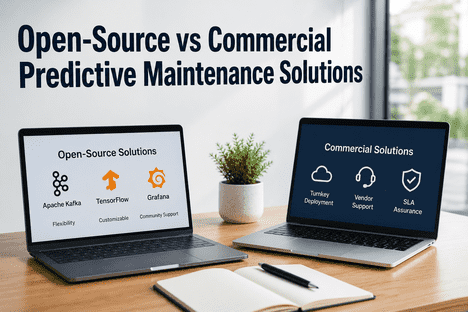
The commercial model matters because it determines whether AI predictive maintenance delivers ROI or becomes a recurring-cost line item. iFactory's turnkey package is a one-time capital purchase. You own the NVIDIA server, the trained model weights, the sensor configuration, the integrations, and all plant data — outright. There are no recurring license fees, no per-asset subscription charges, no data egress costs, and no kill switch. Year-one remote support and model retraining are included in the fixed price. After year one, you can renew support, run the system in-house using our handover documentation, or mix both approaches. The platform keeps running regardless of your support renewal decision because the hardware and software are yours.
Dimension
SaaS AI Vendor
DIY On-Prem Build
iFactory Turnkey
Time to production
2–4 weeks (limited scope)
9–18 months
6–12 weeks
Commercial model
Recurring subscription per asset
CapEx + your internal team
One-time CapEx · no recurring fees
Data sovereignty
Vendor cloud
Your floor
Your floor · zero egress
Hardware procurement
N/A (cloud only)
You source, spec, and rack GPUs
Shipped pre-racked, burn-in tested
OT integration (PLC/SCADA)
Your responsibility
Your responsibility
iFactory engineers handle on-site
Cybersecurity zoning
Manual configuration
You design
Pre-configured IEC 62443 SL-3
Model weight ownership
Vendor retains IP
You own
You own outright
Operator training
Self-serve documentation
Your team trains itself
On-site per-shift training included
Ongoing support
SaaS support tier
Self-managed
24/7 remote monitoring · year-one included
Three Deployment Timelines — Pick Your Path
Every plant starts with the same hardware and software stack. The deployment timeline varies based on anchor use case, existing sensor coverage, and integration complexity. All three paths end with production AI running on your floor, owned by you, with zero recurring license fees.
Path A
Predictive Maintenance Pilot
6–8 weeks
Single anchor use case — bearing fault prediction, gearbox monitoring, or pump degradation. Pre-configured LSTM model for one asset class. PLC/SCADA integration for 5–10 critical assets. Operator dashboard live with health scores and alerts.
Best fit
First AI deployment. 5–20 critical assets. Validate ROI before scaling.
Wk 1–2 Use-case scoping + sensor mapping
Wk 3–5 Server delivery + PLC integration
Wk 6–8 Baseline collection + operator training
Path B
Multi-Asset Fleet Deployment
8–12 weeks
Multiple LSTM models deployed across bearing, gearbox, pump, and fan asset classes. Full CMMS integration with auto work order creation. iFactory Shift Logbook deployed for operators and reliability engineers. Bearing sparing logic integrated.
Best fit
50–200 rotating assets. Mature reliability program. CMMS already in use.
Wk 1–3 Asset inventory + integration matrix
Wk 4–8 Server stack + multi-model deployment
Wk 9–12 CMMS cutover + shift handover training
Path C
Full Plant Modernization
10–14 weeks
All rotating asset classes covered. NVIDIA server cluster with redundant inference nodes. Full MES, ERP, PLC, SCADA, and historian integration. Plant-wide operator dashboards, automated work order lifecycle, and spares optimization. Legacy PdM systems retired.
Best fit
200+ assets across multiple production lines. Strategic platform consolidation.
Wk 1–4 Full asset inventory + OT network audit
Wk 5–10 Parallel build + integration test
Wk 11–14 Cutover + legacy system sunset
Get a Fixed-Price Proposal for Your Plant Within 5 Business Days
Send us your asset list, approximate asset count, ERP version, and top failure history. We return a written proposal — hardware spec, LSTM model scope, sensor integration plan, CMMS connector configuration, operator training schedule, and year-one support — all at a fixed price. One PO. One go-live date. One team accountable for every wire and every screen.
iFactory ships four pre-trained LSTM models — one per rotating equipment class — each fine-tuned on the fault frequencies and degradation curves specific to that asset type. Models are pre-loaded on the NVIDIA server and configured for your specific asset list during on-site deployment. No data science team required. No model training project. The models begin inferencing within hours of server power-on against a 4-week baseline collection period that establishes each asset's healthy fingerprint.
M
Motor Bearing Fault Prediction
LSTM + FFT envelope spectrum model. Detects BPFO, BPFI, BSF, and FTF amplitude trends. Classifies four-stage severity progression. Predicts spall initiation 30–90 days ahead with 87–94% accuracy. Auto-creates CMMS work order with bearing part number and RUL estimate.
30–90 day prediction horizon
G
Gearbox Tooth Wear Detection
Multi-sensor fusion model combining vibration, acoustic emission, and oil debris analysis. Detects gear tooth pitting, cracking, and root fatigue at Stage 1. Predicts remaining useful life from wear trajectory. Sideband analysis identifies specific gear stage and tooth count.
20–60 day prediction horizon
P
Pump Impeller & Cavitation Detection
Vibration + current + pressure sensor fusion model. Detects impeller wear, cavitation onset, and balance degradation. Separates hydraulic from mechanical fault signatures. Predicts performance curve shift before efficiency drop triggers production impact.
15–45 day prediction horizon
F
Fan Blade & Balancing Prediction
Accelerometer + tachometer fusion model. Detects blade pass frequency harmonics, imbalance progression, and resonance shifts. Predicts structural fatigue 30–60 days ahead. Separates aerodynamic from mechanical imbalance for targeted maintenance action.
30–60 day prediction horizon
What Integration Looks Like When It's Actually in Scope
The difference between a turnkey AI deployment and a vendor handoff is visible in the integration layer. Most vendors deliver a model API and call it done. iFactory delivers the full integration chain — from raw wire on the factory floor to ERP-posted work orders — because integration scope gaps are the single largest cause of PdM pilot failure. Every deployment includes below scope items that most vendors classify as "customer responsibility."
In Scope — iFactory Handles
Physical cabling from PLC panels to OPC-UA gateway
OT network switch configuration and cybersecurity zoning
Firewall rules for historian write-back and CMMS posting
Ethernet network uplink from server to plant network
PLC and SCADA system access credentials
ERP/CMMS admin credentials for connector setup
Existing accelerometer sensor data streams (if available)
Maintenance history and failure records for model training
Safety escort for on-site engineers during deployment
ROI — What the Turnkey Package Delivers in the First Quarter
The business case for a turnkey AI predictive maintenance package is not about software substitution — it is about cost avoidance on catastrophic rotating equipment failures that stop production lines for extended periods. Plants moving from reactive or periodic preventive maintenance to continuous AI-native condition monitoring see measurable improvements across four metrics in the first quarter post-deployment. The hardware, software, integration, training, and support are all included in a single fixed price with zero recurring license fees, so every dollar of cost avoidance flows directly to the plant's bottom line.
−50–70%
Unplanned rotating equipment failures
AI identifies bearing spalls, gear tooth cracks, and pump cavitation 15–90 days before functional failure. Emergency breakdowns shift to planned repairs during scheduled maintenance windows with pre-positioned spares.
−25–40%
Total maintenance cost
Condition-based replacement eliminates premature bearing changes and unnecessary overhauls while catching faults before spalls propagate to shaft or housing damage that inflates costs by 5–10x.
+30–50%
Mean time between equipment replacement
Timely corrective actions based on actual degradation data — regreasing, alignment correction, contamination control — extends service life before replacement is needed.
6–9 mo
Typical ROI payback period
Full investment recovery through unplanned failure reduction, maintenance cost optimization, and extended fleet life. One-time CapEx means no recurring fees eroding returns.
See the Turnkey Stack Running on Real Factory Data
Walk through the full architecture — NVIDIA server rack, PLC tag streaming, LSTM model inference, CMMS work order auto-creation, and operator dashboard — on a live factory model. Our deployment lead walks the stack stage by stage and sketches a timeline for your environment. No pitch deck. No slideware. Working infrastructure.
Vendor Evaluation — Eight Questions to Ask Before Signing a PdM Contract
Generic AI model vendors handle the inference math. Turnkey PdM vendors handle the deployment reality — hardware procurement and burn-in, OT network cybersecurity zoning, PLC tag mapping across multiple controller brands, ERP connector configuration with your specific CMMS version, operator training per shift and role, and 24/7 model drift monitoring. The eight criteria below separate vendors who have completed factory-floor AI deployments from vendors selling a model API and calling it a platform.
01
Hardware delivery scope
Ask:
"Does your price include the NVIDIA server, racking, cabling, burn-in testing, and OT cybersecurity configuration — or is hardware a separate line item?"
The server is the foundation. If hardware procurement, racking, and network zoning are separate contracts or "customer responsibility," the deployment timeline doubles and integration risk shifts to your team.
02
Pre-loaded model scope
Ask:
"Which LSTM or transformer models are pre-loaded on the server at shipment — and which asset classes do they cover?"
Pre-loaded models for bearing, gearbox, pump, and fan failure prediction should be included and configured for your asset list during deployment. If models require separate training projects, the 6–12 week timeline is not achievable.
03
PLC and SCADA integration
Ask:
"Does your team handle physical cabling, PLC tag mapping, OPC-UA configuration, and firewall rule setup — or is that our plant IT team's responsibility?"
OT integration is the single largest source of PdM pilot failure. The vendor's engineers should handle every connection from PLC panel to model input, including cybersecurity zoning and protocol bridge configuration.
04
CMMS / ERP connector depth
Ask:
"Which CMMS and ERP systems do you have production-tested connectors for — and does the connector auto-create work orders with fault type, RUL, and recommended part number?"
Work order auto-creation with specific fault classification, severity stage, remaining useful life estimate, and replacement part number transforms AI predictions from notifications to actionable maintenance instructions.
05
Operator training model
Ask:
"Does your price include on-site, per-shift operator training — or is training self-serve documentation and video tutorials?"
Operators on different shifts need hands-on training with the actual dashboard, alert response playbooks, and shift handover procedures. Self-serve training materials result in 40%+ lower adoption rates in the first quarter.
06
Data sovereignty and ownership
Ask:
"Who owns the trained model weights, sensor configuration, and all plant data — and what happens if we stop paying the subscription?"
A turnkey CapEx model means you own everything outright — server, model weights, configurations, and data. SaaS models that retain model IP or require ongoing subscription for access create vendor lock-in and data egress risk.
07
Model drift monitoring
Ask:
"Who monitors model accuracy drift, data feed health, and infrastructure uptime — and what is the response SLA?"
Model drift is inevitable as equipment ages, operating conditions shift, and sensor characteristics change. 24/7 remote monitoring with proactive retraining prevents silent prediction accuracy degradation that undermines trust in the system.
08
Deployment timeline guarantee
Ask:
"When does the first AI-classified fault alert reach our CMMS in production — and what is the guaranteed timeline from PO to go-live?"
6–12 weeks is the production benchmark for a turnkey package. Path A is 6–8 weeks. Path C is 10–14 weeks. Vendors quoting 6+ months are building custom development or scoping hardware and integration as separate projects.
Want to evaluate your shortlisted vendors against this 8-criterion framework? Book a Demo and our team will run a structured vendor scorecard against your specific rotating equipment fleet requirements and deployment context.
Expert Perspective — Why Turnkey Beats Build-Your-Own for Plant AI
"The single biggest mistake plant managers make in AI predictive maintenance procurement is treating it as a software purchase. It isn't. The AI model is maybe 15% of the scope. The other 85% is the hardware that runs it, the OT network that connects it, the PLC tags that feed it, the ERP connector that posts its output, and the operator training that makes it useful. A vendor selling a model API without the deployment stack is handing you 15% of a solution and calling it a platform. A turnkey package that ships the pre-racked server, pre-loaded models, pre-built connectors, on-site integration engineers, and per-shift operator training — that is a solution. The architectural decision is not which model has the highest accuracy. It is which vendor shows up with a finished system."
— iFactory AI Deployment Practice, 2026 industry insight
6–12 wk
from PO to production AI running on your floor
One PO
hardware, software, integration, training, support
Zero recurring
license fees · you own the server, models, and data
Frequently Asked Questions
Does the turnkey package include sensors for each asset, or do we need to provide our own?
The package integrates with your existing accelerometers, current transducers, temperature sensors, and PLC data streams. For assets without existing sensors, wireless MEMS accelerometer kits and current clamps can be scoped into the fixed-price quote. iFactory's engineers mount and configure all sensors during on-site deployment in weeks 6–8. No sensors are required upfront; sensor procurement and installation are included in the turnkey price when specified in scope.
What happens if model accuracy drifts after deployment?
iFactory's operations team monitors model drift, data feed health, and infrastructure uptime 24/7. If a model's prediction accuracy degrades due to equipment aging, operating condition shifts, or sensor characteristic changes, our team retrains the model proactively. Year-one remote monitoring and model retraining are included in the turnkey package. After year one, you can renew the monitoring service or run model maintenance in-house using our handover documentation. Either way, you own the model weights and retraining pipeline.
Can the turnkey package integrate with our existing SAP Plant Maintenance or IBM Maximo system?
Yes. iFactory ships pre-built, production-tested connectors for SAP PM, Oracle Maintenance, IBM Maximo, Infor EAM, and Maintenance Connection. The connector reads your asset hierarchy, posts work orders with fault type classification, severity stage, remaining useful life estimate, and recommended replacement part number, and closes the loop when the repair is completed. Connector configuration and testing are part of the on-site deployment scope — not a separate integration project.
What is the total cost of the turnkey package, and are there any hidden fees?
The price is fixed per server deployment, scoped to your asset list and anchor use case selection. It includes the NVIDIA server appliance with burn-in testing and OT cybersecurity zoning, pre-loaded LSTM models, all PLC/SCADA and CMMS integration, on-site operator training per shift, and year-one 24/7 remote monitoring with model retraining. There are no recurring license fees, no per-asset subscription charges, no data egress costs, and no kill switch. Year-one support is included; after year one, renew support or run in-house. iFactory returns a written proposal within 5 business days of receiving your asset list, asset count, ERP version, and top failure history.
What happens to our data and the AI models if we choose not to renew the support contract after year one?
The NVIDIA server, all trained model weights, sensor configurations, integration connectors, and plant data remain your property — outright. The platform continues running without interruption. iFactory provides handover documentation that enables your team to manage model retraining, data feed monitoring, and infrastructure maintenance independently. There is no kill switch, no data egress, and no recurring license that must be paid to keep the system operational. You can renew support at any point if your team later decides they want remote monitoring coverage again.
Get Your Fixed-Price Turnkey Proposal — 5 Business Days
Send us your asset list, approximate asset count, ERP version, and top failure history. We return a written proposal with hardware specification, LSTM model scope, sensor integration plan, CMMS connector configuration, operator training schedule, and year-one support — all at a fixed price. One PO. One go-live date. One team accountable for every wire and every screen.