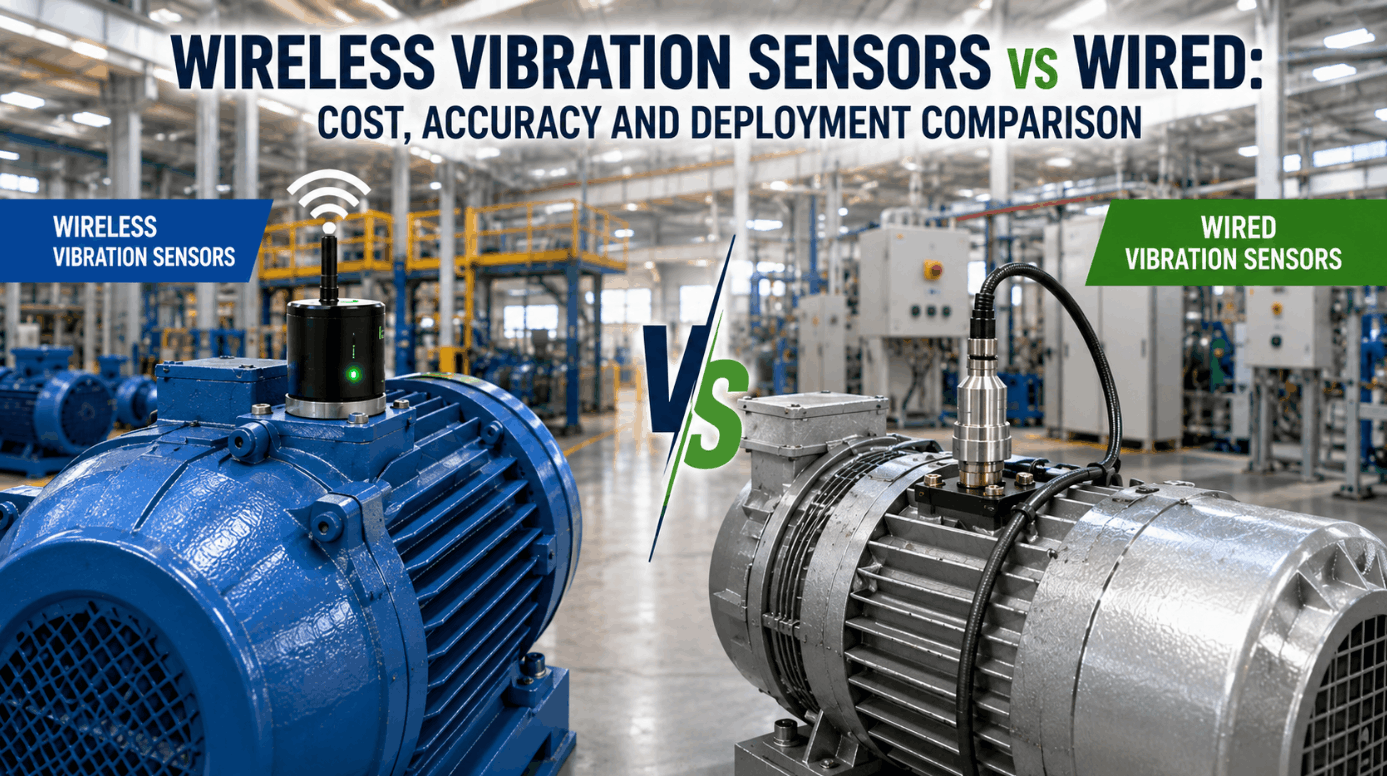
Selecting between wireless and wired vibration sensors is one of the most consequential infrastructure decisions in a predictive maintenance program — not because the technology difference is subtle, but because the wrong choice at deployment scale compounds into years of over-budget maintenance cycles, coverage gaps on critical assets, or inspection data that arrives too infrequently to catch bearing failures before they become unplanned stoppages. The decision framework most U.S. manufacturing facilities use is incomplete: it focuses on unit cost and misses the total cost of ownership gap that emerges when cable runs, conduit work, junction boxes, and multi-day shutdowns for installation are included. A wired IEPE accelerometer on a critical motor costs $200–$400 for the sensor. Add conduit, cable, DAQ card, labor, and shutdown time, and the installed cost per monitoring point regularly exceeds $2,000. A wireless vibration sensor on the same asset — fully installed, connected to a gateway, and live in the analytics platform — runs $200–$500 total. That cost structure changes what coverage is economically justifiable, and coverage is exactly what determines whether a PdM program catches failures or produces incident reports. iFactory AI's sensor-agnostic predictive maintenance platform integrates both wireless and wired vibration data sources into a single analytics layer, so your deployment decision is driven by asset criticality and failure physics — not by which sensor type the platform happens to support. If your facility is evaluating sensor deployment options for a PdM buildout, book a demo to see how iFactory maps sensor strategy to asset criticality before you commit capital to either approach.
The Real Cost Gap: Installed Cost per Monitoring Point Is Where the Decision Is Made
The unit cost of a vibration sensor — wired or wireless — is not the number that should drive a PdM deployment decision. The number that matters is the fully installed, operational cost per monitoring point: sensor hardware, mounting hardware, cable or network infrastructure, DAQ integration, labor, and the production shutdown time required to complete the installation without energized equipment. When these components are accounted for, the cost difference between wireless and wired deployments at scale is not marginal — it is structural, and it determines whether a 200-point coverage program is economically feasible or requires a capital justification that takes 18 months to approve.
At 100 monitoring points, that cost differential is $1M–$2M in deployment capital. At 200 points — a typical mid-size plant coverage target — the gap can reach $4M. For most manufacturing facilities, wireless deployment economics are what make broad PdM coverage financially achievable in a single budget cycle rather than a multi-year capital program. To see how iFactory maps this cost structure to your specific asset inventory, book a demo and request a coverage economics analysis.
Accuracy and Sampling Rate: Where Wired Systems Still Hold a Technical Advantage
Cost economics favor wireless sensors decisively for broad coverage deployments. Technical performance favors wired systems for specific asset classes where high-frequency fault detection and continuous sampling are required by the failure physics of the machine. Understanding where that technical gap is decision-relevant — and where it is not — is the core of a defensible sensor strategy.
Usable Frequency Range: The Gap That Actually Matters
Wired IEPE accelerometers connected to high-performance DAQ systems — such as systems sampling at 50 kHz per channel — deliver usable bandwidth from 2 Hz to 20 kHz, covering all relevant fault frequency families: bearing defect frequencies (BPFI, BPFO, BSF), gear mesh frequencies on high-speed gearboxes, and high-frequency structural resonance signatures that indicate early fatigue. Wireless sensors currently deliver reliable amplitude accuracy up to approximately 1–2 kHz on most commercial hardware. This covers the vast majority of rotating equipment fault families on motors running below 3,600 RPM — imbalance, misalignment, looseness, outer race bearing defects — but limits detectability on high-speed gearboxes and equipment where fault frequencies appear above 2 kHz. For 80–85% of typical industrial monitoring points, the wireless frequency range is sufficient. For high-speed turbines, precision gearboxes, and spindles above 10,000 RPM, wired sensors remain the technically appropriate choice.
Sampling Rate: Periodic vs. Continuous — and Why It Changes Failure Detection
Wired DAQ systems sample continuously at rates of 25–50 kHz per channel, producing a complete condition record that captures transient events, shock pulses, and rapid fault progression in real time. Wireless sensors collect samples in periodic bursts — typically every 10 minutes to several hours depending on battery conservation settings — producing a time-stamped snapshot rather than a continuous waveform. For slowly progressing faults like outer race bearing wear or gradual misalignment, periodic sampling at 15–30 minute intervals is sufficient to detect the trend well before the failure threshold. For rapidly progressing faults — inner race bearing spalling, sudden looseness events, or gear tooth fractures — the gap between wireless sample intervals can allow fault progression to advance significantly before the next reading. The appropriate sampling interval for each asset is a function of the failure mode's typical progression rate, not a universal setting. iFactory's platform configures asset-specific sampling strategies based on criticality tier and fault progression data from the asset class.
Noise Floor and Amplitude Accuracy: What Gets Lost in Wireless Signal Chain
Wired IEPE systems with low-noise signal conditioning achieve signal-to-noise ratios of 85–115 dB, resolving vibration amplitudes at the sub-milligram level needed for early-stage bearing defect detection on precision machinery. Wireless sensors — which must integrate ADC conversion, signal processing, and RF transmission electronics in a single compact node — typically achieve SNR values in the 70–90 dB range. For most industrial rotating equipment, this noise floor is not a practical limitation: bearing fault signatures on motors and pumps operating at industrial vibration levels are well above the resolution threshold of wireless sensors. The limitation becomes relevant on precision equipment where fault amplitudes at defect frequencies are small relative to background vibration, or where early-stage inner race defects must be detected before any overall vibration level change is measurable. iFactory's analytics layer applies signal processing algorithms that partially compensate for wireless noise floor limitations through ensemble averaging and baseline-relative trending — extracting fault signatures that raw overall vibration levels would not reveal.
Battery Life and Power Management: The Operational Cost That Persists After Deployment
Battery-powered wireless sensors eliminate cable infrastructure at deployment but create an ongoing maintenance task: battery replacement. Commercial wireless vibration sensors targeting industrial PdM applications achieve 1–5 year battery life at standard sampling intervals, depending on sample frequency settings, transmission frequency, and operating temperature. Facilities deploying 200+ wireless sensors at aggressive sampling intervals can face a battery replacement cycle that becomes a material maintenance burden. iFactory's sensor management layer tracks battery state-of-health for every deployed node and generates advance replacement work orders at 20% remaining capacity — preventing the missed readings and data gaps that occur when batteries discharge unexpectedly between planned maintenance cycles. For high-criticality assets where battery management overhead is unacceptable, externally powered wireless sensors — or a hybrid deployment with wired sensors on the critical tier — eliminates the battery lifecycle issue while preserving the wireless installation advantage on secondary assets.
Deployment Complexity Compared: Installation, Infrastructure, and Integration
Installation complexity is where the wireless advantage is most practically visible — and where the wired case is most commonly underestimated in capital planning. The comparison below covers the full deployment scope from site preparation through live integration with an analytics platform.
Asset-Risk Decision Matrix: Which Sensor Type Belongs on Which Asset
The most defensible approach to sensor technology selection is not choosing one technology for all assets — it is building a tiered deployment strategy that matches sensor capability to asset consequence and failure physics. iFactory's asset criticality framework defines three deployment tiers that have consistently produced the highest PdM program ROI across U.S. manufacturing deployments. Book a demo to walk through your asset inventory against this framework before specifying sensor hardware.
A hybrid deployment following this tiered model — wired sensors on 10–15% of assets (Tier 1), wireless sensors covering the remaining 85–90% — consistently delivers broader coverage at lower total cost than an all-wired program, while preserving the high-frequency, continuous-sample capability where it is genuinely required by failure physics.
Expert Review: Why Sensor Type Is the Wrong Starting Question for PdM Deployments
The question I get most often from plant engineers evaluating a PdM program is: should we go wireless or wired? It is the wrong starting question. The right question is: what are the failure modes on your highest-consequence assets, what is the fault frequency range that needs to be detected, and what sampling interval does the typical fault progression rate require? Once you answer those questions for each asset tier, sensor technology selection writes itself. For 80 to 85 percent of rotating equipment in a typical industrial plant — motors, pumps, fans, conveyors — wireless sensors at 15 to 30 minute intervals cover every fault family that matters: imbalance, misalignment, looseness, outer race bearing defects. The case for wired sensors is real, but it is confined to a specific asset class: high-speed gearboxes, precision spindles, turbines, and any asset where the failure consequence is severe enough that you need continuous waveform data to catch inner race spalling before it cascades. The facilities that get the best PdM program ROI are the ones that deploy broadly with wireless sensors — covering 200 assets instead of 40 — and reserve wired systems for the 10 to 15 assets where continuous sampling is technically justified. Coverage wins. A 40-point wired program with excellent data on 40 assets will always miss failures on the 160 assets it does not cover. A 200-point wireless program with sufficient data on every critical and important asset in the plant is what actually reduces unplanned stoppages.
Conclusion: Coverage Economics Are the Deciding Factor for Most PdM Programs
Wireless vibration sensors do not match wired IEPE systems at the high-frequency end of the performance spectrum — and for a specific tier of high-speed, high-consequence assets, that technical gap is decision-relevant. For the remaining 80–85% of rotating equipment in a typical manufacturing plant, the frequency range, sampling capability, and amplitude accuracy of commercial wireless sensors are sufficient to detect every fault family that drives unplanned stoppages. The installed cost advantage — $200–$500 per wireless point versus $1,500–$2,500+ per wired point — determines whether broad asset coverage is economically achievable, and coverage is the variable that most determines PdM program outcomes. A hybrid strategy — wired sensors on Tier 1 critical assets where continuous sampling is technically required, wireless sensors covering the remaining asset population — consistently delivers the highest ROI: full fault family detection on the assets where it matters most, broad trend-based early warning on every other asset in the facility.
iFactory AI's predictive maintenance platform integrates both data sources into a single analytics layer with asset-specific baseline calibration, consequence-weighted alert prioritization, and automated work order generation — regardless of whether the underlying sensor is a wired IEPE accelerometer or a battery-powered wireless node. The platform adapts to your sensor infrastructure; your sensor infrastructure should be optimized for coverage and asset criticality, not for platform compatibility. To build a sensor deployment strategy calibrated to your specific asset inventory and failure risk profile, book a demo with iFactory's reliability engineering team.