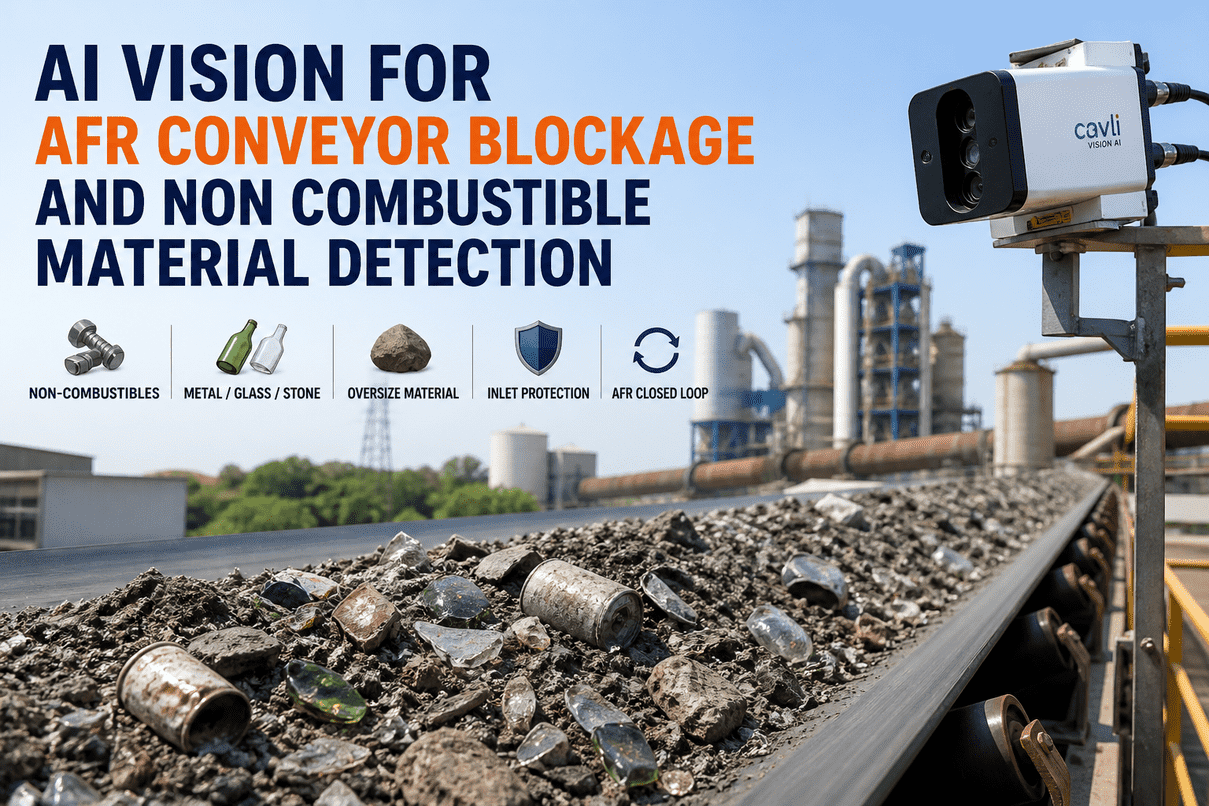
Every cement plant running alternative fuels is playing a quiet numbers game: push thermal substitution rates higher, keep the kiln stable, protect the refractory. What breaks that game — every time — is not the fuel itself. It is the material that should never have been on the conveyor in the first place. Metal. Glass. Stone. Oversize chunks that no shredder caught. They ride the belt quietly, reach the kiln inlet, and the next call you take is from maintenance. See how iFactory Vision catches them before they get there.
Your AFR Conveyor Has Eyes Now
Vision Transformer + Hyperspectral imaging running on an NVIDIA RTX 6000 Pro Blackwell — shipped to your plant, installed by our field team, and live on your conveyor within a 6-week pilot. Hardware, software, cabling, integration, and operator training — all included. You run the pilot, see the detections on your actual AFR stream, and decide.
What Happens When Non-Combustibles Reach the Kiln Inlet
AFR streams — RDF, biomass, tyre chips, industrial waste — carry contaminants that pre-processing misses. The consequences arrive fast and are expensive to fix.
Oversize material jams the inlet chute. One blockage event: 4–8 hours of unplanned downtime, $50k–$150k in lost throughput.
Metal and stone impact the kiln inlet lining at high velocity. Refractory replacement costs run $200k–$800k per campaign depending on damage extent.
Glass melts and coats the clinker burden. Stone adds uncontrolled mineralogy. Both shift clinker quality and force conservative AFR ratios — below the economic optimum.
Non-combustible load disrupts flame temperature. CO and NOx readings spike. Compliance thresholds are breached before the operator on shift knows what happened.
Why Two Models — Not One
A standard RGB camera catches shape and size. It cannot tell you whether a dark mass is rubber, stone, or metal. That material distinction is what makes the difference between a divert and a false alarm. iFactory uses two complementary models on the same frame.
Self-attention across the full conveyor frame — the ViT sees every patch in relation to every other. It catches oversize geometry, detects irregular profiles, and reads conveyor belt loading patterns that signal a blockage risk even before any single object is classified.
Hundreds of spectral bands per pixel. Metal, glass, and stone each carry a unique spectral signature invisible to standard cameras. The hyperspectral layer reads those signatures in real time — no contact, no sample, no delay — and classifies material type with chemistry-level confidence.
Four Non-Combustible Categories — Each Flagged Differently
Not every foreign object carries the same risk. The detection system classifies each type separately — so the divert logic and operator alert are calibrated to actual consequence, not just presence.
Ferrous and non-ferrous metal fragments from waste streams — rebar off-cuts, wire, cans, sheet metal. Metal detectors miss non-ferrous. Vision + hyperspectral catches both.
Glass from municipal waste and industrial packaging. Melts inside the burning zone, forms aggressive glassy phases that attack clinker mineralogy and inlet refractory coating.
Inert mineral material mixed into waste-derived fuels. Adds uncontrolled SiO2 and Al2O3 loading to the kiln — shifts free lime and C3S in clinker without any process adjustment.
Material that passed shredding but exceeds the dimensional limit for the kiln inlet or precalciner feed chute. The ViT reads the geometry in real time — no contact sensor needed.
Protecting Refractory at the Most Vulnerable Point
The kiln inlet — where AFR meets process heat — is the highest-consequence zone in the entire feed chain. A single oversize metal object reaching this point can mean a campaign-ending refractory repair. Here is how the system guards it.
Cameras positioned above the AFR conveyor — upstream of the inlet by 6–12 metres — give the system enough belt travel time to act. ViT and hyperspectral analyse every frame at conveyor speed.
The NVIDIA RTX 6000 Pro Blackwell on-site appliance runs the full inference stack locally. No cloud round-trip. Alert is generated — with material type, confidence score, and belt position — before the object travels 30 cm.
For CRITICAL detections (metal, large oversize): automatic divert gate trigger on a write-confirm pattern — operator sees the alert and the proposed action before it executes. For MEDIUM severity: alert only, operator decides.
Detection timestamp, object type, confidence, operator action, and belt image are stored. Monthly AFR quality reports identify which supplier batches or fuel streams carry the highest contamination load — feeding back into procurement decisions.
Detection That Feeds Back Into Your AFR Strategy
The vision module does not just stop bad material — it builds a contamination record that changes how you buy, blend, and manage your AFR supply chain. Over time, the data closes the loop between the conveyor and the procurement desk.
Every detection is tagged to the active AFR batch and supplier. After 30 days, contamination frequency by supplier is clear — and negotiation-ready. Know exactly which source is sending you trouble before the next delivery.
When contamination rate from a batch is low, the AI recommends a TSR step-up. When it is high, it flags a TSR hold. Substitution rate decisions become data-driven — you push the rate higher on clean batches and protect the kiln on dirty ones.
Refractory wear models receive contamination event data continuously. When stone or metal incidence rises, the wear model adjusts its maintenance forecast — before any temperature signal appears at the thermocouples. You act early, not after the damage.
Detection data is exportable to your AFR pre-processing team. Oversize events tied to a specific shredder pass drive a gap recalibration — the loop closes upstream, not just at the conveyor belt. The problem gets fixed at the source.
The Appliance That Runs It — On Your Site, Not in the Cloud
iFactory ships a pre-configured, rack-ready NVIDIA RTX 6000 Pro Blackwell appliance with all models pre-loaded. You receive it racked. Plug in power and Ethernet. The vision feed is live. No data centre, no cloud subscription, no latency dependency.
Appliance shipped globally. Field tech dispatched for camera mounting, cabling, and PLC/SCADA connection.
ViT and hyperspectral models calibrated to your belt, your AFR stream, your lighting. Pilot detection run with operator review.
Full production mode. Operator training delivered on-site. 24/7 remote monitoring by iFactory from day one.
What Plant Engineers Ask Before Deployment
Yes. The ViT model processes at full frame rate regardless of belt speed. The hyperspectral sensor integrates exposure dynamically. We have tested on belts running up to 2.5 m/s with RDF loads that include tyre chips, biomass, and municipal waste — the detection accuracy holds above 94% in those conditions.
Camera housings are IP67-rated with pressurised air purge. LED arrays are synchronised with camera exposure to maintain image quality in high-dust environments. The models are trained on dusty-condition images specifically — not clean lab data.
It complements — and in most cases extends — metal detection coverage. Traditional metal detectors miss non-ferrous metal and all non-metallic contaminants. Vision catches all four material types. We recommend running both during the first campaign for cross-validation data.
No. iFactory supplies the fully-loaded NVIDIA RTX 6000 Pro Blackwell appliance as part of the turnkey package. It ships racked and pre-configured — you provide line power and Ethernet. Our field team handles everything else.
See What Is On Your AFR Conveyor Right Now
We do not sell you software and leave. iFactory delivers the complete solution — pre-configured NVIDIA appliance shipped to your plant, our field team on-site for camera mounting, cabling, and PLC integration, models calibrated to your AFR stream, operators trained, and 24/7 remote monitoring active from day one. The 6-week pilot runs on your conveyor, on your actual fuel mix — real detections, real diverts, real contamination data before you commit to full deployment.