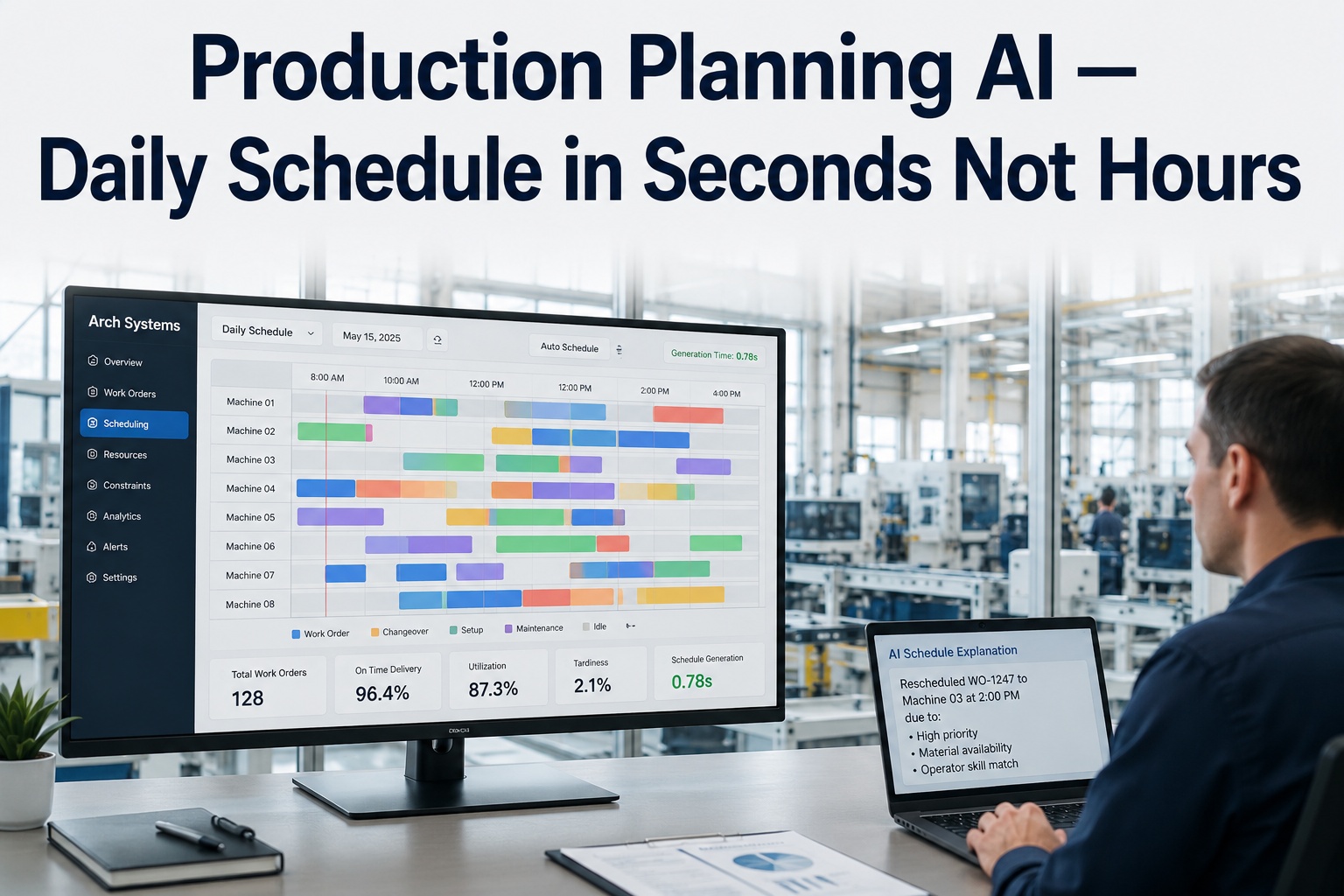
A plant manager spending 3–4 hours each morning building the day's production schedule — in a spreadsheet, by gut feel, juggling changeover matrices, tooling conflicts, operator skill certifications, and late material arrivals — is the single most common scheduling failure mode in discrete manufacturing. iFactory's RL-based production planning AI generates an optimized daily schedule in under one second, re-plans every 15 minutes as conditions change, and explains every decision to your plant manager in plain language. Runs on your on-site NVIDIA GB300 / H200 server. Ships pre-configured, deployed by our engineers, owned by you outright. Get a quote and see a live schedule run on your work order data — fixed-price proposal within 5 business days.
Production Planning AI
Daily Schedule in Seconds, Not Hours
Multi-objective RL (PPO) + constraint solver. Optimizes across changeover, tooling, operator skill, and material availability simultaneously. Re-plans every 15 minutes. Shipped to your plant, deployed by our engineers, owned by you. No cloud. No recurring fees.
Your Planner Is Solving an NP-Hard Problem. Every Morning. With a Spreadsheet.
Job-shop scheduling is a mathematically NP-hard combinatorial problem. As job count, machine count, and constraint count grow, the number of possible sequences grows factorially. A plant running 150 work orders across 20 machines with changeover constraints, operator certifications, and live material availability has more possible schedules than atoms in the observable universe. No human planner finds the optimal answer — they find a workable one, and they spend hours doing it.
RL Agent
Every Constraint Your Best Planner Juggles — Modeled Simultaneously
Most scheduling tools handle one or two constraint types well and ignore the rest. The iFactory RL agent uses a multi-objective PPO policy with a hard-constraint solver layer — soft objectives (minimize makespan, changeover time, WIP) are optimized by the RL policy; hard constraints (operator certs, tooling availability, material presence) are enforced by the solver. Schedule a constraint mapping session — we model your specific constraint set before the quote.
The Plan Is Only Good If It Reflects Reality Right Now
Most planning systems produce a morning schedule that's stale by 09:30. A machine goes down. A material pallet is short. An operator calls in. The plan is wrong and no one has updated it. iFactory's RL agent runs a full replan every 15 minutes — ingesting live machine state, operator presence, material levels, and work order progress from your ERP and MES.
The AI Doesn't Just Re-Plan. It Tells You Why.
Every time the RL agent updates the schedule — whether from a routine 15-minute replan or a disruption event — the plant copilot LLM generates a plain-language explanation for the plant manager. Not a log file. Not a dashboard. A sentence that tells you what changed, why, and what to watch for next.
What Changes When AI Plans the Floor
Autonomous production scheduling delivers 20–30% OEE improvement according to industry benchmarks. The gains come from three sources: changeover time reduction through intelligent sequencing, utilization recovery from removing planner bottlenecks, and on-time delivery improvement from real-time constraint awareness. Get a line-specific ROI estimate before committing to a quote.
The Technical Architecture — How <1 Second Is Possible
Standard optimization solvers hit computational limits at 50–100 jobs. iFactory combines a pre-trained PPO reinforcement learning policy (running on GB300) with a constraint propagation solver for hard constraints. The PPO policy produces a near-optimal solution in milliseconds; the constraint solver validates and adjusts for hard rule violations in a single pass. Talk to our engineering team about scaling to your work order volume.
Pre-trained on millions of simulated scheduling episodes. Accepts live plant state as input. Outputs a ranked sequence of job-machine assignments in <50ms.
Hard constraint validation layer: checks operator certs, tooling conflicts, material presence, and regulatory sequencing rules. Adjusts the RL output to feasibility in a single pass.
Published to shop-floor screens, MES work queues, and SAP production orders automatically.
Plant copilot generates a plain-language summary of what changed and why — pushed to plant manager.
Predicted makespan, changeover minutes, utilization rate, and OTIF score — updated every 15 minutes.
From PO to AI-Planned Shifts in 12 Weeks
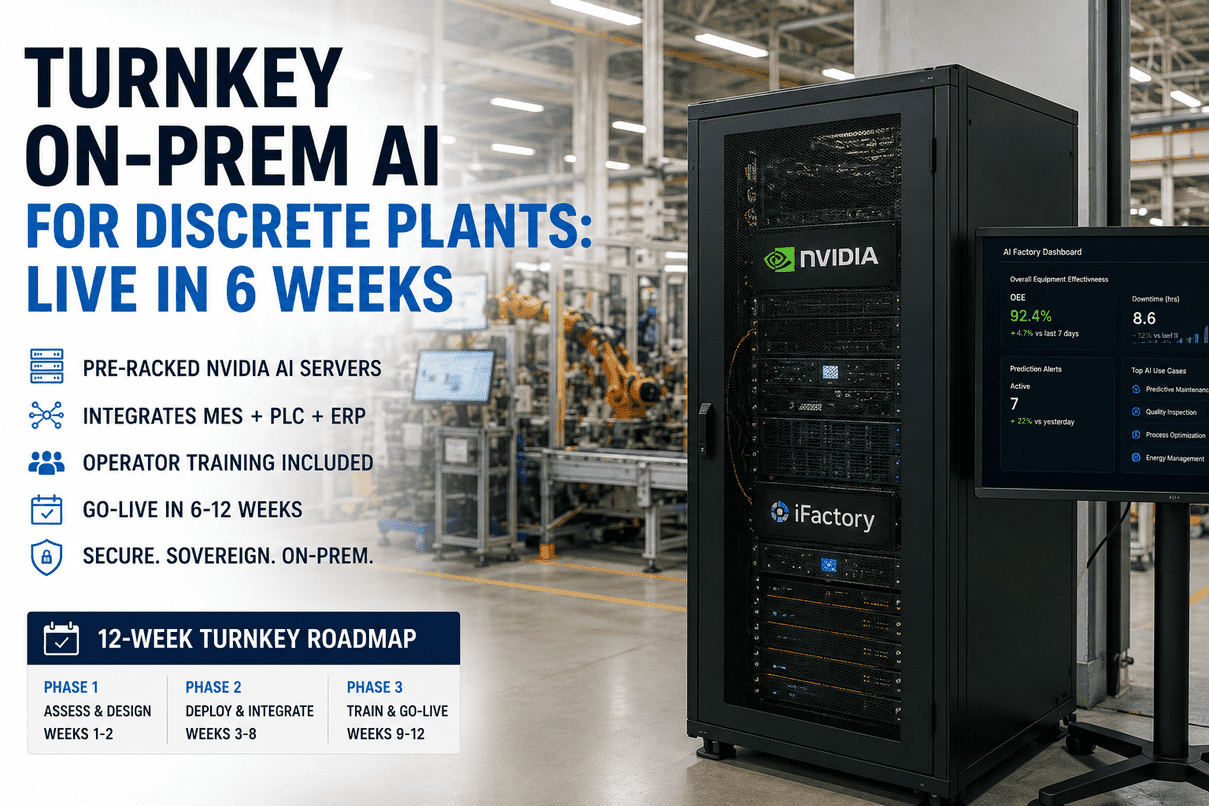
iFactory ships a pre-configured NVIDIA GB300 / H200 server with the RL scheduling model pre-trained on manufacturing job-shop scenarios. Our engineers connect it to your ERP and MES, model your constraint set, run a parallel planning period to validate against your historical schedule compliance, and hand over. You provide power and an internet uplink. Nothing else.
Map your work order types, changeover matrix, operator skill structure, and ERP version. Fixed-price proposal issued.
GB300 + H200 server assembled. RL policy fine-tuned on your historical work order data and constraint set. ERP connectors configured.
Server installed on-site. AI schedule runs in parallel with planner — both plans compared daily to validate quality before go-live.
AI planner takes over scheduling. You own the server, RL model, weights, and all scheduling data outright. $0 recurring fees.
What Plants Ask Before Deploying AI Planning
The PPO policy scales comfortably to 500+ work orders and 50+ machines per plant. For multi-plant environments, each plant runs its own RL instance with a shared material/inventory layer. Schedule a scoping call to confirm fit for your volume.
SAP S/4HANA (RFC + OData), SAP ECC, Oracle EBS, Infor, and most MES platforms via REST or direct DB connector. Material availability, work orders, operator rosters, and tooling registers are all pulled live. Tell support your ERP version to confirm connector availability before the quote.
Typically 2–4 weeks of parallel planning — AI schedule vs. planner schedule run side by side. We compare makespan, changeover time, and OTIF daily. When the AI consistently beats the human plan, we hand over. No pressure to cut over early.
Yes — always. The AI publishes a recommended schedule. Planners can drag-and-drop override any job in the Gantt view. The RL agent then re-optimizes around the locked change in under a second, showing the downstream impact of the override before the planner commits.
Get a Fixed-Price Quote
Send us your work order volume, machine count, ERP system, and top scheduling pain points. We return a written proposal — hardware, RL model, ERP connectors, on-site deployment, training, year-one support — within 5 business days.