Bearing-related faults account for 41–42% of all industrial motor failures. A bearing caught at Stage 2 wear costs $1,000 to fix; run to failure, it seizes the shaft and housing — a $50,000+ replacement, plus unplanned downtime at $260,000 per hour on a critical line. iFactory's LSTM + FFT + multi-sensor PdM model predicts motor bearing, gearbox tooth, pump impeller, and fan blade failures 30–90 days ahead with 87–94% accuracy, auto-creates SAP PM work orders, and delivers a plain-language failure summary with OEM manual citations to the technician before they touch the machine. Ships pre-configured on NVIDIA Jetson + H200, deployed by our engineers, owned by you outright. Get a quote and a live demo on your rotating equipment data — proposal within 5 business days.
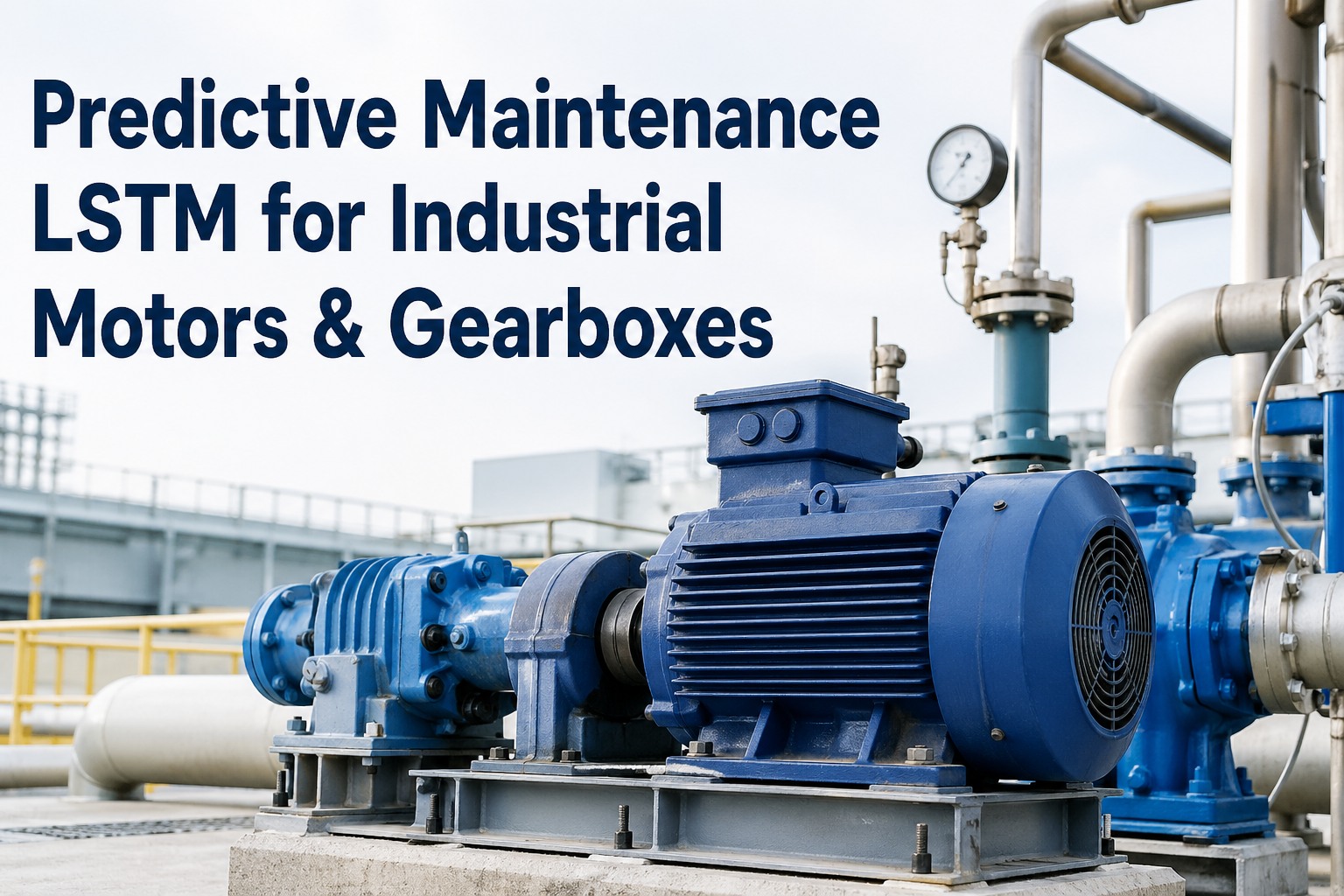
Predictive Maintenance LSTM
for Industrial Motors & Gearboxes
LSTM + FFT envelope + multi-sensor fusion. Predicts bearing, gearbox tooth, pump impeller, and fan blade failures 30–90 days ahead. Shipped to your plant, deployed by our engineers, owned by you. No cloud. No recurring fees.
The $47 Bearing That Costs $127,000
Bearings account for 70% of rotating machinery failures. Caught at Stage 2 wear, a bearing costs $1,000 to replace in a planned window. Run to failure, it seizes — turning a $1,000 repair into a $50,000+ gearbox replacement plus production downtime. Gearbox failures alone average $50,000–$250,000 per incident in direct repair costs, before lost production is counted.
Early degradation
at 30–90 days out
Moderate wear
Human detects — maybe
Advanced damage
Secondary damage begins
Catastrophic failure
Emergency repair + overtime
One Model Architecture. Four Asset Classes. Each Pre-Trained.
iFactory ships four pre-trained LSTM models — one per rotating equipment class — each fine-tuned on the fault frequencies and degradation curves specific to that asset type. Our engineers connect the sensors during the on-site install. Schedule a sensor mapping session before the quote.
How 30-Day Advance Warning Is Achieved
Three processing stages work in sequence: FFT envelope analysis extracts fault frequencies from raw vibration; LSTM learns the temporal degradation curve of each asset; multi-sensor fusion cross-validates the LSTM signal against temperature, pressure, and current to eliminate false positives before an alert is raised. Talk to our sensor engineering team about your asset inventory and sensor coverage.
Triaxial accelerometers, current transducers, temperature sensors, and process sensors sampled at up to 51.2 kHz on Jetson edge nodes. Raw waveforms stored locally — zero cloud egress.
Fast Fourier Transform converts time-domain waveform to frequency spectrum. Envelope detection isolates bearing fault frequencies (BPFI, BPFO, BSF, FTF) and gear mesh frequencies (GMF + sidebands). Fault frequency amplitude tracked as a continuous health index.
LSTM processes the health index time series — learning each asset's unique baseline and degradation curve. The model distinguishes normal operational variance from genuine degradation trends, projecting a remaining useful life (RUL) estimate with a 30–90 day failure window confidence band.
Before any alert is raised, the LSTM output is cross-validated against corroborating signals — temperature trend, current signature, process flow, and oil particle count where available. All signals must agree before an alert is pushed. This eliminates the false positive rate that plagues single-sensor vibration systems and causes alert fatigue.
Accuracy Per Asset Class — and What It Means in Practice
Accuracy figures are not marketing ranges — they reflect iFactory deployment performance across validated installations. 87% on motors means 87 of every 100 actual bearing failures are predicted within the 30–60 day window, before the failure reaches Stage 3. False positive rate after multi-sensor validation: under 6%.
| Asset Class | Primary Fault Mode | Prediction Accuracy | Failure Horizon | Key Sensors | False Positive Rate |
|---|---|---|---|---|---|
| Industrial Motors | Bearing inner/outer race, rotor imbalance | 87% | 30–60 days | Vibration + current + temp | <6% |
| Gearboxes | Gear tooth wear, bearing, oil breakdown | 91% | 45–90 days | High-freq vibration + oil particle | <5% |
| Pumps | Impeller cavitation, seal wear, bearing | 89% | 30–75 days | Pressure + flow + vibration | <7% |
| Fans & Blowers | Blade imbalance, erosion, belt wear | 94% | 30–60 days | Vibration + pressure diff + speed | <4% |
Alert Fires. SAP Work Order Created. Technician Gets the Brief.
Most PdM systems stop at the alert. The technician still has to look up the asset, check the manual, write the work order, and figure out which parts to pull. iFactory closes that loop: the plant copilot LLM auto-drafts the SAP PM work order, cites the relevant OEM manual section, lists the parts needed, and delivers a plain-language brief to the technician — all before they walk to the machine.
I've prepared the SAP work order and technician brief. Ready to release on your approval.
Without this: same alert would require 45 minutes of manual investigation, manual SAP entry, and a tech arriving at the machine without knowing which bearing or what to check for. Everything above ran on your on-site server. Zero data left the plant.
See the full SAP PM integration page for bidirectional connector details including work order confirmation, materials reservation, and completion write-back.
From PO to Live PdM Alerts in 12 Weeks
iFactory ships a pre-configured NVIDIA Jetson + H200 server with all four LSTM models pre-loaded. Our engineers install sensors on your rotating equipment, configure the FFT pipeline, connect to SAP PM, and run a 4-week baseline collection period before the models go live. You provide power and an internet uplink. Nothing else.
Asset list, nameplate data, existing sensor inventory, SAP PM equipment hierarchy. Fixed-price proposal issued within 5 business days.
Jetson + H200 server assembled. LSTM models pre-loaded and tuned to your asset nameplates. SAP PM RFC connector configured.
Engineers mount accelerometers, wire current transducers, install temperature probes and edge Jetsons. All cable runs and conduit handled.
4-week baseline collection establishes each asset's healthy fingerprint. Models go live. You own the server, LSTM weights, sensor config, and all data — outright.
What Plants Ask Before Deploying PdM
No. The fully-loaded Jetson + H200 server is supplied and installed by iFactory. Accelerometers, current transducers, and edge nodes are scoped in the fixed-price quote.
A standard Jetson + H200 deployment handles 50–200 rotating assets with full FFT + LSTM processing. For larger fleets, additional edge Jetson nodes are added at the asset cluster level. Schedule a sizing call with our sensor engineering team.
No sensors required upfront. Our engineers mount wireless or wired accelerometers, current clamps, and temperature sensors during the on-site install in Week 6–8. All sensor procurement and installation is included in the turnkey price.
The sensor is installed, nameplate data entered, and the LSTM model runs a 4-week baseline collection period for that asset before going live. No retraining of the other assets. Talk to support about bulk asset onboarding procedures.
Get a Fixed-Price Quote.
Send us your asset list, approximate asset count, SAP version, and top failure history. We return a written proposal — hardware, LSTM models, sensor install, SAP PM connector, operator training, year-one support — within 5 business days.