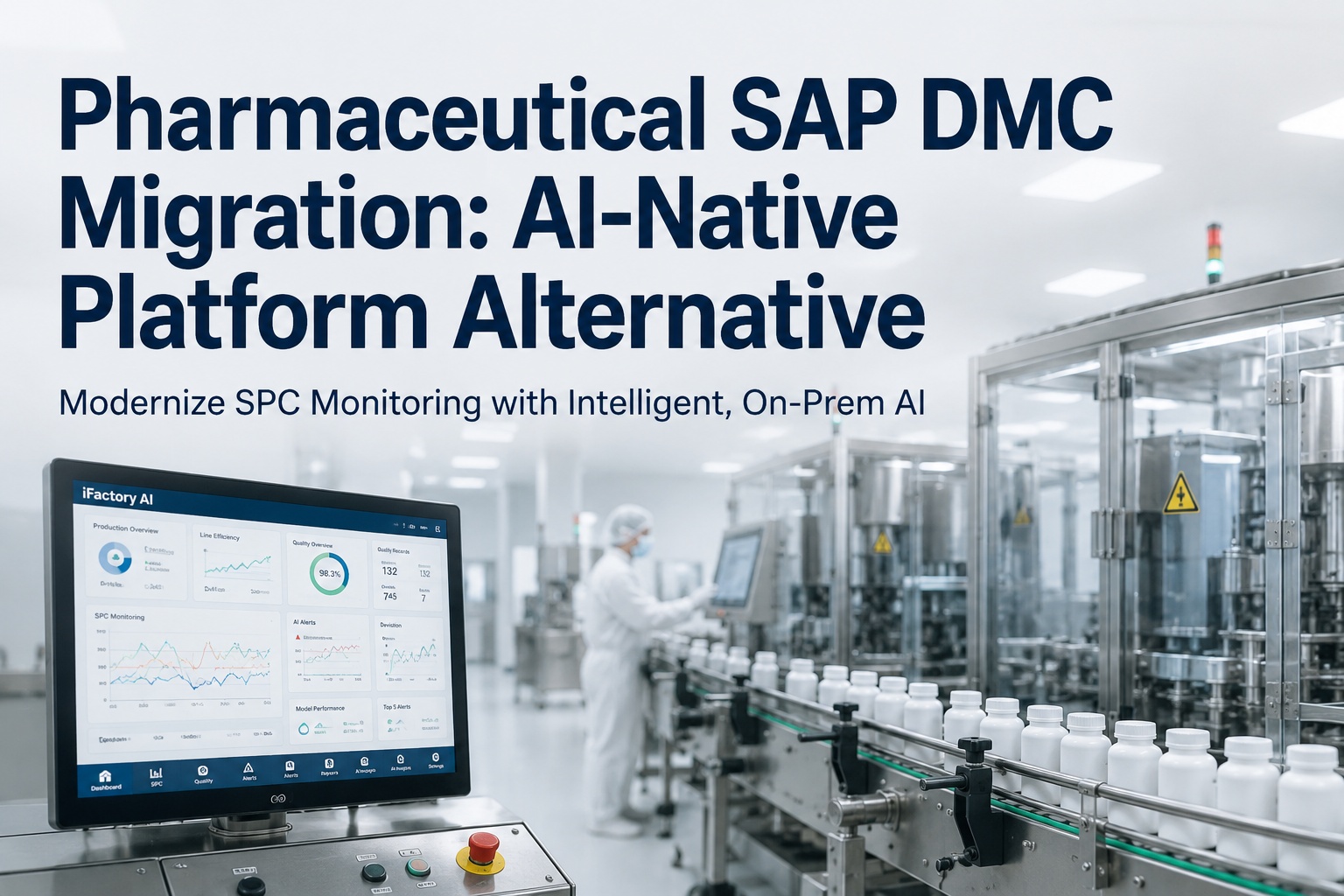
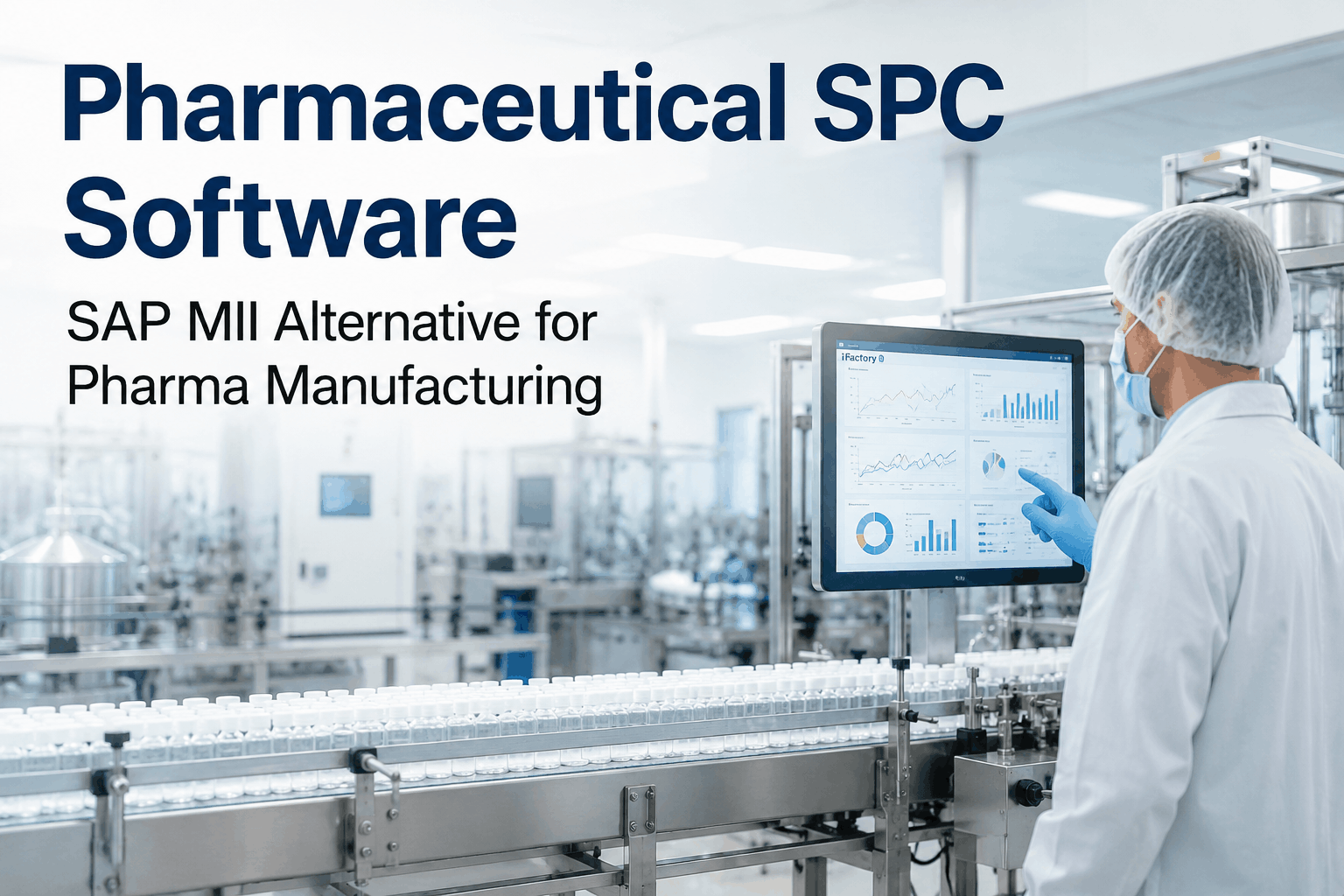
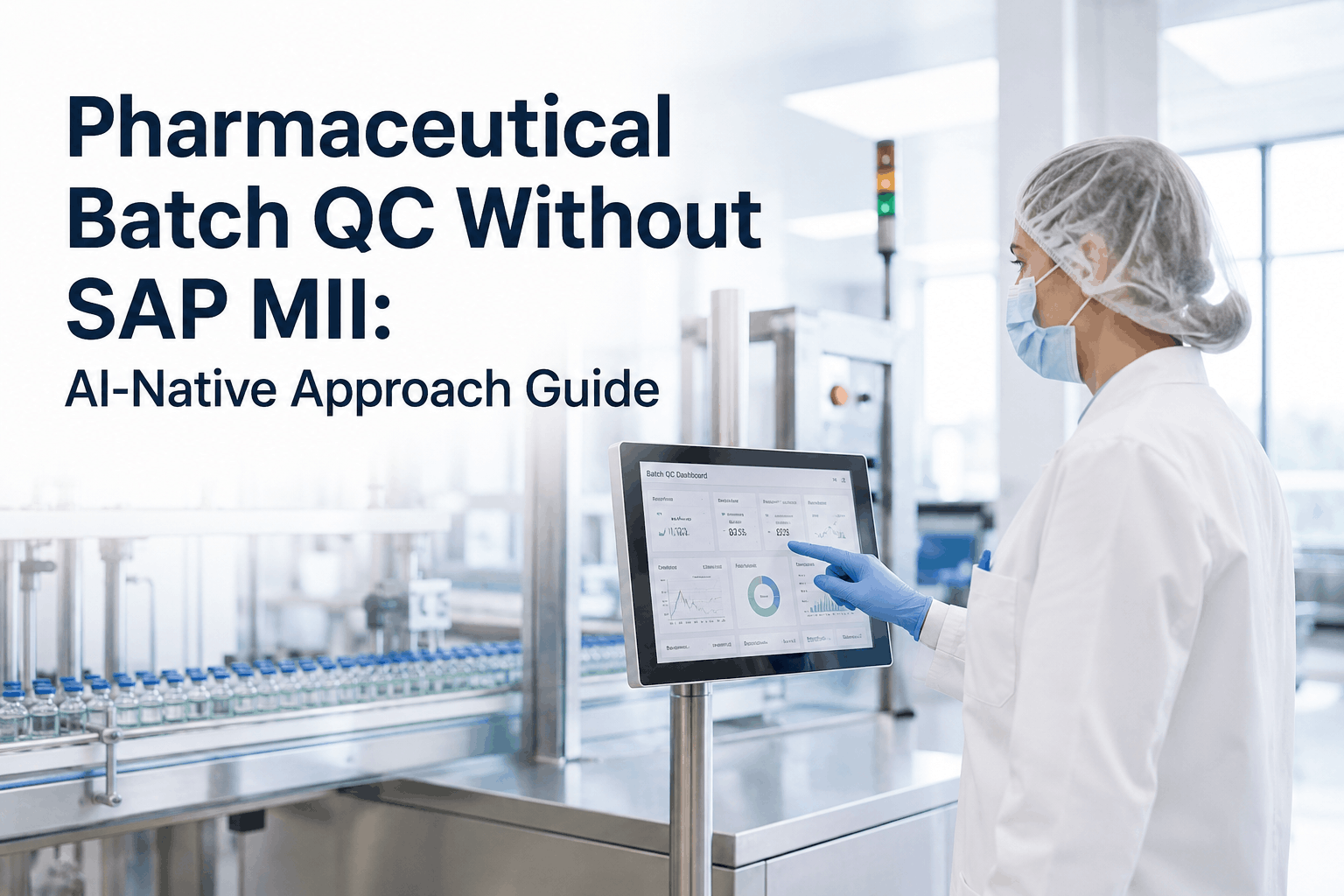
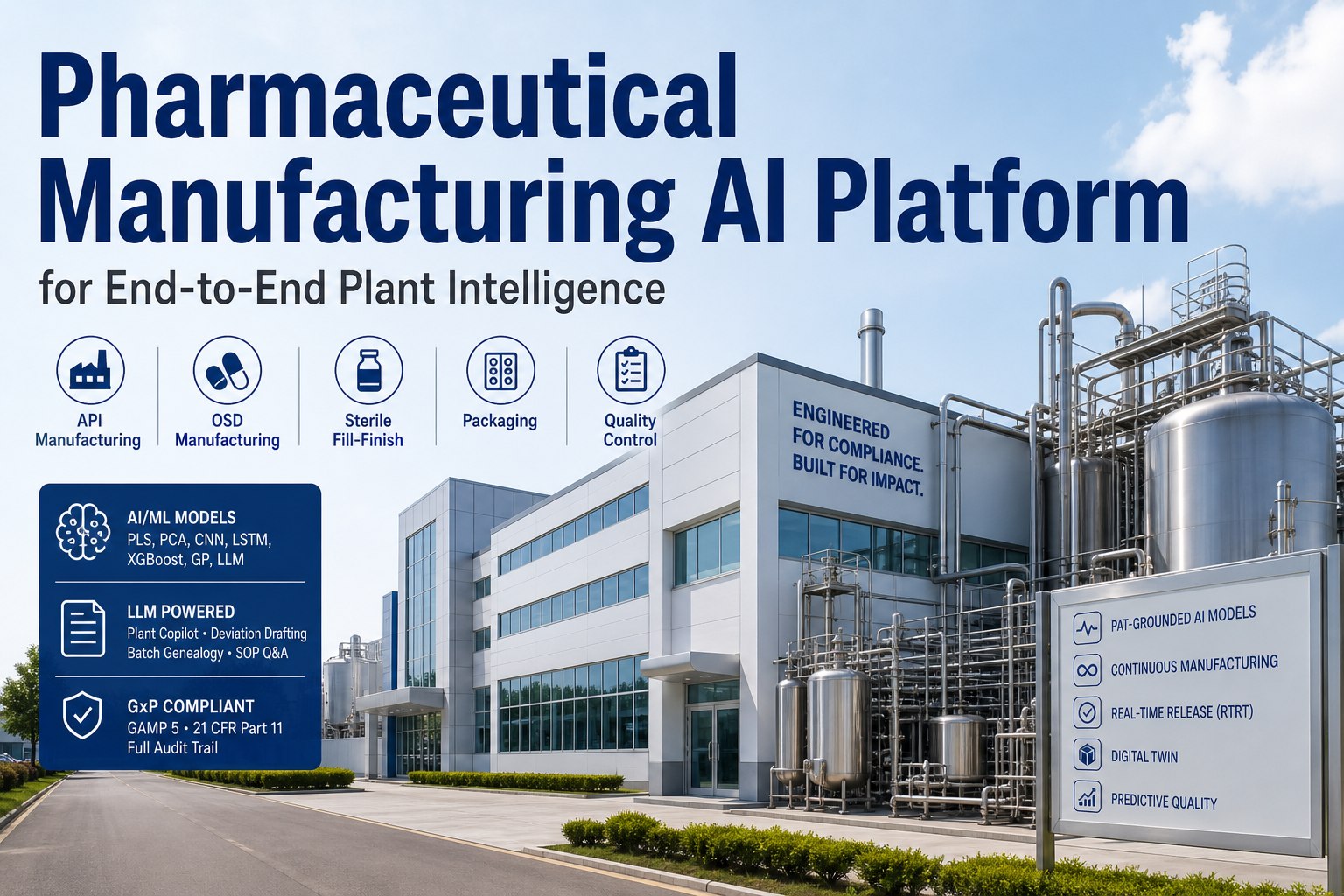
In a pharmaceutical plant, a tablet press is producing — and somewhere between the last preventive maintenance cycle and the next QC release review, a compression force is drifting, a granulator bearing is degrading, and a coating spray atomization pressure is climbing toward a batch deviation. By the time QC catches it, an investigation is already open, the batch is on hold, and the cost compounds: scrap material, delayed release, regulatory notification, and the inevitable CAPA. Legacy SAP MII analytics were designed for a different era — static dashboards, retrospective reports, manual root-cause workflows. They cannot see the drift in time. AI-native predictive analytics can. This page walks through exactly how pharmaceutical manufacturers are modernizing their SAP MII predictive analytics into AI-native manufacturing apps that meet GxP, support CSV, and deliver real-time intervention — without compromising the validated state. Book a 30-minute GxP-aware working session to map your specific MII analytics estate against AI-native equivalents.
7–14
Days of failure forewarning typical for lyo condensers, autoclave gaskets, and tablet press tooling
GAMP 5
Category 4 configured product designation supports straightforward CSV path
ALCOA+
Data integrity principles baked into the AI prediction lifecycle, not bolted on later
6–9
Months of CSV effort saved with pre-mapped URS, FS, DS, IQ, OQ, PQ templates
The Pharma Problem: Why Legacy MII Analytics Run Out of Runway
SAP MII shipped strong analytics capabilities for its era. In a 2026 GxP environment with FDA AI-manufacturing guidance evolving and EMA Annex 11 scrutiny rising, those capabilities show their age in specific, concrete ways. Below are the five gaps pharma manufacturers actually hit.
01
Retrospective by design
MII dashboards summarize after the fact. Batch deviations surface during QC review. By the time the production team sees the trend, the deviation is logged, the investigation is open, and the financial damage is irreversible.
02
Univariate alerts, multivariate failures
Most MII alert rules look at one parameter at a time. Pharma processes fail multivariately — compression force drifts while granule moisture climbs while press speed varies. PLS, PCA, and multivariate batch analysis are how modern pharma actually monitors processes.
03
No native PAT or soft-sensor capability
Soft sensors that infer viable cell density, product titer, or glycosylation from in-line measurements are core to modern biopharma. MII can integrate the data; it cannot run the models. Workarounds add complexity and validation burden.
04
CSV friction grows with every customization
Every new BLS transaction, custom action block, or .irpt page added to MII demands its own validation evidence. Over a decade, the CSV burden of the MII estate compounds — and revalidating with each NetWeaver or Java patch eats QA bandwidth.
05
End of mainstream maintenance in 2027
SAP MII mainstream maintenance ends December 31, 2027; extended ends December 31, 2030. Regulated environments cannot tolerate unsupported software approaching audit cycles. The migration window is a defined finite resource.
Static Reports Cannot Catch Multivariate Drift. AI-Native Predictive Analytics Can.
Right-first-time batches, faster QC release, and predictive maintenance on lyo, autoclaves, and tablet presses are not separate initiatives — they share the same analytics foundation. iFactory's pharma migration playbook handles all three on a GxP-compliant, AI-native platform.
What AI-Native Predictive Analytics Looks Like in a Pharma Plant
Predictive analytics in pharma is not one technique. It is a layered stack of AI use-case archetypes — monitoring, decision support, control optimization, and inspection — each with its own data sources, model types, and regulatory mapping. Below is what each layer does and where it surfaces in a real plant.
USE CASE 01
Predictive Maintenance on Critical Pharma Assets
AI models trained on pharma-specific failure signatures predict equipment failures 7–14 days ahead. Lyophilizer condenser pressure trends. Autoclave gasket compression force history. Tablet press tooling wear patterns. Coating pan spray nozzle clogging. Granulator bearing vibration signatures.
Asset types: Lyo condensers, autoclaves, tablet presses, granulators, coating pans, filling lines, packaging equipment
Models: Anomaly detection, remaining-useful-life regression, vibration-signature classification
Outcome: Failures predicted in advance; maintenance shifts from reactive to scheduled within validated CAPA process
USE CASE 02
Multivariate Batch Monitoring & Soft Sensors
PLS, PCA, and dynamic multivariate models monitor entire batches in real time, not parameter-by-parameter. Soft sensors infer hard-to-measure variables — viable cell density, product titer, glycosylation patterns — from in-line measurements. Drift gets caught while the batch is still recoverable.
Source data: PAT instruments, online sensors, historian tags, at-line analytics, historical batch context
Models: PLS / PCA fingerprints, soft-sensor inference, golden-batch comparison
Outcome: Right-first-time rate improves; deviation count drops; QC release accelerates
USE CASE 03
Vision AI for In-Line Visual Inspection
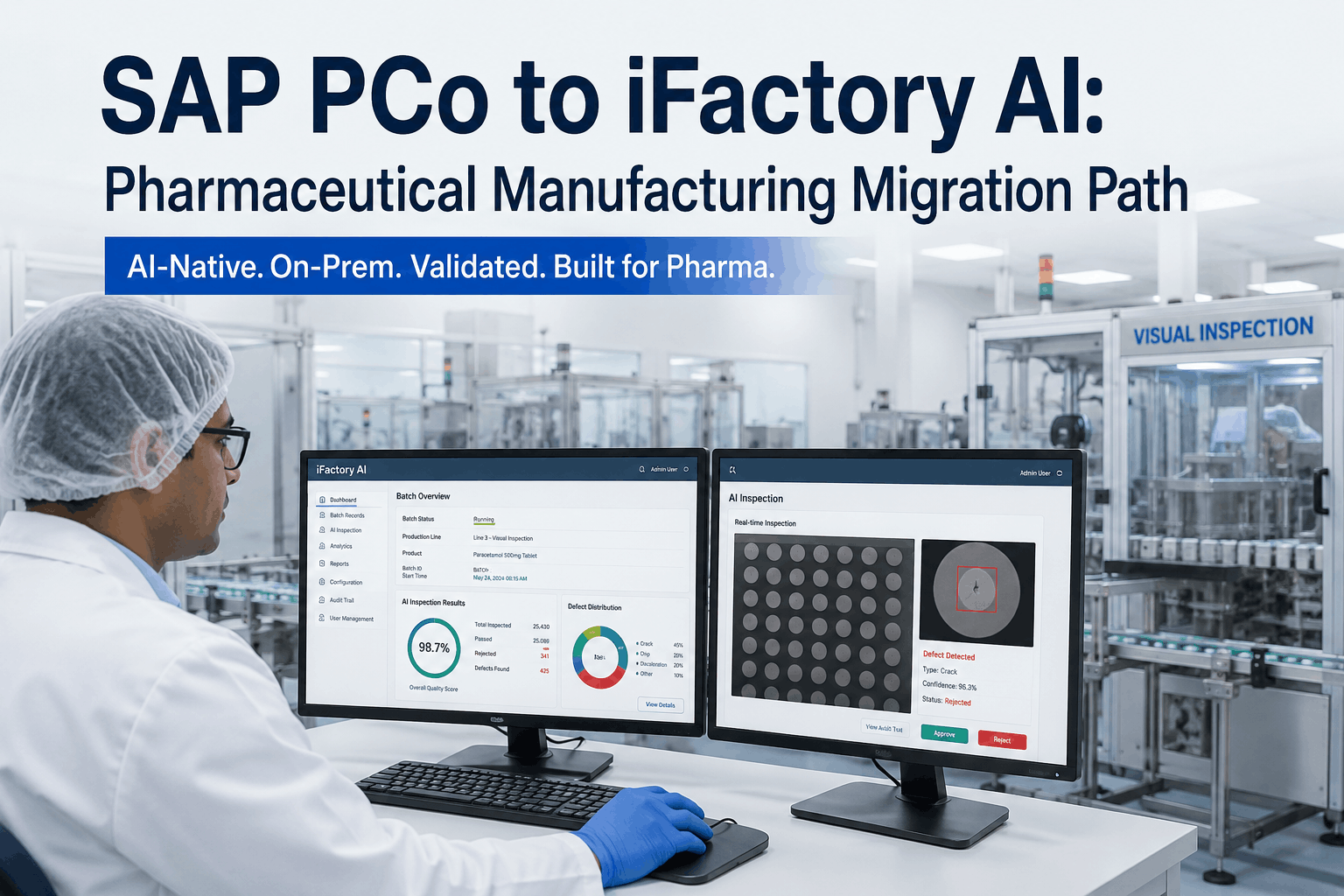
Computer vision models trained on your defect library inspect every tablet, vial, or unit dose as it passes — not a periodic sample. Capping defects, fill volume anomalies, label misalignments, foreign particle detection in liquid fills. Full-population inspection at line speed.
Source data: High-speed line cameras, your historical defect image library
Models: CNN classification, anomaly-based detection, segmentation
Outcome: Defect escape rate drops; sampling workload reduces; release documentation strengthens
USE CASE 04
Process Control Optimization & APC
Advanced process control models recommend setpoint adjustments to stay inside the QbD design space. The AI does not override control — it suggests, with confidence intervals and contributing-factor explanations. Operators and process engineers retain control; the model improves their decisions.
Source data: Historian, MES, batch records, recipe master, CPP/CQA definitions
Models: Model-predictive control, Bayesian optimization, design-space navigation
Outcome: Yield improves; variability narrows; design-space excursions decrease
USE CASE 05
GxP Plant LLM Copilot for Operators & QA
A foundation language model fine-tuned on your SOPs, batch records, deviation history, OOS reports, change controls, and OEM manuals. Operators query in plain language. QA gets deviation drafts in seconds. Investigators trace batch genealogy across decades of records. Runs on-prem; nothing leaves your validated network.
Source data: SOPs, batch records, deviation history, OOS, change controls, OEM manuals
Models: Fine-tuned LLM (typically 70B-class) with retrieval-augmented generation
Outcome: Investigation cycles compress; SOP adherence improves; tribal knowledge preserved
The GxP Compliance Backbone: How AI Stays Validated
Predictive analytics in pharma is not a feature you turn on. It is a regulated capability that requires URS, FS, DS, IQ, OQ, PQ documentation, ongoing change control, and revalidation triggers. The iFactory platform is engineered for GxP from the ground up — not adapted after the fact. Below are the eight elements that make AI-native analytics validatable.
01
GAMP 5 Category 4 designation
Configured product classification, not custom development. Validates against a known framework with auditor-recognized expectations. Reduces CSV effort and approval risk.
02
Pre-mapped CSV templates
URS, FS, DS, IQ, OQ, PQ templates ship with the platform with traceability matrices auto-generated. Saves 6–9 months of CSV effort per implementation.
03
ALCOA+ data integrity by design
Attributable, Legible, Contemporaneous, Original, Accurate, Complete, Consistent, Enduring, Available — wired into the data spine, not bolted on. Every AI prediction has full lineage.
04
21 CFR Part 11 compliance
Audit trails on every AI prediction, electronic signatures on model deployment, role-based access controls, time-stamped event logging — covering all Part 11 requirements out of the box.
05
CSA-aligned validation approach
Computer Software Assurance methodology — risk-based, critical-thinking-driven testing of what matters most. Aligned with FDA's published CSA guidance, not 1990s exhaustive testing.
06
Model lifecycle manager
Triggers revalidation automatically when CPPs change, raw material specs change, or model versions update. Keeps AI in validated state without manual tracking overhead.
07
ICH Q9 & Q10 alignment
Quality risk management and Pharmaceutical Quality System framework integrated into the platform's governance model. QbD design space navigation is a first-class concept, not a workaround.
08
Model explainability for regulators
Every AI recommendation comes with top-N contributing-factor explanations. When regulators ask "how do you know what your AI did?" the answer is in the audit trail, not in slides.
AI in a Validated State Is Not an Oxymoron. It Is an Engineering Discipline.
The platforms that succeed in pharma start with GxP. The platforms that retrofit GxP onto consumer-grade AI tooling fail at validation. iFactory was engineered for regulated manufacturing from the first commit — every prediction has lineage, every model has lifecycle controls, every change has documentation.
How Each Role in the Pharma Plant Experiences the Change
The same migration looks different to each function. What follows is the practical view from each role — what the day-to-day experience becomes when MII predictive analytics are replaced with AI-native equivalents.
PROCESS ENGINEER
Sees multivariate drift, not univariate alerts.
PLS/PCA models flag batches deviating from the golden fingerprint while the batch is still recoverable. Setpoint recommendations come with confidence intervals. CPP excursions trend before they become deviations.
QA / QC MANAGER
Deviation drafts in seconds, audit trails in hours.
The GxP plant LLM drafts deviation reports from batch records and historian data. Investigations that took weeks now take days. QC release accelerates because the evidence is already in audit-ready form.
MAINTENANCE LEAD
Schedules lyo and autoclave repairs 7–14 days ahead.
Predictive maintenance models identify bearing wear, gasket degradation, and seal failures weeks before they reach production-stopping severity. PM compliance for HACCP-equivalent pharma assets becomes automatic.
CSV / VALIDATION LEAD
Six to nine months of validation effort saved.
Pre-mapped URS, FS, DS, IQ, OQ, PQ templates ship with the platform. Traceability matrices auto-generate. Revalidation triggers fire automatically when CPPs or models change. CSV becomes a process, not a project.
PLANT MANAGER
Live OEE, live yield, live deviation rates across every suite.
No more waiting for end-of-shift reports. The plant manager sees what is happening across granulation, compression, coating, packaging, and inspection in real time, with AI-suggested explanations for anomalies.
SITE / OPERATIONS HEAD
Right-first-time batches, faster QC release, fewer regulatory observations.
The cumulative effect of predictive maintenance, multivariate monitoring, vision QC, and AI-assisted investigations shows up in the metrics that matter at the site level: batch success rate, release cycle time, deviation count, and audit outcomes.
Migration Pattern: From MII Analytics to AI-Native, Under Change Control
Pharma migrations are not big-bang. Production must continue. Validated state must hold. Auditors must stay satisfied. The pattern below is the rhythm that works in regulated environments — phased, documented, and reversible at every step.
PHASE 1 · Weeks 1–4
URS & Risk Assessment
Document user requirements. Classify under GAMP 5. Define CSV plan and GxP scope. Tag every existing MII analytics artifact for preserve, transform, or retire. Risk-rank each artifact per ICH Q9 principles.
PHASE 2 · Weeks 4–10
Data Spine & Installation Qualification
Connect MES, LIMS, historian, and PAT systems to the new platform. Run IQ on the infrastructure. Validate connectivity, security, and data integrity. Generate ALCOA+ evidence for every data flow.
PHASE 3 · Weeks 10–18
Model Training & Operational Qualification
Train PLS/PCA on your historical batches. Train CNN on your defect library. Fine-tune plant LLM on your SOPs, batch records, and deviation history. Run OQ on every model with documented test scripts and acceptance criteria.
PHASE 4 · Weeks 18–28
Performance Qualification & Parallel Run
PQ with side-by-side validation against existing QC and MII analytics. Document deviations, root causes, and acceptance decisions. Sign-off requires Quality, Production, Validation, and IT collaboration.
PHASE 5 · Weeks 28+
Go-Live, Change Control & Continuous Monitoring
Released into validated state. Continuous monitoring active. Revalidation triggers fire automatically on CPP, raw material spec, or model version changes. MII components retire site-by-site after stable-quarter validation.
SAP MII vs. AI-Native Predictive Analytics: Pharma Comparison
The honest side-by-side, framed for the GxP-regulated pharma workload specifically. Both have legitimate strengths; the gap on AI capabilities is real and getting wider.
Right-First-Time Batches. Predictive Maintenance on Lyo and Autoclaves. CSV in Months, Not Years.
Pharmaceutical manufacturers modernizing their MII analytics with iFactory report faster QC release, fewer deviations, predictive interventions on critical assets, and dramatically lower CSV burden. The migration runs under change control. The validated state holds throughout.
Frequently Asked Questions
Can AI predictions actually run in a validated GxP state?
Yes. The key is treating AI as a configured product under GAMP 5 Category 4 with full URS, FS, DS, IQ, OQ, PQ documentation, ALCOA+ data integrity, 21 CFR Part 11 audit trails, and automatic revalidation triggers when CPPs, raw material specs, or models change. iFactory is engineered for this from the start, not adapted after the fact.
Book a CSV Discussion for the full validation package.
What about FDA's evolving AI manufacturing guidance?
FDA's AI manufacturing discussion paper covers transparency, robustness, and managing model updates over time. These map onto ICH Q9 (risk management) and Q10 (PQS). iFactory's platform is built around the same principles — explainable predictions with top-N contributing factors, formal change control, and continuous monitoring with documented revalidation.
Talk to Support for the regulatory mapping.
Do the AI models work for biopharma and small-molecule processes equally?
The model archetypes apply across both, but the model variants differ. Biopharma leans heavily on soft sensors for viable cell density, titer, and glycosylation. Small-molecule leans on multivariate batch fingerprints, compression force monitoring, and granulation endpoint prediction. The platform supports both with domain-tuned model libraries.
Book a Demo for your specific process modalities.
How does the plant LLM stay inside our validated network?
A 70B-class foundation model fine-tuned on your SOPs, batch records, deviation history, OOS reports, change controls, and OEM manuals. Runs on GPU hardware inside your facility. Nothing leaves your network. Operators query in plain language; QA gets deviation drafts; investigators trace batch genealogy. Air-gapped and on-prem-capable.
Talk to Support for deployment architecture.
Will our LIMS, MES, and historian integrations carry over from MII?
Yes. Standard pharma integrations — LIMS, MES, historians (OSIPi, IP21, iHistorian), PAT instruments, batch record systems, change-control systems — connect via the new platform's native connector framework. Tag mappings, sample rates, and authentication migrate from MII configurations.
Book a Demo to map your specific integrations.
What is the smallest first step we can take this quarter?
A 4-week pre-migration assessment covering URS, risk classification, and an inventory of your MII analytics artifacts. Output: a GxP-aware migration plan with effort estimates, CSV scope, and 2–3 highest-impact use cases for the new platform — typically predictive maintenance on critical assets or multivariate batch monitoring on a flagship product.
Talk to Support to scope it.
Predictive Analytics That Catch Drift in Time. Validated State That Holds. Pharma Operations Modernized.
Tablet presses, granulators, lyophilizers, autoclaves, filling lines, and packaging equipment all generate data your current MII analytics cannot fully exploit. AI-native predictive analytics close that gap — under GxP, under change control, under audit-ready documentation. iFactory delivers the platform, the CSV templates, and the migration playbook engineered for regulated pharma manufacturing.
Failures predicted 7–14 days ahead on critical pharma assets
GAMP 5 Cat 4, ALCOA+, 21 CFR Part 11 built in
6–9 months of CSV effort saved per implementation
Multivariate PLS/PCA batch monitoring + vision QC
On-prem plant LLM fine-tuned on your validated data