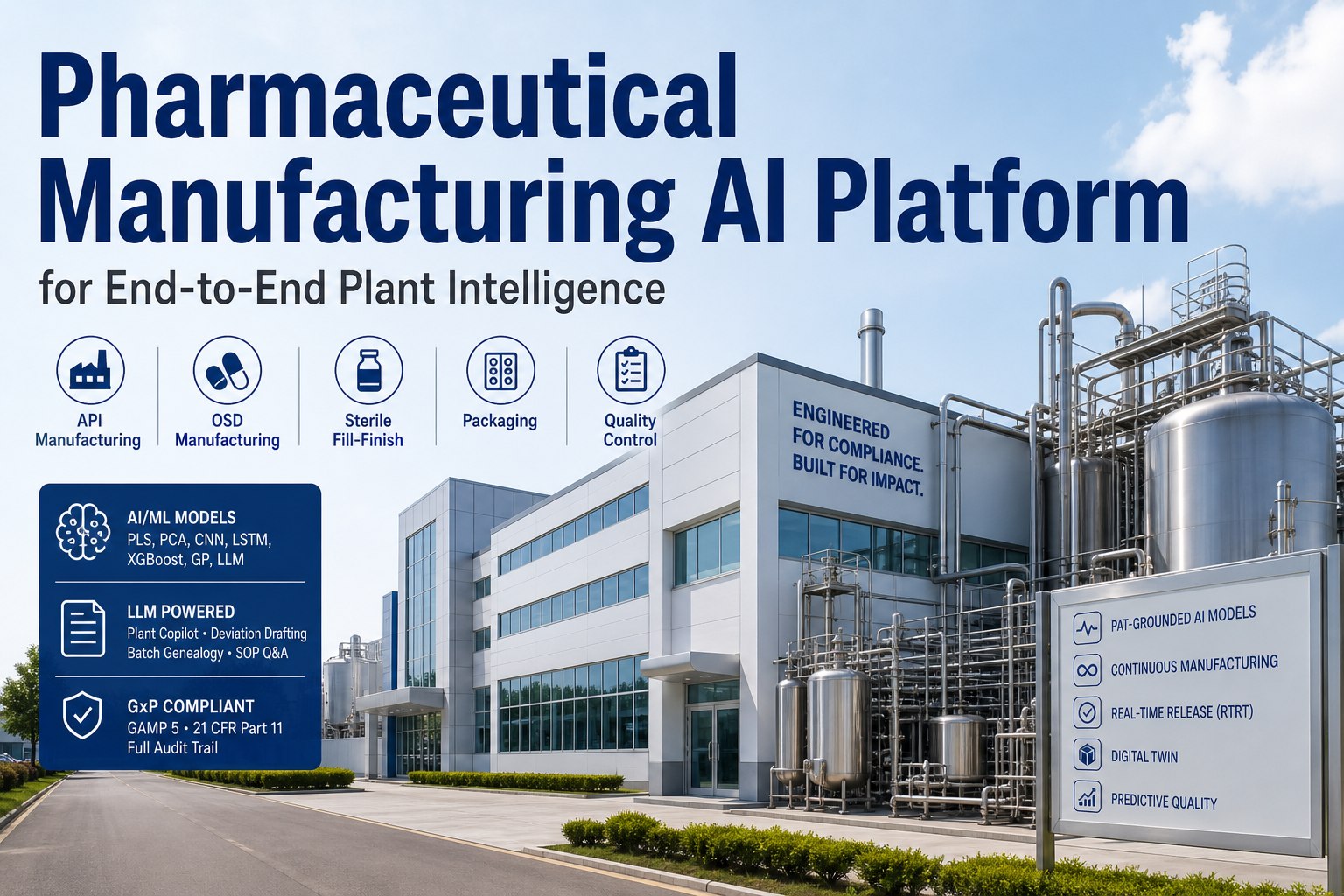
Pharmaceutical manufacturing is in the middle of a paradigm shift that SAP MII / xMII / DMC was never designed for. The industry is moving from batch processing toward continuous manufacturing — driven by FDA encouragement, ICH Q13 guidance, and the operational economics of smaller footprints, faster release, and tighter quality control. Continuous manufacturing changes the optimization problem fundamentally. In batch, you optimize between batches; quality is assessed at batch end, deviation is investigated after the fact, APQR consolidates data quarterly or annually. In continuous the entire production stream is the unit of optimization — quality is determined moment by moment by Process Analytical Technology (PAT), deviations have to be detected and corrected in real-time, and the optimization loop runs continuously rather than between cycles. Descriptive SAP MII dashboards reporting batch summaries are not the wrong tool for this — they are not the right tool at all. iFactory AI is the AI-native continuous process optimization platform purpose-built for pharma's continuous manufacturing transition — pre-configured NVIDIA appliance, pre-loaded PAT integration, real-time multivariate models, closed-loop optimization, and full GxP validation, deployed in 6–12 weeks. This page is the pharma operations guide to continuous process optimization with iFactory AI — the paradigm shift, the architecture, the operational coverage, and how the migration from SAP xMII actually works.
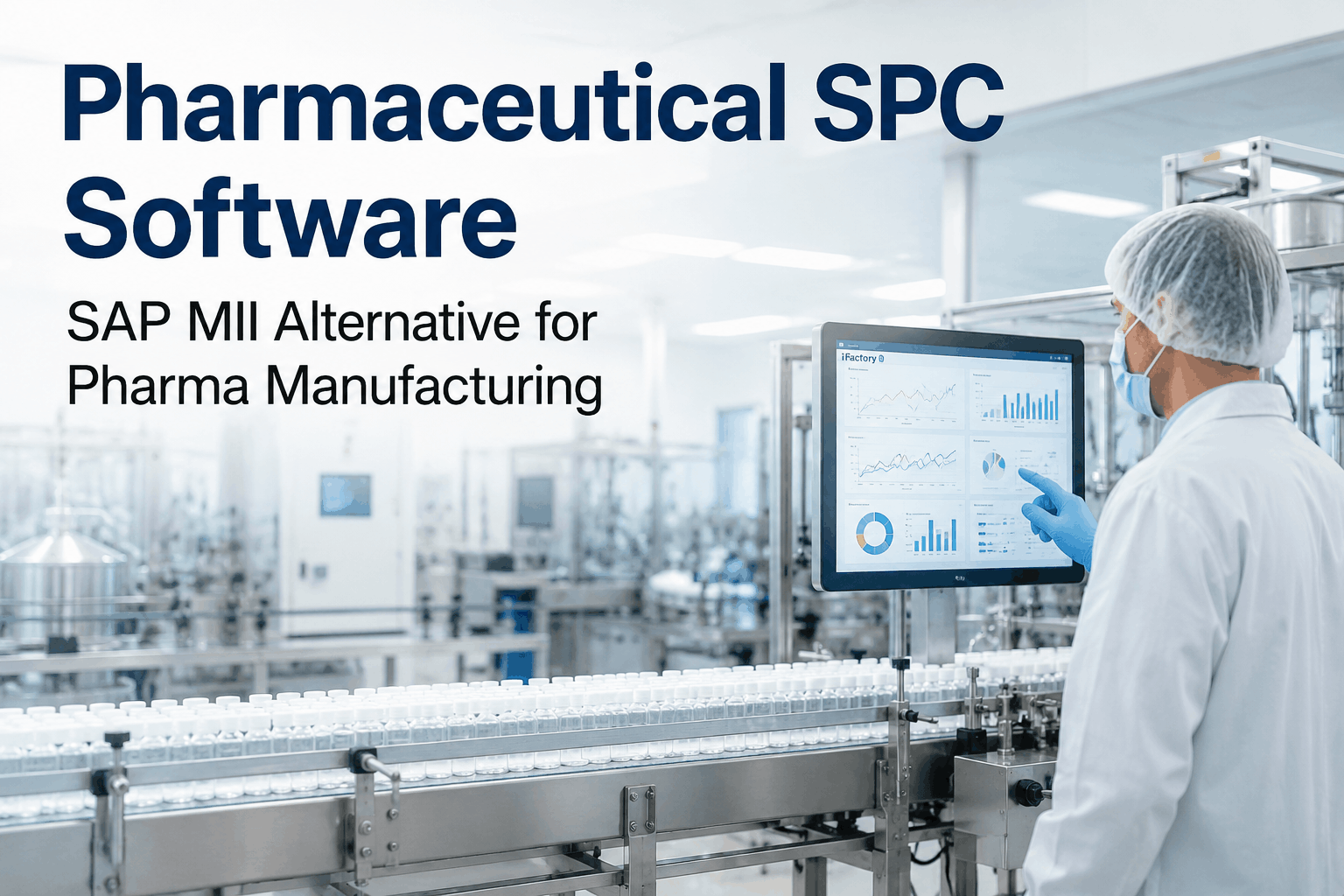
Best SAP xMII Alternative for Pharmaceutical Manufacturing in 2026
The pharma operations guide to continuous process optimization with iFactory AI — replacing SAP MII / xMII / DMC with PAT-integrated, GxP-validated real-time process control for the continuous manufacturing transition. On-prem AI, real-time analytics, no cloud lock-in, 6–12 week deployment.
The Paradigm Shift: Batch vs Continuous Manufacturing Optimization
The reason SAP MII / xMII cannot deliver continuous process optimization is not implementation effort — it is architectural. The batch paradigm assumes optimization happens between discrete units; the continuous paradigm assumes optimization happens continuously across an uninterrupted stream. The comparison below shows the implications for the pharma operations team.
The continuous paradigm is not an upgrade to the batch paradigm — it is a different mental model that requires different supporting infrastructure. The SAP MII pattern can be made to record continuous data, but it cannot deliver the closed-loop optimization that defines continuous manufacturing. That capability is what iFactory's continuous process optimization architecture is built for.
Want to see continuous process optimization applied to your specific pharma manufacturing setup? Schedule the AI Manufacturing Transformation Workshop — iFactory's pharma team will map your batch or continuous process and demonstrate the optimization on representative data. Sessions available this week.
PAT-Driven Closed-Loop Optimization Architecture
Continuous process optimization in pharma rests on a closed-loop architecture that integrates PAT instruments (NIR, Raman, mass spec, soft sensors), multivariate process models, and intervention pathways back into the process. The architecture below shows how the loop runs continuously, with iFactory as the central optimization engine.
The five-step loop runs continuously rather than in discrete cycles. PAT instruments stream measurements; multivariate models infer Critical Quality Attributes (CQAs) in real-time; the optimization engine decides whether a setpoint adjustment is needed; the action goes to the PLC or DCS; the verification step logs everything as a GxP-compliant audit record. The whole loop completes in under 50ms per iteration on the on-prem appliance — fast enough to act before deviation propagates through the continuous stream.
Want a closed-loop optimization architecture mapped to your specific PAT instruments and process? Send your PAT setup, process flow, and current SAP xMII state to iFactory support and the pharma team will return a tailored architecture proposal — typically within 3 business days, no obligation.
Continuous Optimization Across Pharma Operations
What runs through the continuous optimization layer across pharma operations
Continuous process optimization is not limited to the manufacturing process itself — the same architecture extends to cleanroom environment, deviation management, APQR, and serialization. The coverage map below shows how iFactory unifies these operational concerns under a single continuous optimization layer.
The unifying layer is what makes the architecture worth the migration. Process, cleanroom, deviation management, and serialization all feed into the same continuous optimization engine and all share the same GxP-validated audit log. APQR data is assembled continuously rather than reconstructed annually. Real-Time Release Testing becomes operationally feasible because the underlying CQA evidence is already continuous.
Three Migration Paths for Pharma Continuous Process Optimization
Stay on MII / xMII
Extended SAP maintenance. Batch-paradigm patterns applied to continuous processes. No closed-loop optimization. Compliance gap grows.
SAP DMC (Cloud)
Cloud modernization. WAN-bound latency unsuitable for closed-loop control. GxP cloud validation burden. Cloud lock-in concerns.
iFactory AI On-Prem
PAT-integrated closed-loop optimization, GxP-validated, ICH Q13-aligned. NVIDIA appliance on-prem. RTRT-capable. 6–12 weeks.
Six Pharma Continuous Process Applications
Continuous OSD
Continuous oral solid dosage with PAT-integrated optimization. NIR for blend uniformity, weight, hardness. Real-Time Release feasible.
Continuous Bioprocessing
Multivariate models for cell density, productivity, glycoform. Continuous capture chromatography. Optimization across the perfusion cycle.
API Continuous Flow
Reaction monitoring with inline mass spec and Raman. Closed-loop control of temperature, flow, residence time. Impurity prediction.
Cleanroom Optimization
Continuous environmental monitoring with HVAC optimization. Predicts excursions before they occur. Reduces deviation triggers.
Deviation Management
Real-time deviation detection with closed-loop response within process limits. Deviation prevention rather than after-the-fact CAPA.
APQR Automation
APQR data assembled continuously through the year rather than reconstructed annually. Cycle time drops dramatically.
Want application-specific projections for your continuous process? Send your pharma manufacturing setup and PAT inventory to iFactory support and the pharma team will return a customised projection with 12-month roadmap — typically within 3 business days, no obligation.
GxP, ICH Q13 & Regulatory Alignment — Native to the Platform
Pre-built workflows for pharmaceutical regulatory frameworks
- 21 CFR Part 11 — electronic records & signatures
- EU Annex 11 — computerised systems
- ICH Q13 — continuous manufacturing guidance
- ICH Q8 / Q9 / Q10 / Q12 — QbD & lifecycle
- FDA PAT Guidance — Process Analytical Technology
- GAMP 5 — risk-based validation approach
- Data integrity — ALCOA+ throughout
- Serialization — DSCSA & EU FMD support
Every continuous optimization decision the platform makes is logged as a 21 CFR Part 11-compliant audit record with full ALCOA+ data integrity. ICH Q13 alignment is built into the optimization architecture rather than retrofitted. The pharma operations team gets continuous manufacturing capability with the regulatory compliance posture pharma requires — not as a separate workstream, but as a property of the architecture.
Two Real Pharma Continuous Process Optimization Outcomes
Pharma manufacturer running continuous tablet line with Real-Time Release ambition
A mid-size pharma manufacturer running a continuous OSD line for a high-volume product wanted to enable Real-Time Release Testing to dramatically cut release cycle time. SAP xMII captured batch data but had no closed-loop optimization, no integrated PAT analytics for inline CQA inference, and no continuous APQR assembly. RTRT remained out of reach despite the underlying process being continuous-capable.
Biologics manufacturer running perfusion bioreactors for monoclonal antibody production
A biologics manufacturer ran perfusion bioreactors for mAb production but lacked continuous optimization across the perfusion cycle. Productivity varied bioreactor to bioreactor, glycoform consistency was a recurring quality concern, and the integration between bioreactor PAT (Raman, mass spec) and the downstream capture chromatography was manual. SAP xMII saw the data but could not drive closed-loop optimization across the steps.
Neither scenario matches your operation? Send your pharma segment, process type, and current SAP xMII state to iFactory support and the pharma team will return a customised migration analysis with 12-month roadmap — typically within 3 business days, no obligation.
iFactory's Pharma Deployment — On-Premise or Cloud
Same AI-native platform on either deployment model. On-prem is recommended for continuous process optimization given closed-loop latency requirements (PAT-to-correction in <50ms), GxP validation boundary, and recipe/formulation IP sovereignty. Cloud is available for multi-site pharma operations consolidating central optimization.
iFactory On-Premise Appliance Recommended for continuous process optimization · GxP-validated boundary
- Pre-configured NVIDIA AI server — pre-loaded pharma models, racked, ready.
- <50ms PAT-to-correction — closed-loop optimization at process speed.
- GxP boundary intact — validation contained on-prem.
- Recipe & CQA IP stays on-site — sovereignty preserved.
iFactory Cloud For multi-site pharma operations with central governance
- Fully managed — no rack, no facility requirements.
- Same continuous optimization engine — full capability.
- Multi-site APQR consolidation across plants.
- Fastest deployment — first plant live in 2–4 weeks.
The continuous manufacturing transition needs continuous process optimization, not batch dashboards.
PAT-integrated closed-loop optimization, multivariate process models, real-time deviation prevention, RTRT-enabling continuous evidence — all on a pre-configured NVIDIA appliance, GxP-validated, on-prem, live in 6–12 weeks. The best SAP xMII alternative for the pharmaceutical continuous manufacturing transition. The AI Manufacturing Transformation Workshop sizes the migration for your specific process.
FAQ: Pharma Continuous Process Optimization & SAP xMII Migration
How does iFactory integrate with our PAT instruments?
iFactory integrates natively with the major PAT platforms — NIR (Bruker, Sartorius, ABB), Raman (Kaiser, MarqMetrix, Indatech), mass spectrometry (Waters, Thermo, Agilent), and soft sensors built on multivariate models. The integration adapters carry PAT measurements into the continuous optimization engine in real-time, with proper handling of GxP audit requirements at every step. The deployment team configures specific PAT instruments during the 6–12 week installation window. Book a demo to discuss your specific PAT setup.
Is iFactory GxP-validated and compliant with 21 CFR Part 11?
Yes. iFactory follows GAMP 5 risk-based validation methodology and is delivered with validation documentation that supports your IQ/OQ/PQ activities. Every continuous optimization decision is logged as a 21 CFR Part 11-compliant audit record with full ALCOA+ data integrity (Attributable, Legible, Contemporaneous, Original, Accurate, Complete, Consistent, Enduring, Available). The on-prem deployment keeps the validated boundary intact and supports EU Annex 11 alongside US 21 CFR Part 11.
Can iFactory enable Real-Time Release Testing for our products?
The platform enables RTRT for products and processes that are RTRT-feasible — continuous OSD, continuous bioprocessing, and certain API processes typically qualify with the right PAT setup. The continuous optimization engine produces the continuous CQA evidence required to support an RTRT submission. iFactory's pharma team assists with the regulatory submission framing and ongoing evidence integrity. The actual RTRT approval is from your regulatory authority, but the platform provides the technical foundation.
How does the migration from SAP xMII actually work for continuous processes?
The migration runs in parallel — iFactory stands up alongside SAP xMII, the continuous optimization engine begins running in shadow mode validating against the existing SAP data, then cuts over to primary control after parity is established and validation activities are complete. SAP xMII can remain available as fallback during a defined stabilization period. The pharma operations and IT teams retain full control of the sequencing and the rollback path at every step, with GxP-appropriate change control governing the entire migration.
How does APQR change with continuous optimization?
APQR data is assembled continuously throughout the year rather than reconstructed at review time. Trend analysis, deviation history, CAPA effectiveness, and batch-to-batch variability all live in the continuous optimization layer's audit log, ready to be consolidated into the APQR report on demand. Most pharma operations see APQR cycle time drop 75% or more, with higher-quality analysis because the underlying data is structured continuously rather than retrieved batch-by-batch.
Do I have to buy NVIDIA servers separately?
No. iFactory's on-premise appliance ships fully loaded — pre-configured NVIDIA AI server, pharma continuous optimization models pre-installed, network gear, cabling, edge devices for PAT integration, and adapters for SAP MII/xMII/ERP, plant historians, LIMS, and major DCS / PLC platforms. You provide rack space, line power, Ethernet, and PAT integration points. The deployment team handles installation, GxP validation activities, and configuration across the 6–12 week window.
What does the AI Manufacturing Transformation Workshop cover for pharma?
The half-day workshop covers — current-state SAP MII/xMII/DMC assessment for continuous process readiness, batch-to-continuous paradigm walkthrough on your specific products, PAT integration plan, closed-loop optimization demonstration on representative data, ICH Q13 and RTRT feasibility assessment, three-path migration comparison, GxP validation roadmap, and ROI projection. Outcome is a concrete migration plan suitable for pharma operations, quality, IT/OT, regulatory, and finance.
Move from batch dashboards to continuous process optimization. ICH Q13 ready.
PAT-integrated closed-loop optimization, real-time deviation prevention, RTRT-enabling continuous evidence, APQR assembled continuously — on a pre-configured NVIDIA appliance, GxP-validated, on-prem, live in 6–12 weeks. The best SAP xMII alternative for pharmaceutical continuous manufacturing. The Workshop sizes the migration for your specific process — sessions available this week.