The oil & gas operator's daily experience with SAP MII / xMII reflects an architectural era that has been replaced everywhere else in industrial software. Process data lives in PI historian, alarm management runs through Honeywell Experion or Yokogawa CENTUM DCS, batch data goes to xMII for reporting, maintenance records sit in SAP PM, safety procedures live in document management systems, historical knowledge resides in operators' heads — and the operator's job is to synthesize all of it during a four-hour shift handover or a midnight unit upset. The cognitive load is enormous, the systems don't talk to each other, and decisions that should take 30 seconds frequently take 30 minutes because finding the right information requires navigating multiple disconnected applications. Industrial GenAI Copilots change this fundamentally. An operator asks a question in natural language — "why is the FCC reactor temperature drifting?" or "when should H-101 be cleaned?" or "show me the last three startup sequences for this unit" — and the AI copilot responds with synthesized answers drawing across process data, historian, maintenance records, safety procedures, and historical operator notes, all in seconds. iFactory AI delivers this on a pre-configured NVIDIA appliance running on-premise inside the refinery, LNG plant, or gas processing facility — replacing SAP MII, SAP xMII, and SAP DMC with an AI-native platform purpose-built for the realities of oil & gas operations, live in 6–12 weeks. This page is the O&G operator's guide to the AI-Native Manufacturing Revolution, what Industrial GenAI Copilots actually do for refinery operations, and how the migration economics work for downstream and midstream operations.
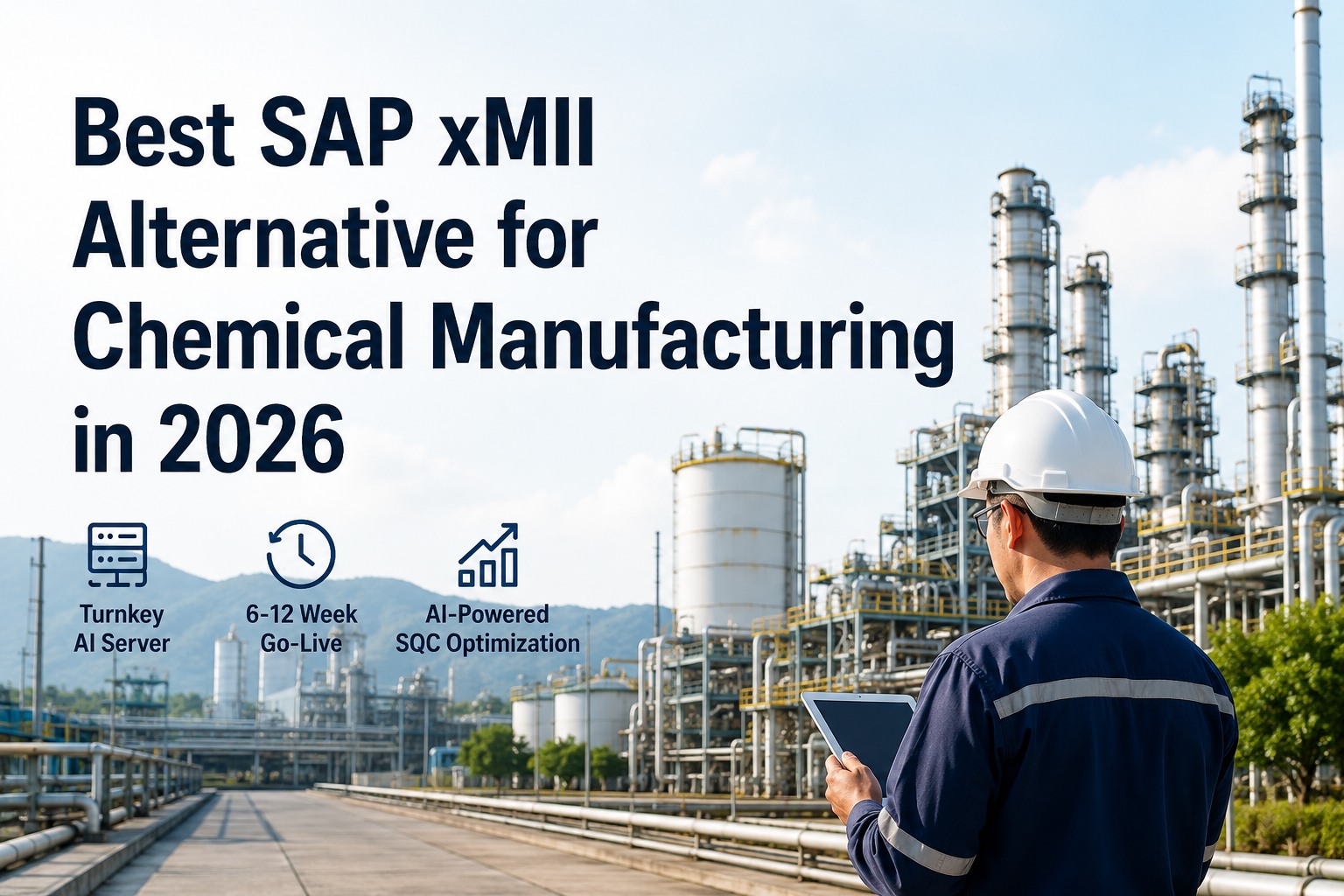
Best SAP xMII Alternative for Oil & Gas Manufacturing in 2026
The oil & gas operator's guide to the AI-Native Manufacturing Revolution — Industrial GenAI Copilots that answer process, maintenance, safety, and yield questions in seconds · adaptive SPC across refinery units · autonomous root-cause analytics. AI-native on-prem platform replacing SAP MII / xMII. Pre-configured NVIDIA appliance, 12-week deployment.
The Oil & Gas Operator's Reality — Today vs After Migration
Refinery, LNG plant, and gas processing operators carry institutional knowledge no platform has ever fully captured. The AI-Native Manufacturing Revolution doesn't replace that expertise — it amplifies it. The operator's role shifts from manually correlating data across disconnected systems to making informed decisions with synthesized context delivered in seconds. The comparison below shows what the daily operator experience actually looks like before and after migration.
What O&G operators do today
- Navigate 5–8 disconnected systems for shift handover
- Pull PI historian trends manually for unit review
- Reference paper or PDF procedures for startup/shutdown
- Search SAP PM separately for maintenance history
- Investigate alarm storms manually across DCS
- Consult senior operators for institutional knowledge
- Document deviation reports after the fact
- Spend 50–60% of shift on data gathering work
- Knowledge transfer fragile · retirement risk
What O&G operators do after migration
- Ask Copilot natural language questions across all systems
- Receive synthesized answer in 30 seconds with sources
- Copilot guides through startup/shutdown sequences
- Maintenance history surfaced automatically with context
- Alarm storms triaged by AI with ranked priorities
- Institutional knowledge captured in models · always available
- Audit evidence built continuously as operations run
- Spend 60–70% of shift on substantive decisions
- Knowledge persistent across retirements and shifts
For operators specifically, the most visible change is the time required to answer "what's happening on this unit right now and what should I do about it?" — a question that frequently took 15–30 minutes of investigation now answers in 30 seconds with Copilot context. Multiply that across the 40–60 such questions a typical refinery operator encounters per shift, and the recovered time is substantial.
Want a sized assessment of operator time reallocation for your specific O&G operation? Schedule the AI Manufacturing Transformation Workshop — iFactory's O&G team will model your current operator workflow and project post-migration time reallocation across shift activities. Sessions available this week.
Industrial GenAI Copilots for Oil & Gas — Four Operator-Focused Types
The Industrial GenAI Copilot isn't a single chatbot — it's a portfolio of specialized AI assistants trained on different operational domains. Each copilot draws across the same underlying data and knowledge layers but applies domain-specific reasoning to operator questions. The four most operationally impactful copilots for oil & gas operations are shown below with representative conversation snippets.
Process Operations Copilot
Maintenance Copilot
Safety Copilot
Yield Optimization Copilot
Each copilot operates with full context of the plant's operational history — PI historian trends, DCS alarm history, SAP PM records, procedure documents, safety case data, and accumulated operator notes. Responses cite sources and recommend operator-approved actions rather than executing autonomously. Operators retain complete authority over all operational decisions; the copilot serves as a research and synthesis assistant, not a decision-maker.
Want to see Industrial GenAI Copilots running on representative scenarios from your refinery, LNG plant, or gas processing operation? Schedule the AI Manufacturing Transformation Workshop — sessions include live demonstration tuned to your specific O&G operation. Sessions available this week.
Refinery-Wide Copilot Integration — Multi-Unit View
How Copilots span the major refinery processing units
The Industrial GenAI Copilots aren't unit-specific — they operate across the entire refinery, gas processing, or LNG facility. The architecture below shows how a single operator can query across the major processing units, with each Copilot specialized to its domain but drawing on the same underlying operational context.
Three Migration Paths from SAP MII for Oil & Gas
Stay on xMII
Extended maintenance, manual operator workflow continues. No Industrial GenAI Copilots, no AI-native SPC. Operator cognitive load unchanged.
SAP DMC (Cloud-Only)
Cloud migration with descriptive analytics upgrade. Latency-bound for real-time operator queries. WAN-dependent during outages. Cloud lock-in concern.
iFactory AI On-Prem
Industrial GenAI Copilots running on-prem. AI-native SPC with adaptive limits. PSM/HAZOP integration native. No cloud lock-in.
Six Oil & Gas Operations Where AI-Native SPC + Copilots Pay Back Fastest
Crude Distillation Unit (CDU)
Adaptive SPC across atmospheric and vacuum columns. Copilot guides cut point adjustments. Yield optimization typically +2–4% on gasoline-naphtha cut.
FCC & Catalyst Operations
Multivariate SPC on reactor temperature, catalyst circulation, regenerator efficiency. Copilot tracks catalyst activity decay across cycles.
Reformer Operations
Predictive SPC across reformer reactor temperatures and pressure differentials. Copilot supports balancing octane targets and hydrogen yield for refinery-wide optimization.
LNG Liquefaction Trains
Adaptive SPC on liquefaction efficiency, refrigerant compositions, heat exchanger performance. Copilot guides cryogenic train optimization across seasonal variation.
Gas Processing & Sweetening
Multivariate SPC on amine concentration, regeneration efficiency, water content. Copilot supports troubleshooting and optimization across processing trains.
Petrochemical Operations
Adaptive SPC across steam cracker furnaces, separation trains, polymerization reactors. Copilot supports product transition and grade changeover.
Want application-specific projections for your O&G operation? Send your refining/LNG/gas processing configuration to iFactory support and the O&G team will return a customised migration projection with 12-month roadmap — typically within 3 business days, no obligation.
OSHA PSM, API Standards & Energy Management — Built In
Pre-built workflows for oil & gas regulatory frameworks
- OSHA PSM — Process Safety Management 29 CFR 1910.119
- EPA RMP — Risk Management Program 40 CFR 68
- API RP 754 — Process Safety Indicators
- API 510 / 570 / 653 — Inspection codes
- IEC 61511 / ISA 84 — Safety instrumented systems
- ANSI/ISA 18.2 — Alarm management
- ISO 50001 — Energy management systems
- HAZOP / LOPA — Hazard and operability studies
The Compliance Layer captures PSM critical operating limit excursions, API 754 process safety indicators, alarm management metrics, and energy intensity tracking continuously as the plant operates. Regulatory audit prep (OSHA, EPA inspections) typically drops from 2–4 weeks of manual preparation to 4–8 hours of review. Safety case evidence remains accessible during regulatory inquiries and incident investigations.
Two Real Oil & Gas Operator Outcomes
Mid-size refinery with CDU, FCC, reformer, and hydrotreating units running on SAP xMII
A mid-size refinery (180,000 BPD throughput) running atmospheric and vacuum CDU, FCC, reformer, hydrotreating, and supporting utilities. Operators spent significant shift time navigating between PI historian, SAP MII, DCS interfaces, and paper procedures. Yield optimization opportunities were known but acted on inconsistently due to operator information overload. Senior operator retirements created knowledge transfer concerns.
LNG liquefaction plant with seasonal performance variation and energy intensity concerns
An LNG liquefaction plant with two parallel trains producing 5.2 MTPA. Seasonal ambient temperature variation drove specific energy variability of ±8%, with operators struggling to optimize refrigerant compositions and heat exchanger performance across conditions. SAP xMII captured the operational data but couldn't model the multivariate cryogenic optimization opportunity.
Neither scenario matches your operation? Send your refinery/LNG/gas processing configuration to iFactory support and the O&G team will return a customised migration analysis with 12-month roadmap — typically within 3 business days, no obligation.
iFactory's Oil & Gas Deployment — On-Premise or Cloud
Same AI-native platform on either deployment model. Same Industrial GenAI Copilots, adaptive SPC, autonomous RCA. For oil & gas operations specifically, on-prem is the strongly recommended default because of process safety integration requirements, latency considerations for real-time operator queries, and the operational independence needed during WAN outages.
iFactory On-Premise Appliance Strong default for refineries, LNG plants, gas processing facilities
- Pre-configured NVIDIA AI server — racked, software-loaded, ready to plug in.
- <50ms Copilot response — keeps up with operator query rates.
- PSM/HAZOP integration — safety-case evidence built continuously.
- Works during WAN outages — Copilots and SPC continue operational.
iFactory Cloud For multi-site O&G operations with central engineering oversight
- Fully managed — no rack, no facility requirements.
- Same AI capabilities — Industrial GenAI Copilots, adaptive SPC.
- Cross-site benchmarking across refineries or LNG plants.
- Fastest deployment — first site live in 2–4 weeks.
The AI-Native Manufacturing Revolution for oil & gas is the Copilot at the operator's side.
Industrial GenAI Copilots that answer "what's happening on this unit?" and "what should I do about it?" in seconds rather than minutes — running on a pre-configured NVIDIA appliance inside your refinery, LNG plant, or gas processing facility. Yield improvements of 3–7% typical in year one. The AI Manufacturing Transformation Workshop sizes the migration concretely for your specific O&G operation.
Frequently Asked Questions
How do Industrial GenAI Copilots integrate with our existing DCS and historian?
iFactory integrates natively with major O&G platforms — Honeywell Experion / Yokogawa CENTUM / Emerson DeltaV / Siemens PCS 7 DCS systems, OSIsoft PI historian, AspenTech IP.21, GE Proficy, ABB 800xA. The Copilots draw context from these existing systems rather than replacing them. SAP MII / xMII / PM are similarly integrated for batch and maintenance data. The deployment team configures specific integrations during the 6–12 week installation.
Do the Copilots respect process safety requirements?
Yes — process safety integration is foundational. The Safety Copilot specifically draws from PSM critical operating limits, HAZOP studies, LOPA analysis, and procedure documents. Recommendations always defer to operator authority and respect engineered safety limits. The platform captures every Copilot interaction with full audit trail for safety case documentation. AI Copilots provide synthesized context for operator decisions — they don't execute operations autonomously.
How does adaptive SPC differ from traditional SPC in O&G applications?
Traditional SPC uses static control limits — fixed thresholds regardless of operating conditions. Adaptive SPC tunes limits automatically based on current crude assay, ambient conditions, catalyst age, equipment state, and operational mode. For oil & gas operations with constantly varying feedstock and condition profiles, adaptive limits dramatically reduce false alarms while catching real drift that static limits would miss.
What about Copilot accuracy and hallucinations?
iFactory's Copilots are built with strict grounding — every response cites the specific operational data, document, or procedure it draws from. Responses are constrained to actual plant data rather than generic LLM responses. Confidence scores accompany every recommendation. Operators can verify cited sources directly. The architecture eliminates the "hallucination" risk that plagues general-purpose LLMs in industrial contexts.
Do I have to buy NVIDIA servers separately?
No. iFactory's on-premise appliance ships fully loaded — pre-configured NVIDIA AI server, software pre-installed, network gear, cabling, integration adapters for major O&G DCS platforms. You provide rack space, line power, Ethernet, and DCS/historian/SAP integration points. The deployment team handles all installation and configuration. For cloud, no hardware investment at all.
Can we deploy on one processing unit first before refinery-wide?
Yes — and it's the recommended approach. Start with the unit where operator information overload is most acute (typically CDU or FCC for refineries, liquefaction train for LNG). Validate the Copilot accuracy and adaptive SPC performance on a single unit. Then expand unit-by-unit in 2–4 week waves. Full refinery deployment typically completes in 4–6 months for a mid-size facility.
What does the AI Manufacturing Transformation Workshop cover?
The half-day workshop covers — current-state SAP xMII assessment, O&G operator workflow analysis, Industrial GenAI Copilot demonstration on representative refinery / LNG / gas processing scenarios, three-path migration comparison with cost/timeline projections, PSM and API standards integration, deployment roadmap, ROI projection on yield improvement and operator productivity. Outcome is a concrete migration plan. Suitable for operators, plant leadership, process engineering, IT, and finance representatives.
Operators are the most senior intelligence in your plant. Copilots make that intelligence persistent and accessible.
The AI-Native Manufacturing Revolution for oil & gas isn't about replacing operators — it's about giving operators the synthesized context every decision benefits from, in seconds rather than minutes. Industrial GenAI Copilots running on a pre-configured NVIDIA appliance inside your facility. Yield improvements of 3–7% typical. 12-week deployment. The Workshop is the fastest way to size the migration for your specific O&G operation.