If you are responsible for evaluating SAP xMII alternatives for a food & beverage manufacturing operation, you are confronting the same five capability questions every senior plant leader is confronting in 2026 — what replaces our SAP MII / xMII for AI-powered vision inspection on packaging and quality lines, what gives us real-time OEE monitoring across changeover and CIP-heavy operations, what delivers continuous quality analytics across HACCP and customer specs, what unifies food traceability from raw ingredient to finished case, and what surfaces root cause for the quality events that determine whether scorecards hold or slip. The reality every evaluator quickly discovers is that the answer is rarely one tool. Most operations end up either stitching five point solutions together — each with its own integration, data model, and operational overhead — or staying on SAP xMII for the structural parts they cannot easily replace, while bolting on AI capabilities as separate systems. Neither path delivers an integrated AI-native platform, and both leave the original SAP MII limitations in the architecture. iFactory AI is the AI-native single platform purpose-built for this evaluation — vision inspection, OEE monitoring, quality analytics, food traceability, and root cause analysis on one pre-configured NVIDIA appliance, deployed on-premise in 6–12 weeks, replacing SAP MII and SAP PCo with a unified architecture rather than a five-tool stack. This page is the F&B evaluator's comprehensive guide to why iFactory AI is the best SAP xMII alternative for food & beverage manufacturing in 2026 — the capability comparison, the decision drivers, and the migration that actually works.
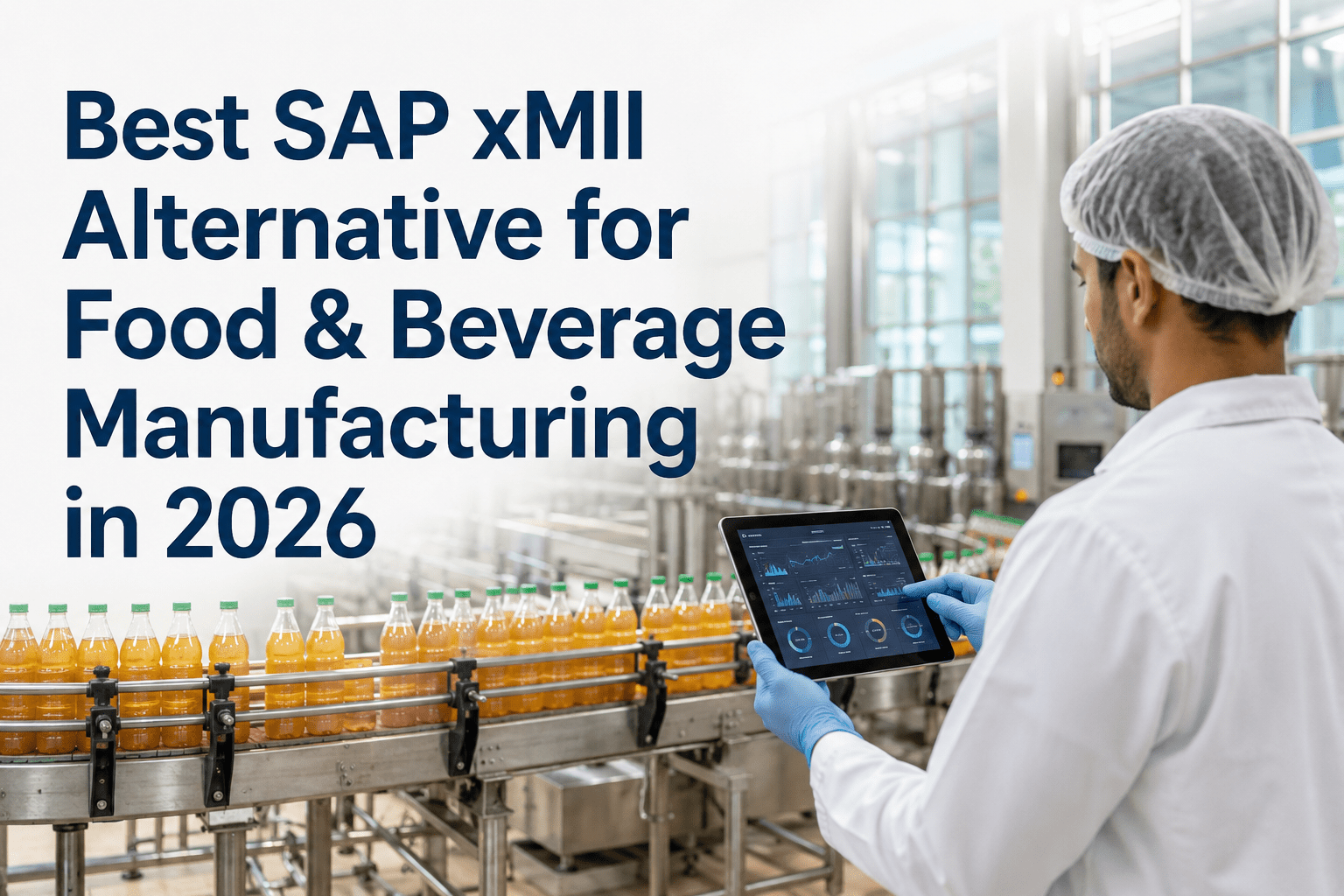
Best SAP xMII Alternative for Food & Beverage Manufacturing in 2026
The senior F&B evaluator's comprehensive guide — iFactory AI vs SAP MII / xMII / PCo across the five capabilities that actually matter: AI vision inspection, OEE monitoring, quality analytics, food traceability, and root cause analysis. Unified AI-native platform, on-premise NVIDIA appliance, no cloud lock-in, 6–12 week deployment.
iFactory AI vs SAP MII / xMII — The Five-Capability Comparison
The five capabilities below are what an F&B operation actually needs from its manufacturing intelligence platform in 2026 — and they are precisely where SAP MII / xMII most visibly falls short. The comparison is not a feature checklist; it is a structural assessment of what each platform actually delivers across the capabilities a senior evaluator is most likely to be measured on.
The pattern across all five rows is the same — iFactory delivers each capability natively on a single platform, while the SAP MII / xMII pattern requires either bolting on third-party solutions or accepting descriptive-only intelligence. For the senior evaluator, the choice is not really capability-by-capability — it is between unified AI-native architecture and a multi-tool integration project.
Want this capability comparison scored against your specific F&B evaluation criteria? Schedule the AI Manufacturing Transformation Workshop — iFactory's F&B team will benchmark iFactory against your current SAP MII state across all five capabilities. Sessions available this week.
One Platform, Five AI-Native Capabilities
The architectural point is what distinguishes iFactory from any combination of point solutions. The five capabilities run on the same unified data model, share context with each other in real-time, and produce a single compliance audit log — not five separate logs that have to be cross-referenced manually. The diagram below shows how the five capabilities fit together inside the iFactory architecture.
AI Vision Inspection
Edge-deployed CNNs on packaging, fill, seal, label, foreign-object, and product-defect lines
OEE Monitoring
Predictive OEE with auto cause attribution across availability, performance, and quality factors
Quality Analytics
Adaptive SPC, autonomous HACCP/allergen agents, continuous customer-scorecard evidence
Food Traceability
FSMA 204-ready end-to-end genealogy with recall scope bounded in minutes
Root Cause Analysis
Autonomous RCA correlating quality events to upstream process signatures in seconds
Want to see all five capabilities running together on representative F&B scenarios? Book a unified-platform demo — sessions show how vision findings feed quality analytics, OEE losses link to RCA, and traceability covers everything continuously. Sessions available this week.
Why F&B Operations Are Replacing SAP xMII in 2026
The six reasons senior evaluators cite for replacing SAP xMII
Across recent F&B platform evaluations, six decision drivers consistently dominate the migration justification. The pattern is structural, not incidental — these are the reasons SAP xMII is structurally limited rather than poorly implemented.
The drivers compound rather than substitute. Most F&B operations cite four or more of the six in their evaluation justification — and the pattern is that no single point-solution upgrade resolves multiple drivers at once, which is exactly why the comprehensive AI-native platform path keeps winning.
Want to map these drivers against your specific F&B operation? Send your current SAP MII / xMII state and platform evaluation criteria to iFactory support and the F&B team will return a customised driver assessment — typically within 3 business days, no obligation.
Three Paths Forward for F&B Manufacturing
Stay on MII / xMII
Extended SAP maintenance with point-solution AI bolt-ons. Five separate tools, five separate integrations. Limitations persist.
SAP DMC + Cloud AI
Cloud-only modernization. Recipe IP leaves plant. WAN-bound latency. Uncapped AI compute. Vendor lock-in compounds.
iFactory AI Unified Platform
Five capabilities on one NVIDIA appliance. On-prem, no cloud lock-in, predictable TCO. The best SAP xMII alternative for F&B.
Six F&B Segments Where the Migration Pays Back Fastest
Dairy & Beverage
Adaptive CIP optimization, predictive OEE on filling lines, vision QA on bottling and capping. Five-capability value compounds.
Snack & Bakery
Vision inspection on packaging, allergen agents, autonomous quality coverage, FSMA 204 traceability. Particularly valuable on co-manufactured lines.
Meat & Poultry
Microbiological risk agents, USDA-aligned compliance, end-to-end traceability. Vision QA on labelling, weight, and packaging integrity.
Frozen Foods
Vision QA on packaging and sealing, traceability through freezing and cold chain, RCA on freezer cycle issues. Allergen control across product changes.
Co-Manufacturer / CPG
Customer compliance agents maintaining per-brand specs, traceability per customer, vision QA across multi-brand product changes.
Multi-Plant F&B Groups
All five capabilities deployed per plant with portfolio-level intelligence. TCO amortizes across plants for best 5-year economics.
Want segment-specific projections for your operation? Send your F&B segment and footprint to iFactory support and the team will return a customised 12-month roadmap — typically within 3 business days, no obligation.
F&B Regulatory & Compliance — Native to the Unified Platform
Pre-built workflows for the frameworks senior evaluators are measured on
- HACCP — critical control point monitoring
- FSMA — Food Safety Modernization Act
- FSMA Rule 204 — food traceability final rule
- SQF / BRC / GFSI — global food safety standards
- Allergen management — 14 major allergens
- USDA — meat & poultry inspection support
- FDA 21 CFR Part 117 — preventive controls
- Customer specs — major retailer scorecards
The compliance evidence is the byproduct of running the five capabilities continuously — not a separate workstream the team has to maintain. Every CCP reading, every allergen segregation, every CIP cycle, every spec compliance check, every lot genealogy entry, every vision finding, and every RCA conclusion lands in the same unified audit log. Audit prep becomes hours of review rather than weeks of reconstruction.
Two Real F&B Comprehensive Migration Outcomes
F&B group with 6 plants consolidating onto iFactory across all five capabilities
A mid-large F&B group operating 6 plants across dairy, snack, and beverage segments faced a fragmented platform landscape — SAP MII at each plant, third-party vision systems at some, separate quality and traceability tools, and a recurring evaluation cycle that produced point-solution upgrades rather than architectural progress. The senior leadership team decided to replace the multi-tool stack with a single AI-native platform across all six plants.
F&B co-manufacturer producing across multiple brands and tight spec compliance demands
An F&B co-manufacturer producing snack bars, beverages, and packaged foods across multiple major retail and CPG brands faced compounding evaluation pressure — each brand wanted its own quality evidence, traceability rigor varied by customer, vision QA was inconsistent across lines, and OEE reporting was end-of-shift only. The evaluation team selected iFactory as the unified platform across all five capabilities.
Neither scenario matches your operation? Send your F&B segment, plant footprint, and current platform state to iFactory support and the team will return a customised migration analysis with 12-month roadmap — typically within 3 business days, no obligation.
iFactory's F&B Unified Deployment
Same five-capability platform on either deployment model. On-prem is recommended for F&B given recipe and customer-spec IP sensitivity, line-speed latency for vision and OEE decisions, and the predictable TCO that on-prem CapEx delivers vs cloud OpEx scaling.
iFactory On-Premise Appliance Recommended for F&B · all five capabilities on one appliance
- Pre-configured NVIDIA AI server — all five capabilities pre-loaded, racked, ready.
- <50ms edge inference — line-speed AI decisions for vision and OEE.
- Recipe & customer IP stays in plant — sovereignty preserved.
- Predictable CapEx TCO — no OpEx-growing cloud AI compute.
iFactory Cloud For multi-plant F&B groups with central governance
- Fully managed — no rack, no facility requirements.
- Same five capabilities — full platform available.
- Portfolio-level intelligence across plants and brands.
- Fastest deployment — first plant live in 2–4 weeks.
Five capabilities. One platform. The best SAP xMII alternative for F&B.
Vision inspection, OEE monitoring, quality analytics, food traceability, and root cause analysis on a single pre-configured NVIDIA appliance — not five tools stitched together. Unified data, unified audit log, unified team interface. On-prem, no cloud lock-in, 6–12 week deployment, predictable TCO. The AI Manufacturing Transformation Workshop sizes the migration for your specific F&B operation.
FAQ: Best SAP xMII Alternative for F&B Manufacturing
Why is iFactory described as the best SAP xMII alternative for F&B specifically?
Three reasons specific to F&B operations. First, the five capabilities most F&B evaluators need (vision, OEE, quality, traceability, RCA) ship on a single platform rather than as separate tools. Second, on-prem AI keeps recipe and customer-spec IP inside the plant boundary, which F&B operations are particularly sensitive about. Third, F&B-specific workflows (HACCP, FSMA 204, allergen control, CIP optimization, customer scorecards) are pre-loaded rather than custom-built. Book a demo to see all five on representative F&B scenarios.
Can we migrate one capability at a time, or does it have to be all five?
Capability-by-capability. The recommended approach is to start with the highest-pain capability for your operation — often AI vision inspection or predictive OEE — and bring the others online in phases. The platform is the same, so each capability you activate plugs into the unified data model and audit log automatically. Most F&B operations have all five capabilities active within 6–9 months of first-plant deployment.
How does iFactory integrate with our existing SAP S/4 / ERP?
iFactory replaces the SAP MII / xMII / PCo layer but integrates natively with SAP S/4 / ERP for production orders, BOM, material master, financial reporting, and downstream business processes. The S/4 investment stays intact; only the manufacturing intelligence layer is modernized. Existing PCo configurations and tag mappings are imported during deployment so OT-side continuity is preserved.
What about FSMA Rule 204 traceability — is iFactory ready?
Yes. FSMA Rule 204 traceability is built into the platform's data model — Key Data Elements (KDEs), Critical Tracking Events (CTEs), and the lot genealogy chain are captured continuously across the five capabilities. Recall scope can be bounded in minutes rather than days because the lot data is structured from production rather than reconstructed at incident time. Sortable, exportable, and aligned to FDA expectations.
How does this compare to evaluating five separate AI tools?
The five-tool path looks cheaper per tool but compounds operationally. Five separate integrations to maintain, five separate data models that have to be cross-referenced, five separate audit logs, five separate vendor relationships, and no shared context across tools. iFactory's unified architecture eliminates this overhead. Most F&B operations find the unified platform is also less expensive in total once the integration and operational costs of the five-tool path are honestly counted.
Do I have to buy NVIDIA servers separately?
No. iFactory's on-premise appliance ships fully loaded — pre-configured NVIDIA AI server, all five capability models pre-installed, network gear, cabling, edge devices for line-side inference, and integration adapters for SAP MII/xMII/ERP and major F&B plant systems. You provide rack space, line power, Ethernet, and integration points. The deployment team handles installation and configuration across the 6–12 week window.
What does the AI Manufacturing Transformation Workshop cover?
The half-day workshop covers — current-state SAP MII/xMII/PCo assessment, five-capability demonstration on representative F&B scenarios (vision, OEE, quality, traceability, RCA), capability prioritization for your operation, three-path migration comparison with cost and timeline projections, F&B compliance walkthrough (HACCP, FSMA 204, allergen control), deployment roadmap, and sized ROI projection. Outcome is a concrete migration plan suitable for senior leadership, operations, quality, IT/OT, and finance.
Stop evaluating five tools. Evaluate one platform that delivers all five capabilities.
Vision inspection, OEE monitoring, quality analytics, food traceability, and root cause analysis on a single AI-native platform — pre-configured NVIDIA appliance, on-prem, 6–12 week deployment, IATF-equivalent F&B compliance built in. The best SAP xMII alternative for food & beverage manufacturing in 2026. The Workshop is the fastest way to size the migration — sessions available this week.