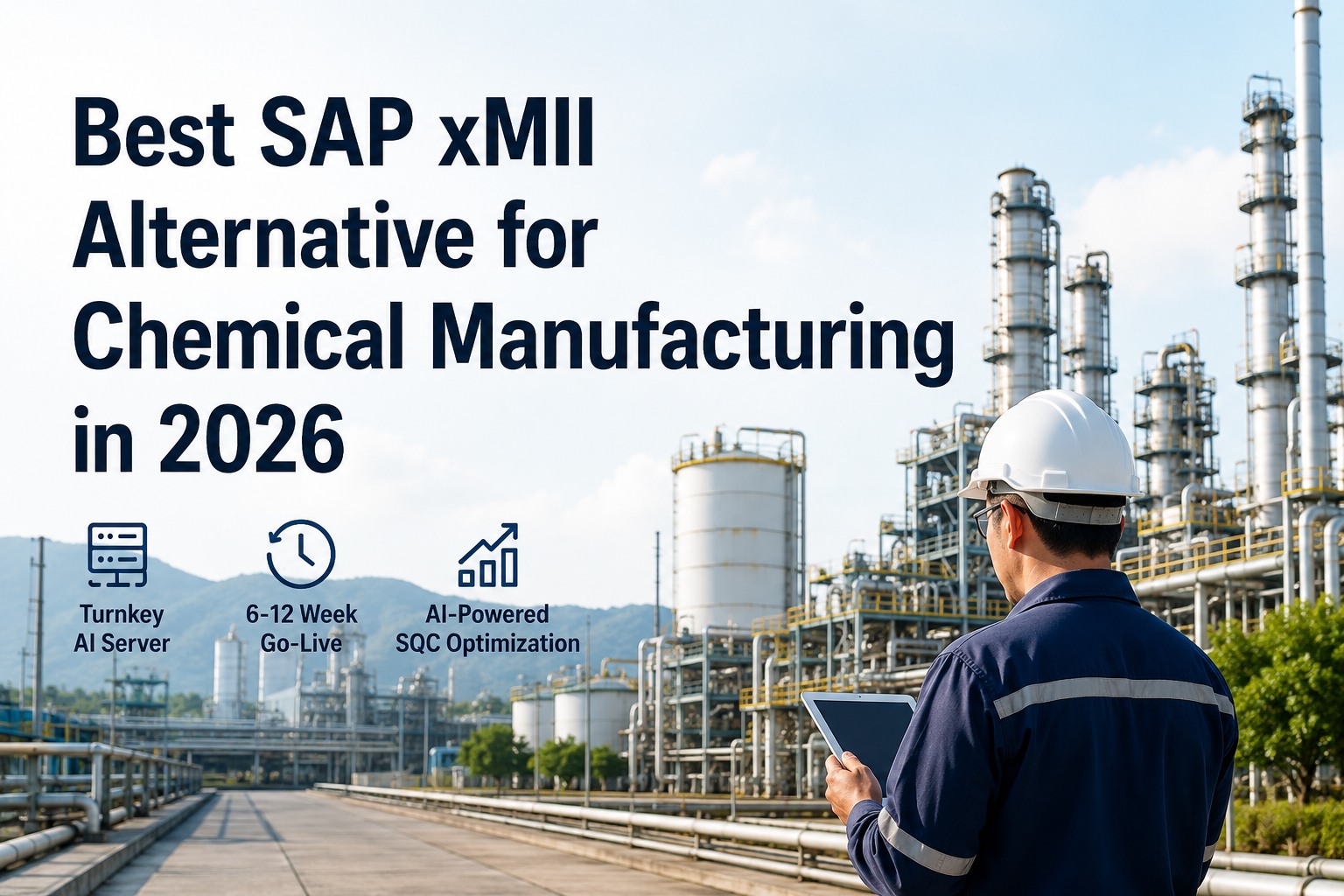
For chemical manufacturers running SAP xMII today, the 2026 decision is structurally simpler than the typical SAP analyst framing suggests. Mainstream maintenance for SAP MII and xMII ends December 2027, and the SAP-recommended path is Digital Manufacturing Cloud — a cloud-mandatory MES that does not run existing custom xMII transactions. For chemical plants — continuous reactors, distillation trains, batch specialty operations — cloud-mandatory is not just a deployment preference but a fundamental architectural mismatch with reactor-protection latency requirements, process IP sovereignty needs, and the LIMS-heavy integration profile of chemical operations. iFactory AI is the AI-native xMII alternative that delivers chemical SQC optimization across both deployment modes — turnkey on-premise NVIDIA appliance for plants with strict latency or sovereignty requirements, and fully-managed cloud for chemical groups consolidating governance across multiple sites. Same platform, same AI models, same SQC depth — your deployment choice determined by your operating reality, not by the vendor's architecture. This is the 2026 chemical SAP xMII alternative.
Best SAP xMII Alternative for Chemical Manufacturing
iFactory AI delivers chemical SQC optimization as the AI-native SAP MII / xMII / DMC alternative — adaptive multivariate control, LIMS-aware analytics, reactor and continuous-process intelligence. Choose your deployment: turnkey NVIDIA on-prem or fully-managed cloud. Same platform. Live in 6–12 weeks.
One Platform · Two Deployment Modes · Choose What Fits
The single feature SAP DMC cannot match for chemical manufacturers — and the feature most platform comparisons quietly skip — is deployment flexibility. iFactory ships the same AI-native platform as either a turnkey on-premise NVIDIA appliance racked inside the plant, or as fully-managed cloud delivered through iFactory's secure infrastructure. Identical AI models, identical SQC depth, identical APIs. Your deployment decision is determined by your operating reality, not forced by the vendor.
- Sub-50ms edge inference — reactor-protection grade latency
- Process IP stays in plant — full data sovereignty
- No WAN dependency — operations continue if internet drops
- Pre-loaded chemical models — reactor, distillation, polymerization
- Full BOM included — server, edge devices, integration adapters
- Locked CapEx — predictable cost, no cloud bill surprises
SAME SQC DEPTH
SAME APIs
- No facility requirements — no rack, no power, no IT footprint
- Fastest go-live — first plant live in 2–4 weeks
- Portfolio governance — single pane across multiple sites
- Auto-scaling compute — model training scales with usage
- Continuous updates — new chemical models pushed automatically
- OpEx model — predictable monthly subscription
Not sure which deployment fits your operation? Get your AI roadmap — iFactory's chemical practice walks through both options against your specific reactor, distillation, and LIMS footprint, with no obligation.
Why Chemical Plants Are Moving Off SAP xMII in 2026
The structural mismatch between SAP xMII and modern chemical operations is no longer just a software preference. It is an architectural constraint that compounds with every quarter the plant runs reactive instead of predictive. Five drivers consistently push chemical manufacturers off the SAP stack toward AI-native alternatives.
December 2027 EOL pressure
Mainstream maintenance for SAP MII and xMII ends in 18 months. Consulting capacity tightens through 2027. Plants planning migration in 2028 will pay 30–50% more for less qualified resources.
Static SPC misses chemical reality
Three-sigma univariate limits computed at baseline cannot handle correlated process variables — temperature, pressure, pH, flow, concentration move together. Static charts produce noise, not signal.
LIMS lives outside MII
Lab results from GC, NIR, titration, and viscosity testers sit in separate systems. Engineers reconcile by hand. SQC charts blind to half the quality picture.
Custom transactions don't transfer to DMC
A decade of accumulated xMII transactions — batch records, reactor recipes, regulatory documentation — does not move to SAP DMC. Rebuild quotes regularly hit $4–8M per plant.
No native AI for chemical processes
SAP xMII delivers descriptive reporting. The AI capabilities chemical plants need now — adaptive multivariate SPC, predictive off-spec, GenAI plant copilot — are not native to the platform.
What iFactory Delivers Across the Chemical Plant
iFactory's chemical practice ships with pre-loaded AI models across the operating modes a chemical plant actually runs — continuous, batch, hybrid, and specialty. Each operating mode has its own SQC math, its own quality signal profile, and its own LIMS round-trip requirements. The platform handles all of them on the same appliance or cloud instance.
Batch Reactor Operations
Path-aware SQC for temperature ramps, addition rates, residence time. In-batch correction before write-off. Specialty chemicals, fine chemicals, intermediates.
Continuous Distillation
Streaming DCS at sub-second cadence. Reflux ratio, tray temperatures, bottoms composition monitored multivariately. PCA / PLS native, not retrofitted.
Polymer & Plastics
Extruder pressure, melt temperature, screw torque, line speed. Line-speed quality decisions require sub-50ms inference — on-prem appliance is the only fit.
Pharma APIs & Fine Chemicals
FDA cGMP, 21 CFR Part 11, validated environments. Continuous SQC with audit-grade evidence, e-batch records, deviation management. On-prem strongly recommended.
LIMS Round-Trip
Native adapters for LabWare, STARLIMS, SampleManager, LabVantage. Inline DCS reconciled with offline lab results continuously — the SQC layer sees both streams.
GenAI Plant Copilot
Natural-language queries against live plant data. "Why did yield drop on Reactor 2 last shift?" answered in seconds. Operator AI assistant on every console.
Cloud vs On-Prem — The Decision Matrix
The honest decision matrix for chemical plants. Both deployment modes share the same AI capabilities; the choice comes down to operational reality. The matrix below maps the eight dimensions that consistently drive the decision in chemical operations.
| Driver | On-Prem Wins | Cloud Wins |
|---|---|---|
| Reactor-protection latency | Sub-50ms edge inference required | Acceptable when 100ms+ latency tolerable |
| Data sovereignty / process IP | Data stays in plant always | Acceptable risk per data governance policy |
| GxP / validated environment | FDA 21 CFR Part 11 simpler on-prem | Possible with managed cloud and validation |
| Connectivity reliability | Remote plants, poor WAN, no fallback | Reliable connectivity available |
| Multi-site portfolio governance | Per-site deployment overhead | Single pane, central control |
| Time-to-go-live | 6–12 weeks per plant (turnkey) | 2–4 weeks first plant |
| IT footprint & facility load | Rack space, power, network required | Zero facility footprint |
| Cost predictability | Locked CapEx, no usage surprise | OpEx scales with usage (predictable) |
The pragmatic reality — most chemical groups deploy hybrid: on-prem at flagship plants with strict latency or GxP requirements, cloud at smaller sites with reliable connectivity. iFactory supports both simultaneously under one portfolio governance.
The Production Supervisor's New Day
The platform decision shows up in the production supervisor's daily workflow. On SAP xMII, the supervisor reacts to events after they have happened — chasing trends in dashboards, reconciling lab results to inline readings, fielding quality calls without context. On iFactory, the supervisor's day is predictive and conversational.
6–12 Week Implementation — Same Process, Either Deployment
The deployment mode changes the artifact, not the workflow
Whether you choose the on-prem NVIDIA appliance or the fully-managed cloud, the implementation follows the same three-phase pattern. The variation is in installation logistics, not in capability delivery.
Connect & Calibrate
On-prem: NVIDIA appliance racked and powered. Read-only connectivity to DCS, PLCs, LIMS, SAP xMII established.
Cloud: Secure tunnels established to plant data sources. Same data, hosted infrastructure.
Parallel Run & Validate
Chemical AI models activated against your data. Adaptive multivariate SPC and predictive off-spec run in shadow mode alongside SAP xMII. Parity validated workload-by-workload.
Cutover & Scale
iFactory becomes primary for migrated workloads. SAP xMII held as fallback for stabilization period. Operator AI copilot goes plant-wide. Cross-zone analytics activated.
Chemical Plant Outcomes — What Lands
The best SAP xMII alternative for chemical manufacturing in 2026.
Adaptive multivariate SQC, predictive off-spec, LIMS-aware analytics, reactor and continuous-process intelligence — delivered on the deployment that fits your operation, not the deployment forced by the vendor. On-prem NVIDIA appliance or fully-managed cloud. Live in 6–12 weeks. Get your AI roadmap this week.
FAQ — Chemical SAP xMII Migration
Can we deploy iFactory as both on-prem AND cloud across our chemical group?
Yes — and this is the most common pattern for multi-site chemical groups. Flagship plants with strict latency, GxP, or sovereignty requirements typically deploy on-prem, while smaller sites or regional plants run on cloud. Both deployments run the same platform with shared AI models, and iFactory's portfolio governance gives a single pane across the entire estate. The deployment choice is set per-plant based on operating reality, not group-wide. Get your AI roadmap to see the hybrid pattern applied to your specific sites.
Does the cloud deployment preserve our process IP and trade secrets?
iFactory's fully-managed cloud runs in single-tenant infrastructure with documented data governance and SOC 2 Type II controls. Your process data and trained models remain isolated to your tenant. That said, for plants where process IP sovereignty is absolute — proprietary catalyst chemistry, fine chemical formulations, pharma APIs — the on-prem appliance is the unambiguous choice. The point is having the choice rather than being forced cloud-only as with SAP DMC.
How does iFactory handle the SAP MII / xMII / DMC migration specifically?
The pattern is workload-by-workload with SAP MII / xMII running in parallel during sprints 1–2. Each chemical workload — multivariate SPC, dashboards, batch records, LIMS round-trip, custom transactions — is migrated independently to iFactory with parity validation before cutover. SAP MII is held as fallback during a defined stabilization period. The chemical SAP team retains full sequencing control and rollback path at every workload.
What about custom xMII transactions we built over the last decade?
Inventoried during the connect-and-calibrate phase, then mapped to configured iFactory workflows or API integrations. The configurable approach typically replaces custom xMII transactions with workflows that are faster to change and lower-maintenance than BLS scripts. Where a transaction encodes critical chemistry or batch logic exactly, that logic carries across to iFactory configuration during parallel run, with parity validation before cutover.
Does cloud deployment support our pharma chemical GxP requirements?
For most pharma chemical workloads — fine chemicals, intermediates, non-API processes — managed cloud with proper validation supports GxP requirements. For API manufacturing under FDA 21 CFR Part 11 and EU Annex 11 with strict validated-environment requirements, on-prem deployment is typically simpler to validate and is the recommended pattern. Both options are available; the validation effort differs.
How does pricing compare between on-prem and cloud?
On-prem is a CapEx-heavier model with locked Year-1 cost ($0.7–2.0M per plant including NVIDIA appliance, models, integration adapters, and implementation). Cloud is OpEx-based with predictable monthly subscription scaling by data volume and AI usage. Five-year TCO is comparable between the two at typical chemical plant scale — the choice is driven by financial preference and operating constraints rather than a clear cost winner. Both run roughly one-third of the cost of an equivalent SAP DMC rebuild.
What does the AI roadmap session actually deliver?
Half-day session with iFactory's chemical practice. Output is a concrete migration document covering current-state SAP MII / xMII / DMC workload inventory; deployment recommendation (on-prem, cloud, or hybrid) for each plant; chemical AI model catalog matched to your processes; LIMS and DCS integration plan; 6–12 week implementation roadmap; ROI projection; and a turnkey quote. Suitable for executive sign-off across operations, quality, IT, and finance.
Pick the deployment that fits your plant — not the one forced by your vendor.
iFactory AI is the only AI-native SAP xMII alternative that ships chemical SQC optimization across both turnkey on-prem and fully-managed cloud. Same platform, same AI models, same SQC depth. Pre-configured NVIDIA appliance or managed cloud. Live in 6–12 weeks. Get your AI roadmap this week.