Traditional Advanced Process Control on chemical plants — Aspen DMC, Honeywell Profit, Yokogawa Exasmoc, ABB — followed the same operating pattern for two decades. Engineers ran a six-to-twelve-week identification campaign to build a linear MPC model, deployed it, and watched it slowly drift out of relevance as feed slates, catalyst age, ambient conditions, and grade changes pulled the real process away from the identified model. The same engineers spent the next two years re-tuning, re-identifying, and patching to keep the controller useful. SAP xMII sat above it all as a descriptive reporting layer, never participating in the control loop. AI-driven adaptive process control collapses that cycle: self-tuning models that learn continuously from live data, MPC that handles non-linear regimes natively, and a single platform that runs both the SQC layer and the control loop. iFactory AI delivers it on-prem (turnkey NVIDIA appliance) or as fully-managed cloud — 12-week deployment, no identification campaign required. This is why chemical plants are moving.
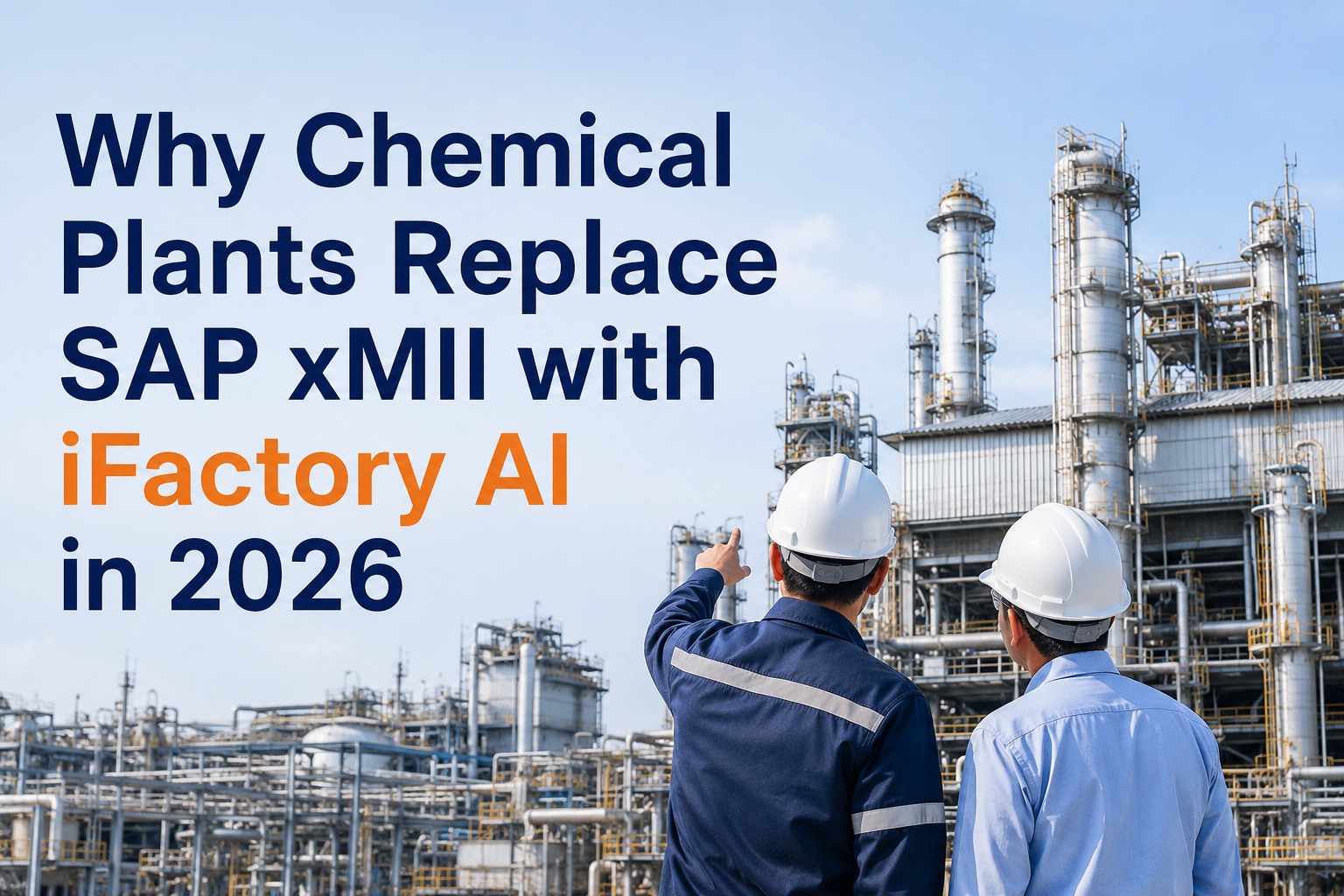
Why Chemical Plants Replace SAP xMII with iFactory AI in 2026
The shift from traditional MPC + SAP xMII to AI-driven self-tuning adaptive process control. Replace static identification campaigns with continuously-learning models. One platform for SQC, control, and operator AI assistance. 12-week deployment, on-prem or cloud.
The Three Stages of Process Control Maturity
Chemical plants sit at one of three stages on the process control evolution curve. SAP xMII deployments overwhelmingly map to stage 1 or stage 2 sites — the leap to stage 3 is where AI-driven adaptive control opens new yield, energy, and throughput territory.
Want a maturity assessment for your specific plant? Book a demo today — iFactory's chemical practice will benchmark your control stack and return a stage 3 transition plan within 3 business days.
How Self-Tuning Adaptive Control Actually Works
Four loops running continuously in parallel — not a batch retraining job. The diagram below shows the streaming feedback architecture that replaces traditional identification campaigns.
Stream
Process variables, lab results, ambient conditions, valve positions ingested at 100Hz+ from DCS, OPC UA, MQTT.
Model
Non-linear AI models updated continuously. Regime transitions detected automatically. No model rebuild needed.
Optimize
MPC computes optimal setpoint trajectory over the prediction horizon. Multi-variable, constraints honored.
Learn
Actual outcomes feed back. Model error narrows over time. Operator overrides also captured as training signal.
What AI MPC Controls in Chemical Plants
Distillation Columns
Reflux ratio, reboiler duty, side draws optimized continuously. Energy reduction 3–8%, throughput +2–5%, off-spec reduction.
Batch Reactors
Temperature ramp profile, addition rate, residence time controlled per recipe state. In-batch correction before write-off.
Crystallizers
Supersaturation, cooling profile, seed loading optimized for crystal size distribution. Reduces filtration losses.
Polymer Reactors
Molecular weight distribution, conversion, melt index controlled across grade transitions. Off-grade product cut 40–60%.
Continuous Reactors
Conversion, selectivity, residence time managed across feed variations. Yield improvement 1–3% sustained.
Furnaces & Steam Systems
Combustion, draft, steam header pressure optimized in real time. Energy savings 4–7% across utilities.
iFactory AI vs Traditional APC + SAP xMII
| Dimension | Traditional MPC + SAP xMII | iFactory AI Self-Tuning |
|---|---|---|
| Model build | 6–12 week identification campaign | Continuous from streaming data |
| Linearity | Linear models · regime drift | Non-linear native · regime-aware |
| Tuning maintenance | Quarterly engineer effort | Self-tuning · continuous |
| SQC integration | Separate systems · reconciled | Same platform · same data layer |
| Operator AI assistant | Not available | Natural-language live queries |
| Deployment time | 12–18 months | 12 weeks turnkey |
| Year-1 cost / plant | $1.5–4M typical | $0.7–2.0M turnkey |
| SAP xMII status | EOL Dec 2027 — replacement forced | Native replacement included |
12-Week Deployment · No Identification Campaign
Connect & Observe
NVIDIA appliance racked (on-prem) or cloud tenant provisioned. Read-only connectivity to DCS, OPC UA, LIMS, SAP xMII. Models begin learning from streaming data.
Advisory Mode
AI MPC runs in shadow mode against existing PID / traditional MPC. Setpoint recommendations shown to operators for review. Models continue to learn.
Closed-Loop Control
Closed-loop control activated per unit at the chemical engineering team's pace. SAP xMII reporting workflows migrated. Operator copilot live plant-wide.
Documented Chemical Plant Outcomes
Move from identification campaigns to self-tuning AI MPC.
iFactory AI replaces SAP xMII and aging traditional MPC stacks with self-tuning adaptive process control. Distillation, reactors, crystallizers, polymer lines — all on one platform. NVIDIA appliance or fully-managed cloud, your choice. Live in 12 weeks. Book a demo today.
FAQ — AI-Driven APC in Chemical Plants
How is self-tuning AI APC different from Aspen DMC or Honeywell Profit?
Traditional MPC products use linear models built from identification campaigns and require periodic retuning by engineers as the process drifts. iFactory's AI MPC uses non-linear models that learn continuously from streaming data — regime changes, feed slate shifts, catalyst aging, ambient variation are all captured automatically. No identification campaign, no quarterly retuning, no model drift. The control objective stays the same; the maintenance overhead is eliminated. Book a demo to see it run on your data.
Does iFactory ship on-prem only or is cloud available?
Both. On-prem (turnkey NVIDIA appliance with 99.9% uptime SLA) is the recommended default for chemical plants — sub-second control loop latency, data sovereignty for proprietary chemistry, reliability through poor connectivity. Fully-managed cloud is available for multi-site chemical groups consolidating governance. Same platform, same AI models, same control depth on either deployment.
Can iFactory run alongside our existing Aspen / Honeywell MPC?
Yes — the most common pattern is parallel operation during the migration. iFactory runs in advisory mode alongside the existing MPC for the first 4–8 weeks, with setpoint recommendations shown to operators. As the chemical engineering team builds confidence, closed-loop authority transitions per unit. Many plants retain the legacy MPC as fallback for a defined stabilization period before decommissioning.
What about SAP xMII batch records, SQC, and operator workflows?
All replaced natively by the same platform. iFactory's chemical practice ships with continuous electronic batch records, multivariate SPC, LIMS round-trip, and operator AI copilot — no separate systems, no integration projects. The SAP xMII reporting layer is migrated workload-by-workload alongside the control modernization, sharing one data layer.
What does the demo session cover?
30-minute working session with iFactory's chemical practice. Walks through self-tuning APC on a real chemical process — distillation column, reactor, or polymer line as applicable. Shows continuous learning, regime detection, setpoint recommendation, and operator copilot in action. Output is a tailored ROI projection and 12-week deployment quote with full BOM. Slots available this week.
2026 is the year chemical APC stops being a maintenance burden.
Self-tuning models, no identification campaigns, SAP xMII reporting replaced, operator AI on every console. 12-week deployment on a turnkey NVIDIA appliance or fully-managed cloud. Book a demo today.