For digital transformation leaders in food & beverage manufacturing, the decision facing you in 2026 is not whether to modernize off SAP MII / xMII / DMC — that decision is essentially made, the only question is when. The real architectural decision is what to replace it with. The two serious paths are continuing toward a cloud-only AI architecture (SAP DMC plus cloud AI services) or moving to an on-premise AI architecture (a pre-configured NVIDIA appliance running pre-loaded F&B AI models inside the plant). These two architectures have fundamentally different implications for latency, recipe and customer IP sovereignty, total cost of ownership, scaling economics, and operational independence during WAN outages — and once you commit to one direction, reversing course is expensive. The AI-Native Manufacturing Revolution shifts the calculation in favor of on-prem AI for F&B operations specifically, because the data that matters most — recipes, customer specs, allergen models, quality patterns — is precisely the data F&B operators are most reluctant to send to a cloud provider, and the decisions that matter most run at line speed faster than a cloud round trip can deliver. iFactory AI is the on-prem AI-native platform purpose-built for this transition. This page is the F&B digital transformation leader's architectural guide to the AI-Native Revolution — the on-prem vs cloud AI decision, what runs on the iFactory appliance, the 5-year TCO economics, and how the migration from SAP xMII actually works.
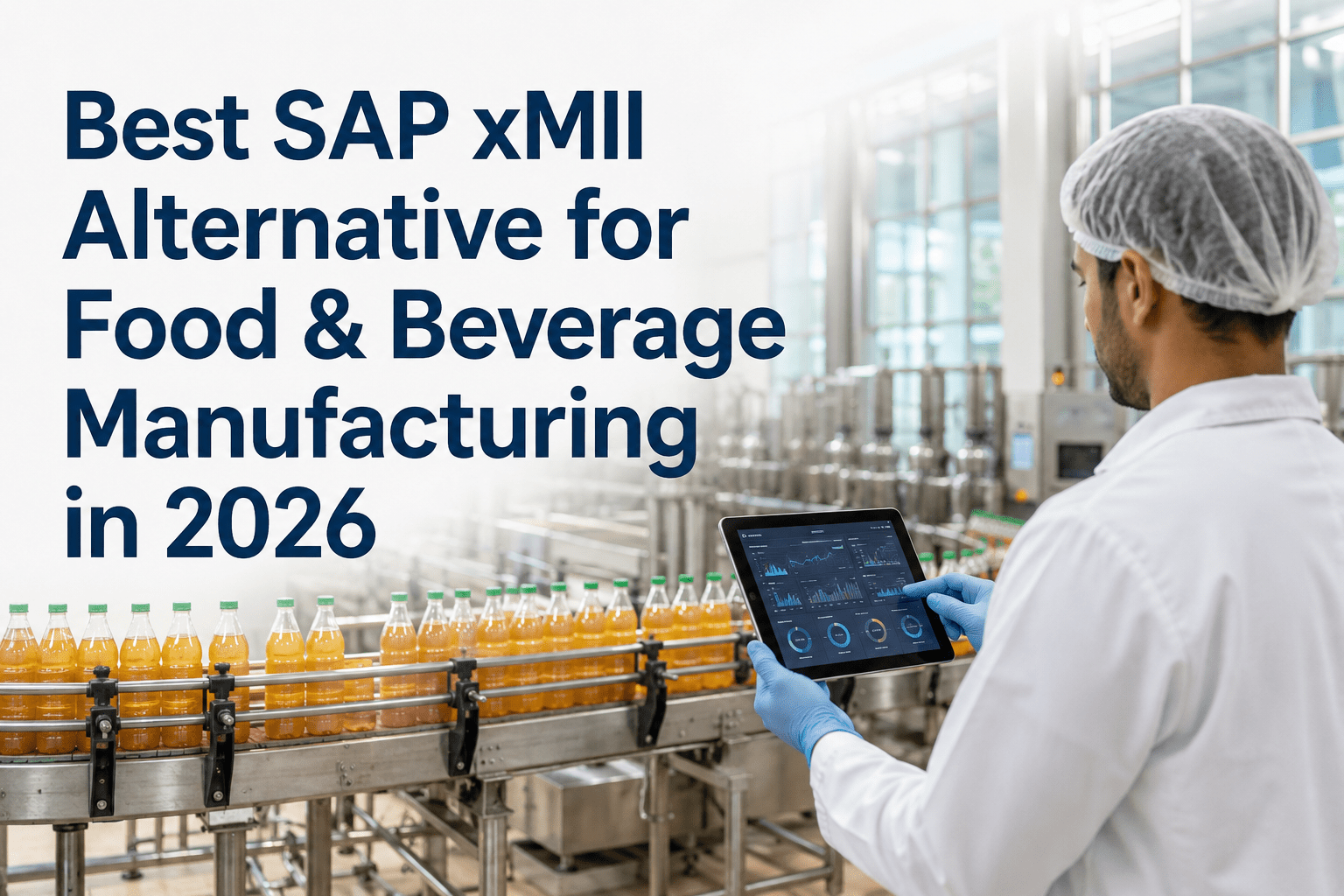
Why Food & Beverage Plants Replace SAP xMII with iFactory AI in 2026
The F&B digital transformation leader's architectural guide to the AI-Native Manufacturing Revolution — on-prem AI models on a pre-configured NVIDIA appliance vs cloud-only AI architecture. The TCO economics, the recipe-IP sovereignty, the line-speed latency, and the 6–12 week migration. Predictive analytics, on-prem NVIDIA AI, no cloud lock-in.
The Architectural Decision: On-Prem AI vs Cloud-Only AI
For a digital transformation leader, this is the decision that sets the trajectory of every downstream investment. The two architectures look superficially similar — both promise predictive analytics, AI-driven quality, real-time insights — but the underlying differences in latency, sovereignty, TCO, and operational independence have compounding implications for an F&B operation. The comparison below maps the two architectures across the dimensions that matter most for a DT leader's evaluation.
For F&B specifically, three of these dimensions tend to dominate the DT leader's decision: recipe and customer-spec IP cannot meaningfully sit outside the plant boundary; quality decisions at line speed cannot tolerate cloud round-trip latency; and the OpEx-growing cost curve of cloud AI compute at industrial volumes becomes uncomfortable as AI usage scales. The on-prem AI architecture resolves all three structurally.
Want this architectural comparison scored against your specific F&B operation and digital roadmap? Schedule the AI Manufacturing Transformation Workshop — iFactory's F&B team will map your current SAP MII/DMC state to a sized on-prem AI architecture with concrete TCO. Sessions available this week.
What Runs on the iFactory On-Prem AI Stack for F&B
The strength of an on-prem AI architecture depends entirely on what is actually pre-loaded and ready to deploy. A bare AI server with empty model slots is not a working platform. The iFactory stack ships fully loaded with F&B-specific AI capabilities running on the NVIDIA appliance from day one — not as cloud services called over a network, but as edge-inference models executing locally inside the plant.
This is what "pre-loaded" actually means — every layer of the stack is operational at delivery. The DT leader does not face a multi-month integration project to make basic AI capabilities work; the appliance arrives with F&B models trained on industry data, ready to be tuned to plant-specific patterns during the 6–12 week deployment window.
F&B AI Models — What Actually Ships
Each model on the stack is specialized for an F&B operational problem and tuned to industry data before plant-specific refinement begins. The six core models below cover the highest-value F&B AI applications and run as edge inference on the appliance.
Adaptive SPC Model
Learns each product, line, and shift's normal behavior. Adapts limits automatically as conditions change. Eliminates false alarms while catching genuine drift.
AI Vision Inspection
Visual inspection for packaging, fill, seal, label, foreign object, and product defects. Catches issues human inspectors and traditional vision systems miss.
Predictive Quality Model
Predicts deviations 4–24 hours ahead from process trajectory. Enables intervention before quality events form rather than after they happen.
CIP Optimization Model
Replaces fixed-time over-CIP with verified clean-to-target. Optimizes cycle duration per soil load while improving verification confidence.
Autonomous Quality Agents
HACCP CCP, allergen control, sanitation, microbiological risk, customer compliance, and recall risk — six agents operating continuously.
Multivariate RCA Model
Correlates quality events to upstream process signatures across hundreds of variables. Surfaces root causes that single-variable SPC misses.
Want a model-by-model fit assessment for your F&B segment? Send your segment and current SAP MII state to iFactory support and the F&B team will return a customised model-fit report — typically within 3 business days, no obligation.
5-Year TCO: On-Prem AI vs Cloud-Only AI
How the economics diverge as AI usage scales
The two architectures look similar in year one but diverge sharply over five years. Cloud AI is OpEx-growing — every prediction, every inference, every model invocation generates ongoing compute charges that scale with usage. On-prem AI is CapEx-led — the appliance is paid once and runs increasingly more workloads without marginal cost. For an F&B operation running AI continuously across SPC, vision, quality agents, and predictive models, the difference compounds.
The crossover point — where on-prem cumulative TCO sits below cloud-only — typically occurs between months 14 and 22 for a single-plant F&B deployment, and earlier for multi-plant deployments where the appliance amortizes across more workload. By year five, the gap is consistently 40–60% in favor of on-prem AI, with the additional benefits of sovereignty, latency, and outage independence layered on top.
Three Migration Paths from SAP xMII for F&B
Stay on xMII
Extended maintenance, no AI. Falling behind competitive baseline. Eventual forced migration without architectural choice.
SAP DMC + Cloud AI
Cloud-only architecture. WAN-bound latency. Recipe IP exits plant boundary. OpEx-growing AI compute costs. Vendor lock-in.
iFactory On-Prem AI
NVIDIA appliance with pre-loaded F&B models. Edge inference, in-plant sovereignty, predictable TCO, 6–12 week deployment, no cloud lock-in.
Six F&B Operations Where On-Prem AI Pays Back Fastest
High-Speed Vision QA
Edge AI vision at line speed needs sub-50ms inference. Cloud round-trip cannot keep up. On-prem appliance is the only viable architecture.
Recipe-Sensitive Operations
Recipe and formulation IP cannot meaningfully sit outside the plant boundary. On-prem AI keeps proprietary data inside the validated network.
Multi-Site Quality Groups
Each plant runs on-prem AI with central quality intelligence orchestration. Amortizes appliance across multiple plants for stronger TCO.
CIP-Heavy Operations
CIP optimization model needs real-time interaction with cycle controllers. Edge inference enables true adaptive CIP rather than fixed-time.
Remote / Rural Plants
Remote plant locations with limited or unreliable WAN cannot run cloud-dependent AI. On-prem appliance operates independently.
High-AI-Volume Plants
Plants running AI continuously across many lines and use cases face uncapped cloud OpEx. On-prem CapEx caps the cost predictably.
Want a per-application TCO projection for your F&B operation? Schedule the AI Manufacturing Transformation Workshop — iFactory's team will build a sized 5-year TCO comparison against your current SAP architecture. Sessions available this week.
F&B Regulatory & Compliance — Native to the Platform
Pre-built workflows for F&B quality and safety frameworks
- HACCP — critical control point monitoring
- FSMA — Food Safety Modernization Act
- SQF — Safe Quality Food certification
- BRC / GFSI — global food safety standards
- Allergen management — 14 major allergens
- USDA — meat & poultry inspection support
- FDA 21 CFR Part 117 — preventive controls
- Customer specs — major retailer scorecards
Compliance evidence is generated continuously rather than reconstructed at audit time — every CCP reading, every allergen segregation, every CIP cycle, every spec compliance check is logged with full traceability. The on-prem deployment keeps this evidence inside the validated network boundary, simplifying both the audit posture and the DT leader's data sovereignty story.
Two Real F&B Digital Transformation Outcomes
F&B group with 8 plants consolidating off SAP xMII as part of enterprise digital transformation
An F&B group running 8 plants across beverages, dairy, and packaged foods inherited a fragmented SAP MII / xMII landscape from acquisitions. The DT leader's mandate was to consolidate to a single AI-capable platform with predictable TCO and recipe-IP sovereignty. Cloud-only architecture failed the sovereignty test for recipe data; SAP DMC failed the TCO test as AI usage projections grew.
Beverage manufacturer that started on cloud-only AI and hit architectural walls
A mid-size beverage manufacturer initiated digital transformation on a cloud-only AI architecture in 2024 and ran into compounding problems within 18 months — latency made line-speed vision QA unworkable, WAN outages stopped quality systems entirely, recipe data sovereignty raised customer concerns, and AI compute costs grew faster than projected. The DT leader needed an architectural reset that preserved DT progress.
Neither scenario matches your operation? Send your F&B segment, plant footprint, and current SAP MII state to iFactory support and the F&B team will return a customised migration analysis with 12-month roadmap — typically within 3 business days, no obligation.
iFactory's F&B Deployment — On-Premise or Cloud
Same AI-native platform on either deployment model. On-prem is recommended for F&B given recipe IP sensitivity, line-speed latency, and WAN-outage resilience. Cloud is available where DT strategy prioritizes central governance over edge-speed.
iFactory On-Premise Appliance Recommended for F&B plants · resolves cloud-only architecture failure modes
- Pre-configured NVIDIA AI server — pre-loaded F&B models, racked, ready.
- <50ms edge inference — line-speed AI decisions.
- Recipe & customer-spec IP stays in plant — sovereignty preserved.
- CapEx-led TCO — predictable, scales without marginal cost.
iFactory Cloud Where central governance prioritized over edge speed
- Fully managed — no rack, no facility requirements.
- Same AI model library — full F&B stack available.
- Portfolio-level intelligence across plants and brands.
- Fastest deployment — first plant live in 2–4 weeks.
The DT decision is the architecture, not the vendor. Choose architecture first, vendor follows.
On-prem AI on a pre-configured NVIDIA appliance — edge inference, recipe-IP sovereignty, CapEx-led predictable TCO, WAN-outage resilience, 6–12 week deployment. The AI-native alternative to SAP MII / xMII / DMC for F&B. The AI Manufacturing Transformation Workshop sizes the architectural migration concretely for your operation.
FAQ: F&B On-Prem AI Architecture & SAP xMII Migration
Why is on-prem AI specifically better than cloud AI for F&B operations?
Three F&B-specific reasons dominate. First, recipe and customer-spec IP cannot meaningfully sit outside the plant boundary — F&B operators are particularly sensitive about proprietary formulations. Second, line-speed decisions like vision QA on bottling or sealing need sub-50ms inference that cloud round-trip cannot deliver. Third, AI compute at industrial F&B usage volumes becomes OpEx-growing in the cloud while CapEx-led on-prem. The architectural decision sets your trajectory for years. Book a demo to map this to your specific operation.
How does on-prem AI integrate with our existing SAP MES/ERP landscape?
iFactory integrates natively with SAP MII / xMII / ERP for production context and lot data, plus with plant historians (OSIsoft PI and similar), LIMS, QMS platforms, and MES systems. The AI runs on-prem while pulling context from these existing systems — no rip-and-replace required. The DT leader retains the existing SAP investment for transactional functions while gaining AI-native quality, vision, and predictive capabilities. This integration is configured during the 6–12 week deployment.
What's the realistic 5-year TCO difference vs cloud-only AI?
For a typical single-plant F&B deployment, the on-prem TCO crossover (where on-prem cumulative cost falls below cloud) occurs between months 14 and 22. By year five, the cumulative gap is consistently 40–60% in favor of on-prem, with sovereignty, latency, and outage independence as additional benefits. Multi-plant deployments hit crossover earlier because the appliance amortizes across more workload. The Workshop produces a sized TCO comparison for your specific configuration.
How do model updates work without cloud connectivity?
Model updates ship to the on-prem appliance through a secure managed channel, with the customer controlling when and what to deploy. Continuous learning happens locally on the appliance — the models refine on plant-specific data without that data ever leaving the boundary. This gives F&B operators the benefits of evolving AI without the data sovereignty trade-offs of cloud-only architectures. Update cadence and rollout governance are configurable per DT leadership preference.
Do I have to buy NVIDIA servers separately?
No. iFactory's on-premise appliance ships fully loaded — pre-configured NVIDIA AI server, F&B AI models pre-installed, network gear, cabling, edge devices for line-side inference, and integration adapters for SAP MII/xMII/ERP and plant systems. You provide rack space, line power, Ethernet, and integration points. The deployment team handles installation, validation, and configuration across the 6–12 week window. For cloud deployment, no hardware investment at all.
Can we deploy at one plant first before enterprise rollout?
Yes — and it's the recommended DT approach for multi-plant F&B groups. Start with the plant where AI value materializes fastest (typically the largest, most complex, or quality-cost-heaviest plant). Validate the on-prem architecture, prove the TCO, and refine the deployment model. Then expand plant-by-plant with central orchestration unifying as each site comes online. A typical 6–8 plant enterprise deployment completes in 8–12 months end-to-end.
What does the AI Manufacturing Transformation Workshop cover?
The half-day workshop covers — current-state SAP MII/xMII/DMC architectural assessment, on-prem vs cloud AI architecture comparison with your specific use cases, sized 5-year TCO projection across both architectures, F&B AI model library walkthrough, deployment roadmap, sovereignty and integration architecture, and ROI projection. Outcome is a concrete migration plan suitable for DT leadership, plant operations, IT/OT, finance, and quality.
Architecture is the decision. Choose on-prem AI; everything else follows.
Edge inference, recipe sovereignty, CapEx-led predictable TCO, 40–60% 5-year savings vs cloud-only, and 6–12 week deployment. The AI-native alternative to SAP MII / xMII / DMC for F&B — purpose-built for the operational realities that make on-prem the right choice. The Workshop is the fastest way to size the migration for your specific operation — sessions available this week.